Showing posts with label vertigo. Show all posts

Friday, June 14, 2019

De Palmas

Body Double (1984): written by Brian De Palma and Robert J. Avrech; directed by Brian De Palma; starring Craig Wasson (Jake), Melanie Griffith (Holly), Gregg Henry (Sam), and Deborah Shelton (Gloria): 

It's hard to believe now that Body Double was condemned as immoral and horrible and all that jazz back in 1984, primarily because of a scene in which a woman is killed with a giant drill. Of course, De Palma shoots this scene so that we never see the drill go through the woman. People reacted to what they thought they saw, and to what was implied. People also reacted to the film's use of porn films in its narrative. Well, and the fact that Body Double is De Palma's love letter to all things Hitchcock, and Vertigo in particular. But the violence now looks quaint. Body Double is less violent than a typical episode of Law and Order: Special Victims Unit.

It's also a love letter to Hollywood and movie-making and actors. Craig Wasson is perfectly cast as a somewhat nebbishy Every-actor who gets pulled into a murder investigation because of his voyeurism, and soon demonstrates that he might be The World's Greatest Detective. 

Melanie Griffith generated most of the positive buzz for the movie in her role as Holly Body, the porn star who soon becomes key to Wasson solving the mystery of who killed his neighbour (with the aforementioned drill), and why. Griffith is terrific -- it really was a star-making performance.

I don't know that this is De Palma's best movie, but it's his most purely enjoyable. Is it misogynistic? I don't know. Less so than Hollywood (or Western culture) was in 1984, probably. For the sake of comparison, Hitchcock killed two female characters in Vertigo in the late 1950's. De Palma kills one, and she actually gets avenged in the course of the movie. Radical. Highly recommended.


DePalma (2015): directed by Noah Baumbach and Jake Paltrow; starring Brian De Palma as himself: A 100-minute interview with Brian De Palma takes the viewer on a survey of his life and film-making career. De Palma is a tremendously entertaining and opinionated film-maker. Even non-fans of his work might find this film fascinating. And if you do like De Palma's work, it's a gold-mine of opinions and anecdotes and observations. Highly recommended.

Monday, April 9, 2018

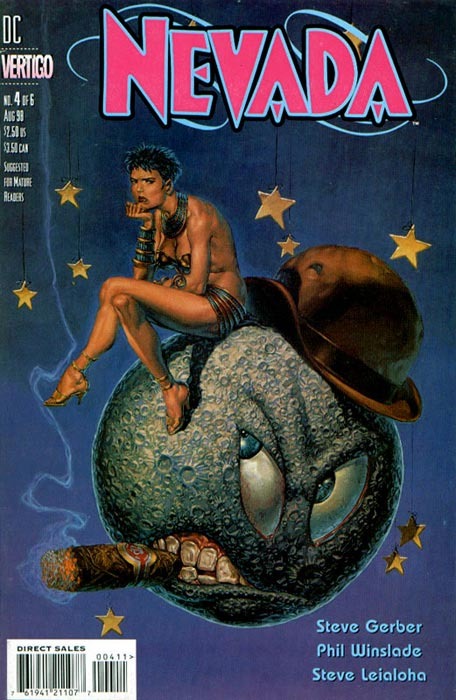
Nevada

Nevada (1998/ Collected 1999)): written by Steve Gerber; illustrated by Phil Winslade, Steve Leialoha, Dick Giordano, and others: Steve Gerber was one of the great Marvel writers of the 1970's, a quirky member of a new wave of comics writers who'd grown up on Marvel's blend of superheroism and pop psychology and wanted to make superhero comics more literate and 'adult.' 

His greatest popular success was his own creation (along with artist Val Mayerik) -- Howard the Duck, terribly botched by the movie and terrifically compelling when written by Gerber. But Gerber created Howard for Marvel, which meant that when he left Marvel, Howard stayed.

Gerber did a lot of compelling comic-book work over the subsequent decades, from a terrific in-continuity Superman miniseries (The Phantom Zone, 1981) to an abortive scifi epic originally pitched as a reboot of DC's Hawkman (Void Indigo) to a host of other often short-lived titles. 

Nevada supposedly sprung from a brief incident in a 1977 Howard the Duck story in which a chorus girl who works onstage with an ostrich fights a "killer lampshade." Some time in the 1990's, Neil Gaiman supposedly asked Gerber when he would go into this story in more depth. The six-issue DC/ Vertigo miniseries Nevada was the result.

It's a typically atypical Gerber story, mostly self-contained but clearly designed to allow for a sequel or a regular series that never happened. It's set in Las Vegas. There's a chorus girl and her dancing ostrich, a mysterious homeless man, a guy with what looks like a Lava Lamp for a head, a laser beaming a message from outer space into the security system of a casino, a series of strange locked-room murders, and some extremely cosmic vistas and philosophies. Gods and angels fight in the skies over Las Vegas. Well, gods and angels from the human POV.

It's a solid piece of off-kilter Gerber genre-bending, ably illustrated by Phil Winslade in a manner that keeps the stranger concepts grounded in representational verisimilitude. The ostrich is a bit of a hoot. Recommended.

Sunday, June 25, 2017

Marked by 9/11


Can't Get No (2006) written and illustrated by Rick Veitch: Manhattan CEO Chad Roe has a bad day when complainants launch lawsuits against his company and its signature product -- a truly indelible marker. Stock prices drop into the Zero range. Angry victims of the truly permanent marker want Roe's head. It's September 9, 2001 in New York.

Can't Get No is a surreal, often grotesque piece of left-wing agit-prop from writer-artist Rick Veitch. It's also brilliant and, in my comic-reading experience, unique. I've never encountered a comic before in which the odd, often vague blocks of text (no word balloons or, for that matter, directly attributed quotations here) interact with the occasionally grotesque but also splendidly, comically rendered art so as to induce a sort of trance state in the reader.

Pages go by, and the text seems to vanish from one's memory before it can be stored. Veitch has conjured up a graphic novel that reflects the mass-culture wasteland of America and its cancerous hold on individuals and on the planet. I'd hate to see what this book would do to someone truly stoned.

This is a quest narrative in which images carry the weight while the text noodles away in the background, strange and elusive. There's a Theme Park one probably won't forget. And there's Chad Roe, whose body is turned into a canvas early on for a couple of artists interested in those permanent markers. 

Don't look for epiphanies or life-changing revelations at the end, though. It seems to me that the point of Can't Get No is that some people simply cannot permanently change. They've already drowned in the toxic, memoryless, money-obsessed melting pot that is America, melting. Highly recommended.

Tuesday, May 31, 2016

Last Monkey Standing

Y: The Last Man: Deluxe Edition Volumes 1-5 (2002-2007/ Collected 2014-2016): written by Brian K. Vaughan; interior illustrations by Pia Guerra, Jose Marzan Jr., Goran Sudzuka, and Paul Chadwick; covers by Aron Wisenfeld, J.G. Jones, and Massimo Carnevale:

Brian K. Vaughan and Pia Guerra's 60-issue Vertigo comic series from the early oughts reads like the greatest TV series never made. This makes a certain amount of sense, as Vaughan has worked in TV to good effect over the years. It's now available in five volumes rather than ten, making it something of a bargain for your summer reading list.

On a normal day in 2002, something happens. Every man on Earth drops dead simultaneously. Along with the men go a wide array of males of other animal species. Even sperm banks are somehow affected, the sperm itself rendered inert.

Well, seemingly every man but one -- 23-year-old Yorick Brown, part-time magician and escape artist, full-time purposeless slacker. And the male capuchin helper monkey he'd just received to train in an attempt to do something positive with his life. He named the monkey Ampersand (&) because he has an enduring interest in grammar and punctuation. He's also an English Lit graduate whose father gave he and his older sister (Hero) names of minor Shakespearean characters.

The 60 issues (or 1300 pages) of Y: The Last Man follow Yorick's picaresque quest to discover the cause of -- and hopefully cure for -- whatever devastated humanity. The pace is brisk, the characters nicely drawn, and Pia Guerra's art on most of the issues is about as clean and straightforward as it gets. This isn't an 'art' book, but Guerra's rendering and panel-to-panel continuity favourably remind me of legendary Superman artist Curt Swan's understated, emotive art from the 1970's and 1980's. Nothing showy, just solid story-telling.

Some of the set-up can seem a bit TV-coy at points, especially Yorick and Hero's names, and the fact that the story couldn't work at all if Yorick's mother wasn't a United States Senator. Vaughan's clever enough to puncture his own set-up at points, however, as Yorick repeatedly muses on the improbabilities of his life.

Yorick's co-protagonists for much of the series are Agent 355, a female agent of a super-secret American spy agency founded by George Washington, and Dr. Alison Mann, a cloning expert who may be able to save humanity's future. Their adventures range from violent confrontations to social parables to the occasional almost-Swiftian observation of one strange new satiric pocket of society or another, from the apocalyptically inclined Amazons to a peaceful community of escaped prisoners. 

Y: The Last Man makes any number of gender and social observations while it wends its way from New York to San Francisco to Australia to Japan to China to Russia to France and seemingly everywhere in-between over the course of five narrative years that parallel the five years the title was published. And it's smart enough to make Ampersand a poo-throwing jerk -- the last monkey isn't all that cute and cuddly. 

In all, this is fine work -- clever, funny, and often quite moving. And unlike many great comic series, it really seems almost perfect for TV adaptation. Which I'm guessing is why we've never actually seen it adapted. Oh, Hollywood! Highly recommended.

Thursday, May 19, 2016

Four Views of Mount Constantine

In the beginning... John Constantine by Moore, Veitch and Totleben c. 1984.

Oh, occult investigator/magician/former punk-rock musician John Constantine. Invented by Alan Moore, Rick Veitch, Stephen Bissette and John Totleben in the pages of Swamp Thing in the mid-1980's, he's become an eminence grise at DC Comics. His first series ran an impressive 300 issues at what became DC's adult-horror imprint Vertigo, though Constantine started before Vertigo existed. That 300-issue run had an impressive array of writers come and go over the years, along with an army of artists. 

That DC cancelled Constantine's Vertigo title to bring him back into the mainstream DC Universe continues to gall me: the two non-Vertigo Constantine series have been at best pale reflections of Constantine at his best. He looks like Sting. He probably sounds a lot like John Lennon, as they both hail from Liverpool. He fights Heaven, Hell, and assorted supernatural and human forces in between!


John Constantine Hellblazer: Son of Man (1998-99/Collected 2004): written by Garth Ennis; illustrated by John Higgins: Early 1990's Constantine scribe Garth Ennis returns for an arc with gritty artist/colourist John Higgins. Higgins' characters are stocky and brutal, befitting the story. As with many Constantine stories, it begins at the Ravenscar psychiatric facility in which Constantine spent a couple of years recuperating after the disastrous magical events in Newcastle in the early 1980's. A South London crime boss springs the young, unstable Constantine because he needs a magician to bring his five-year-old son back to life. 16 years later, an older Constantine gets pulled back into the crime boss' story again. There are repercussions to raising the dead.

Ennis, the most grotesque and splattery of all Constantine writers, brings the grue here. Higgins is an able collaborator, though he's not the world's best drawer of babies. The regrets of a misspent youth jostle for prominence with the regrets of a misspent present. The climax is comically anti-climactic, as Ennis always enjoyed taking the piss out of all of his protagonists and antagonists. But boy, the one demon we see here is surprisingly talky, given what sort of demon it turns out to be. Recommended.


John Constantine Hellblazer: Good Intentions (2000-2001/ Collected 2002): written by Brian Azzarello; illustrated by Marcelo Frusin: One of a very few Americans to write Constantine's book, Brian Azzarello takes the Hellblazing magician on a tour of rural America. Marcelo Frusin's art is maybe a shade too cartoony at points for the events it depicts. It also gets cheese-cakey at an unfortunate point involving Constantine's rescue of a woman who was being kidnapped so as to be raped and killed: maybe not the time for the hot underwear shots. Overall, the story is both weird and occasionally revolting. Constantine screws up, of course, but under the circumstances, almost anyone would. Infamous at the time for strongly implying a sex act between a drugged and drunken Constantine and a dog. I kid you not. Lightly recommended.


John Constantine Hellblazer: Stations of the Cross (2004/Collected 2006): written by Mike Carey; illustrated by Leonard Manco, Marcelo Frusin, Chris Brunner, and Steve Dillon: Mike Carey's lengthy run as Constantine writer concludes here with an amnesiac Constantine beset by foes human and demoniac. Even without his memory, Constantine is dangerous to foes and allies alike. The climactic story, from the double-sized 200th issue, gives us Constantine at his most vulnerable. It's a fine finish to Carey's tenure. The art works throughout, and is especially dark and evocative during Constantine's voyage into the labyrinth below the church of a malign cult. Recommended.


John Constantine Hellblazer:  The Roots of Coincidence (2008/Collected 2009): written by Andy Diggle; illustrated by Leonard Manco, Giuseppe Camuncoli, and Stefano Landini: This volume ends Andy Diggle's run as Constantine writer with a recontextualization of just who Constantine's greatest enemy was and is. Diggle draws effectively on Constantine's long comic-book history for this revelation. It works, though the mechanics of John's battle with his arch-nemesis never become crystal clear. It's a solid end to a solid run of comics, though the horror elements are mostly muted this time out and one of the lesser opponents, Mako, just doesn't have a name that strikes fear into me. Lightly recommended.

Thursday, January 28, 2016

One Bad Rabbit, Furnished in Relatively Early Gaiman

Free Country: A Tale of the Children's Crusade: written by Neil Gaiman, Toby Litt, Jamie Delano, Alisa Kwitney, and Rachel Pollack; illustrated by Chris Bachalo, Peter Snejberg, Peter Gross, Mike Barreiro, Al Davison, and others (1993-94/2015/Collected 2015): DC's adult-oriented fantasy comics line Vertigo tried its first line-wide crossover in the early 1990's. As Neil Gaiman notes in his introduction to this volume, no one really knew how to do such a thing. The result was a special event with a beginning and an end but a confusing and disjointed middle.

In this volume, Gaiman and company work to give Free Country: A Tale of the Children's Crusade a workable middle and a partially rewritten end so that everything holds together. I think they succeed, thus giving a 'lost' Gaiman comics story a new life in a collected edition.

The original structure of Free Country: A Tale of the Children's Crusade saw beginning and ending chapters published in two extra-length Free Country comic books, while the middle of the story appeared in several of Vertigo's ongoing comics that included Animal Man, Swamp Thing, and Black Orchid. Gaiman's Dead Boy Detectives (boy ghosts who elected not to go to the afterlife), who first appeared in Gaiman's A Season of Mists story arc in The Sandman, drive the plot as they accept a job to find a young girl's missing brother. He went missing along with everyone else in his English village. Why? Well, therein lies the story.

And really, what an enjoyably dense and epic story it is. Writers Neil Gaiman, Toby Litt, Jamie Delano, Alisa Kwitney, and Rachel Pollack mesh together quite wonderfully -- their individual voices remain distinctive without being jarringly discordant. 

The art duties are primarily handled by pencillers Chris Bachalo, Peter Snejberg, and Peter Gross. They work well together, as all are able cartoonists who can lightly depict the realistic while also doing fine work with the more fantastical artistic elements. And all of them do one sinister talking rabbit!

The story weaves together the history of the real Children's Crusade with mythology, folklore, and the particular fictional mythologies of the various comics involved in the crossover. The Dead Boy Detectives, on what I believe is their first real case, are a humourous, sympathetic pair. The looming menace to all the Earth's children gives a horrific tone to some of the comic, as does the truly disturbing section devoted to that real Children's Crusade. It's a fine thing that Free Country: A Tale of the Children's Crusade has been restored and refurbished for contemporary consumption. Highly recommended.

Friday, October 23, 2015

Rhymes With 'Karl Marx'

The Complete Carl Barks Disney Library Volume 11: A Christmas for Shacktown (1951-52/Reprinted 2013): written and drawn by Carl Barks; edited by Gary Groth and J. Michael Catron; editorial material by R. Fiore, Donald Ault, Rich Kreiner, and others.

The Fantagraphics Carl Barks Library presents some of Donald Duck's most Marxian adventures in this volume of stories from 1951 and 1952. And by 'Marxian,' I mean Karl and not the Brothers. 

Every story herein seems to be about the absurdities and inequities of capitalism. Writer-artist Carl Barks is such a fine and entertaining storyteller that no one at Walt Disney seems to have noticed the critique of Capitalism in pretty much every story. At point, it's a lot like Das Kapital with talking ducks.

This is another beautiful volume of reprints from Fantagraphics Books in the Carl Barks Disney Library. Barks' smooth, funny and often beautiful cartooning comes through on every page. The colour reproduction is sensible in its replication of the four-colour tones the comics were drawn for, the biographical and critical notes useful. 

As to Capitalism and Ducks... well, in the course of this selection of 1-page, 10-page, and 32-page adventures starring Donald, Huey, Louie, Dewey, and Uncle Scrooge, money dominates. We see a quest for a rare (and real) stamp that takes our heroes to the lost city of gold, El Dorado, where an obsession with acquiring silver dominates: too much gold has made gold valueless and silver a prize beyond all measure. 

We see Scrooge McDuck hire Donald to help him spend money fast enough to keep his money bins from exploding, leading to a week of wretched excess that ends with a bizarre and hilarious twist that reveals the all-devouring nature of Scrooge's wealth, a wealth he is increasingly the servant of. 

We follow the odious Gladstone Gander, luckiest duck alive, as he falls into wealth after wealth after wealth while the hard-working Donald and nephews repeatedly find themselves screwed over.

I mean, it's astonishing. Maybe the critics in this volume dwell too much on the Barksian critique of capitalism. But the accumulation of these stories reprinted here and in other Barks Disney Library volumes makes an overwhelming case for Barks' often horrified bemusement at the American pursuit of money and the falseness of such beliefs as 'Cheaters never prosper' or 'Hard work always results in financial reward' or 'Rich people are wise and benevolent job creators.' That last one sees its refutation in Scrooge McDuck, hoarder and skin-flint supreme, but also in an assortment of other rich people who are absent-minded buffoons or malevolent tyrants. 

But because Carl Barks is  dealing with funny stories about talking ducks and other anthropomorphized animals, he can throw a blistering social critique like "A Christmas in Shacktown" at his then-massive readership of millions of children without anyone in the adult world noticing. It's an astonishing, on-going act of subversive popular story-telling. And it's the immensely entertaining and beautifully drawn world of Carl Barks, master storyteller. With ducks. Highly recommended.


Uncle Sam: written by Steve Darnall and Alex Ross; illustrated by Alex Ross (1997): This blistering, satiric attack on the corruption of the American Dream is probably the least-popular work ever illustrated by beloved comic-book painter Alex Ross. That's too bad, because Ross and scripter Steve Darnall deliver a beautifully and sometimes disturbingly illustrated graphic novel that jumps through the history of America as viewed by what appears to be a living avatar of Uncle Sam. But this Uncle Sam has been driven insane by his country's atrocities and contradictions. The ending peters out a bit, but the overall effect is quite remarkable -- a scathing satire and jeremiad done up in Ross' photo-realistic art. Recommended.

Tuesday, November 18, 2014

Constantine in Hell

John Constantine Hellblazer: The Gift: written by Michael Carey; illustrated by Leonardo Manco, Fraser Irving, Tim Bradstreet, and others (2004-2005; collected 2007): Mike Carey's fine run on what was DC-Vertigo's flagship title for various stretches of its 300-issue run comes to a mournful close. It's a volume that really needs to be read immediately after the previous collection, Reasons to be Cheerful, as the two collect what is really one long arc. 

Pissed-off, post-punk, Liverpudlian magician John Constantine finds himself in the crosshairs of an entire demonic family, three of whom are his children by a particularly sinister form of magical rape (!!!). And they're the grandchildren of his longest-running demonic foe, Nergal, who's been messing things up for Constantine since the early 1980's Newcastle incident that sent John to the Ravenscar psychiatric facility for several months.

But Nergal needs help against his daughter and grand-children to regain his kingdom in Hell. And John needs Nergal's help before all of John's remaining friends and relatives end up murdered by John's demonic hellspawn.

The whole thing is marvelously written and illustrated, though I occasionally wish that Leonardo Manco would let go a bit in his visuals, especially in those occasionally photo-referenced urban backgrounds. But his character work is exquisite, and in that 300-issue-run, I'd rank him below only John Ridgway and Steve Dillon as long-time artistic chroniclers of the Hellblazer.

Mike Carey's swan song on the title is as gritty and imaginative as ever, with the politics of Hell never so tellingly and squalidly depicted, nor John's anguish. Really a fine end to a fine run, and hopefully DC will collect this and Reasons to be Cheerful in one volume when they reach that point in the re-reprinting of Constantine. Highly recommended.

Wednesday, September 26, 2012

Land of Dreams

Sandman: The Dream Hunters: adapted by P. Craig Russell from a novella by Neil Gaiman and Yoshiaka Amano (2009): Writer-artist Russell adapted Neil Gaiman's illustrated 1999 Sandman novella into comic-book form to help celebrate the 20th anniversary of the first issue of Gaiman's hyper-popular Sandman series. The novella itself was released to celebrate the 10th anniversary of Sandman. What will the 30th anniversary bring?

Told as if it were an old Japanese folk story (it isn't, though Gaiman's afterword to the 1999 novella convinced a lot of people, including Russell, that it was), The Dream Hunters chronicles the adventures of a female fox, a young monk, and a magician searching for a cure for his chronic fear. It's set in a legendary Japan of animal spirits, demons, and witches. The Sandman himself -- Dream, or Morpheus -- plays a supporting role, as he periodically did in his own comic-book series. The narrative focus is squarely upon the fox and the monk.

Russell's art is pleasingly legendary in its own way, as sometimes cartoony and sometimes nightmarish demons rub shoulders with realistically rendered humans, a slightly anthropomorphic fox, and some truly horrible witches. Or are they oracles? Russell's faces are always expressive, that expressiveness the product of just a few lines properly placed.

The colouring by Lovern Kindzierski apparently tries to replicate the palette available to Japanese print-makers of a certain era. It's a lovely, muted wash of pastels and faded primary colours. Much of the wording remains Gaiman's, but Russell has done a fine job of selecting what to keep in language and what to render as art. All in all, this is a marvelous addition to the Sandman library, and worth owning whether or not one already has the novella. Highly recommended.

Thursday, March 8, 2012

Brain Candy: Not So Dandy

iZombie Volume 1: Dead to the World: written by Chris Roberson; illustrated by Mike Allred (2009-2010; collected 2010): Breezy, fun DC Vertigo series about the adventures of Gwen Dylan, reluctant zombie, and her natural and supernatural friends.

Gwen looks relatively normal most of the time, but she needs to eat human brains once a month to avoid turning into a more standard shambling, drooling zombie. As she doesn't like the taste of brains, this is something of a drag. At least her job as a gravedigger gives her easy access to the gray matter she needs but doesn't crave.

And at least she has friends, most notably Ellie, a young woman/ghost who died some time in the early 1960's, and Scott, a were-terrier. Gwen gets stuck trying to figure out who killed the owner of the brains she eats near the beginning of this collection -- the memories of the deceased transfer to her, though understanding them can be something of a chore. And there will be other supernatural problems to face as well, including mummies and vampires and monster-hunters.

Roberson keeps things light without getting glib, and Allred's art is, as always, a clean-lined pleasure. It's funny that more straightforward, 'traditional' comic-book art continues to thrive in the Vertigo line while the 'mainstream' DC line gets ever murkier and ever more over-rendered and buried in a slop of full-process colour. So it goes. Recommended.

Tarot of Terror

Lucifer Volume 4: The Divine Comedy: written by Mike Carey; illustrated by Peter Gross and Dean Ormiston (2002; collected 2003): Lucifer, based on the version of Lucifer in Neil Gaiman's earlier Sandman series, has succeeded in creating his own universe. Humans and supernatural beings have flocked there from God's universe through any one of thousands of portals, there to live by only two commandments: Thou shalt not worship any gods, and thou shalt not attempt to be worshipped as gods.

And things seem to proceed swimmingly.

But Lucifer has enemies and rivals. He also has allies, though he doesn't have any friends -- he's a self-involved jerk, which means readerly sympathy has to be built upon the supporting characters and, negatively, by showing that Lucifer's enemies are much, much worse than he is.

Carey, Gross, and Ormiston succeed in this task -- Carey's writing zips along, combining inventiveness with a quirky oddness of original creation; Gross and Ormiston are deft cartoonists, cleanly rendering a world of wonders and terrors both supernatural and natural. And the fallen Cherubim Gaudium really is cute in a gargoyley way as he complains his way across two creations.

Lucifer's chief opponent here is the Basanos, a sentient Tarot Card deck created as a malign twin of the Book of Destiny. The Basanos can see all possible realities and force the outcome they desire; Lucifer is powerful enough to shrug off almost any and all attacks imaginable. But we're dealing with a deck of cards here -- They/It have something up Their/Its sleeve(s). Highly recommended.

Saturday, September 17, 2011

Hit and Miss

Hitman: Who Dares Wins, written by Garth Ennis, illustrated by John McCrea and Garry Leach (1998): For awhile, DC reprinted Hitman in these insanely short volumes. Now that they've started a new, comprehensive reprint program, this volume officially becomes obsolete. Oh, well.

Hitman always seemed like it should have been a Vertigo title during its run in the 1990's, but nonetheless it remained wedged uncomfortably in the DC Universe. Garth Ennis seemed to go out of his way to make this DC-ness more and more unlikely with each passing issue. Super-powered assassin Tommy Monaghan lives and works in Batman's Gotham City, though Batman never had to deal with a mob boss who's always sitting on the toilet.

This volume, collecting the short arc "Who Dares Wins" and a standalone story, reads like a promotional comic for the SAS. Seriously. Garth Ennis apparently has a severe boner on for Great Britain's Special Air Service, the most dangerous soldiers in the world (depending on what military magazine you read).

A four-man SAS Black Ops team gets sent to America to kill Monaghan and his best friend because they accidentally killed an SAS team during the first Gulf War. The SAS proceed to kill pretty much every mobster in Gotham en route to killing Tommy and Company. Not much hilarity ensues, a rarity for Hitman -- Ennis seems so taken with the alpha-tough-guyness of the SAS that humour entirely evaporates, leaving the reader stranded with the ostensible protagonist being repeatedly humiliated by the super-manliness of the SAS.

The tone ends up being jarringly off, as black humour collides with a somewhat masturbatory paean to the undefeatable mates of the SAS. John McCrea's art is solid as usual, and given an extra sheen by inker Garry Leach (legendary artist on the first few stories of Alan Moore's Marvelman), but Ennis seems almost entirely out to lunch for this one. Not recommended.