Showing posts with label swamp thing. Show all posts

Thursday, January 28, 2016

One Bad Rabbit, Furnished in Relatively Early Gaiman

Free Country: A Tale of the Children's Crusade: written by Neil Gaiman, Toby Litt, Jamie Delano, Alisa Kwitney, and Rachel Pollack; illustrated by Chris Bachalo, Peter Snejberg, Peter Gross, Mike Barreiro, Al Davison, and others (1993-94/2015/Collected 2015): DC's adult-oriented fantasy comics line Vertigo tried its first line-wide crossover in the early 1990's. As Neil Gaiman notes in his introduction to this volume, no one really knew how to do such a thing. The result was a special event with a beginning and an end but a confusing and disjointed middle.

In this volume, Gaiman and company work to give Free Country: A Tale of the Children's Crusade a workable middle and a partially rewritten end so that everything holds together. I think they succeed, thus giving a 'lost' Gaiman comics story a new life in a collected edition.

The original structure of Free Country: A Tale of the Children's Crusade saw beginning and ending chapters published in two extra-length Free Country comic books, while the middle of the story appeared in several of Vertigo's ongoing comics that included Animal Man, Swamp Thing, and Black Orchid. Gaiman's Dead Boy Detectives (boy ghosts who elected not to go to the afterlife), who first appeared in Gaiman's A Season of Mists story arc in The Sandman, drive the plot as they accept a job to find a young girl's missing brother. He went missing along with everyone else in his English village. Why? Well, therein lies the story.

And really, what an enjoyably dense and epic story it is. Writers Neil Gaiman, Toby Litt, Jamie Delano, Alisa Kwitney, and Rachel Pollack mesh together quite wonderfully -- their individual voices remain distinctive without being jarringly discordant. 

The art duties are primarily handled by pencillers Chris Bachalo, Peter Snejberg, and Peter Gross. They work well together, as all are able cartoonists who can lightly depict the realistic while also doing fine work with the more fantastical artistic elements. And all of them do one sinister talking rabbit!

The story weaves together the history of the real Children's Crusade with mythology, folklore, and the particular fictional mythologies of the various comics involved in the crossover. The Dead Boy Detectives, on what I believe is their first real case, are a humourous, sympathetic pair. The looming menace to all the Earth's children gives a horrific tone to some of the comic, as does the truly disturbing section devoted to that real Children's Crusade. It's a fine thing that Free Country: A Tale of the Children's Crusade has been restored and refurbished for contemporary consumption. Highly recommended.

Sunday, January 25, 2015

Come for the Giant Sloth, Stay for the Invunche

In Patagonia by Bruce Chatwin (1977): Chatwin's relatively small output is a treasure trove of odd travels and idiosyncratic observations, many of those observations yoked over the decades to Chatwin's fascination with nomadic humans throughout history and prehistory. Indeed, in The Songlines, Chatwin meditates on the nomadic pre-humans of a million years ago or more.

In Patagonia made the very British Chatwin a star in a very specific firmament, that of travel writing. Chatwin himself said that In Patagonia was a "Cubist" approach to travel writing, as the book consists of 97 short chapters focused on very specific incidents and individuals from Chatwin's own encounters and from histories of the Patagonia region.

Oh. Patagonia. It's a somewhat inhospitable area at the southern extremity of South America, shared between Chile and Argentina. Chatwin travelled through the area in 1974, picking up local stories to go with his experiences, and sometimes fictionalizing both. Chatwin was a New Journalist in the style of Tom Wolfe or even Hunter S. Thompson: the factuality of his narrative cannot always be trusted, though the wit of the observations can.

The book's fairly loose structure comes from Chatwin's voyage to the origin point of a Chatwin family heirloom lost in his youth -- a swatch of Patagonian hide and hair taken from the remains of one of Patagonia's extinct specimens of megafauna, a giant sloth. 

Along with a lot of South America's other megafauna, the giant sloth met its end when a land-bridge with the northern Americas brought wave after wave of new apex predators to the continent. Smaller South American animals such as the porcupine and the armadillo successfully colonized North America, but their larger cousins were pretty much wiped out.

Following this animal colonization comes wave after wave of human colonization and extinction, from prehistory to the early 20th century. Chatwin touches upon tales of natives and Europeans and more Europeans, of Americans, of Welsh settlers, of Butch Cassidy and the Sundance Kid, of worker's revolts, of South Africans, and so on, and so forth. All these nomads, settling and being unsettled.

Regardless of its truthiness, In Patagonia is a fine work, humane and searching. There's even a hook for horror fans: the section of the book devoted to the Chilitoe legend of the malign male witches of the Brujeria tickled then-comic-book-Swamp-Thing-writer Alan Moore's fancy in the early 1980's. He included the Brujeria, and their hideously and intentionally deformed servant the Invunche, in Swamp Thing's American Gothic storyline. And now NBC's Constantine series, based on another Alan Moore horror hero, has offered us much-altered versions of the Invunche and its masters. Pop will eat itself, indeed, and everything else. Highly recommended.

Wednesday, May 14, 2014

Demon, Barf

The Demon: written by Matt Wagner; illustrated by Matt Wagner, Art Nichols, and Bernie Mireault (1986-87, 1992; collected 2013): Matt Wagner's done fine work on his own characters and on characters for DC. Alas, his work on The Demon, while sometimes lovely to look at, is also a wordy, needlessly labyrinthine, bleak mess.

As originally conceived and executed by writer-artist Jack Kirby in the early 1970's, Etrigan the Demon was a surprisingly jolly demon who enjoyed beating the Hell out of supernatural menaces but otherwise seemed like a loveable scamp. Kirby's Demon is the clearest, most obvious forerunner of Mike Mignola's Hellboy, another good demon.

However, when Alan Moore reimagined Etrigan in a thrilling, disturbing three-part story in Saga of the Swamp Thing in the early 1980's, the ramifications of that reimagination would be an eternal souring of the pot. Moore's Demon was a barely controlled monster. He also spoke in rhymes all the time, where Kirby's Demon only rhymed to cast spells. Thus was unleashed thirty years and counting of an astonishingly misguided reinterpretation of an enjoyable but minor Kirby character.

Wagner's 4-issue-miniseries revamp of Etrigan makes Alan Moore's version look like a sun-filled romp in a jolly, jolly park by comparison. Jason Blood, the Demon's 'host,' is now a bumbling, easily manipulated fool whose personality in no way resembles either Kirby's dedicated occultist or Moore's tragic, sardonic hero. Etrigan is a monster who speaks in rhymes that often, in their utterly confusing diction, pretty much form an airtight case for why Etrigan should not speak in rhymes all the time. At least not when Matt Wagner's writing him.

The art has some flashes of surreal brilliance, especially in a sequence in which demons invade an apartment through the walls.  The annoyingly intrusive frame narration becomes an unwelcome Greek Chorus very, very quickly. The whole thing is dense and unpleasant, and that narrative density serves a story that's actually paper-thin.

Alas and alas and alas, the depressing view of Etrigan has won out over the last 30 years. A Wagner-penned and illustrated standalone issue from the Demon's early 1990's series is a lot looser and more fantastic artistically. Unfortunately, the whole thing is narrated by Etrigan in a series of rhymes. Somebody please make sure Matt Wagner never, ever writes anything in rhymes again. It's horrible. Wagner can be a compelling writer and artist, especially on his own wonderful Mage and Grendel books. Seek those out, not this. Not recommended.

Saturday, March 30, 2013

Rotworld


Rotworld: written by Jeff Lemire, Scott Snyder, and others; illustrated by Yanick Paquette, Marco Rudy, Steve Pugh, Travel Foreman, and others (2011-2013): I'd imagine that DC will eventually package the entire Rotworld run of Swamp Thing, Animal Man, and several issues of Frankenstein: Agent of S.H.A.D.E. into one 1000-page omnibus volume. While only a handful of issues from each title bore the Rotworld banner, the entire story actually started with the rebooted Swamp Thing and Animal Man comic books back with their first issues in September 2011, and was really only resolved with issues 18 of those books this March.

The set-up was relatively simple: there are three great living kingdoms on Earth: the Green (Vegetation Kingdom), the Red (Animal Kingdom), and the Rot (well, guess). Swamp Thing is the living avatar of the Green, Animal Man is essentially the acting regent of the Red until his daughter comes of age, and long-time Swamp Thing villain Anton Arcane is the avatar of the Rot.

Normally the three powers live in an occasionally contested balance, but over the last 200 years, Arcane's stewardship of the Rot has led him to attempt to extinguish the other two forces in order to remake the Earth into a polluted, distorted kingdom for himself. And then he'll reach out for other planets.

So, over about 800 story pages, Swamp Thing and Animal Man and a number of allies battle the Rot in the past, present, and future of the Earth. Yes, time travel is involved. And as this is part of the 'soft' reboot of the DC Universe, Swamp Thing himself has been born again: it turns out he was never really Alec Holland, but he will be Alec Holland again. Animal Man also learns an assortment of things that fall squarely into the category of Everything You Knew Was Wrong. Long-time Swamp Thing paramour Abigail Arcane gets the biggest conceptual makeover, however: she, and not her evil Uncle, is supposed to be the avatar of the Rot.

Did this story need to cover so many issues? Well, no. The reversals of fortune become frustrating at points, and there are times throughout where one wishes they'd just get on with it. But Snyder and Lemire also do some nice word-smithing and character-building.

Animal Man and Swamp Thing really shine in the art department, especially in those issues drawn by Yanick Paquette or Steve Pugh. Paquette really goes all-out depicting the verdant yet often horrifying world of Swamp Thing: it's the best art Paquette has ever done. Pugh, who's been around the Animal Man book before, has a rare flair for the grotesque and the cloachal. Frankly, they could have gone off-schedule a bit more (or made both books 8-times-a-year, like in the oldey-timey days of comic books) so that Pugh and Paquette could have handled all the art chores. Oh, well.

As both books present new origins for their avatars, the whole storyline isn't a bad jumping-on point for new readers. Long-time readers will of course wonder where the Hell the Fungus Kingdom -- the Grey -- is for the duration. Matango! Recommended.

Tuesday, October 30, 2012

In Flight from Lost Time

A Small Killing: written by Alan Moore; illustrated by Oscar Zarate (1991): Oscar Zarate's art, lovely and grotesque and colourful, really adds layers to the this odd story of a successful designer of advertising campaigns and the demons that haunt him. Alan Moore works on a much smaller scale than he does in better-known works such as Watchmen or From Hell. This move away from the epic may explain why this sometimes seems to be Moore's least-discussed major work. No explosions, no heroes, no villains, and no real fantasy elements. Well, maybe.

An ex-patriate Englander in New York starts to see a mysterious little boy on the eve of his trip to Moscow to design an ad campaign for an American soda-pop's first foray into glasnost-era Russia. memories of past failures and betrayals begin to haunt him, always counterpointed with his own justifications and evasions -- we're shown the past and given the protagonist's often wildly off-base commentary upon it. And then, prior to travelling to Moscow, he returns to England to visit his parents.

The telling of the story is much more compliated than the above synopsis makes it, with flash-backs and flash-sideways, numinous 'normal' objects become mythic in memory, fragments of dialogue to sift through, panel composition and colouring to mull over. Zarate does some marvelous things as he moves back and forth from subjective to objective, from crowds to solitude, from the grotesque to the everyday. A fine piece of work that deserves more recognition. Maybe Moore should have stuck a superhero in it. Highly recommended.

Sunday, September 2, 2012

Swamped

Swamp Thing: Raise Them Bones: written by Scott Snyder; illustrated by Yanick Paquette and Marco Rudy (2011-2012; collected 2012): I'm not sure there was any character who more needed a clean reboot than Swamp Thing when DC implemented its line-wide 'soft' reboot late last summer. Alas, this was indeed a soft reboot -- apparently, pretty much everything that happened to Swamp Thing in 40 years of comic-book adventures happened to him anyway. It all just happened in five years. Or something. We still haven't really been told.

With this loopy, continuity-albatross around their necks, Snyder, Paquette and Rudy do a solid job of giving us a partially rebooted Swamp Thing who has yet to be Swamp Thing even though he already was Swamp Thing. I'm not explaining that last bit any further. Paquette and Rudy draw some lovely, gooshy creature work, and a suitably gloopy, grungy, fertile swamp environment; Snyder deftly sketches out characters who are both familiar and subtly changed.

Unfortunately, Swamp Thing, like a number of other New 52 titles, drops us into a lengthy storyline that, as of this writing, shows no signs of wrapping up any time soon. We're essentially reading the longest origin story for Swamp Thing ever written, by a factor of five or six and climbing.

And we're also in a storyline that intimately crosses over into an equally lengthy storyline in Animal Man. By the time it's all over, the opening storyline of the new Swamp Thing will also be the single longest Swamp Thing arc in comic-book history. I've enjoyed it so far, but I enjoy it less and less as I go along. None of the issues stand alone, and some of the issues require a parallel reading of Animal Man as well.

Frankly, Captain, I'm exhausted.

I'll keep reading, but I sincerely hope that after this enormous opening, we get a few stand-alone issues and short arcs. If we don't, here and elsewhere in the New 52 line, DC will founder on its new continuity with astonishing rapidity. Recommended.

Sunday, July 15, 2012

Tainted Love with the King of the Vampires

John Constantine: Hellblazer: Tainted Love: written by Garth Ennis; illustrated by Steve Dillon (1993; collected 1998): Writer Garth Ennis made his name at DC with his violent, moody work on DC's horror flagship title John Constantine: Hellblazer prior to creating the popular and influential Preacher series with artist Steve Dillon.

Picking up where the Fear and Loathing storylineleft off, Tainted Love takes John Constantine about as low as he can go, homeless onto the streets of London where old enemies and new come to believe he can finally be finished off.

Constantine is in terrible emotional and physical trauma for much of this collection, in which we discover that his real super power is the ability to fight supernatural evil even while falling-down drunk. Will he pull out of it before the seemingly eternal King of the Vampires or Satan himself finally get their revenge on him? And what's going on with the archangel Gabriel? And how's former lover Kit doing back in Belfast? All will be revealed. Well, some anyway. Highly recommended.


Fear and Loathing in Heaven and Hell

John Constantine: Hellblazer: Fear and Loathing: written by Garth Ennis; illustrated by Steve Dillon (1992-93; collected 1997): Writer Garth Ennis made his name at DC with his violent, moody work on DC's horror flagship title John Constantine: Hellblazer prior to creating the popular and influential Preacher series with artist Steve Dillon.

Ennis is one of those writers who seems to have arrived fully formed, primarily because his early development took place in British comics that weren't readily available in North America in the early 1990's. By 1992, Ennis really was pretty much fully formed -- for good and ill (mostly good), his voice is as distinctive here as it is today.

As only the fourth person to write John Constantine (after co-creator Alan Moore and Rick Veitch in Swamp Thing and, on Constantine's own book, Jamie Delano for the first 40 issues), Ennis quickly put his stamp on the character, upping the violence and writing in a more direct, less poetic style than Moore and Delano. Constantine now seemed more of an aged punk and less of a dandyish mod -- he was straight out of Liverpool.

Ennis' peculiar and fairly rare (at least in the early 1990's) synthesis of ultraviolent splatterpunk with a detailed and increasingly harrowing portrayal of the supernatural still packs a punch in the stories collected in Fear and Loathing. The world is an awful one whether the violence is being perpetrated by monsters human or supernatural -- and even the highest of angels can be a monster in Constantine's world. Constantine works ceaselessly to thwart the plans of Heaven and Hell alike, because both Heaven and Hell seek control over the fragile, fallen human world.

In this collection, Constantine's personal life -- his rewarding relationship with Kit -- comes under fire even as he attempts to stop a British Neo-Nazi group from gaining favour with the archangel Gabriel. Constantine also celebrates his 40th birthday with a party involving most of DC's supernatural characters -- Hellblazer was still nominally part of the mainstream DC universe at this point, despite the fact that thematically this made absolutely no sense.

So we get such supernatural stalwarts as Zatanna, Swamp Thing, and the Phantom Stranger involved in a surprise birthday bash for the 40-year-old Liverpudlian (or Scouser). That issue is one of the few blessedly free of tension, and involves instead some of Ennis's funniest (and earliest) scenes taking the piss out of mainstream superhero characters. But damnation, as always, looms. Highly recommended.

Tuesday, February 14, 2012

Giant-size Swamp Thing

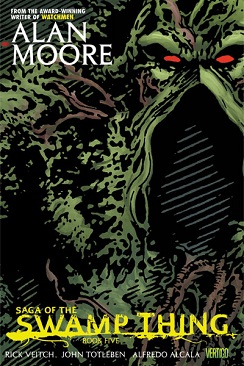
The Saga of the Swamp Thing Volume 5: written by Alan Moore, Steve Bissette, Rick Veitch, and John Totleben; illustrated by Rick Veitch, Steve Bissette, John Totleben, and Alfredo Alcala (1986; collected 2011): The penultimate collection of Alan Moore's career-making run on DC's Saga of the Swamp Thing sees Rick Veitch take over as primary penciller. As previous Swamp Thing penciller (and then-continuing cover artist) Steve Bissette notes in the informative introduction, Veitch's interest in science fiction over horror helped shift the book to a more science-fiction-oriented direction. But first Swamp Thing would travel to Gotham City for a fateful encounter with Batman. Then it was off into space for several issues for an odyssey that would conclude in the next volume.

The double-sized issue featuring Swamp Thing's battle with Batman is a doozy, showcasing as it does longtime Swamp Thing inker John Totleben's second full-art stint on the comic book. It's gorgeous: Totleben's art often looked like he was cutting his fine lines into wood or perhaps copper. It's elegant and old-school without being stiff or anachronistic. This was the time of Frank Miller's Dark Knight Returns, so Batman gets a really, really big Batmobile. However, Moore's Batman is much more sympathetic and fallible than Miller's -- and reasonable, in the end, as he and Swamp Thing ultimately resolve their differences without killing each other.

Subsequent issues further develop the character of Swamp Thing's beloved Abigail Cable, reintroduce two horribly transformed characters from Martin Pasko's early 1980's run on Saga, and bring us Swamp Thing's first foray into space travel. One can see Moore straining at the chains of the endless status quo of the mainstream superhero universe here. Things may return to the baseline at the end of each seemingly world-changing event, but logically they shouldn't.

Even if DC wouldn't soon anger Moore and cause him to leave the mainstream forever, one can't really believe, reading these stories, that he would have been much longer satisfied with 'The More Things Change, The More They Stay The Same.' Highly recommended.


The Saga of the Swamp Thing Volume 6: written by Alan Moore, Steve Bissette, and Rick Veitch; illustrated by Rick Veitch, Steve Bissette, John Totleben, Alfredo Alcala, and Tom Yeates (1986-87; collected 2011): And so Alan Moore's time as writer of DC's Saga of the Swamp Thing comes to an end after four years and nearly 50 issues'-worth of adventures. When he took over with issue 20, Moore was a British comic-book writer making his American debut. When he finished, he was the most praised writer of mainstream comic books in North America.
Swamp Thing's space odyssey continues, as the muck-encrusted Plant Elemental desperately seeks a way back to Earth and the arms of his beloved Abby. Meanwhile, on Earth, Abby believes Swamp Thing to be dead and starts to gradually move on with her life. Yes, they are literally star-crossed lovers.

The move into space brings Swamp Thing into contact (and occasionally conflict) with some of DC's Silver Age space characters, most notably Earth hero Adam Strange and a couple of really jerky Hawkpeople from Hawkman's planet of Thanagar. Swamp Thing also encounters a creepy machine entity in an artistic tour-de-force for Totleben, who illustrates an entire issue in the sort of heavy-duty collage that really does have to be seen to be appreciated, an issue that also allows Moore to cut loose with a long burst of prose-poetry meant to show the alien-ness of the issue's narrator, a world-sized machine intelligence pining for love in the lonely abyss of space.

Swamp Thing also encounters some of Jack Kirby's New Gods in an issue written by Veitch, one that showcases the more satiric, blackly comic and irreverent Swamp Thing that Veitch would be writing a lot more of when he took over from Moore as Saga writer with issue 65. Bissette's first full script sees Abby back on Earth encountering a character from the very beginnings of Swamp Thing back in the early 1970's, when it was written by Len Wein and illustrated by Bernie Wrightson. And there's a Green Lantern to be met before our hero returns home and Moore's stint as writer concludes with the lovely, elegaic "Return of the Good Gumbo." It was one hell of a ride. Highly recommended.

Tuesday, November 1, 2011

Swamp Thing


DC Comics Classics Library: Roots of the Swamp Thing, written by Len Wein, illustrated by Bernie Wrightson, Nestor Redondo, Mike Kaluta and Luis Dominguez (1972-1974, 1991; collected 2009): Swamp Thing (who never calls himself that) is one of those DC characters with a loyal following that stretches back 40 years to his first appearances. That's mainly thanks to the spectacular artwork of Bernie Wrightson, with an assist to the melodramatic writing by Wein, who makes Swampy into a brooding, quasi-Byronic hero. Well, if Byron were a scientist who'd been changed by a lab accident into a 7-foot-tall "muck-encrusted mockery of a man."

DC was cooking with gas in the early 1970's, the result of an influx of astonishing new writing and artistic talent. Marvel, mostly moribund, was in the process of becoming what DC had been -- a conservative comic-book company with a highly controlled house style for both art and story. Meanwhile, DC seemed to keep stumbling and bumbling along into mostly short-lived by influential and critically revered series. Swamp Thing was one of those.

Wrightson was great at grotesques, at horror and the macabre, and Wein supplied him with a ten-issue run of horror tropes for Swamp Thing (really Alec Holland, or so he thought at the time) to shamble into battle against, including a Frankenstein's monster, a werewolf, a witch, and a Cthulhoid monstrosity living in a mineshaft in Maine. Here, of course, the misunderstood monster is the hero, as are some of the monsters he first battles and then befriends. It's a horror-tinged paean to outsiders. Wrightson also gave of one of the most interesting artistic imaginings of Batman up to the time.

Some moments clunk, of course -- Wein was a young writer, and his solutions to some of the problems he creates for Alec Holland can be a bit on the ridiculous side. I'm also not entirely convinced Wein knew what "brackish" meant. So it goes. Wrightson would leave after ten issues, followed by Wein three issues later after a capable but not Wrightsonesque artistic run by Nestor Redondo.

The book would go on for several more issues, be cancelled, and return in the early 1980's to accompany the release of the woeful Swamp Thing movie. Eventually would come writer Alan Moore (Watchmen), with his entry into American comic-book writing coming on Saga of the Swamp Thing. But that was still nearly a decade away. This stuff, though, is golden. Muck-encrusted gold, but still. Highly recommended.

Tuesday, September 27, 2011

Hell House of Lords

John Constantine Hellblazer: Original Sins (Revised Edition), written by Jamie Delano and Rick Veitch, illustrated by John Ridgway, Rick Veitch, Tom Mandrake, Alfredo Alcala, Brett Ewins and Jim McCarthy (1988-89; collected 2011): Liverpudlian occult investigator and magician John Constantine's first solo adventures (he'd been introduced in Swamp Thing by Alan Moore, Rick Veitch, Steve Bissette and others in the mid-1980's) get a new collection here, with two stories from Swamp Thing added to the volume.

Writer Jamie Delano really made the character his, giving Constantine an even more jaded and cynical bent. But Constantine, a dangerous man who gets his companions killed, a lot, nonetheless fights the malign schemes of Heaven and Hell alike. And protecting humanity requires a lot of booze and a lot of cigarettes.

And a lot of politics. Thatcher's Great Britain and Reagan's America are the primary settings for Delano's initial 40-issue run on the title, and both places are drenched in blood and intimately and intricately tied to the apocalyptic plans of Heaven and Hell. Good times, good times!

Delano had a real flair for twisted updatings of traditional supernatural threats. His demons are stockbrokers in souls and day traders in damnation, literally at points. Soccer hooligans get transformed into hideous monsters. Computers strain to reach the shores of Heaven. Heaven has put a new group on the board, the Resurrection Crusade, believing it destined to create the next Messiah. Hell has countered with the Damnation Army, led by long-time Constantine nemesis Nergal.

Constantine also faces an ancient hunger demon in New York and a horrifying resurrection of Viet Nam veterans in the American heartland when he's not stalking the nightmarish streets of jolly old England. John Ridgway's art is, for my money, the best Constantine ever had in his own book -- grimy, realistic, grotesque. It perfectly suits Delano's exploration of Constantine's damned yet heroic psyche, and the terrible new ways evil works in the go-go 1980's. How Hollywood got a Keanu Reaves movie out of this is anyone's guess. Highly recommended.

Friday, April 22, 2011

Swamping


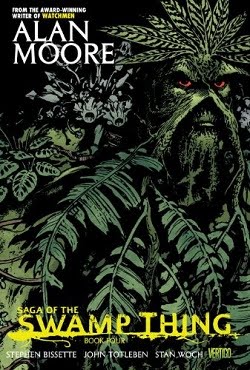
Saga of the Swamp Thing Volume 4, written by Alan Moore, illustrated by Steve Bissette, John Totleben, Rick Veitch, Stan Woch, Ron Randall, Alfredo Alcala and Tom Mandrake (1985-86; collected 2011): Blessedly, DC continues to go with non-glossy-coated paper and relatively muted colours for the re-collected Swamp Thing series. I still have nightmares about the candy-coloured original collected paperback of Alan Moore's run, from the late 1980's.

Herein we get the second half of Alan Moore's longest arc on the series, the "American Gothic" storyline. As Swamp Thing visits more American supernatural hotspots, John Constantine gathers his occult forces as part of his plan to stop the Patagonian sorcerers' circle The Brujeria from unleashing the original, pre-Creation Darkness on the universe in an effort to destroy Heaven itself. In between battling serial killers and haunted houses, Swamp Thing learns more about the history of plant elementals on Earth, and why they are created periodically through the years.

Occult investigator John Constantine is already his old snarky self, though less of a magician than he'd later be in his own book. Moore's tour of DC's lesser-known occult characters is a lot of revisionist fun, as is the showdown between an allied army of demons, angels and mystical superheroes and the forces of the Original Darkness (or 'O.D.' as I like to call it!). Moore seems to delight in taking the piss out of some of DC's more pompous supernatural heroes (Dr. Fate and the Spectre take quite an uncharacteristic pounding) so that our favourite plant elemental can finally save the day.

While a lot of different artists worked on these issues, a fair level of artistic continuity is maintained; the real stand-out, though, is long-time Swamp Thing inker John Totleben's full-art duties on what was issue 48. It's an astonishingly high-level debut, presaging his horrifying, beautiful work on his later collaboration with Moore, Miracleman. Highly recommended.

Wednesday, January 6, 2010

When Swamp Thing Left Birmingham

Comics:

Swamp Thing: Riverrun by Mark Millar, Phil Hester, Kim DeMulder, Chris Weston and Phil Jiminez (1995; uncollected): Given writer Millar's superstar status in comic books over the last decade, I don't why DC Comics hasn't collected his lengthy run on Swamp Thing. Just another mystery of DC's often bizarre collected editions policies (Showcase Presents Booster Gold before Jonah Hex Vol. 2? Seriously?).

Grant Morrison and Millar came onboard Swamp Thing after a lengthy run by Nancy Collins and pretty quickly got Swamp Thing out of the domestic life he'd been enjoying with Abby (and later daughter Tefe) since Alan Moore was on the book in the mid-1980's. Once Millar was established, Morrison left for about a dozen other DC books.

In this seven-issue storyline, Millar has Swamp Thing jumping to different alternate worlds which may or may not be 'real' -- they also may simply be the dying hallucinations of a suicidal writer who won't stay dead, and so asks Swamp Thing to get her 'out' of the world of her own stories in which she's trapped. This is an 'arc' structure used to good effect by previous Swamp Thing writers Alan Moore and Rick Veitch. Moore had Swamp Thing compelled willy-nilly through space for several issues, while Veitch had the same thing happen related to time. Indeed, Veitch's writer/artist run on Swamp Thing came to an end when Swamp Thing jumped to the crucifixion, complete with a cover depicting Swamp Thing as the cross upon which Christ was crucified. That issue never actually saw print, making it one of the most legendary of unseen comic-book stories.

In any case, Millar is in top form here. The writing's sharp and occasionally disturbing, and the situations are quite clever, with the 'Nazis won WWII' reality being especially interesting. Of course, it's not collected, so you'll have to hit the back-issue bins to read it. Oh, well.


Books:

The Watchers Out of Time and Other Stories by August Derleth and H.P. Lovecraft: Fantasy fiction owes a huge debt to Wisconsin writer/editor/publisher Derleth, whose Arkham House kept writers like H.P. Lovecraft and Clark Ashton Smith in print during the 1940's and 1950's before the horror boom began in the 1960's. He also introduced Ramsey Campbell and Brian Lumley to the world, to name just two.

While Edgar Allan Poe had possibly the worst literary executor ever, Lovecraft had possibly the best -- maybe a bit over-eager and a bit too quick to italicize important paragraphs in Lovecraft's stories, but otherwise just about the best friend a dead author who never made much of a living from writing while he was alive could hope for. That Lovecraft earned a Library of America edition in 2007 is as much a testament to Derleth as to the Revelator from Providence.

Derleth made something of a cottage industry out of writing stories based on fragments and notes left behind by Lovecraft after his death in 1937, enough to fill several thick volumes. This book collects some of the best. Derleth's Cthulhu Mythos was a bit happier than Lovecraft's -- there were a lot more ways to thwart the forces of darkness, and they were far more frequently constructed as forces of darkness rather than Lovecraft's conception of the uber-dangerous Great Old Ones as being beyond concerns of good and evil, which were ultimately just human constructions anyway.

Derleth's primary 'tic' -- italicizing final paragraphs -- is in full bloom here, and the selection of stories is a bit Innsmouth-heavy for my tastes, but the whole thing is worth reading if you've run out of Lovecraft to read or re-read. I think the best story is the short and evocative "The Fisherman of Falcon Point", which reads as much like a dark fairy-tale as it does a story set in the world of Cthulhu and Dagon and all those other crawly super-beings itching to return to Earth and turn us all into either dinner or experimental subjects. Recommended.


The Book of Basketball by Bill Simmons: Simmons, a regular columnist at ESPN.com, assesses pretty much every aspect of the National Basketball Association one could want. And then some. The book is meandering, digressive, and laden with footnotes -- all in all, a messy joy to read, rife with pop culture and porn references sprinkled amidst the assessments of the 96 greatest NBA players ever, the best teams ever, the biggest MVP voting screw-ups, the size of Dennis Johnson's Johnson and why the fallaway jumper is the preferred shot of superstars who never quite break through to win an NBA title.

His analysis is thought-provoking and occasionally hilarious, especially when he's taking shots at Vince Carter and Tracy McGrady, or singing the praises of Larry Bird, Michael Jordan and Kevin McHale. Highly recommended for people with at least some knowledge of basketball, pop culture, and pornography.

Friday, November 6, 2009

Beware of Exploding Vampires

COMICS:

Neil Gaiman's Midnight Days by Neil Gaiman, Steve Bissette, John Totleben, Mike Hoffman, Mike Mignola, Dave McKean and others (1988-2005; collected 2005): I'd imagine that someday soon this slim, over-priced collection of Neil Gaiman's non-Sandman, non-miniseries DC work will be replaced by a larger volume that will also include the missing Poison Ivy piece mentioned herein, the lost-and-found Superman/Green Lantern team-up that was initially meant to be the final issue of the abortive weekly Action Comics experiment of the late 1980's, and Gaiman's recent "Whatever Happened to the Caped Crusader?"

As is, this is an interesting volume of Gaiman's American comics baby-step, highlighted by the terrific John Constantine one-off "Hold Me" illustrated by frequent Gaiman collaborator Dave McKean. More for completists than anyone else -- you wouldn't want to introduce someone to Gaiman through this stuff, no matter how interesting I might find the Mike Mignola-illustrated Floronic Man short or the Swamp Thing annual featuring Brother Power the Geek.


The Unwritten: Tommy Taylor and the Bogus Identity; How the Whale Became by Mike Carey and Peter Gross (2009): This is great metafantasy in any medium. Over the first five issues of the series (which I'm assuming will be collected forthwith), Carey and Gross begin an epic fantasy involving readers, writers, vast conspiracies, children's literature, Rudyard Kipling, Mark Twain, Mary Shelley, Frankenstein's creature, Internet message boards, the nature of fandom, messiahs, and one confused man who thinks he's the adopted son of the long-missing author of a best-selling, beloved children's fantasy series about a magical boy named Tommy Taylor. The writer apparently named this son after his famous creation. Or did he?

Gross's art is sharp and deft in its ability to shift across the comics art spectrum from cartoony to mimetic and back again. Carey's been writing much-praised comics for more than a decade now, but I think this his best work by far -- his Invisibles, Sandman or Preacher, if you will. Highly recommended.