Showing posts with label steve bissette. Show all posts

Tuesday, July 21, 2015

Horror Comix Anthologies: The Big Book of Taboo

Taboo Issue 4 (1990): edited by Stephen Bissette and Nancy O'Connor, containing the following comics: Text pieces, interviews, and bios by Steve Bissette with Jean-Marc Lofficier; Front cover by Moebius; Back cover by Brian Sendelbach; Frontispiece by Nancy O'Connor; "Dreaming And The Law" written and illustrated by Phillip Hester; "1963" illustrated by Dave Sim; Untitled written and illustrated by Charles Burns; "Babycakes" written by Neil Gaiman and illustrated by Michael Zulli; "Cholesterol" written and illustrated by D’Israeli"; "Davey’s Dream" written by Mark Askwith and illustrated by Rick Taylor; "Eyes Of The Cat aka Les Yeux Du Chat" written by Alejandro Jodorowsky and illustrated by Moebius (originally printed in France in 1978); "El Topo" written by Alejandro Jodorowsky and illustrated by Spain Rodriguez (originally printed in Europe in 1979);  "Retinal Worm" written and illustrated by S. Clay Wilson; "La Fugue {The Escape}" written and illustrated by P. Foerster;  "Blue Angel" written by Tim Lucas and illustrated by Steve White; "Morrigan Tales" written by Elaine Lee and illustrated by Charles Vess; "These Things Happen" written and illustrated by  Rick Grimes; "Neither Seen Nor Heard" written by L. Roy Aiken and illustrated by Mike Hoffman; From Hell, Chapter Three: Blackmail or Mrs. Barrett written by Alan Moore and illustrated by Eddie Campbell; From Hell Pin-Up illustrated by Alan Moore.

The fourth oversized paperback issue of the late, much-lamented Taboo contains a wealth of great horror and weird comics material. The high point is a reprint of Alejandro Jodorowsky and Moebius's 1978 collaboration "The Eyes of the Cat," a lengthy weird horror tale made up entirely of gorgeous and occasionally disturbing full-page panels by Moebius. Combined with interviews with the two, it makes for quite a treat. Spain Rodriquez's odd 'tie-in' to the Jodorowsky film El Topo completes this part of the package.

The rest of the anthology is excellent as well, from the third serialized chapter of Alan Moore and Eddie Campbell's epic graphic novel about Jack the Ripper, From Hell, to a horrifying bit of insect craziness from underground comix mainstay S. Clay Wilson. Elaine Lee writes a fascinating new-wave fairy tale illustrated by Charles Vess in his old-school, Hal Foster by way of N.C. Wyeth style. Most of the short pieces are genuinely horrific, and it's interesting to see relatively early, non-Sandman Neil Gaiman as illustrated by the fine, overlooked Michael Zulli, and very early Phil Hester writing and drawing. Taboo was very much cutting-edge horror for its time, and rewards reading now if one can find issues of it. Highly recommended.


The Big Book of the Unexplained: written by Doug Moench; illustrated by Russ Heath, Sergio Aragones, Brent Anderson, Joe Sacco, Steve Leialoha, and many others (1997): Another enjoyable entry in Paradox Press' 'Big Book of' series of single-author, multiple-artist comics anthologies from the 1990's. This foray into the world of UFO's, cryptids, and general all-around Fortean madness (indeed, a cartoon version of Charles Fort is our narrator) is fun stuff with a wide variety of artists working in a wide variety of styles to alternately creep the reader out and make the reader laugh while, perhaps, thinking a little, at least about the credulity of the human animal. Recommended.

Friday, November 21, 2014

Cosmic Shorts

Shiny Beasts: written and illustrated by Rick Veitch with Alan Moore and S.R. Bissette (1979-1985; collected 2009): Back in the long-lost days just before Marvel launched Epic, its own comics anthology magazine to compete with Heavy Metal, young turks like Rick Veitch and Steve Bissette were graduating from the first classes of the Joe Kubert School for Comics Art and entering the American comic-book industry. Veitch brings together his early-career short pieces done for Heavy Metal and Epic here, and they're a dazzling bunch for such a young writer and artist.

Veitch's interests have always tended towards science fiction and satire, and this book offers a heady dose of both. However, the mostly eponymous story, "Shiny Beast", points more towards Veitch's 21st-century graphic novel Can't Get No, with its reliance on pictures to carry the narrative.

Veitch would get better, and quickly, but there's a real charge to watching him play around with various illustrative techniques. His cosmic spacescapes dazzle in a couple of stories, making me wish someone had commissioned him to do a fully painted and airbrushed New Gods story. Blackly humourous twist endings abound, a legacy of both Veitch's work with editor Robert Kanigher at DC and of the long history of twist endings in short comic-book horror pieces, going back to EC Comics.

A generous afterword offers insight about Veitch's grwoth as an artist, his influences and mentors, and his collaborators. Several of those early Kubert School graduates were a close-knit bunch, sometimes living together to be able to afford the rent, and so a lot of work contains material from whoever was able to help out on a given day. It's a short and enjoyable volume, and would go well as a lead-in to some of Veitch's longer work from the same period, especially Abraxas and the Earthman and The One. Recommended.

Saturday, August 16, 2014

Cigarette Burned

Tales from the Crypt Archives Volume 2: written by Al Feldstein; illustrated by Wally Wood, Jack Davis, Jack Kamen, Graham Ingels, Joe Orlando, and others (1951-52; reprinted 2010): Another collection of horror stories ranging from good to great, from the days before the Comics Code Authority lobotomized American comic books.

It amazes me how fresh and enjoyable most of the stories in this volume remain. EC had the finest comic-book artists in America for much of its too-short existence. The stories, written for the most part by editor Al Feldstein, occasionally get a bit rote (the vengeance of the dead was always an EC horror staple, along with some truly atrocious puns), but many are clever short stories in their own right.

But the art, of course, is the thing. Wally Wood is a bit out of his depth here -- he was always best on science fiction and non-supernatural thrillers, and the two covers he assays are weirdly non-horrific. But when you've got 'Ghastly' Graham Ingels, Jack Davis, Jack Kamen, and Joe Orlando on the beat, everything's going to be fine. Davis, also a long-time Mad artist, is droll and blackly comic. Orlando and Kamen are fine, moody artists.

And Ingels remains one of the greatest horror artists to ever draw comic books. Many of his monsters are disturbingly malformed. He's the granddaddy of so many modern horror artists, from Bernie Wrightson through Steve Bissette and Rick Veitch. His grotesques anticipate both the distorted spaghetti monsters of films such as John Carpenter's The Thing and the human monsters of The Texas Chainsaw Massacre and The Hills Have Eyes. Highly recommended.


John Constantine Hellblazer: Death & Cigarettes: written by Peter Milligan; illustrated by Simon Bisley, Guiseppe Camuncoli, and Stefano Landini (2012-2013; Collected 2013): 300 issues of Vertigo's John Constantine Hellblazer come to an end in this volume, so that Constantine can continue his adventures, in somewhat altered and youthfulized form, over in a title set in DC's mainstream superhero universe.

Created by Alan Moore, Steve Bissette, John Totleben, and Rick Veitch in Swamp Thing in the early 1980's as a sort of punk-attitude occult investigator from rust-belt Northern England, Constantine has had a long, varied, and distinguished career both in other people's comics and in his 25 years of his own title. He's even survived a completely screwy Keanu Reeves movie. And he's getting his own TV series this fall.

For me, the heights of John Constantine Hellblazer were reached early, with Jamie Delano writing the first 40 issues or so. Ably complemented by artists that included John Ridgway (understated and sinister), Sean Phillips and, in Delano's then-finale on the series, cover-artist Dave McKean doing an entire issue, Delano created a dense, kitchen-sink milieu of horror for Constantine.

Most of the humour in the title came from Constantine's sarcastic reaction to the horrors he faced. We were always meant to view Constantine through the lens of his own self-evaluation as a cursed punk, but we were also forced to conclude that he was indeed a very, very dark knight standing between humanity and the inimical forces of heaven and hell alike.

So we fast-forward here, to the end. I was gratified to discover that the Internet had as many problems figuring out just what the Hell the last three pages of the last issue mean. The whole thing ends on a note of ambiguity that may be entirely intended or may be sloppy story-telling. I have no idea.

Writer Peter Milligan gives us a 60-ish Constantine gifted with a super-hot 40-years-younger wife, a suddenly retconned-into-existence nephew who looks exactly like him, and a not-particularly imposing group of supernatural menaces to usher him out of his title. The art's generally so dark as to verge on inexplicable. Also, as some Internet wag noted, the main artists here seem to have forgotten that Constantine was visually modelled on Sting circa 1983, and not on Gary Busey circa 2013. The years have not been kind.

Stuff happens. There are a lot of sex scenes. Constantine's niece, once a capable presence when written by others, shows up as a traumatized shell of her former appearances. What's technically a demonic rape is played strictly for laughs. Did Constantine and his universe deserve better than this? Yeah. But we'll always have Newcastle. Spend your money on the John Constantine Hellblazer collections written by Delano, Garth Ennis, Andy Diggle, or Mike Carey instead. Not recommended.

Thursday, September 13, 2012

Heartburst

Heartburst and Other Pleasures: written by Rick Veitch with Alan Moore; illustrated by Rick Veitch with Steve Bissette (collected 2008): This selection of Veitch's early 1980's graphic 'novel' Heartburst and a number of other short pieces from two decades is a pleasure to read.

Heartburst (really only 48 pages long and called a 'novel' when first published when, as Veitch notes in his introduction, the derived-from-the-French 'graphic album' would have made more sense) presents an Earth colony that has based its entire culture on the early American TV broadcasts that are just arriving on that world thanks to the pesky speed of light.

That Earth colony, a sort of quasi-Roman Catholic fascist tyranny, is also in the process of exterminating the intelligent natives of that planet for, among other things, being too sexually liberated.

Veitch does a nice job of playing in a very satiric, 1950's science-fictional universe, but with more sex and a little more nudity, and the quantum-spiritualism elements of the text are really quite charming. The whole thing would only be more enjoyable at two or three times the length, where certain elements (such as the travelling circus) might end up feeling more organic and a bit less forced.

The short pieces and sketches give brief snapshots of Veitch throughout his career. He's remained remarkably consistent, and as a bonus, the colours in this collection really 'pop': it looks terrific. Recommended.

Tuesday, February 14, 2012

Giant-size Swamp Thing

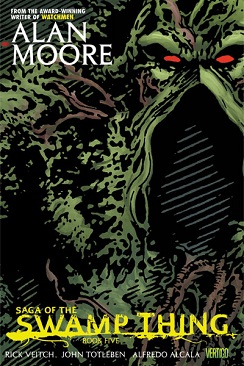
The Saga of the Swamp Thing Volume 5: written by Alan Moore, Steve Bissette, Rick Veitch, and John Totleben; illustrated by Rick Veitch, Steve Bissette, John Totleben, and Alfredo Alcala (1986; collected 2011): The penultimate collection of Alan Moore's career-making run on DC's Saga of the Swamp Thing sees Rick Veitch take over as primary penciller. As previous Swamp Thing penciller (and then-continuing cover artist) Steve Bissette notes in the informative introduction, Veitch's interest in science fiction over horror helped shift the book to a more science-fiction-oriented direction. But first Swamp Thing would travel to Gotham City for a fateful encounter with Batman. Then it was off into space for several issues for an odyssey that would conclude in the next volume.

The double-sized issue featuring Swamp Thing's battle with Batman is a doozy, showcasing as it does longtime Swamp Thing inker John Totleben's second full-art stint on the comic book. It's gorgeous: Totleben's art often looked like he was cutting his fine lines into wood or perhaps copper. It's elegant and old-school without being stiff or anachronistic. This was the time of Frank Miller's Dark Knight Returns, so Batman gets a really, really big Batmobile. However, Moore's Batman is much more sympathetic and fallible than Miller's -- and reasonable, in the end, as he and Swamp Thing ultimately resolve their differences without killing each other.

Subsequent issues further develop the character of Swamp Thing's beloved Abigail Cable, reintroduce two horribly transformed characters from Martin Pasko's early 1980's run on Saga, and bring us Swamp Thing's first foray into space travel. One can see Moore straining at the chains of the endless status quo of the mainstream superhero universe here. Things may return to the baseline at the end of each seemingly world-changing event, but logically they shouldn't.

Even if DC wouldn't soon anger Moore and cause him to leave the mainstream forever, one can't really believe, reading these stories, that he would have been much longer satisfied with 'The More Things Change, The More They Stay The Same.' Highly recommended.


The Saga of the Swamp Thing Volume 6: written by Alan Moore, Steve Bissette, and Rick Veitch; illustrated by Rick Veitch, Steve Bissette, John Totleben, Alfredo Alcala, and Tom Yeates (1986-87; collected 2011): And so Alan Moore's time as writer of DC's Saga of the Swamp Thing comes to an end after four years and nearly 50 issues'-worth of adventures. When he took over with issue 20, Moore was a British comic-book writer making his American debut. When he finished, he was the most praised writer of mainstream comic books in North America.
Swamp Thing's space odyssey continues, as the muck-encrusted Plant Elemental desperately seeks a way back to Earth and the arms of his beloved Abby. Meanwhile, on Earth, Abby believes Swamp Thing to be dead and starts to gradually move on with her life. Yes, they are literally star-crossed lovers.

The move into space brings Swamp Thing into contact (and occasionally conflict) with some of DC's Silver Age space characters, most notably Earth hero Adam Strange and a couple of really jerky Hawkpeople from Hawkman's planet of Thanagar. Swamp Thing also encounters a creepy machine entity in an artistic tour-de-force for Totleben, who illustrates an entire issue in the sort of heavy-duty collage that really does have to be seen to be appreciated, an issue that also allows Moore to cut loose with a long burst of prose-poetry meant to show the alien-ness of the issue's narrator, a world-sized machine intelligence pining for love in the lonely abyss of space.

Swamp Thing also encounters some of Jack Kirby's New Gods in an issue written by Veitch, one that showcases the more satiric, blackly comic and irreverent Swamp Thing that Veitch would be writing a lot more of when he took over from Moore as Saga writer with issue 65. Bissette's first full script sees Abby back on Earth encountering a character from the very beginnings of Swamp Thing back in the early 1970's, when it was written by Len Wein and illustrated by Bernie Wrightson. And there's a Green Lantern to be met before our hero returns home and Moore's stint as writer concludes with the lovely, elegaic "Return of the Good Gumbo." It was one hell of a ride. Highly recommended.

Friday, April 22, 2011

Swamping


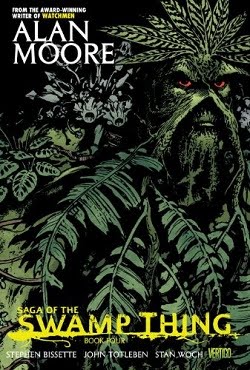
Saga of the Swamp Thing Volume 4, written by Alan Moore, illustrated by Steve Bissette, John Totleben, Rick Veitch, Stan Woch, Ron Randall, Alfredo Alcala and Tom Mandrake (1985-86; collected 2011): Blessedly, DC continues to go with non-glossy-coated paper and relatively muted colours for the re-collected Swamp Thing series. I still have nightmares about the candy-coloured original collected paperback of Alan Moore's run, from the late 1980's.

Herein we get the second half of Alan Moore's longest arc on the series, the "American Gothic" storyline. As Swamp Thing visits more American supernatural hotspots, John Constantine gathers his occult forces as part of his plan to stop the Patagonian sorcerers' circle The Brujeria from unleashing the original, pre-Creation Darkness on the universe in an effort to destroy Heaven itself. In between battling serial killers and haunted houses, Swamp Thing learns more about the history of plant elementals on Earth, and why they are created periodically through the years.

Occult investigator John Constantine is already his old snarky self, though less of a magician than he'd later be in his own book. Moore's tour of DC's lesser-known occult characters is a lot of revisionist fun, as is the showdown between an allied army of demons, angels and mystical superheroes and the forces of the Original Darkness (or 'O.D.' as I like to call it!). Moore seems to delight in taking the piss out of some of DC's more pompous supernatural heroes (Dr. Fate and the Spectre take quite an uncharacteristic pounding) so that our favourite plant elemental can finally save the day.

While a lot of different artists worked on these issues, a fair level of artistic continuity is maintained; the real stand-out, though, is long-time Swamp Thing inker John Totleben's full-art duties on what was issue 48. It's an astonishingly high-level debut, presaging his horrifying, beautiful work on his later collaboration with Moore, Miracleman. Highly recommended.