Showing posts with label jack kirby. Show all posts

Sunday, June 6, 2021

Thor and the Eternals

Thor and the Eternals: The Celestials Saga (1979-1980/This collection 2020): written by Roy Thomas, Mark Gruenwald, and Ralph Macchio; illustrated by Keith Pollard, Chic Stone, John Buscema, and Gene Day; adapting portions of Richard Wagner's RING CYCLE (seriously): 

Say what you will about longtime comic-book writer Roy Thomas, but he really likes Norse mythology and Wagner's RING CYCLE. So much so that he shoehorns a really wonky take on the former and an even wonkier shoehorning of the latter into this lengthy attempt to fit Jack Kirby's Eternals into mainstream Marvel continuity.

As it wasn't enough to just figure out how the Eternals could possibly fit into Marvel's already overstuffed pantheons of Norse, Greek, and pretty much every other god on record with the exception of the Christian ones, Roy said, no, I'm also going to offer a new expanded origin for the Norse gods seen in THOR. And I'm going to adapt the RING CYCLE. And the RING CYCLE will explain mysteries of Thor's origins that no one realized were mysteries before. 

And I'll have a sizeable portion of this story narrated by the sentient, giant floating eyeball that Odin sacrificed for knowledge back when the eye was neither sentient nor floating nor giant. The eyeball will tell this story to the titular hero of this saga, Thor, who will be almost as baffled as the readers will be. 

And then Roy left Marvel before the story was over, leaving Mark Gruenwald and Ralph Macchio to figure out how to end the whole thing, though I assume Roy may have left notes or something,

It's far and away the craziest cosmic saga of Marvel's Bronze Age, ably illustrated by John Buscema and the always under-rated Keith Pollard. Roy would go on to retell the Norse Ragnarok with DC's Justice Society of America chipping in to help the Norse gods. Then he and artist Gil Kane would adapt the RING CYCLE in the early 1990's, this time without added superheroes. Because it don't mean a thing if it ain't got that Ring... of the Nibelung! Recommended.


Tuesday, June 18, 2019

X-men: Dark Phoenix (2019)

X-Men: Dark Phoenix (2019): written and directed by Simon Kinberg; based on characters and situations created by Jack Kirby, Stan Lee, Len Wein, Dave Cockrum, Chris Claremont, John Byrne, and otrhers; starring James McAvoy (Professor X), Michael Fassbender (Magneto), Jennifer Lawrence (Raven), Nicholas Hoult (Beast), Sophie Turner (Jean Grey/ Phoenix), Tye Sheridan (Cyclops), Alexandra Shipp (Storm), Evan Peters (Quicksilver), Kodi Smit-McPhee (Nightcrawler), and Jesicca Chastain (Vuk):

X-Men: Dark Phoenix wasn't terrible. Certainly not enough for all the now-cliched Internet agita about it. Spoilers ahoy!

I wonder if it suffered at the box office in part because it uses Hollywood's ubiquitous Daddy-Daughter trope in a negative sense. Young Jean "Phoenix" Grey is abandoned by her father after Jean accidentally kills her mother because she hates the music Mom is playing on the car radio. Professor X chooses not to tell Jean that her father is still alive after the accident. This seems to me to be a good idea as Jean is only 8 and is traumatized. He slips up by never telling her as a teen or adult that her father is alive, but in his defense, Professor X is a busy man!

The main problem is that once Disney's acquisition of Fox was imminent, Disney clearly told Fox to change the ending of Dark Phoenix because it was similar to the ending of Captain Marvel -- Jean Grey was supposed to destroy a giant alien spaceship that had come to try to acquire the Phoenix Force for itself, saving the Earth and (seemingly) sacrificing herself in the process. This led to reshooting the climax a year after filming had originally ended.

The film-makers changed this woman vs. spaceship battle to a battle between the aliens on one side and the X-Men and human soldiers on the other side, all on a prison train. 

Because nothing says epic sci-fi confrontation more than a battle in and around the apex of 19th-century travel technology.

Of course, this led to an interesting plot hole. Is the spaceship still in orbit? Because the answer would seem to be 'Yes,' given that we saw the aliens come to Earth in the now obligatory meteorite-like landing pods.

So it goes.

Perhaps needless to note at this point, there's no Daddy-Daughter issues in the original comic book Dark Phoenix Saga. Jean's parents are loving and accepting of her mutant powers, and when she gains the Phoenix powers, the saga plays out as a cautionary tale about absolute power corrupting absolutely, along with self-sacrifice. Realizing that the Phoenix Force could never be controlled, Jean commits suicide. Or does she? That was a story for another day!

Lightly recommended.


Saturday, March 30, 2019

Captain Marvel (2019)

Captain Marvel (2019): based on characters created by Stan Lee, Arnold Drake, Jack Kirby, Gene Colan, and many others; written by Nicole Perlman, Meg LeFauve, Anna Boden, Ryan Fleck, and Geneva Robertson-Dworet; directed by Ryan Fleck and Anna Boden; starring Brie Larson as Carol Danvers /Captain Marvel, Samuel L. Jackson as Nick Fury, Ben Mendelsohn as Talos, Jude Law as Yon-Rogg, Annette Bening as Supreme Intelligence/Mar-Vell, Gemma Chan as Minn-Erva, Lee Pace as Ronan, Mckenna Grace as Young Carol Danvers, Djimon Hounsou as Korath, and Clark Gregg as Agent Phil Coulson:

What's weird about Captain Marvel is that it's more like a Joss Whedon project than Whedon's two Avengers movies. Relentlessly light in tone, Captain Marvel is basically a buddy comedy featuring Carol 'Captain Marvel' Danvers and a young, mid-1990's Nick Fury, played by a CGI-youthanized Samuel L. Jackson. 

Disney seems to have spent all the de-aging CGI money on Jackson, as a de-aged Agent Phil Coulson (Clark Gregg) often looks like a nightmare from the Uncanny Valley.

This is the first Captain Marvel in the Marvel Cinematic Universe, though the Carol Danvers Captain Marvel is the third or fourth so-named hero in Marvel history (and not the original Captain Marvel -- that is the 'Shazam'-uttering Fawcett Comics hero soon to appear in a movie called Shazam; after DC acquired the rights to that Captain from Fawcett, they forgot to trademark the name, thus leading to Marvel debuting their then-male Captain Marvel in the late 1960's).

It's a mostly fun, light snack. It's overly long in the climax department, as pretty much every blockbuster now is these days, relentlessly ticking off items on a Checklist of Closure. Brie Larson is fine as the good Captain, though she's not given much to work with beyond a surface jokiness. Jackson seems to be delighted to be doing comedy work, as do Jude Law as Marvel alien Kree mentor Yon-Rogg and Ben Mendelsohn as the alien Skrull leader Talos. Recommended.

Saturday, January 12, 2019

Marvel 2016 Again!

Captain America: Civil War (2016): based on characters and situations created by Joe Simon, Jack Kirby, Mark Millar, Stan Lee, and others; written by Christopher Markus and Stephen McFeely; directed by Anthony and Joe Russo; starring Chris Evans (Captain America), Robert Downey Jr. (Iron Man), Anthony Mackie (The Falcon), Sebastian Stan (The Winter Soldier), Elizabeth Olsen (Scarlet Witch), Paul Bettany (The Vision), and Scarlet Johansson (Black Widow): 

Fast-moving, crowded film pits lots of Marvel super-heroes against lots of other Marvel super-heroes. The movie stays moderately zippy as it leaps from location to location. It also manages to bring Spider-man into the Marvel Cinematic Universe in fairly rousing fashion. Well, rousing if you enjoy seeing the increasingly dickish Iron Man practice child endangerment! It's really not a Captain America movie but rather a third (at the time) Avengers movie.

Black Panther gets introduced too, and ends up being one of the few voices of reason. All hail Wakanda!


Things go on about one super-hero battle too long, in part because the best part of the whole movie occurs during that second-to-last battle as the movie goes all-out comic book. Boy, though, the Vision's costume is terrible. If nothing else, the film suggests that Marvel's Damage Control comic, in which super-powered cleaners clean up the aftermaths of super-battles, should be turned into a movie franchise. Stat. Recommended.


Doctor Strange (2016): based on the character created by Steve Ditko; written by Jon Spaihts, Scott Derrickson, and C. Robert Cargill; directed by Scott Derrickson; starring Benedict Cumberbatch (Dr. Stephen Strange), Rachel McAdams (Rachel Palmer), Chiwetel Ejiofor (Mordo), Benedict Wong (Wong), Tilda Swinton (The Ancient One), and Mads Mikkelsen (Kaecilius): 

A bit of a boiler-plate Marvel Movie (think Iron Man with magic instead of technology and you've pretty much got it) enlivened by some ambitiously loopy visuals, albeit some of them riffing on Inception and not anything in the Dr. Strange comic books themselves.

The changes to Dr. Strange's character make him a twin for Robert Downey Jr.'s snarky Tony Stark. That's faithful to the original comics version of pre-magic Dr. Strange, not so much for post-magical-training Dr. Strange, possibly early Marvel's least quippy hero -- even Reed Richards (or Sue Storm, for that matter) got off more zingers than Dr. Strange in the 1960's. 

Created by writer-artist Steve 'Spider-man' Ditko, Dr. Strange's non-quippy gravitas probably makes him the Marvel character who would most benefit from a trade to DC Comics for, say, the Legion of Super-heroes.

Benedict Cumberbatch is fine as Dr. Strange, though his American accent is all kinds of weird. Chiwetel Ejiofor does nice work as a seriously reworked Mordo. Mads Mikkelsen plays the least interesting Marvel Movie villain since Mickey Rourke and Sam Rockwell in Iron Man 2. Rachel McAdams is stuck playing Natalie Portman in the Thor movies, only moreso.

The movie's visuals fail spectacularly at the end even as they also succeed admirably in translating Ditko's surreal comic-book visuals of the Dark Dimension into the movie world. To say that the visual redesign of Dr. Strange's greatest foe is regrettable is about the most praise I can offer. The poor bugger has been biggie-sized into a giant floating head that looks an awful lot like what would happen if you painted the Tron visuals for the Master Control Program onto an accordion.

As to the white-washing in regards to Asians... yep, one of Marvel's first prominent, 'good' Asian characters is no more. Doc's mentor, the ancient Asian known only as the Ancient One, is now the surprisingly spry Tilda Swinton, a.k.a. The Whitest Actress Ever. And the other tweaks made to the Ancient One's character don't help much either. 

In other areas, the magic training Strange endures now has all the length and rigor of selecting icons off a computer screen. Really, it makes the Harry Potterverse seem like a world teeming with educational rigor by comparison. Doctor Strange just has to make funky Kung Fu moves -- no pronouncement of spells required. 

And the mystical doodad Strange and friends need to travel through space-time? It's there to be dropped at a crucial moment, as these things always are. And it's called a 'Sling Ring,' thus recalling one of the lowest of low points in adaptations of Marvel comics to other media -- the laughable Thing animated show of the 1980's and the cry "Thing ring, do your thing!" On the bright side, the Wand of Watoomb makes a cameo and the Cloak of Levitation gains the personality of  loyal dog. Lightly recommended.

Friday, April 20, 2018

Jack Kirby's Black Panther

Black Panther Vs. Abominable Snowman!
Jack Kirby's Black Panther (1976-78; collected in two volumes 2005): written by Jack Kirby with Jim Shooter and Ed Hannigan; illustrated by Jack Kirby and Mike Royer with Denys Cowan: Jack Kirby's Black Panther followed the cancellation of Jungle Action and the premature end to Don McGregor and Billy Graham's run on Black Panther in that Marvel comic book. Readers who followed the character from one book to the next must have suffered from whiplash. 

Kirby's Black Panther is a super-scientific adventurer whose first multi-issue adventure involves a team-up with a diminuitive collector of weird antiquities named Mr. Little on a quest to find the second of two objects known as King Solomon's Frogs. They've discovered one. It periodically pulls someone or something in from another time. Together, the two assume, the two frogs should form a controllable time machine. OK!

This is Jack Kirby in full-on lunacy mode. It's great lunacy, mile-a-second action, wild double-page spreads, and some of the oddest of Kirby's 1970's narratives. I mean, a time machine shaped like a frog (why?) is weird enough. 

But the time machine will eventually pull in a dangerous, hyper-evolved human from millions of years in the future. There will also be a hidden kingdom founded by seven samurai. There will be a half-brother of T'Challa (that is, the Black Panther) who will seize control of the kingdom of Wakanda. There will be a Council of relatives of the Black Panther who will come together from across the world to battle that half-brother while T'Challa is stuck in the samurai kingdom.

Oh, and a lost Black Panther will stumble across a science-fiction movie filming in the North African desert. It isn't Star Wars, but it's clearly a nod to the Tunisia filming location of Star Wars. Kirby's work on a film adaptation of Roger Zelazny's Lord of Light would be used to help some of the American hostages out of Iran. Remember Argo? They actually shot but didn't use a scene with Jack Kirby. It's true!

Whiplash, though, oh boy! This is rollicking science fantasy laced with absurdity. If you like more serious versions of Black Panther that address social and racial concerns, this is probably not your Black Panther. I love it. I love McGregor's version too. I am entertained by multitudes! Highly recommended.

Black Panther: Panther's Rage

One of many dynamic pages from Graham and McGregor

Black Panther: Panther's Rage (Marvel Epic Collection Volume 1) (1966, 1973-1976; collected 2015): written by Don McGregor; illustrated by Billy Graham, Rich Buckler, Gil Kane, Klaus Janson, and others: Jack Kirby and Stan Lee gave Black Panther life. Don McGregor and artists Rich Buckler and especially Billy Graham gave the character a soul. And note that the character predates the 1960's political movement of the same name by several months.

The recent Marvel movie used a number of elements from the McGregor-penned run included in this collection. Much is different, however. After reprinting the Black Panther's first two-issue appearance in Fantastic Four in 1966, this volume reprints McGregor's entire run on Black Panther from Marvel's Jungle Action comic book. What a ride it is!

The Lee/Kirby two-parter is fascinating insofar as it gives us an African superhero who rules over a seemingly backwater African nation that's actually a hive of super-technological sophistication. Beyond that, Black Panther is fairly boilerplate -- a noble fellow with a desire for revenge against white villain Ulysses Klaw. Still, the storyline is notable not only because the Black Panther is the first modern black superhero from a major comic-book company, but because Wyatt Wingfoot, a smart non-superhero Native American, saves the day in the first of the two Lee/Kirby issues. It's sort of a racial milestone for American superheroes.

McGregor's stuff is a whole different story. The mix of super-science and tradition remains in the Black Panther's country of Wakanda. McGregor's interests are such that Black Panther becomes a self-sacrificing, self-doubting character very early in the arc, with subsequent issues building on these attributes. 

This Black Panther had moved to America and joined the Avengers after his intro in FF; McGregor's work brings him back to a Wakanda that's grown turbulent in his absence. And Erik Killmonger (the villain of the movie as well) intends to wrest control of Wakanda from the Black Panther.

What follows is one of the longest sustained narratives in American superhero comic books to that point in the mid-1970's, one of the first true serialized graphic novels. Initial artist Rich Buckler does solid work. Once Billy Graham comes on board, the art really soars. And it's notable that Graham is one of the first African-American artists to work on a major publisher's superhero book.

Graham and McGregor are ambitious in their storytelling ambitions -- a variety of intriguing single and double-page compositions are just one way the art stands out. Graham is especially good at character work, faces and poses that make each character an individual. An issue inked by P. Craig Russell is especially fine as a horror story filled with grotesques.

The Black Panther's physical sufferings throughout McGregor's run, depicted and described in detail, cast him repeatedly in the role of a suffering Christ figure -- albeit a two-fisted Christ. I don't know that any mainstream superhero has had his suffering depicted in such detail. It ties into McGregor's ethos insofar as McGregor tempers the thrills of superheroics with repeated examinations of the physical and mental ramifications of Men in Tights walloping one another.

Erik Killmonger's plans ultimately occupy 13 (!) issues of Jungle Action. As Jungle Action was bimonthly, this first arc (titled Panther's Rage) went on for more than two years. Subsequently, McGregor and Graham send the Black Panther back to America to battle the KKK. Never let it be said that McGregor shied away from political and social issues. Alas, Marvel cancelled Jungle Action before the Klan storyline was over. It's still a bracing bit of storytelling. In all, highly recommended.

Saturday, March 31, 2018

Thor: Ragnarok (2017)

Thor: Ragnarok (2017): based on characters and stories by Jack Kirby, Walt Simonson, Sal Buscema, Larry Lieber, Stan Lee, and others; written by Eric Pearson, Craig Kyle, and Christopher Yost; directed by Taika Waititi; starring Chris Hemsworth (Thor), Tom Hiddleston (Loki), Cate Blanchett (Hela), Idris Elba (Heimdall), Mark Ruffalo (Banner/Hulk), Tessa Thompson (Valkyrie), Jeff Goldblum (Grandmaster), Anthony Hopkins (Odin), Taika Waititi (Korg), Benedict Cumberbatch (Dr. Strange), Clancy Brown (Surtur), and Karl Urban (Skurge the Executioner): 

See also

The off-beat jolliness and humour of this Marvel entry only grows on a small screen. One wishes Joss Whedon had the leeway to make as jolly a superhero movie. Chris Hemsworth is a comic revelation, closely followed by Mark Ruffalo himself as Bruce Banner and in motion-capture CGI as Banner's Hulkish alter ego. All that and so much design work based on Jack Kirby's art, right down to Hela's head-dress and all those weird circuit diagrams painted on every wall. Highly recommended.

Black Panther (2018)

Black Panther (2018): based on characters and concepts created by Jack Kirby, Stan Lee, Don McGregor, Billy Graham, and others; written by Ryan Coogler and Joe Robert Cole; directed by Ryan Coogler; starring Chadwick Boseman (Black Panther/ T'Challa), Michael B. Jordan (Erik 'Killmonger' Stevenson), Lupita Nyong'o (Nakia), Danal Gurira (Okoye), Martin Freeman (Everett Ross), Daniel Kaluuya (W'Kabi), Letitia Wright (Shuri), Winston Duke (M'Baku), Angela Bassett (Ramonda), Forest Whitaker (Zuri), and Andy Serkis (Ulysses Klaue):

Marvel's epic about its first African superhero is obviously a crowd-pleaser, based on its stunning box-office success. It's an enjoyable piece of work. Ryan Coogler and company do about as well as one can in these things when it comes to superhero characterization, and some of the early fight sequences are nicely staged without too many quick edits, especially a battle in a Korean casino.

We also get a good look at the high-tech kingdom of Wakanda in all its utopian, Afro-futuristic glory. Much of the visual design for the capital of Wakanda is thoroughly grounded in the work of writer-artist Jack Kirby, who co-created the Black Panther with Stan Lee in the pages of the Fantastic Four in the 1960's. Given the success of Black Panther and the even-more-Kirbyesque Thor: Ragnarok, Kirby's art still has some power to awe and delight.

I have my usual quibbles, some of them anyway. The final battle goes on forever and occurs on too many fronts to be dramatically satisfying. And changing the last name of sound- and vibranium-obsessed villain Ulysses Klaw (a spirited Andy Serkis, probably glad to be out of the motion-capture suit for once) to 'Klaue' is a hilarious moment in micro-managing "verisimilitude" in superhero movies.

For a rare moment, Marvel has a movie villain whose motivations make psychological sense in a serious way in Michael B. Jordan's inspired turn as Erik "Killmonger." He's about one personality change away from being a hero, which is what makes him so involving (well, that and Jordan's charismatic performance). He's almost a tragic hero, to the extent that one roots for him to "turn good."

Chadwick Boseman is terrific in the difficult role of the mostly saintly Black Panther. An all-star cast of women does great work as Black Panther/T'Challa's female honour guard, his teen-genius sister, his ex (a fun and funny Lupita Nyong'o) , and his mother, a regal Angela Bassett. Coogler and company even manage to navigate the potentially offensive Black Panther character known as Man-Ape, in part by never mentioning him by that name and instead making he and his people something other than antagonists. 

The tribal leader formerly known as Man-Ape (played by a solid Winston Duke) even gets some comic moments as he punctures the assumptions of Caucasian second-banana Bilbo, I mean, CIA agent Martin Freeman. Now that's good film-making! Highly recommended.

Tuesday, November 14, 2017

Thor: Ragnarok (2017)

Thor: Ragnarok (2017): based on characters and stories by Jack Kirby, Walt Simonson, Sal Buscema, Larry Lieber, Stan Lee, and others; written by Eric Pearson, Craig Kyle, and Christopher Yost; directed by Taika Waititi; starring Chris Hemsworth (Thor), Tom Hiddleston (Loki), Cate Blanchett (Hela), Idris Elba (Heimdall), Mark Ruffalo (Banner/Hulk), Tessa Thompson (Valkyrie), Jeff Goldblum (Grandmaster), and Karl Urban (Skurge the Executioner): Almost too jolly and jaunty an entry in the Marvel Movie Sweepstakes, given the death toll in the movie. Reducing Gotterdammerung to a punchline seems both too much and not enough.

Oh, well. Thor: Ragnarok is also the Marvel movie that looks most like the comic books it's based on, particularly Jack Kirby's 1960's work on Thor and Walt Simonson's writer-artist duties on his great Thor run of the 1980's. 

The tone is really more Simonson than Kirby -- there was a jocularity and a sense of the absurd to his run, though he was better than the film-makers at balancing the epic and the absurd. Full credit to director Taika Waititi, whose What We Do In the Shadows was an absurdly hilarious faux-documentary. 

The movie goes on about 15 minutes' worth of CGI battles too long. All the actors are as fresh and lively as in any Marvel production to date, and Cate Blanchett camps it up as super-villain Hela, whose crazy head-piece comes right off the Jack Kirby pages (so, too, the designs of many of the aliens in campy Jeff Goldblum's space-court, extras from Kirby's 1970's space-god saga The Eternals). Even Bruce Banner and the Hulk are funny. Recommended.

Friday, June 9, 2017

Florence Foster Jenkins (2016)

Florence Foster Jenkins (2016): based on a true story; written by Nicholas Martin; directed by Stephen Frears; starring Meryl Streep (Florence Foster Jenkins), Hugh Grant (St Clair Bayfield), Simon Helberg (Cosme McMoon), and Rebecca Ferguson (Kathleen): Delightful comic drama about the world's worst singer, New York socialite and philanthropist Florence Foster Jenkins. She thinks she can sing. Husband Hugh Grant humours her because he loves her. Actually, pretty much everyone humours her because she's a nice person who throws a lot of money around. 

This movie isn't quite the laugh riot it was advertised as -- it's also a bittersweet movie about folly and sacrifice. The cast is terrific throughout, Stephen Frears directs with unforced elegance, and the singing... boy oh boy that singing. Meryl Streep nails Jenkins' dementedly above-range 'coloratura,' as recordings of the actual singer played under the end credits demonstrate. Recommended.


Tuesday, April 25, 2017

Astro City!

100 Issues of Astro City!  (1995-2017): written by Kurt Busiek; illustrated by Brent Anderson, Alex Ross, and others: 100 issues of Astro City over 22 years and at least three publishers. That's quite a milestone in today's rapid cancellation comics marketplace. 

Writer Kurt Busiek helped implement a sort of 'soft' revisionism in superhero comic books with Astro City. The series has always paid fond homage to the super-heroes and pulp heroes of a hundred years (and more!) of publishing. But it's done so with character-driven stories and a meticulously worked-out history.

The basic set-up for Astro City was that the eponymous city, near the slopes of Mount Kirby, held within it super-heroes who paid homage to the super-heroes of American comic-book history without simply being slavish pastiches of those super-heroes. Samaritan, for example, is Astro City's nod to Superman -- but as established early in Astro City's run, he's his own man, with his own origins and his own dreams, day-time and otherwise. Nonetheless, he fights evil just like Superman: there's nothing cynical or calculated about Samaritan.

Other characters who hew close to their sources include the Silver Agent (Captain America) and Winged Victory (Wonder Woman). But both get to have finely observed, multi-issue stories about them over the course of Astro City's run. Indeed, the Silver Agent's fate is the thread that unites the entire year-long The Dark Age storyline. 

Astro City give us heroes with problems, but it also shines a sometimes amusing, sometimes poignant light on a world in which not everyone with super-powers or super-technology wants to be a super-hero (or super-villain). It travels to small towns to check out the hero life there. It tracks super-hero families over the course of generations. It examines how life in the different boroughs of Astro City works -- things differ, especially in the borough that's home to supernatural beings and watched over by the mysterious hero dubbed The Hanged Man. One of its most poignant characters is Steeljack, a small-time super-villain who basically fell into super-villainry and then spends a couple of storylines (and 20 years or so) trying to claw his way out of it.

It's been a great ride, one I hope continues. Busiek and primary Astro City artists Brent Anderson (interiors) and Alex Ross (covers) have created something that now looms, like Mount Kirby, as a testament to what good writing and artwork can do with super-heroes. One never feels cheated by Astro City on the writing or artistic fronts. Anderson, who started his career very much in the vein of Neal Adams, has become an artist now more in the role of long-time Superman artist Curt Swan, an artist who can comfortably depict both the mundane and the cosmic, sometimes within the same panel. 

And Busiek gives full textual value: unlike the vast majority of modern super-hero comics, an issue of Astro City takes more than three minutes to read. That isn't to say that Astro City is text-heavy -- instead, its text/art balance is more in keeping in line with mainstream superhero comics prior to the oughts, when 'decompression' became first the superhero buzz-word and then the stranglehold.


The richness of Astro City also lies in the way it comments on super-hero stories while presenting super-hero stories that work on a prima facie level. The Samaritan's arrival in 1986 corresponds to the year DC Comics hired writer-artist John Byrne to reboot Superman. The lengthy Dark Age storyline comments on the periodic veers of mainstream super-hero comics into grim and gritty territory. Various place names, including that looming Mount Kirby, celebrate comics creators. Nonetheless, Busiek's characters are their own people even as they also evoke famous super-heroes and super-villains.

Perhaps the greatest subversiveness of Astro City is that it presents hope (or perhaps Hope) and goodness as being valid concepts, no matter how bad things may seem. It's the finest long-form super-hero comic ever presented. Long may it run! Highly recommended.

Thursday, November 24, 2016

Trekking to the Oldies

Star Trek: Gold Key Archives Volume 1 (1967-69/ This edition 2014): written by Dick Wood; illustrated by Nevio Zeccara and Alberto Giolitti: Oh, those loopy Gold Key Star Trek comics of the 1960's and 1970's! The first six issues collected here were originally written and drawn by people who had never seen an episode of Star Trek and had been handed what seems to be the briefest of Show Bibles. 

The artists had photo references, but no idea how big the Enterprise was (a cutaway illustration makes it seem about as big as a B-52 bomber) or what James Doohan looked like (Scotty is unrecognizable). The stories themselves are generic space opera, albeit with a few clever moments. The first story is pretty much full-blown scifi horror, an area the real Trek delved into very infrequently. And as a piece of horror, and body horror, it's actually pretty effective, though unrecognizable as Trek

Subsequent stories gradually move closer to Trek, with a clever story about rogue machines endlessly building cities being the strongest, Trekkiest of the stories. Why Dark Horse devoted a fairly pricey Archive series to these books is a bit of a mystery: these things are best enjoyed on cheap paper, preferably in a massive, inexpensive collection. Recommended.


Godhead: New Gods/ Green Lantern (2015): written by Robert Vendetti, Charles Soule, Van Jensen, Cullen Bunn, Justin Jordan, and others; illustrated by Ethan Van Sciver, Billy Tan, Dale Eaglesham, and others: DC tried to reinvent Jack Kirby's iconic Fourth World characters for its post-Flashpoint, rebooted superhero universe of the 'New 52' in this crossover event with the Green Lantern books. It's pretty much a failure on every level, burdened with a plot that's mostly massive battle scenes and a lot of fussy, often confusingly laid-out art. And oh so many Lanterns! 

The leader of the 'good' forces of the 'New Gods,' Izaya the Inheritor, has gone from reflective philosopher-king to violent imperialist. So, too, such previously peaceful New Gods characters such as Lightray, who's now just another soldier in a Cosmic Cold War. Design-wise, nothing of Kirby's has been improved upon. Metron and his Mobius Chair are now a fussy, over-rendered mess. Orion now wears an outfit that makes him look like a bellhop when his helmet is removed. Izaya is just another guy in over-rendered armour.

The 'event' involves the New Gods, self-appointed defenders of the entire multiverse,  discovering the existence of Green Lantern rings, oh, about 5000 years into the existence of those Green Lantern rings. That's some nice universal monitoring, boys. Of course, this is the expanded universe of Green Lantern rings. Which is to say, there are also thousands upon thousands of humans and aliens flying around not only with Green Lantern rings, but with Red and Yellow and Orange and Blue and Indigo and Violet Lantern rings. And there are collector's item, one-of-a-kind White and Black Lantern rings as well. Plaid rings are surely on the horizon.

Izaya decides some combination of these rings will allow him to defeat cosmic menace Darkseid once and for all. Or maybe he just needs the White Lantern ring to do that. Whatever. Much fighting and blowing things up ensues. There's about enough plot here for maybe 50 pages of a comic book, extended to fill 300 increasingly interminable pages. Now that DC has executed a soft line-wide reboot again with the Rebirth event. one can only hope that this dismal bunch of Fourth-World wannabes has been consigned to the ash-heap of continuity resets. Not recommended.

Friday, September 30, 2016

Weird Science Romance Bukkake

Young Romance 2: The Early Simon & Kirby Romance Comics (1947-49/ Collected 2014): edited and restored by Michel Gagne; written and illustrated by Joe Simon and Jack Kirby: A second beautiful job of restoration here by Michel Gagne and friends, rescuing Joe Simon and Jack Kirby's tremendous, tremendously popular romance comics of the 1940's and early 1950's from obscurity.

It's a whole different side of Simon and Kirby (co-creators of Captain America, among many other things), one filled with domestic melodrama and solid depictions of the mostly normal. Entertaining as all Hell -- one can see how these comics rapidly became best-sellers. If it weren't for the Comics Code Authority's implementation in the 1950's, comics like these would have helped the American comics industry mature faster by about four decades. Highly recommended.


Crooked Little Vein (2007) by Warren Ellis: Or, Michael McGill and Trix Search for the Secret Constitution. Seriously. Burned-out PI McGill gets himself hired by the President's heroin-addicted Chief of Staff to find the missing Secret Constitution. It's not just a document. Read aloud, it causes people to obey it -- but only when heard in person, not reproduced electronically. And the Chief of Staff wants to make America great again by hypnotizing people back into a 1950's mindset.

OK! The Chief selects McGill because McGill is a self-described "shit magnet." Weird things happen to him, constantly, a fact the Chief believes will lead him inevitably to the Secret Constitution. So off McGill goes, soon to be accompanied by avant-garde grad student Trix, whom McGill meets at a Godzilla Bukkake Night he's stumbled into.

Yes, Godzilla Bukkake: people who are sexually aroused by giant, filmed Japanese monsters to the point of simultaneous release. Hoo ha! And that's not the weirdest thing in the novel.

Warren Ellis, crackerjack comic-book writer and futurist, has a lot of fun in this novel with strange incidents and people and a book-length parody of the standard hard-boiled-detective novel. His narrator is hapless and generally more acted-upon than acting, with sidekick Trix getting him going at various points in the text. 

It's all provided within a narrative that satirizes Bush 2-era America and the Republican obsession with "family values." The Secret Constitution could conceivably cause gay people to 'turn straight,' all part of 'making America great again.' There's even a reclusive, insane billionaire who made a failed presidential run -- think Ross Perot by way of an X-rated Monty Python skit.

Sure, the novel's not deep. But it's fun and diverting and pointedly satiric. The events recall Hunter S. Thompson; the prose style recalls the hard-boiled school of Chandler and Hammett. It's 21st-century picaresque. Recommended.

Monday, September 19, 2016

All-American

Essential Captain America Volume 2 (1968-1970/ Collected 2004): written by Stan Lee, Jack Kirby, and Jim Steranko; illustrated by Jack Kirby, Jim Steranko, Gene Colan, John Romita, Joe Sinnott, Syd Shores, and others: The great transition period of Captain America begins here, as co-writer/penciller Jack Kirby gives way to Jim Steranko gives way to John Romita gives way, finally, to Gene Colan, who would stay on the book for a few years as penciller. 

Early red-giant-phase Stan Lee writes Steve Rogers, Captain America, as such an angsty bastard that the book occasionally shudders to a halt, bloated and inert and over-stuffed with bathetic self-pity. Redemptively, the art is good throughout, and Steranko's innovative lay-outs are such a  show-stopper that they've been collected and re-collected on numerous occasions. I don't know that the Gene Colan/Joe Sinnott art team ever entirely works for me -- Sinnott's inks normalize Colan's pencils a bit too much, make them a bit too smooth. 

It's 1968 when the collection begins, and Kirby and Stan Lee are clearly producing too much material at the time -- Lee's writing is well into its state of decay. Kirby is still great, but he's decreased the number of panels per page already, as he did on all of his Marvel books in the late 1960's. It makes for more interesting visual storytelling but also a real and notable decrease in content. Cap's African-American pal The Falcon makes his debut here. Once Kirby and Steranko leave, the new villains become ridiculous, as Lee flounders to create interesting villains and mostly fails. Recommended.


Doc Savage: The Spider's Web (2016/ Collected 2016): written by Chris Roberson; illustrated by Cezar Razek: Writer Chris Roberson nails venerable pulp hero Doc Savage much more effectively in his second go-round on the Man of Bronze's adventures for Dynamite Comics. Cezar Razek is a pleasant, straightforward cartoonist. I wish Dynamite would put an artist more, well, dynamic, on the new adventures of Doc Savage. So it goes. Any time Doc has to deal with an Earthquake Machine is all right with me. Recommended.

Thursday, September 1, 2016

The Old and the New-Old

Batman (Detective Comics) Archives Volume 2 (1941-42/Collected 1991): written by Bill Finger and Don Cameron; illustrated by Jerry Robinson, George Roussos, Bob Kane, Fred Ray, and others: The Batman Mythos begins to mature with great rapidity in this second archive of stories from Detective Comics (where Batman premiered in 1939). Robin is part of the team, the Joker and the Riddler are recurring villains, and the origin of Two-Face appears here.

As Batman co-creator Bob Kane (with writer Bill Finger, finally being credited by DC in 2016, more than 40 years too late for the long-deceased Finger) doing less and less artwork, Batman's art gets progressively better because frankly, Bob Kane sort of sucked when he wasn't swiping other people's art. Jerry Robinson is on-board for the Joker, a character he co-created, while also supplying a much more pleasingly cartooned, detailed, and often funny Batman and Robin. George Roussos supplies his usually capable inks, complete with his ever-present giant moons.

The stories, most written by Finger, are at their best when they pit Batman against his growing rogue's gallery. Batman vs. mobsters is sort of boring. Batman vs. a mind-reading scientist, the Joker, or the Penguin is pretty great. One of the things to note about the early Batman is how text-heavy and panel-heavy it is. Kids were much faster readers in 1941! One wishes at times that the art was allowed to breath at times with fewer panels per page, but it would be years before this was true in the superhero comic book except in rare exceptions drawn by the Eisner or Simon&Kirby Studios. Recommended.


The Boy Commandos Volume 1 (1941-42/Collected 2010): written and illustrated by Joe Simon and Jack Kirby: Terrible, muddy colour reproduction caused by somebody who doesn't know how to use a colour scanner makes for some tough pages in this collection. Still, it's rewarding to read one of the first 'kid gang' comics. And what a gang! Co-writer-artists Joe Simon and Jack Kirby basically serve up Our Gang with Heavy Weaponry in the Boy Commandos, as a bunch of prepubescent boys run around Europe and Asia machine-gunning the crap out of the Axis powers. 

And they're sanctioned by the Allied military! 

The Boy Commandos are a multi-national group nominally led by adult Captain Rip Carter. Their adventures are wild and woolly, and a lot more fun than those of most adult WWII comic-book characters. One can see how the 'kid gang' comic became a popular one in the 1940's before fading out around the end of WWII. Recommended. Boy, this needs to be colour-adjusted, though.


Essential Fantastic Four Volume 2 (1963-1965/Collected 1995): written and illustrated by Stan Lee and Jack Kirby; inked by Chic Stone, George Roussos, Vince Coletta, and Frank Giacoia: The Stan Lee/Jack Kirby Fantastic Four (the stretchable Mr. Fantastic, Invisible Girl, Human Torch, and super-strong Thing) starts to become a more recognizable, traditional superhero comic in this second collection of the FF's 1960's stories, in glorious B&W because this is an Essential B&W collection. They fight fewer monsters and more traditional super-villains. They also fight the Infant Terrible in a story that whoever wrote the Trelayne episode of  the original Star Trek may have prior to penning "The Squire of Gothos." 

The FF's goofiest, funniest enemies from their first volume of adventures -- the Red Ghost and his Super-Apes (!!!) -- do appear here in all their ridiculous glory. The Watcher, the Blue Area of the Moon, Doctor Doom, Prince Namor, the Super-Skrull, and the Mole Man return; Dragon Man, the Hate Monger, Mr. Gideon, the Frightful Four (including yet-to-be-revealed-as-Inhuman Medusa), and Franklin Storm debut. 

Team-ups with Doctor Strange, the Avengers, the X-Men, and a brief Peter Parker cameo sell the interconnectedness of the growing Marvel Universe to the reader. There are many stand-out stories here. Probably my favourite pits the mighty, wise-cracking Thing against a maddened, more-mighty Hulk for page after page of terrific superhero combat. The Thing's later pummeling of Dr. Doom is also a personal favourite, drawn with succinct power by Jack Kirby.

Stan Lee is typically bombastic and melodramatic throughout, with the slapstick antics of the eternally bickering Thing and Human Torch to add humour. The inking of Kirby's pencils starts off rough with George Roussos, who's a terrible fit with Kirby. It picks up with Chic Stone. Joe Sinnott's masterful inks of Kirby on the FF are still a year or so away by the end of this volume. Highly recommended.


Thor: Godstorm (2001-2002; collected 2011): written by Kurt Busiek; illustrated by Steve Rude and Mike Royer: Fun homage by Busiek, Rude, and late-career Jack Kirby inker Mike Royer to the sort of story normally found in Stan Lee and Jack Kirby's run on The Mighty Thor in the 1960's. Thor's battle with the sentient thunderstorm Godstorm occurs in three different eras as depicted in the story. 

Busiek does that thing he does in which his writing is both homage (to Stan Lee) without being overly imitative of Lee's melodramatic verbiage. Steve Rude gives us his own action-packed, sometimes cartoony pencils, made to look just a bit more Kirbyesque than usual by Rude and inker Royer. My only complaint here would be that I'd like more of Busiek, Rude, and Royer's Thor. It's swell. Highly recommended.

Wednesday, July 27, 2016

The Inhuman Condition

The Inhumans: The Origin of the Inhumans: written by Stan Lee and Jack Kirby; illustrated by Jack Kirby, Joe Sinnott, and others (1965-68/ Collected 2013): Fun, 400-page collection of the first four years of Marvel appearances of the Inhumans by Jack Kirby and Stan Lee. The mainstays of the Inhumans are here, the characters who would become the Royal Family of the group -- Black Bolt, Medusa, Gorgon, Karnak, Triton, Crystal, and super-giant-teleporting dog Lockjaw.

Medusa, with her crazy stretching prehensile hair, first appeared as a villain in Fantastic Four. Bigger things awaited, as she was eventually revealed to be an Inhuman and one of the good guys. What's an Inhuman? The result of an ancient attempt by the alien Kree Empire to mess with human genetics in the interest of... well, as presented here, simply because. Later retcons would make the Inhumans a weapons experiment, an idea that persisted on the TV show Agents of S.H.I.E.L.D. this season. But here, the Kree are basically interested in the science of genetic engineering for its own sake,

So are born the Inhumans, who form a highly advanced society of super-powered beings while humanity still lives in caves. They'd eventually hide from the rest of humanity until they encountered the Fantastic Four and gradually came out of that hiding.

Ideas and characters come bursting out of Jack Kirby here, most of them still in use by Marvel today in comics and other media. Some issues of Fantastic Four have been carved up so that just the Inhumans sequences are reprinted. That's a good idea in this case -- in several cases, the Inhumans material is a B-plot that only gets a couple of pages in a comic.

Kirby's storytelling is action-packed and occasionally poignant. Two of the great under-rated Lee/Kirby superhero battles appear here, as the Fantastic Four battles two of the Kree, first the long-slumbering Sentry and then the 'public executioner,' Ronan the Accuser. Ronan got burned off in somewhat altered form in the Guardians of the Galaxy movie. Too bad -- he's a much more interesting character when he's not Cuckoo.

If one owns a collected Lee/Kirby Fantastic Four in some form, this volume isn't necessary (though it also includes Inhumans stories from the back pages of Thor). But even then, this is a pretty good way to encounter the Inhumans, who are sorta like mutants except that they're not. And as always with the Fantastic Four under Lee and Kirby's direction, there's a pleasing and almost unique blend of low comedy, soap opera, action, and cosmic moments. Highly recommended.

Friday, June 3, 2016

Fantastic Bore

Fantastic Four (2015): based on the comic book created by Jack Kirby and Stan Lee; written by Jeremy Slater, Simon Kinberg, and Josh Trank; directed by Josh Trank; starring Miles Teller (Reed Richards/ Mr. Fantastic), Michael B. Jordan (Johnny Storm/ Human Torch), Kate Mara (Sue Storm/ Invisible Girl), Jamie Bell (Ben Grimm/ The Thing), Toby Kebbell (Victor Von Doom/ Doctor Doom), and Reg E. Cathey (Franklin Storm):

A truly misguided effort sucks all the fun out of Marvel's first family of superheroes. Writer-director Josh Trank got this gig on the basis of Chronicle, his found-footage film about teen-agers with super-powers gone horribly wrong. And there are moments in Fantastic Four that would make for a great superhero movie just so long as it wasn't about the Fantastic Four. Our heroes were some of the first whose origins were presented straightforwardly by Jack Kirby and Stan Lee as moments of Body Horror. Some of that remains here, and it's the best thing about the movie.

Unfortunately, the movie is slow, ponderous, and weighed down with characters who seem to have been written to be as annoying as possible. Following the lead of Marvel's revisionist Ultimate Fantastic Four comic book (not by Lee and Kirby), our heroes are all teen-agers now, while Doctor Doom is only a few years older. None of this helps. The actors, especially Michael B. Jordan as Johnny Storm, do their best with the awful material. This isn't their fault. 

The movie pretty much throws away everything that made the original FF awesome, from the bickering, nearly soap-operatic melodrama to the low-comedy hi-jinks of The Thing and The Human Torch to the looming menace of Doctor Doom, here reduced to an angry crash-test dummy with ill-defined super-powers. The FF no longer get their powers by being heroic in a very early 1960's way (they want to beat the Soviets into manned orbit). Now they get drunk and take their goofy-ass transdimensional Stargate out for an ill-advised test drive. What larks, Pip!

It's all really pretty terrible, and as boring as Hell for long stretches. I think Josh Trank could do a great job on certain revisionist superhero properties -- or preferably on his own creations. This movie made me long for the goofy mediocrity of the early oughts FF movies. And I had to read 200 pages of classic Kirby/Lee Fantastic Four to get this movie out of my head. Also, whoever thought taking away The Thing's blue shorts was a good idea should be fired. Now. Forever. Not recommended.

Monday, March 28, 2016

Jungles and Gangsters


Tarzan of the Apes: adapted by Robert Hodes from the novel by Edgar Rice Burroughs; illustrated by Burne Hogarth; introduction by Maurice Horn (1972): Burne Hogarth took over the syndicated Tarzan strip when Canadian-born Hal Foster left in 1937 to create Prince Valiant. For roughly ten years, Hogarth honed his comics skills on the strip before leaving to do other work. This volume, illustrated by Hogarth in the late 1960's, is an unusually early American graphic novel. 

It's now available, together with its sequel, from Dark Horse. This volume is the 1972 version. It's an adaptation of roughly the first third of the Edgar Rice Burroughs novel that introduced Tarzan to the world. The illustrations are beautiful, the African settings lush, the panel composition charged with energy. Well-worth picking up from Dark Horse for any Tarzan fans, or fans of human anatomy in motion. Highly recommended.


In the Days of the Mob: written and illustrated by Jack Kirby with Mike Royer, Vince Colletta, Frank Giacoia, John Costanza, Steve Sherman, and Mark Evanier; introduction by John Morrow (1971/Collected 2013): Fun collection of stories written and drawn by the great Jack Kirby for an adult-oriented, magazine-sized crime comic entitled In the Days of the Mob that released but one issue in 1971.


The introduction details DC's complete incompetence at creating a B&W comics line. And this Comics Journal review details the production problems that persist in this volume. Nonetheless, it's a fascinating and enjoyable volume of stories that aren't much like any other Kirby stories. Recommended.

Saturday, March 12, 2016

Love in the Time of Machines

I like big boots and I cannot lie
Ghost in the Shell 2: Man-Machine Interface (1991-2003/ Collected 2005): written and illustrated by Shirow Masamune; translated by Frederik Schodt and Toren Smith: Well, it's interesting, the sequel to manga-become-anime hit Ghost in the Shell. The seemingly endless, technobabble-heavy monologues, dialogues, conversations, and footnotes about philosophy and technology slow everything to a crawl in between the action set-pieces, which are themselves well-rendered and staged. 

The Major from the first Ghost in the Shell now works for a massive multinational. Or is it the Major? The cybernetic police officer for Section 9 has a slightly different name and look. But as she's pretty much entirely an AI inhabiting cyberspace and a host of different robotic bodies, her identity isn't necessarily clear. And Shirow Masamune ultimately puts a cyberspace spin on a Borgesian short story, making questions of identity both paramount and oddly moot.

The technobabble and philosophy are something of a slog after awhile -- one wishes for an editor to give some shape and clarity to it all. Instead, the big unwieldy philosophy pill is sweetened by a seemingly endless series of drawings of naked women with those creepy little-girl manga heads. But they're not really naked because in the real world, when they're naked, they're artificial bodies that lack nipples and genitalia. Ditto the cyberspace world, with one important exception late in the narrative.

It's as if we confront again and again some NuRuskin aesthetic, a world where the female body lacks body hair, nipples, and genitalia. And as the cyberspace renderings of such represent how the various characters 'see' themselves, this is a choice, conscious or sub-conscious, of the minds inhabiting those hairless bodies unblemished by messy body hair or genitalia. Make of that what you will. That those gobs and gobs and gobs of techno-philosophy are delivered by those mechanized bodies is part of the point. Maybe the whole point. 

It's not all that enjoyable a narrative (when it bothers being a narrative), with its action moments existing almost independently from the babble. In a way, it anticipates the problems of the second and third Matrix movies, only on a somewhat more thoughtful level. Moments of tee-hee levity make everything even more problematic, as if the 12-year-old boy inside Shirow Masamune were periodically erupting into the text to ogle the nude/non-nude girlies who occasionally flirt like teen-age stereotypes. Lightly recommended.


Young Romance: The Best of Simon and Kirby's Romance Comics (1947-57/ Collected 2012): written and illustrated by Joe Simon and Jack Kirby; restored and edited by Michel Gagne: That time in the late 1940's and early 1950's when Joe Simon and Jack Kirby invented the Romance comic book for an under-served audience of teen-aged girls? Remember that? No? Well, it happened.

And those comics were immensely popular. But then the Great Disaster of American comic books, the Comics Code Authority, came to pass. America's rapidly evolving species of comic books for teens and adults were neutered, rendered into stories primarily of interest only to children.

But during that brief flourishing, Romance comics were huge. And Simon and Kirby demonstrate in these pages, lovingly restored by Canada's own Michel Gagne, that they were masters of something other than superhero comics. 

The dozen or so pre-Code stories collected here are a lot of fun -- pulpy, full of emotion, and often dealing with quite adult characters and situations. One can see why they were so popular. They're models of narrative economy. But they also hew quite close to realism in Simon and Kirby's art, with carefully modulated bursts of melodrama and bombast. As with a lot of other pre-Code comics, these suggest an American comic-book industry and readership unencumbered by the ball-and-chain of the superhero. It's like catching glimpses of a lost, better world. Highly recommended.


Trillium: written and illustrated by Jeff Lemire (2013): Enjoyable, time-twisting science-fiction story from the increasingly prolific Ontario, Canada writer-cartoonist Jeff Lemire. Humanity faces extinction at the 'hands' of a sentient virus in the future. A species of Trillium (yes, the provincial flower of Ontario) may hold the key to humanity's survival. The problem is getting to it inside an alien city. But that city is more than it seems -- it links past and future, and can perhaps rewrite reality. 

Lemire keeps things moving briskly while also playing with lay-out and comic-book story-telling conventions. It's by no means a great work -- and feels padded by at least 25%, to be honest -- but it's certainly worth a read. And Lemire's scratchy, often grotesque art-style makes for an interesting take on what are mostly Old-School, Golden-Age science-fiction conventions. Recommended.

Sunday, February 7, 2016

Three Chose Adventure!


The Straight Story: written by John Roach and Mary Sweeney; directed by David Lynch; starring Richard Farnsworth (Alvin Straight), Sissy Spacek (Rose), Everett McGill (Tom the John Deere Dealer), Kevin and John Farley (The Twins), and Harry Dean Stanton (Lyle Straight) (1999): David Lynch had no part in the writing of this movie so far as I can tell, a first in his career. The visuals, the soundscape, and the performances of the actors are all Lynchian, though. 

It's a brilliant, based-on-a-true-story look at one stubborn old man on what seems to be a quixotic quest to visit his ailing brother whom he's not talked to in a decade. The quixotic part concerns the fact that our protagonist Alvin Straight is too near-blind to drive a car and too poor to afford a bus or train visit from his home in Iowa to his brother's home in Wisconsin. So he decides to make a six-week trek on a John Deere riding lawnmower pulling a hand-modified, covered cart.

And he does. The bulk of the movie concerns that trek going down the road, the people Straight meets along the way, and the natural landscapes through which he passes, quietly observing. Lynch punctuates the movie with Sublime scenes of thunderstorms, vast fields, and the starry sky above, all of them subject to Straight's quiet regard. 

It's the acting, though, that makes The Straight Story especially special. This was a cancer-wracked Richard Farnsworth's final role before his death. His Alvin Straight is stoic and stubborn, but also extremely protective of those whom he loves -- including his mentally challenged adult daughter, marvelously realized by Sissy Spacek. He's a straight shooter. And his stubborn decency wins over everyone whom he encounters. It's an extraordinarily sweet movie, especially for Lynch, but I don't think it's as out-of-character as many critics did at the time.

For one, Lynch has always been fascinated by idiosyncratic characters. Well, he must be -- he's written so many of them! Alvin Straight is perhaps most similar to the eponymous character in The Elephant Man, achingly human while faced with hardship. But the idiosyncratic characters support the movie throughout as well, from the fine Everett McGill's (Big Ed!) John Deere dealer to the fellow World War Two vet with whom Straight commiserates about the mental scars of those long-ago battles.

And while the movie takes its stubborn optimism from Alvin Straight, it's also shot through with darkness remembered and long contemplated by Straight, from a horrible secret of his World War Two career as a sniper to the bitterness and alcoholism that led to falling out with his brother. Maybe the movie contains one too many Alvin-delivered homilies about the importance of family, but I think what's put on the screen earns those homilies their imaginative space. It may be a sweetheart of a movie, but it's the dark moments that put that sweetness into high relief. Highly recommended.


Garth Ennis' The Demon Volume 1: written by Garth Ennis; illustrated by John McCrea and others (1993-94/Collected 2015): Ennis and McCrea's anarchic, vulgar take on Jack Kirby's non-anarchic, non-vulgar Etrigan the Demon is a hoot for those with a strong stomach. It's no more faithful to Kirby's original conception of a demon who fights on the side of the angels than, well, pretty much every other take on The Demon after Kirby's. Indeed, the only comic book that ever came close to Kirby's energetic mix of super-heroism and the supernatural is Mike Mignola's Hellboy

Ennis and McCrea, like Alan Moore and Matt Wagner before them, make Etrigan a barely controlled monster. They make the human Etrigan shares a body with, Jason Blood, into a whiny incompetent. They make the various supporting characters into buffoons and punchlines. So it goes. It all works because Ennis and McCrea are really good at ultraviolent horror comedy. It also works because they introduce their super-powered hitman character (cleverly dubbed Hitman) in the course of these issues. Hitman would get his own series. As is pretty much always the case with Ennis, he'd seem a lot more comfortable and a lot less scabrous writing his own character.

The standout story arc here sees Ennis and McCrea bring back DC's venerable weird war series The Haunted Tank. The cognitive dissonance generated by a story of an American tank haunted by a Confederate general taking on a bunch of resurrected, supernatural Nazis with the help of a nihilistic Demon is a wee bit mind-blowing. Perhaps never moreso than in a scene in which the Demon explains to the Nazis why he finds them repugnant. It's crazy fun, and it allows Ennis to himself resurrect some of the ridiculous maneuvers the dinky little Haunted Tank once performed so as to defeat seemingly endless hordes of vastly superior Nazi machinery.

Is this Kirbyesque? No. And Ennis' decision to have Etrigan speak in rhymes all the time -- based on a long-standing, DC-wide misreading of Kirby's original Etrigan , who only occasionally spoke in rhyme -- can make for some truly godawful writing at points. But, you know, Nazi zombies in tanks! Recommended.


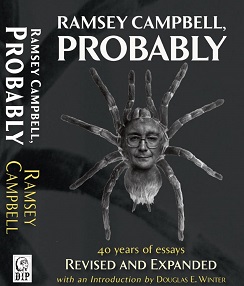
Ramsey Campbell, Probably (1968-2015/Collected in 2015 Revised Edition) by Ramsey Campbell, edited by S.T. Joshi: 40 years of non-fiction pieces by World's Greatest Horror Writer Ramsey Campbell. There are autobiographical pieces which illuminate Campbell's often harrowing early life, essays on various writers, pieces on social issues related to horror, and essays and introductions originally written for Campbell's novels and short-story collections. 

In all, they're dandy. And so many of them in this big book from PS Publishing! Campbell is thoughtful and often self-effacing when he writes about his own work, and those essays that do this offer a wealth of information about how and why certain decisions were made in the writing process, and what Campbell thinks about those decisions in retrospect. 

He's also debilitatingly funny in many of the essays, never moreso than when he deals with The Highgate Vampire hoax. There's also hilarity to be had in portions of his self-appraisal (for some reason, a section on his attempt to include the word 'shit' in a Lovecraftian story submitted to August Derleth's Arkham House nearly had me lying on the floor). 

His essays on writers are occasionally scathing but for the most part positive. A melancholy essay on the late John Brunner stands out as a painful meditation on what happens when a very good writer is forgotten in today's publishing climate. A wide-ranging essay on the novels of James Herbert is a sensitive reappraisal of that (alas, also late) best-selling writer's work as a foundational stratum of working-class, English horror shot through with deeply held social concerns not usually seen in English horror up to that time.  Many of the writers Campbell writes about are also friends, thus shedding a certain personal light on writers ranging from Robert Aickman to the (then) Poppy Z. Brite.

General pieces include the almost-obligatory '10 horror movies for a desert island' essay, several examinations of horror in general and the general public's attitude towards horror, the 'Video Nasties' censorship hysteria in the Great Britain of the 1980's and early 1990's, and examinations of the history of horror. Campbell's lengthy autobiographical essay "How I Got Here" is also invaluable in understanding his life and work. He's almost painfully self-revelatory at points, while remaining refreshingly free of self-pity. 

Oh, and there's an essay on British spanking-based pornography. Really, you can't go wrong with this collection. How often is one going to find revelatory close readings of major H.P. Lovecraft stories and brief 'plot' synopses of faux-English-school-girl spanking pornography in the same book? Highly recommended.