Showing posts with label hard-boiled. Show all posts

Monday, January 7, 2019

The Knife Slipped (Cool & Lam #2) (1939) by Erle Stanley Gardner

The Knife Slipped (Cool & Lam #2) (1939) by Erle Stanley Gardner writing as 'A.A. Fair': The great Hard Case Crime book line published this 'lost' hard-boiled detective novel from the creator of Perry Mason, Erle Stanley Gardner. It was meant to be the second in Gardner's [Bertha] Cool & [Donald] Lam series but was rejected by Gardner's publisher in 1939 for being too racy and for having Bertha Cool be a little too criminal.

Cool, a Rabelaisian giant of a woman, runs a detective agency in Los Angeles. Donald Lam is one of her newish detectives. A woman and her mother hire Cool's agency to discover what that woman's husband is up to at night. The answer is... plenty! And not all Hanky Panky!

Gardner was certainly no Hammett or Chandler. His prose is workmanlike for the most part, while some of the characters and situations are stereotypical. Nonetheless, this is an enjoyable, pulpy time-waster. Bertha Cool is a memorable comic grotesque. And some of the perils and pitfalls of private detecting are highlighted as Lam makes some (near) rookie mistakes.

And the novel is surprisingly racy. And surprisingly cynical about pretty much everything, with most of that cynicism expressed by Bertha Cool, about as knee-jerk a pragmatist as one could ask for. Gardner's PI's aren't all that interested in the larger ramifications of the case, leading to a conclusion that's pretty much a dramatic fizzle. I won't read another of the Cool & Lam mysteries published between 1938 and 1970, but I am glad I read this one. It's a hoot. Lightly recommended.

Wednesday, January 24, 2018

The Little Sister (1949) by Raymond Chandler

The Little Sister (1949) by Raymond Chandler: The Little Sister is the fifth (of nine) novels featuring Raymond Chandler's Los Angeles PI Philip Marlowe. Marlowe gets involved in the madness that is Hollywood this time around, along with gangsters and tabloids and a particularly nasty killer who enjoys sticking an ice-pick into the base of his victims' skulls. As is often the case, Marlowe doesn't seem to end up being paid for his cynical, dogged, heroic efforts on the parts of all the people who need his help. 

A seemingly naive young woman from rural Middle America hires Marlowe to find her brother, who moved to LA to see the lights and hasn't been heard of in months. As with every Marlowe case, this initially simple proposition blossoms into a labyrinth of corruption, blackmail, and murder in which almost no one is what she or he appears to be.

Chandler's style was so influential that it permeated hardboiled detective fiction, as he added a level of pungent description and social criticism to the prior pinnacle of hard-boiled fiction (and still influential and excellent, then-and-now), Dashiell Hammett and his detective Sam Spade. 

Both characters were played by Humphrey Bogart, appropriately and memorably, in movies: Sam Spade in The Maltese Falcon and Philip Marlowe in The Big Sleep. An odd but enjoyable movie version of The Little Sister was made in the 1960's with James 'Jim Rockford' Garner as Marlowe. 

The Little Sister moves fast and tight, plot-packed without neglecting Chandler's strengths, deployed through first-person narrator Marlowe, at character study and subtly metaphoric descriptions of the California setting. Highly recommended.

Wednesday, December 6, 2017

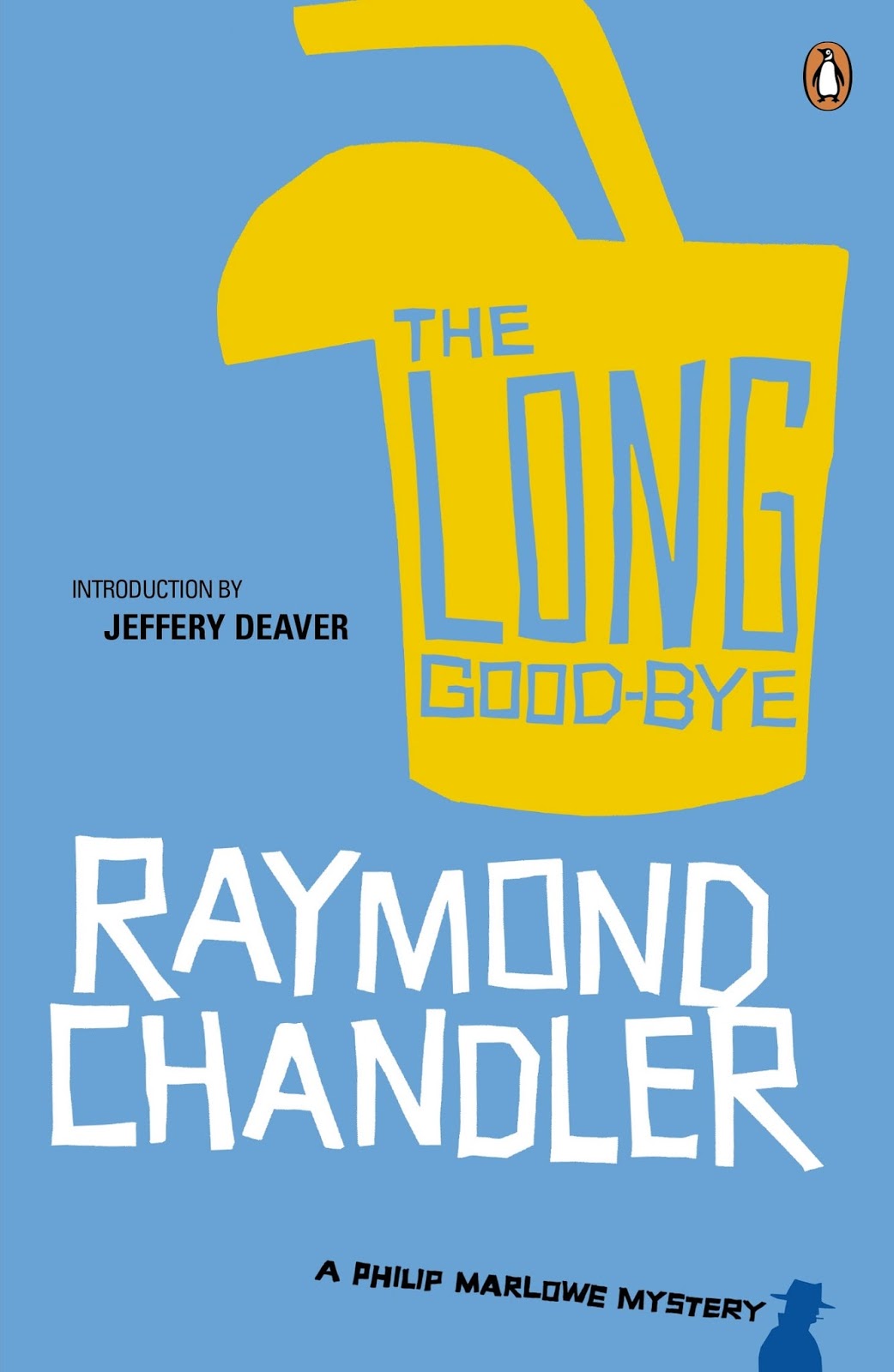
The Long Goodbye by Raymond Chandler

Mmm... big yellow cocktail.
The Long Goodbye [Philip Marlowe #6] (1953) by Raymond Chandler: It's difficult to assess a Raymond Chandler novel when you've read a lot of the novels influenced by Chandler's hard-boiled detective style, much less seen great movie adaptations and great movies influenced by Chandler's transformative work.

The voice of the Chandlerian narrator -- in this case and many others, Los Angeles PI Philip Marlowe -- is that of a cynical, world-weary detective who will nonetheless try to do the right thing. As first-person narration, it's almost infinitely adaptable. 

The narration of the original theatrical release of Blade Runner echoes it. The bleak world of Chinatown subverts it. The triumph of The Big Sleep lies partially in almost perfectly adapting it to the big screen, with help from Chandler himself (and Leigh Brackett, who 30 years later would help write The Empire Strikes Back, the most world-weary Star Wars movie of them all.

Chandler famously railed against the artificiality of most mystery novels in his essay "The Simple Art of Murder." The Long Goodbye seems like the fictional expansion of that essay. Marlowe doesn't so much solve a couple of mysteries as get caught in their undertow before being vomited upon the shore. 

It's a triumph of style and characterization. As a plot, The Long Goodbye makes Murder on the Orient Express look like a true-life case study -- and as the climax recedes once and once again, things get stranger and more complex.

Chandler's depiction of grimy, gaudy Los Angeles rings about as true today as it did then -- or at least as truthy. Philip Marlowe exists not as a possible character, but as the more poetic extrapolation of Dashiell Hammett's earlier Sam Spade. Humphrey Bogart played them both, which somehow makes all the sense in the world. Highly recommended.

Thursday, November 17, 2016

Detectives in La-La Land

The Underground Man (1971/ Lew Archer #16) by Ross Macdonald: The fickle Santa Ana winds bring wildfires to Los Angeles as a preamble to murder and sorrow in this late-career Lew Archer hard-boiled-detective novel from Ross Macdonald. It's one of a handful of Macdonald's best-reviewed novels, and one can still see why: it's about as mournful and minutely observed a psychological study as one could ask for.

Lew Archer was certainly one of the most rueful detectives in American detective fiction, haunted by his own personal failures and by the seemingly endless sea of woe that each and every one of his cases plunged him into. This time around, Archer gets pulled into the disappearance of a neighbour's young son. Murder soon follows, along with the possible revelation of much earlier murder: there's more than a whiff of Greek tragedy in the ways in which the past shapes the present in Macdonald's novels. But there's also a sense of Existential randomness -- the effects often seem to have no moral relation to the causes.

This is a fine novel, detective or otherwise, shot through with cynical wit and sharp observations about character and landscape. While the hills around Los Angeles burn and then suddenly shift to life-threatening mudslides when the rains finally come, Archer searches for the best available solution to the case. Highly recommended.


The Monkey's Raincoat (1987/Elvis Cole #1) by Robert Crais: The first of Robert Crais's nouveau-noir novels about Los Angeles PI Elvis Cole and his laconic partner Joe Pike sets the model for many of Cole's subsequent adventures. Cole narrates in a snarky, cynical, but often heart-felt first-person voice. 

Cole minutely (frankly, too minutely) details everything he does: you'll know what he had for lunch, where he bought the ingredients, and what beer goes best with it. It's Crais's way of showing that as dippy as Cole's comments seem, he's always observing and evaluating everything around him in detail. Or maybe of offering the reader sandwich-making tips,

Hollywood coughs up a missing father-and-son case for Cole. But things quickly go bad. The Monkey's Raincoat shows Los Angeles at its best and worst, and Hollywood at its corruptive nadir. Guns and drugs and femmes fatale show up. There's an incompetent agent to be reckoned with, and an extremely sleazy producer.

There are a few flaws. Crais doesn't quite have Pike's character down yet -- a flaw only apparent in comparison to later novels. Cole's ability to sleep with every woman in a narrative is in place here, though Crais would later remove this element from the series. And the climax is almost hilariously "cinematic" -- which is to say that it's a blood-soaked, bullet-popping Assault on the Impregnable Fortress. Was it written with a movie deal in mind? Hey, Crais lives in Los Angeles too! Recommended.

Friday, September 30, 2016

Weird Science Romance Bukkake

Young Romance 2: The Early Simon & Kirby Romance Comics (1947-49/ Collected 2014): edited and restored by Michel Gagne; written and illustrated by Joe Simon and Jack Kirby: A second beautiful job of restoration here by Michel Gagne and friends, rescuing Joe Simon and Jack Kirby's tremendous, tremendously popular romance comics of the 1940's and early 1950's from obscurity.

It's a whole different side of Simon and Kirby (co-creators of Captain America, among many other things), one filled with domestic melodrama and solid depictions of the mostly normal. Entertaining as all Hell -- one can see how these comics rapidly became best-sellers. If it weren't for the Comics Code Authority's implementation in the 1950's, comics like these would have helped the American comics industry mature faster by about four decades. Highly recommended.


Crooked Little Vein (2007) by Warren Ellis: Or, Michael McGill and Trix Search for the Secret Constitution. Seriously. Burned-out PI McGill gets himself hired by the President's heroin-addicted Chief of Staff to find the missing Secret Constitution. It's not just a document. Read aloud, it causes people to obey it -- but only when heard in person, not reproduced electronically. And the Chief of Staff wants to make America great again by hypnotizing people back into a 1950's mindset.

OK! The Chief selects McGill because McGill is a self-described "shit magnet." Weird things happen to him, constantly, a fact the Chief believes will lead him inevitably to the Secret Constitution. So off McGill goes, soon to be accompanied by avant-garde grad student Trix, whom McGill meets at a Godzilla Bukkake Night he's stumbled into.

Yes, Godzilla Bukkake: people who are sexually aroused by giant, filmed Japanese monsters to the point of simultaneous release. Hoo ha! And that's not the weirdest thing in the novel.

Warren Ellis, crackerjack comic-book writer and futurist, has a lot of fun in this novel with strange incidents and people and a book-length parody of the standard hard-boiled-detective novel. His narrator is hapless and generally more acted-upon than acting, with sidekick Trix getting him going at various points in the text. 

It's all provided within a narrative that satirizes Bush 2-era America and the Republican obsession with "family values." The Secret Constitution could conceivably cause gay people to 'turn straight,' all part of 'making America great again.' There's even a reclusive, insane billionaire who made a failed presidential run -- think Ross Perot by way of an X-rated Monty Python skit.

Sure, the novel's not deep. But it's fun and diverting and pointedly satiric. The events recall Hunter S. Thompson; the prose style recalls the hard-boiled school of Chandler and Hammett. It's 21st-century picaresque. Recommended.

Monday, July 18, 2016

Detectives East, Detectives West

Careless in Red (Inspector Lynley #15) (2008) by Elizabeth George: Well, if nothing else, I'd suggest that the first of Elizabeth George's Inspector Lynley mysteries you ever read shouldn't be this one. It was mine. Nonetheless, there's stuff to admire in this over-sized, over-stuffed mystery set in coastal England among the surfers and locals and tourists. George is a solid and detailed writer of characters, even when those characters slowly move from interesting to boring to intolerable, as they so often do here.

Another reason not to make this one's first Lynley would be the after-effects of a tragedy that afflicted Lynley at the end of the previous novel. It might be better to start with Lynley the upper-class Lord who joined New Scotland Yard and not sad Lynley walking the coast and avoiding everyone he knows.

Jesus, though, this is a long novel (and all of George's mysteries seem to be of similar lengths). Do people really want mysteries that are this long and this melodramatically stuffed with a long list of characters whose lives are explored in exhaustive detail? I guess they do. I think mysteries generally work better at shorter lengths, perhaps 60,000 to 90,000 words for  novel (Careless in Red looks to be about 200,000+ and feels like a million by the end).

Well, and the ending is stunningly unsatisfactory. It partially exists to show that Lynley was right all along and that the investigation of one suspect was pointless, but the attendant lack of closure leaves a sour taste. You will learn a lot about surfing, though, and you will marvel at the ridiculous, comic-relief detective-sidekick Barbara Havers. George is an American who's made a successful writing career out of these giant British mysteries. Anglophilia never gets old. Not recommended as a first Lynley adventure.


Chasing Darkness (Elvis Cole #12) (2008) by Robert Crais: A typically zippy Elvis Cole detective novel set in and around Los Angeles, this time during Fire Season. That cynical knight Cole and his occasional crime-fighting partner Joe Pike seek to unravel the mystery of a dead serial killer who shouldn't be able to have been a serial killer. Cole's relationship with the police is typically rocky, the mystery fair and nicely plotted, and the climax slightly less bloody and body-count-intensive for Crais. 

Ignoring the tricks played with large print and line spacing in this paperback, one notes that Chasing Darkness clocks in at just about the typical length for a 1950's or 60's hard-boiled detective novel -- it's short and to the point. There's a lot of police procedural this time around, as Cole follows the LAPD's investigation with one of his own. Solid entertainment. Recommended.

Saturday, June 25, 2016

End of Watch (2016) by Stephen King

End of Watch (Bill Hodges #3) (2016) by Stephen King: Intrepid but decidedly unhealthy retired police detective Bill Hodges returns in this conclusion to a trilogy that began in Mr. Mercedes and continued in Finders Keepers. Still set in a never-named U.S. Rust Belt city somewhere on one of the Eastern Great Lakes, End of Watch pits Hodges against the seemingly brain-damaged spree killer of Mr. Mercedes.

King manages to pull off something that looked a bit dodgy when it first became manifest in Finders Keepers -- namely, the introduction of the paranormal into the world of Bill Hodges. Brady Hartsfield, the Mercedes Killer of the first Hodges novel, was left with a brain made of mush at the climax of Mr. Mercedes. Hodges' soon-to-be-partner-in-private-detection, Holly Gibney, bonked Hartsfield on the head just before he could blow up an auditorium filled with thousands of boy-band-loving teenagers.

However, experimental drugs and the vagaries of the brain have slowly granted Hartsfield mental powers. He fakes being non compos mentis to avoid prosecution for his crimes while he gains strength and lethality. 

Hartsfield is a return to one of King's favourite types, the Outsider with Wild Talents. Unfortunately, this psychic wants to kill people -- as many of them as possible. King combines a quasi-scientific mind-control premise that stretches back to at least Arthur Conan Doyle's "The Parasite" with an antagonist who's one of Thomas Harris' serial-killing grotesques writ larger and with super-powers. 

Brady Hartsfield doesn't just want to kill people -- he wants to find ways to trick them into killing themselves. And with his powers, he now can. King's heroes have to engage Hartsfield on multiple fronts to stop him, from the Internet to the real world to the nebulous world of the mind. 

Somehow, it all works. Even the bit where a character survives a gunshot because of something in her pocket. Well, OK, that doesn't quite work. 

Otherwise, End of Watch works in part because Bill Hodges and Holly Gibney are carefully drawn characters. Hartsfield is a terrible, pitiful antagonist. There's also an immensely clever plot device involving video games and hypnotism. And there's a snowstormy climax that recalls the closing chapters of The Shining. In terms of tension and pleasure of reading,  Mr. Mercedes remains the best of the Hodges trilogy, but End of Watch runs a close second. Highly recommended.

Sunday, May 22, 2016

His Name Was Archer

The Moving Target (Lew Archer #1)  (1949) by Ross Macdonald (a.k.a. Kenneth Millar): Ross Macdonald's first novel about California P.I. Lew Archer sets the tone for everything that will follow. While bits of information will be doled out about Archer himself in his first-person narration, the focus will remain on the case he's trying to solve. Archer's strengths as a narrator (or Macdonald's as a writer, really) are his careful attention to detail, his understanding of character, and his skill at creating appropriate, revealing metaphors.

Lew Archer really ruled the American hard-boiled roost from the late 1940's until the 1970's, garnering praise from mainstream critics. The praise is deserved. These are fine novels, period, not simply fine detective novels. Macdonald's understanding of characterization and setting are already highly developed in 1949. Only the novel's period-specific references and some of the euphemisms indicate its time period. Otherwise, this could just as easily have been published yesterday.

The plot involves Archer's pursuit of a missing millionaire through various fascinating settings, including the rural compound of a New Agey cult leader. Nothing is as it seems, and no one. Welcome to post-war California. Recommended.


The Doomsters  (Lew Archer #7)  (1959) by Ross Macdonald (a.k.a. Kenneth Millar): More than a decade in and the Lew Archer P.I. series remains fresh, with only the deepening, heart-sick mordancy of its protagonist-narrator Lew Archer to mark the passage of time. Archer's past mistakes surface in this novel, as a now-heroin-addicted man he tried to mentor as a teenager sends a client his way -- straight from an escape from a mental institution. The twists in this case are wild and tangled and horribly human. The tragedy of the narrative is only heightened by the use of a Thomas Hardy phrase for the title -- a phrase repeated from one of Hardy's poems in the narrative. Macdonald portrays mental illness starkly and sympathetically, especially for the late-1950's time of the novel. Highly recommended.


The Goodbye Look (Lew Archer #15)  (1969) by Ross Macdonald (a.k.a. Kenneth Millar): More than 20 years into his career, California P.I. Lew Archer continues to wend his way through the tangled pasts and presents of his clients, often finding things they themselves wished had remained buried. The case here is a complicated one, navigated and explained with Archer/Macdonald's patented observational and metaphorical skills. Archer gets more personally involved than normal in this one, but he still works the case to its necessary conclusion -- one set up with complete fairness but impossible to clearly see until one is almost upon it. Great character writing, great and sad depictions of the damned and the lost and the searching. Highly recommended.

Thursday, April 28, 2016

Southern California Dick

L.A. Requiem (Elvis Cole #8) (1999) by Robert Crais: The Southern California-set Elvis Cole hard-boiled detective series (well, soft-boiled -- Elvis is an emotional softy) always pays off in terms of tightly plotted, minutely detailed detective fiction, almost always with a large side portion of the procedural. There's a lot of procedural in this one, as the police and Cole investigate a murder together thanks to the power and influence of the victim's father. 

As was the case for several Cole novels, the only real drag is Lisa Chenier, Cole's love interest who sucks all the joy and energy out of the novel whenever she appears. It doesn't help that Cole suddenly inspires romantic obsession in a female L.A. cop in this one. Crais is at his best when delineating complicated investigations or dropping the occasional witticism. His romantic writing stinks.

L.A. Requiem stylistically  opened up the Cole series when it came out in 1999, mixing as it does the traditional first-person detective narration with third-person flashbacks involving Cole's hyper-competent detective pal Joe Pike and a number of other characters (including the killer) and third-person narration for events Cole is not present for. 

Overall, the novel's greatest strength lies in its depiction of the course of an investigation. The Los Angeles police are depicted sympathetically, for the most part, with a lot of nuts-and-bolts descriptions of just how a murder case is investigated. Good stuff. Recommended.


The Forgotten Man (Elvis Cole #10) (2005) by Robert Crais: Robert Crais explores L.A. private-eye Elvis Cole's tortured childhood in this novel, in which a man claiming to be Cole's long-vanished father is found murdered in an alley. As always, Crais's depiction of the details of an investigation is top-notch. The flashbacks are also fascinating, as are many of the supporting characters.

Crais also brings in a character from a non-Cole novel, Detective Starkey from Demolition Angel. She's a former bomb-squad officer forced into other police work after getting blown up. She's a fun counterpoint to Cole until she becomes romantically obsessed with him, a sub-plot that Crais used with another female cop in the earlier L.A. Requiem. And it's annoying here too. And while Cole is estranged from gal-pal/wet-blanket Lisa Chenier in this novel, she shows up just enough to put a damper on a number of scenes.

The novel is otherwise solid and twisty and thoroughly enjoyable. The indomitable Joe Pike appears, as does Cole's diffident pet cat. Crais opens up the narrative to third-person material not witnessed by Cole, who otherwise traditionally (for the hard-boiled detective) narrates in first person. The climax is thrilling, though it repeats certain plot elements from the earlier Cole novel L.A. Requiem. And the killer is fascinatingly depicted, though he shares a lot of similarities with the killer in L.A. Requiem. Maybe I shouldn't have read these books back to back. Recommended.