The Two-Minute Rule (2006) by Robert Crais: On the day bank robber Max Holman gets out of jail after a ten-year sentence, his son is murdered. Holman had been estranged from his son for more than a decade. And his son was a police officer. So begins The Two-Minute Rule.
Best known for his Elvis Cole and Joe Pike detective thrillers, writer Robert Crais here builds a compelling and sympathetic character in Holman, dubbed "the Hero Bandit" by the press because he got arrested at his last robbery while performing CPR on one of the bank's customers. As his son's murder looks fishier and fishier, and while the LAPD deems it closed, Holman calls on the help of the former FBI agent who put him away, Katherine Pollard.
Crais makes the nuts-and-bolts of crime, law enforcement, and bank robberies entertaining. More importantly, Holman is his most fully developed character, at least within the pages of one novel rather than a series. Holman is believable even when the plot gets twisty and turny. So too Pollard, retired early to raise a son, left alone when her estranged husband died of a heart attack, and now bored -- and in debt -- in her unwelcome retirement.
Everything builds to the sort of climax that seems ripe for a decent Hollywood director. Crais is an expert choreographer of action sequences, and this is one of his best -- and at points funniest. Recommended.
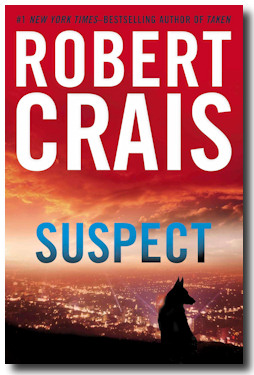
Suspect (2013) by Robert Crais: Crais steps away from his successful series of mystery-thrillers starring Elvis Cole and Joe Pike to focus on a new pair of crime-solvers, LAPD Canine Unit Officer Scott James and his crime-fighting German Shepherd Maggie.
After his partner is killed and he gravely injured, James spends eight months in rehab before rejoining active duty, now with the Canine Unit. Maggie has also been recovering from grave injuries suffered as a Marine dog in Afghanistan during a battle that cost her the life of her previous handler. So of course Scott James picks her, in part because she's about to be turfed out of the Canine Unit training program because of her PTSD. James knows the feeling.
Crais invests a lot of time and effort in trying to capture the mindset of Maggie without slipping into first-person goofiness. He mostly succeeds -- Maggie's sections are described in third-person, but they focus on explaining how a dog thinks and interacts with its environment and with its handler.
James is a little more sketchy. We learn a lot about him on the job, but very little of his background, likes, dislikes, and so on. Maggie is really the star character here, and James could use more fleshing out.
This is a fairly smart, taut thriller that follows James and Maggie as they try to solve the mystery of who killed James' partner, and why. The investigation has stalled. And in good thriller form, James will insert himself into that investigation. As it turns out, Maggie can really help out -- even as James tries various approaches to help Maggie cope with her PTSD and the fear it provokes in the dog, especially whenever there's a loud, unexpected noise.
Maggie's nose knows, eventually -- and the bond that develops between the two. It's a nice change of pace from the Elvis & Joe Pike novels. Recommended.
Stalking the Angel (1989) (Elvis Cole/ Joe Pike #2) by Robert Crais: The theft of a priceless Japanese book from the Los Angeles home of an American businessman sends PI Elvis Cole and kick-ass pal Joe Pike up against dark family secrets and Japanese organized crime. Pike's character begins to come into focus in this, the second Cole/Pike novel, though the blurb on the back still refers to him as a sociopath (he isn't).
The mystery is a bit thin. The climax is an inspired, epic shoot-em-up that seems to have been written with the movie screen in mind. And for foodies and lovers of brand names, Cole's obsessive recounting of the foods he eats and the brands of clothing people wear is at full-throttle. Recommended.
Lullaby Town (1992) (Elvis Cole/ Joe Pike #3) by Robert Crais: Elvis Cole and Joe Pike head to Connecticut in search of the son a famous Hollywood director abandoned years ago before he was famous. Well, his ex-wife took the son with her and disappeared, and the director didn't care then. Now, he wants to reconnect.
The detective work leads Cole to the missing woman quite quickly... and into yet another big mess quickly after that. There's a certain amount of stereotypical fuzzy-mindedness about the Mafia along the way, along with another massive action climax. Crais, who's worked in TV and movies, seems to enjoy skewering Hollywood pretensions and pretenses here without turning the director into a completely unlikable cliche. Recommended.
Free Fall (1993) (Elvis Cole/ Joe Pike #4) by Robert Crais: The estranged fiancee of an LA cop comes to PI Elvis Cole in search of answers as to why her high-school sweetheart has become furtive and distant. And of course it's not simply another woman. Soon, Cole and best friend Joe Pike are fighting both the police and LA gangs as they search for answers. Things lead to a tightly choreographed, bloody climax. Recommended.
Voodoo River (1995) (Elvis Cole/ Joe Pike #5) by Robert Crais: A Hollywood celebrity hires Elvis Cole to track down her birth mother back in Louisiana. Nothing is ever simple in an Elvis Cole adventure.
Along the way to an explanation, Cole runs up against small-town crooks, the world's worst PI, a 200-pound napping turtle, a Lurch-like enforcer, and a whole lot of Louisiana cooking. This novel also introduces the series' one major drag, love-interest Lucy Chenier, who will spend the next few Cole novels boring the bejesus out of the reader even as she entrances Cole. Recommended.
Indigo Slam (1997) (Elvis Cole/ Joe Pike #7) by Robert Crais: Three kids aged 8 to 16 hire Elvis Cole to find their father, who's gone missing from their LA home. As Cole feels sorry for them, he takes on the case rather than calling Child Protective Services. But what seems simple isn't, leading Cole and hyper-competent partner Joe Pike into a Battle Royale between Viet Namese and Russian organized criminals. Recommended.
Sunset Express (1996) by Robert Crais: LA PI Elvis Cole and Zen super-soldier Joe Pike take on a case with more than a whiff of O.J. Simpson in this mystery-thriller. A prominent LA businessman and philanthropist sits in jail, accused of the murder of his wife. The high-priced legal team defending him hires Elvis to track down any leads that might exonerate the businessman. And that's really just the beginning.
Detective work takes the wheel for much of this installment of the Cole/Pike chronicles, though the ending moves effortlessly into thriller territory. An enjoyable, fast-paced read with a cynical take on justice for the rich, marred only slightly by the inclusion of Elvis' girlfriend Lucy Chenier, Louisiana lawyer and most boring recurring character in the whole series. Crais is great at a lot of things, but scenes of love and romance really aren't in his wheelhouse. Recommended.
Demolition Angel (2000) by Robert Crais: Carol Starkey died for several minutes three years before the start of this novel, caught in the explosion of a bomb triggered by an earthquake while she and her superior officer on the Los Angeles bomb squad were trying to defuse it. The medics brought her back; her superior, also her lover, died at the scene. She's off the bomb squad now, a detective with more than a small drinking problem and a chain-smoking habit that apparently allows her to survive never eating.
But now a mysterious bomber-for-hire dubbed 'Mr. Red' has come to LA. And he's not working for hire -- instead, he seems to be targeting bomb squad personnel. As the lead detective on the murder-by-bomb of a former colleague, Starkey soon finds herself the object of Mr. Red's attention.
There's a whiff of the Clarice Starling/Hannibal Lecter relationship in this, but only a whiff. Mr. Red isn't a literature-loving genius -- he's an obsessive bomber with hacking skills thrown into the mix. Crais makes the world of bombs and bombers into a fascinating study of technique and art. Starkey is a compelling character, as are Mr. Red and the ATF agent who arrives to consult on the case early in the narrative. Recommended.
Hostage (2001) by Robert Crais: Jeff Talley is a former Los Angeles hostage negotiator and SWAT member who's moved to a small town near LA to escape the mental anguish of a failed hostage negotiation. Three years have passed, and the small-town quiet has done little to allow him to patch things up with his wife and daughter, much less move beyond the trauma. However, an extremely screwed-up hostage situation in his small bedroom community is about to force him out of his shell.
This Robert Crais novel was made into an OK Bruce Willis movie. I think. In any case, it's an extremely good thriller. Crais is a whiz at piquant, short-form characterization for both minor and major characters alike. Talley is a nicely drawn portrait of despair, PTSD, and dogged commitment to protecting others regardless of the cost to himself. The lead hostage-taker is a squirmy, obsessive kid whose characterization wouldn't be out of place in a Jim Thompson novel. Plot twists blow up every fifty pages or so as the narrative rockets along to its conclusion. Recommended.

The First Rule (2010) by Robert Crais: Joe Pike's career as a military contractor comes back into play when one of his former team members is brutally murdered along with his wife, children, and nanny in what looks like a home invasion by the same murderous thieves who've been terrorizing the LA suburbs for months. It is and it isn't. So Pike supplies the hyper-competent muscle and his partner Elvis Cole supplies the detectiving acumen as the two search for answers and vengeance.
20 years into the Cole and Pike novels, Crais and his characters show no signs of series exhaustion: this is one of the two or three best of those novels, with surprises, detection, and action set-pieces splendidly balanced. Joe Pike even has some refreshing moments of introspection, the big laconic lug. Highly recommended.
The Promise (2015) by Robert Crais: Elvis Cole and Joe Pike are back to detect and kick ass in Los Angeles. They're joined by Scott James and Maggie, the K-9 handler and dog who were the protagonists of Crais' Suspect. There's a lot of highly involving, extremely interesting stuff about how K-9 handlers and their dogs do their work. Like pretty much everyone in the Crais universe, James and Maggie are suffering from the after-effects of violence-related PTSD. But Maggie is a good dog. A very good dog. And a former Marine! Solid, diverting work. Recommended.
The Last Detective (Elvis Cole and Joe Pike #9) (2003) by Robert Crais: LA private detective Elvis Cole and occasional partner Joe Pike deal with a problem close to home this time after the son of Cole's girlfriend is abducted from outside Cole's house by someone who claims to have a grudge against Cole for something that happened during Cole's Tour of Duty in Viet Nam.
The mystery plays pretty much fair this time out, though the reader will probably know what's really happened before Cole and Pike. As with many Cole/Pike adventures, this one ends with a violent, cinematic, and thrillingly choreographed action sequence. It's Hardboiled Action in the Mighty Crais Manner! It's all fun and diverting, if a bit shallow. Recommended.
Taken (Elvis Cole and Joe Pike #15) (2012) by Robert Crais: LA private detective Elvis Cole and occasional partner Joe Pike again deal with a problem close to home as a kidnapping case suddenly results in Cole himself being kidnapped. Mighty, laconic Joe Pike springs into action with the help of nearly-as-mighty good-mercenary Jon Stone as the clock ticks on the lifespans of Cole and the young couple he was searching for.
The set-up for Taken is really interesting. The logistics and practice of illegal immigrant trafficking on the U.S.-Mexico border come in for scrutiny. Real-life horrors are exposed, along with real-life hypocrisies. Pike and Stone make the world's most competent rescue team.
Taken is also Robert Crais' most complex novel from a structural standpoint. Several narratives running at different times and with different POV's converge at the climax, seamlessly. It's really a triumph of plot. Recommended.
The Underground Man (1971/ Lew Archer #16) by Ross Macdonald: The fickle Santa Ana winds bring wildfires to Los Angeles as a preamble to murder and sorrow in this late-career Lew Archer hard-boiled-detective novel from Ross Macdonald. It's one of a handful of Macdonald's best-reviewed novels, and one can still see why: it's about as mournful and minutely observed a psychological study as one could ask for.
Lew Archer was certainly one of the most rueful detectives in American detective fiction, haunted by his own personal failures and by the seemingly endless sea of woe that each and every one of his cases plunged him into. This time around, Archer gets pulled into the disappearance of a neighbour's young son. Murder soon follows, along with the possible revelation of much earlier murder: there's more than a whiff of Greek tragedy in the ways in which the past shapes the present in Macdonald's novels. But there's also a sense of Existential randomness -- the effects often seem to have no moral relation to the causes.
This is a fine novel, detective or otherwise, shot through with cynical wit and sharp observations about character and landscape. While the hills around Los Angeles burn and then suddenly shift to life-threatening mudslides when the rains finally come, Archer searches for the best available solution to the case. Highly recommended.
The Monkey's Raincoat (1987/Elvis Cole #1) by Robert Crais: The first of Robert Crais's nouveau-noir novels about Los Angeles PI Elvis Cole and his laconic partner Joe Pike sets the model for many of Cole's subsequent adventures. Cole narrates in a snarky, cynical, but often heart-felt first-person voice.
Cole minutely (frankly, too minutely) details everything he does: you'll know what he had for lunch, where he bought the ingredients, and what beer goes best with it. It's Crais's way of showing that as dippy as Cole's comments seem, he's always observing and evaluating everything around him in detail. Or maybe of offering the reader sandwich-making tips,
Hollywood coughs up a missing father-and-son case for Cole. But things quickly go bad. The Monkey's Raincoat shows Los Angeles at its best and worst, and Hollywood at its corruptive nadir. Guns and drugs and femmes fatale show up. There's an incompetent agent to be reckoned with, and an extremely sleazy producer.
There are a few flaws. Crais doesn't quite have Pike's character down yet -- a flaw only apparent in comparison to later novels. Cole's ability to sleep with every woman in a narrative is in place here, though Crais would later remove this element from the series. And the climax is almost hilariously "cinematic" -- which is to say that it's a blood-soaked, bullet-popping Assault on the Impregnable Fortress. Was it written with a movie deal in mind? Hey, Crais lives in Los Angeles too! Recommended.
Careless in Red (Inspector Lynley #15) (2008) by Elizabeth George: Well, if nothing else, I'd suggest that the first of Elizabeth George's Inspector Lynley mysteries you ever read shouldn't be this one. It was mine. Nonetheless, there's stuff to admire in this over-sized, over-stuffed mystery set in coastal England among the surfers and locals and tourists. George is a solid and detailed writer of characters, even when those characters slowly move from interesting to boring to intolerable, as they so often do here.
Another reason not to make this one's first Lynley would be the after-effects of a tragedy that afflicted Lynley at the end of the previous novel. It might be better to start with Lynley the upper-class Lord who joined New Scotland Yard and not sad Lynley walking the coast and avoiding everyone he knows.
Jesus, though, this is a long novel (and all of George's mysteries seem to be of similar lengths). Do people really want mysteries that are this long and this melodramatically stuffed with a long list of characters whose lives are explored in exhaustive detail? I guess they do. I think mysteries generally work better at shorter lengths, perhaps 60,000 to 90,000 words for novel (Careless in Red looks to be about 200,000+ and feels like a million by the end).
Well, and the ending is stunningly unsatisfactory. It partially exists to show that Lynley was right all along and that the investigation of one suspect was pointless, but the attendant lack of closure leaves a sour taste. You will learn a lot about surfing, though, and you will marvel at the ridiculous, comic-relief detective-sidekick Barbara Havers. George is an American who's made a successful writing career out of these giant British mysteries. Anglophilia never gets old. Not recommended as a first Lynley adventure.

Chasing Darkness (Elvis Cole #12) (2008) by Robert Crais: A typically zippy Elvis Cole detective novel set in and around Los Angeles, this time during Fire Season. That cynical knight Cole and his occasional crime-fighting partner Joe Pike seek to unravel the mystery of a dead serial killer who shouldn't be able to have been a serial killer. Cole's relationship with the police is typically rocky, the mystery fair and nicely plotted, and the climax slightly less bloody and body-count-intensive for Crais.
Ignoring the tricks played with large print and line spacing in this paperback, one notes that Chasing Darkness clocks in at just about the typical length for a 1950's or 60's hard-boiled detective novel -- it's short and to the point. There's a lot of police procedural this time around, as Cole follows the LAPD's investigation with one of his own. Solid entertainment. Recommended.
The Drowning Pool (Lew Archer #2) (1950) by Ross Macdonald (pen-name of Kenneth Millar): The second Lew Archer detective novel presents a twisty, psychologically weighted mystery for PI Archer to solve -- and that's before the bodies start piling up. Hired to discover who's blackmailing a Southern California heiress, Archer soon finds that the blackmail is just the beginning. Of vengeance? Of business shenanigans? Of old family grievances? Well, that's what Archer has to discover before everyone ends up dead.
Ross Macdonald's writing is crisp and nuanced, mixing often elegant metaphors with clear and straightforward attention to making the mechanics of a complicated plot seem inevitable. Archer is already a rueful, committed PI at this point, and his first-person narration can alternatedly sing and sear with insight and pithy observations. Adapted in the 1960's into a movie starring Paul Newman. Recommended.
 |
| I love this cover |
The Far Side of the Dollar ((Lew Archer #12) (1964) by Ross Macdonald (pen-name of Kenneth Millar): About as dark as the always dark Lew Archer hardboiled-detective novels get, all of it under those sunny Southern California skies. A rebellious teen-aged boy (hey, it's the 1960's) escapes from the psychiatric facility/ reform school his parents have just committed him to. Archer is called in, and soon descends into the underbelly of the family's upper-class American dream. Memorable characters and a fascinatingly twisted path of murders make this Archer novel especially good. Highly recommended.

The Sentry: A Joe Pike Novel (2012) by Robert Crais: Crais takes Joe Pike, sometime-second-banana to his other Southern California PI hero Elvis Cole, out for a mostly-solo spin. A random stop by Pike to check his Jeep's tire pressure leads him, chaos-theory style, into a rapidly escalating series of events centered around an imperiled LA sandwich-shop owner and his niece. Elvis Cole shows up to help Pike solve the mysteries that seem to keep erupting as the novel hurtles along, but much of The Sentry devotes itself to a third-person examination of Pike's thoughts and actions.
As Pike is pretty much a hyper-competent pulp hero, one's interest in the novel depends on how much one likes hyper-competent pulp heroes. I do, but Pike's abilities tend to pull the Cole novels out of the realms of believability when he's just a supporting character. As the lead, he might as well be Doc Savage's occasionally melancholy grandson. The plot hums and whirs like a beautifully constructed machine, and the plot twists are about as twisty as they can get without becoming self-parodic. As seems to be a trope in later novels involving Elvis Cole, at least one female police detective dies. Hmm. An enjoyable entertainment. Recommended.
L.A. Requiem (Elvis Cole #8) (1999) by Robert Crais: The Southern California-set Elvis Cole hard-boiled detective series (well, soft-boiled -- Elvis is an emotional softy) always pays off in terms of tightly plotted, minutely detailed detective fiction, almost always with a large side portion of the procedural. There's a lot of procedural in this one, as the police and Cole investigate a murder together thanks to the power and influence of the victim's father.
As was the case for several Cole novels, the only real drag is Lisa Chenier, Cole's love interest who sucks all the joy and energy out of the novel whenever she appears. It doesn't help that Cole suddenly inspires romantic obsession in a female L.A. cop in this one. Crais is at his best when delineating complicated investigations or dropping the occasional witticism. His romantic writing stinks.
L.A. Requiem stylistically opened up the Cole series when it came out in 1999, mixing as it does the traditional first-person detective narration with third-person flashbacks involving Cole's hyper-competent detective pal Joe Pike and a number of other characters (including the killer) and third-person narration for events Cole is not present for.
Overall, the novel's greatest strength lies in its depiction of the course of an investigation. The Los Angeles police are depicted sympathetically, for the most part, with a lot of nuts-and-bolts descriptions of just how a murder case is investigated. Good stuff. Recommended.
The Forgotten Man (Elvis Cole #10) (2005) by Robert Crais: Robert Crais explores L.A. private-eye Elvis Cole's tortured childhood in this novel, in which a man claiming to be Cole's long-vanished father is found murdered in an alley. As always, Crais's depiction of the details of an investigation is top-notch. The flashbacks are also fascinating, as are many of the supporting characters.
Crais also brings in a character from a non-Cole novel, Detective Starkey from Demolition Angel. She's a former bomb-squad officer forced into other police work after getting blown up. She's a fun counterpoint to Cole until she becomes romantically obsessed with him, a sub-plot that Crais used with another female cop in the earlier L.A. Requiem. And it's annoying here too. And while Cole is estranged from gal-pal/wet-blanket Lisa Chenier in this novel, she shows up just enough to put a damper on a number of scenes.
The novel is otherwise solid and twisty and thoroughly enjoyable. The indomitable Joe Pike appears, as does Cole's diffident pet cat. Crais opens up the narrative to third-person material not witnessed by Cole, who otherwise traditionally (for the hard-boiled detective) narrates in first person. The climax is thrilling, though it repeats certain plot elements from the earlier Cole novel L.A. Requiem. And the killer is fascinatingly depicted, though he shares a lot of similarities with the killer in L.A. Requiem. Maybe I shouldn't have read these books back to back. Recommended.