Showing posts with label alfred hitchcock. Show all posts

Tuesday, July 30, 2019

Searching (2018)

Searching (2018): written and directed by Aneesh Changanty with Sev Ohanian; starring John Cho (David Kim), Michelle La (Margot Kim), and Debra Messing (Detective Vick): Tight, innovative thriller plays out entirely on the computer screen through various applications and feeds. It works on a TV screen without causing eyestrain because the camera does zoom in on relevant material, unlike the Unfriended movies, which are best watched on a computer screen from 18 inches away.

John Cho plays a widower who discovers one day that he doesn't know what his teen-aged daughter has been doing in the months since her mother died. Cho's quest to find his daughter will play out on Facebook and in chat rooms, vlog posts and email and texts. Debra Messing plays the police detective assigned to the case, already more than 24 hours old by the time Cho realizes his daughter is missing.

Searching works in part because it remains intimately focused on Cho's grief and anger. It's also extremely clever in displaying all the ways we are watched in our day-to-day life, voluntarily and involuntarily. The film-makers also do a nice job of creating a twisty plot that plays fair with the audience with its investigative plot. All the evidence of what happened is there -- you just have to watch carefully. All this and several distinctively Hitchcockian tropes deployed in a thoroughly modern manner. Recommended.

Saturday, August 19, 2017

Hitchcock, Affleck, and Ford

Lifeboat (1944): written by John Steinbeck and Jo Swerling; directed by Alfred Hitchcock; starring Tallulah Bankhead (Connie), William Bendix (Gus), Walter Slezak (Willi), Mary Anderson (Alice), John Hodiak (John), Henry Hull (Rittenhouse), Heather Angel (Mrs. Higley), Hume Cronyn (Stanley), and Canada Lee (Joe): Hitchcock's 'Bottle Show' movie remains a surprisingly prickly delight to this day, with terrific performances and tense direction. The survivors of a U-Boat attack on a freighter are stuck in a life boat with a survivor from the U-Boat, also sunk during the exchange. The set-up is a lot like the earlier Stagecoach, if you couldn't get off the titular stagecoach without drowning.

Various class issues play out, as do issues of bigotry and vengeance. People die. The dialogue crackles, especially when spoken by Tallulah Bankhead in one of her rare film appearances. She's a quick-talking female reporter who could be played by Rosalind Russell a la His Girl Friday. Lifeboat defies current Hollywood stereotypes and plot points by not killing the black guy first: nope, Lifeboat kills a baby first. A baby! And the black guy turns out to have the warm family life that all the white characters lack! Good old Hitch. If only we had more like him now. Highly recommended.


Presumed Innocent (1990): adapted by Alan Pakula and Frank Pierson from the novel by Scott Turow; starring Harrison Ford (Rusty Sabich), Brian Dennehy (Horgan), Raul Julia (Sandy), Bonnie Bedelia (Barbara Sabich), Paul Winfield (Judge Larren Lyttle), Greta Scacchi (Carolyn Polhemus), John Spencer (Det. Lipranzer), and Bradley Whitford (Kemp): Veteran screenwriter Alan Pakula's turn as a director wowed people in 1990 with this courtroom thriller. The heavyweight list of actors helps a lot, with stand-out turns from Raul Julia, Paul Winfield, and Brian Dennehy. Harrison Ford is fine, though his haircut is weirdly ridiculous.

Presumed Innocent succeeds or fails on the basis of how well it plays 'Whodunnit?' with the audience. Accused of murdering a colleague he'd had an affair with (Greta Scacchi), Harrison Ford's Chicago-based Assistant District Attorney has to survive a wealth of circumstantial evidence. Or did he do it? Scacchi's ADA Carolyn Polhemus is about as distilled a version of a femme fatale/career-bitch as one ever gets, while Bonnie Bedelia gets stuck with the role of the weepy, wronged wife of Ford's ADA.

The movie holds up pretty well, though it would hold up better if the film-makers had kept the novel's coda, which contextualizes the ending in a way that makes logical sense and adds depth to certain performances. Of course, the movie leaves everything in that leads to this coda, so you can just pretend the coda is there once you discover what it is. Recommended


The Accountant (2016): written by Bill Dubuque; directed by Gavin O'Connor; starring Ben Affleck (Christian Wolff), Anna Kendrick (Dana Cummings), J.K. Simmons (Ray King), Jon Bernthal (Brax), Cynthia Addai-Robinson (Agent Medina), and John Lithgow (Blackburn): Ben Affleck plays an autistic accountant who's also a super-assassin philanthropist. Basically, he's BatRainman. The Accountant is a competent, entertaining thriller. Don't ask more of it. Lightly recommended.

Friday, June 9, 2017

Retreads

Guardians of the Galaxy Volume 2 (2017): based on characters created and/or developed by Jack Kirby, Stan Lee, Steve Gerber, Bill Mantlo, Jim Starlin, and many others; written by James Gunn; directed by James Gunn; starring Chris Pratt (Peter Quill/Star-Lord), Zoe Saldana (Gamora), Dave Bautista (Drax), Vin Diesel (Voice of Groot), Bradley Cooper (Voice of Rocket Raccoon), Michael Rooker (Yondu), Karen Gillan (Nebula), Pom Klementieff (Mantis), and Kurt Russell (Ego the Living Planet): Family, family, family, family, family is great. Mawkish bathos and bathetic mawkishness provide about 20 minutes of dreadful slop that stalls this sequel dead at certain points, all of written, I assume, by the Universal Plot Overlay Generator. 

There's still some cosmic fun to be had, but this is really the sort of comic-book movie that needs to be lean and trim. An initially clever opening credits action sequence rapidly devolves into an ad for Baby Groot merchandise. I was entertained for the most part, but I'm not sure how much more of this Marvel shit I can handle. The actors do a thoroughly solid job of standing in front of green screens and looking surprised. Kurt Russell looks good, but he's totally miscast as Ego, a character who really needs the plummy pomposity of an older English actor. Lightly recommended.


The Man Who Knew Too Much (1956): adapted by John Michael Hayes from a story by Charles Bennett and D.B. Wyndham-Lewis; directed by Alfred Hitchcock; starring Jimmy Stewart (Dr. Benjamin McKenna) and Doris Day (Josephine Conway McKenna): Relatively late-Hollywood-spectacle Hitchcock has sprung rhythms that derail its thriller momentum throughout. I'm not entirely sure this is unintentional -- the movie does seem more like a critique of Ugly Americans Abroad than anything else, with Jimmy Stewart as the ugliest and stupidest of all. 

A much-longer remake of a 1930's Hitchcock film that was superior (especially insofar as the 1930's The Man Who Knew Too Much had Peter Lorre as the Anarchist villain). Doris Day sings "Que Sera Sera" and it's actually relevant to the plot. The Albert Hall assassination sequence is a marvel. Jimmy Stewart is about ten years too old for his character, a fact that Hitchcock would put to much more effective use in the subsequent Vertigo. A sequence set in a Marrakesh restaurant is extremely funny. Too long by 20 minutes, but boy, when it ends, it just ends. Lightly recommended.


I Love a Mystery! (1945): adapted by Charles O'Neal from the radio program created by Carlton E. Morse; directed by Henry Levin; starring Jim Bannon (Jack), Barton Yarborough (Doc), Nina Foch (Ellen Monk), and George Macready (Jefferson Monk): B-movie ports popular 40's radio show to the big screen, with loopy results. There's Orientalism, decapitation, prophecy, and comic-relief Southernisms from 'Doc,' sidekick to private detective Jack. Apartment mate too -- they sleep in separate beds in the same room. 

This film contains some of the funniest 'slow pursuit' material played straight in movie history, as a one-legged man repeatedly catches up to his two-footed prey despite clealry walking much, much slower than they. Extremely odd and, as with B-movies of the time, incredibly short. Lightly recommended.

Florence Foster Jenkins (2016)

Florence Foster Jenkins (2016): based on a true story; written by Nicholas Martin; directed by Stephen Frears; starring Meryl Streep (Florence Foster Jenkins), Hugh Grant (St Clair Bayfield), Simon Helberg (Cosme McMoon), and Rebecca Ferguson (Kathleen): Delightful comic drama about the world's worst singer, New York socialite and philanthropist Florence Foster Jenkins. She thinks she can sing. Husband Hugh Grant humours her because he loves her. Actually, pretty much everyone humours her because she's a nice person who throws a lot of money around. 

This movie isn't quite the laugh riot it was advertised as -- it's also a bittersweet movie about folly and sacrifice. The cast is terrific throughout, Stephen Frears directs with unforced elegance, and the singing... boy oh boy that singing. Meryl Streep nails Jenkins' dementedly above-range 'coloratura,' as recordings of the actual singer played under the end credits demonstrate. Recommended.


Saturday, September 10, 2016

Suspense and/or the Lack Thereof

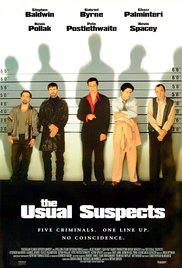
The Usual Suspects (1995): written by Christopher McQuarrie; directed by Bryan Singer; starring Stephen Baldwin (McManus), Gabriel Byrne (Keaton), Benicio Del Toro (Fenster), Kevin Pollak (Hockney), Kevin Spacey (Verbal), Chazz Palmintieri (Dave Kujan), Pete Postlethwaite (Kobayashi), and Giancarlo Esposito (Jack Baer): Still the best thing writer Christopher McQuarrie and director Bryan Singer have ever done, 21 years later. 

And that's OK because among the peaks and troughs of the Tarantino Wave of the early-to-mid-1990's, The Usual Suspects is a very high peak indeed. A delightful, violent romp that also serves as a meditation on the telling and receiving of stories, The Usual Suspects never lags and gets the best out of both able actors (Gabriel Byrne, Kevin Spacey) and otherwise undistinguished actors whose best work appears here (Stephen Baldwin, Kevin Pollak). Benicio del Toro is nearly unrecognizable physically and, thanks to some extremely odd speech patterns, aurally. Highly recommended.


Don't Breathe (2016): written by Fede Alvarez and Rodo Sayagues; directed by Fede Alvarez; starring Stephen Lang (The Blind Man), Jane Levy (Rocky), Dylan Minnette (Alex), and Daniel Zovatto (Money): Admirably tense, terse thriller set in the post-apocalyptic wasteland of present-day Detroit. The creative minds behind the solid remake of Evil Dead go with a bit less gore and grue here, though more than one scene is Not For The Squeamish

The young actors are good as three sympathetic burglars who pick the wrong house, while Stephen Lang (Avatar's nutty Colonel) is extraordinarily menacing as the blind, buff homeowner whose house our unfortunate trio break into in search of a hidden cache of Get Out of Detroit cash. The movie may invert the central premise of classic 1960's thriller Wait Until Dark, but it's also a horrifying reimagining of The Treasure of the Sierra Madre. Brutal but never exploitative. Highly recommended.


Black Sabbath (I tre volti della paura) (1963): adapted from works by Ivan Chekhov, F.G. Snyder, and Aleksei Tolstoy by Mario Bava, Alberto Bevilacqua, and Marcello Fondato; starring Boris Karloff (Gorca/Narrator) and others: Something of a stinker of an Italian anthology horror film from the early 1960's, redubbed for English-speaking audiences. Boris Karloff is fine as both frame narrator and Vourdalak in the third segment. 

The first segment actually goes pretty well until the film-makers unwisely over-use their initially effective Dead Witch Dummy (TM). The second sequence sucks. The third sequence, in which a vampire-like Vourdalak terrorizes a travelling nobleman and a family of peasants, is utterly ridiculous in its plot. It's like a training film on what not to do when menaced by the Undead. Or a cautionary tale about the plague of narcolepsy that ravaged Eastern Europe in the early 19th century. Not recommended.


Spectre (2015): written by John Logan, Neal Purvis, Robert Wade, and Jez Butterworth; directed by Sam Mendes; starring Daniel Craig (James Bond), Christoph Waltz (Blofeld), Lea Seydoux (Madeleine), Ralph Fiennes (M), Ben Whishaw (Q), Naomie Harris (Moneypenny), and Andrew Scott (C): Spectre is a lot like the Roger Moore Bond movies, except for the fact that it's grim rather than light-hearted. And perhaps even more improbable than even the last couple of lousy Moore Bonds. Daniel Craig looks ready to quit the role, and the film-makers don't seem to have written a movie so much as hastily assembled a series of flawed action sequences. 

This lumpy, careless James Bond moves through a world which is either intensely over-crowded or populated by no one but himself, his unlikely love interest, and whoever's trying to kill him. Christoph Waltz does his best to menace in a non-menacing role as an unconvincingly retconned Blofeld, while Andrew Scott, so great as Moriarty to Benedict Cumberbatch's Sherlock Holmes, is mostly wasted as a nefarious British bureaucrat/technocrat. If I never see another climax to an action movie that involves doing something with a computer, it will probably be too soon. Though I did like an earlier action sequence that terminates with the fiery revelation that the bad guys have built their secret HQ out of gas pipelines and exploding wood. Not recommended.


Hitchcock/ Truffaut (2015): written by Kent Jones and Serge Toubiana; directed by Kent Jones; narrated by Bob Balaban: It's too short and it doesn't name the directors who discuss Hitchcock throughout the documentary until the end credits. But it's still great to revisit the monumental Hitchcock/Truffaut book, initially compiled and published in 1966 from a series of interviews Francois Truffaut conducted via translator with Alfred Hitchcock in 1962. Young (Wes Anderson) and old (Martin Scorsese) alike hold both the book and Hitch himself in monumental regard. 

The movie introduces the viewer to several key moments in the text, with special attention paid to Notorious, The Birds, Psycho, and Vertigo. It might help to read the book either immediately before or after seeing the documentary. It's impossible to imagine any contemporary, commercial film-maker being as visually and thematically complex as Hitchcock turned out to be over his 50-year film-making career. He's the Great White Whale of movies, the immensely popular and complex artist. Highly recommended.

Thursday, October 8, 2015

Hitchcock, Ballard, ... Gad?

Dial 'M' for Murder: adapted by Frederick Knott from his own stage play; directed by Alfred Hitchcock; starring Ray Milland (Tony Wendice); Grace Kelly (Margot Wendice), Robert Cummings (Mark Halliday), John Williams (Chief Inspector Hubbard), and Anthony Dawson (Swann) (1954): Mostly minor Hitchcock has the cast but lacks a top-rate script: if you didn't know it was based on a play, you'd figure it out by the second act. Ray Milland's cunning plan to kill wife Grace Kelly by proxy turns out to have too many moving parts -- or perhaps too few. It's a nice time waster, and all of the leads are fine, including John Williams as an increasingly Columbo-esque English policeman. Originally shown in 3-D, only the repeated establishment of an extreme foreground in most shots overtly acknowledges the process. Lightly recommended.


The Wedding Ringer: written by Jeremy Garelick and Jay Lavender; directed by Jeremy Garelick; starring Kevin Hart (Jimmy Callahan), Josh Gad (Doug Harris), Kaley Cuoco (Gretchen Palmer), and Jorge Garcia (Lurch) (2015): Sloppy but engaging buddy comedy manages to graft the narrative apparatus of a Heist movie onto a wedding scenario. Josh Gad plays a lovable, insanely wealthy tax attorney who has no friends -- not even one to be the Best Man at his wedding. Enter Kevin Hart as a man who sells his services as a Best Man to the friendless. And the services of whatever people he can round up to fill the roles of Gad's imaginary groomsmen, Gad having invented and named those groomsmen and the imaginary Best Man to his fiancee and the wedding planner prior to engaging Hart's services. There are rough spots and sections that fall flat, but overall this is a decent, lightweight comedy buoyed by the charms of both Hart and Gad. Recommended.


The Terminal Beach (1964) by J.G. Ballard, containing the following stories: A Question of Re-Entry  (1963); The Drowned Giant  (1964); End-Game  (1963); The Illuminated Man  (1964); The Reptile Enclosure  (1963); The Delta at Sunset  (1964); The Terminal Beach  (1964); Deep End  (1961); The Volcano Dances  (1964); Billennium  (1961); The Gioconda of the Twilight Noon  (1964); and The Lost Leonardo  (1964).

Icy, engaging collection of early 1960's short stories from J.G. Ballard. Many of the stories are at least nominally science fiction. All of them are Weird, though in several cases this Weirdness is entirely a question of tone: nothing overtly fantastic or science-fictional occurs in five of the twelve stories. Nonetheless, even those stories disturb one enough that they straddle the line between the strange and the horrific.

Ballard was only a couple of years away from his avant-garde, experimental period. None of the stories included here are challenging in a structural sense. Several challenge the reader's perceptions of genre, however, along with one's ability to navigate subjective narration and altered states of consciousness. Ballard's concern with the fragility of the human psyche manifests itself again and again in various ways. So, too, the apocalypse, always observed in a cool and somewhat detached manner by either his narrators or the third-person narrative voice. 

But as dry and cool a voice as Ballard can be, behind all those narrative masks exists the mind of an aesthete. The end of the world (if that's what it is) is a hauntingly beautiful place in "The Illuminated Man." Thoughts on art, and the art of Leonardo da Vinci, dominate the quietly horrifying "The Gioconda of the Twilight Noon" and the jolly fantasy "The Lost Leonardo."   And a description of the decay of the body of a mysterious giant takes up the bulk of "The Drowned Giant," a description that haunts and troubles even as the story questions the very nature of the fantastic and people's reactions to unusual events. 

One could call "The Drowned Giant" a horror story about familiarization and the ever-encroaching Un-fantastic. So too "The Gioconda of the Twilight Noon" and "The Delta at Sunset" with their mentally disturbed narrators seeking an escape into a fantastically distorted hallucination that surpasses the 'real' world in scope and beauty, the same 'real' world that reduces the drowned giant to a debased and dismantled normativity. In all, a fine collection. Highly recommended.

Tuesday, July 7, 2015

Montage!

Hitchcock: adapted by John J. McLaughlin from the book by Stephen Rebello; directed by Sacha Gervasi; starring Anthony Hopkins (Alfred Hitchcock), Helen Mirren (Alma Reville Hitchcock), Scarlett Johansson (Janet Leigh), Danny Huston (Whitfield Cook), Toni Collette (Peggy Robertson), Michael Stuhlbarg (Lew Wasserman), James D'Arcy (Anthony Perkins), Jessica Biel (Vera Miles), and Michael Wincott (Ed Gein) (2012): While it plays somewhat fast and loose with the facts, Hitchcock is an enjoyable look at the making of Psycho. The movie was a gamble at the time, which is why Hitchcock funded it himself. And he would ultimately reap the benefits: adjusted for inflation, Psycho would have a $350 million North American gross in 2015... on an adjusted budget of $10 million.

Anthony Hopkins, fat suit and all, makes for a relatively fun Hitchcock, and Helen Mirren is also good as his wife Alma, who worked on all of his films though often without credit. Scarlett Johansson doesn't look much like Janet Leigh, but she's fine in the role. The movie mixes the personal travails of Hitch and Alma with the challenge of adapting Robert Bloch's Psycho when the film censors will allow neither nudity nor graphic violence. Even showing the toilet in Marion Crane's hotel room was a scandalous deal at the time because apparently Americans had never seen toilets before. Oh, censorship board!

As with most films about artists, we never really get a particularly good sense of what made Hitchcock great other than Following His Gut and Believing In Himself. We do get a montage of Hitchcock performing montage at the end (which is to say, editing), as he whips Psycho into shape in the editing room. The artistic process is otherwise pretty much glossed over, which is a shame given Hitchcock's meticulous nature when it came to the technical aspects of great film-making. Virtually all great directors are great technicians. But if you want to know how Hitchcock actually thought, pick up Hitchcock/Truffaut. Recommended.


Night Shift: written by Lowell Ganz and Babaloo Mandel; directed by Ron Howard; starring Henry Winkler (Chuck), Michael Keaton (Bill), Shelley Long (Belinda), Gina Hecht (Charlotte) and Richard Belzer (Pig) (1982): Ron Howard's first comedy as a director pretty much introduced both Shelley Long and Michael Keaton to the world. It also gave the Fonz one of his few good lead roles in a film, as the introverted, nebbishy night shift supervisor at a New York morgue who almost inadvertantly ends up running a prostitution ring out the morgue. Cue the montage of money rolling in, women trying on clothes, and Michael Keaton being zany.

Michael Keaton plays the Wacky Spirit of Life and Shelley Long plays the Hooker with a Heart of Gold. It all holds up pretty well. It should be shown whenever someone wants to make a case for legalizing prostitution. That Richard Belzer plays a gangster named Pig is pretty funny. And Kevin Costner wanders through as a frat boy at a party. Howard and his screenwriters Lowell Ganz and Babaloo Mandel would follow this with their break-out hit Splash. In any case, be prepared for casual nudity. And yes, underground sex clubs were and are a thing in New York. Recommended.

Wednesday, July 1, 2015

Solitary Men

John Wick: directed by Chad Stahelski and David Leitch; written by Derek Kolstad; starring Keanu Reeves (John Wick), Michael Nyqvist (Viggo Tarasov), Alfie Allen (Iosef Tarasov), Willem Dafoe (Marcus), Dean Winters (Avi), Adrianne Palicki (Ms. Perkins), and John Leguizamo (Aurelio) (2014): Fun revenge-action movie directed by a former stunt man/stunt director takes full advantage of Keanu Reeves' low-key charms. 

The action sequences, whether car chases or hand-to-hand combat or lengthy shoot-outs, are all splendidly choreographed. This is in its way as pleasingly low-tech and old-school as Mad Max: Fury Road, and almost as much fun. There's also a refreshing amount of wit in the film's Hotel for Assassins, complete with strict house rules (Rule#1: No business on the premises!). The cast is top-notch, with Alfie Allen (Game of Thrones' Theon Greyjoy) as a suitably puerile and squirmy object of Keanu Reeves' wrath. Highly recommended.


The Lady in the Lake: adapted by Steve Fisher from the novel by Raymond Chandler; directed by Robert Montgomery; starring Robert Montgomery (Philip Marlowe), Audrey Trotter (Adrienne Fromsett), Lloyd Nolan (Lt. DeGarmot), Dick Simmons (Chris Lavery), and Leon Ames (Derace Kingsby) (1947): As an experiment, The Lady in the Lake is interesting in theory: much of the movie is told in the first person (which is to say, with a first-person camera) by Raymond Chandler's Philip Marlowe. Robert Montgomery both plays Marlowe and directs.

Alas, Montgomery simply isn't a good enough director to find ways to make the first-person camera work visually interesting, especially since the technology of the time severely limits the amount and speed of movement a camera was capable of. Montgomery's also woefully miscast as Marlowe, whose greatest portrayer will always be Humphrey Bogart but who has also been memorably played by Robert Mitchum, Eliot Gould, and James Garner, among others.

The four types of shots we see again and again include people talking to Marlowe without moving, Marlowe getting knocked out, Marlowe looking in a mirror, and Marlowe looking at his hands so we can see what he's doing with them. The Lady in the Lake does seem to have been watched by the Coen Brothers: a sequence in which Marlowe is chewed out in a police station by Bay City cops really seems to loom in the background of The Big Lebowski, though Marlowe escapes without taking a coffee mug to the head. Not recommended.


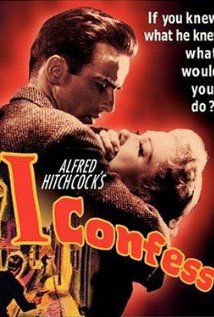
I Confess: adapted by George Tabori and William Archibald from a play by Paul Anthelme; directed by Alfred Hitchcock; starring Montgomery Clift (Father Logan), Anne Baxter (Ruth Grandfort), Karl Malden (Inspector Larrue), Brian Aherne (Willie Robertson), and O.E. Hasse (Otto Keller) (1953): Quebec City co-stars with Montgomery Clift in this moody, expressionistic Hitchcock thriller. Hitchcock's shot selection when it comes to Quebec is perhaps the most impressive thing about this movie, with looming churches, the nigh-cyclopean Chateau Frontenac,  cramped streets, and all the shadows that night can provide. 

Clift is striking and mournful as a Roman Catholic priest accused of a murder he didn't commit. But his Father Logan is royally screwed: not only did he hear the confession of the murderer, thus binding him with the Seal of the Confessional, but the murderer decides to frame Father Logan for that murder. And Logan's pre-priesthood romance with the now-married Anne Baxter has supplied stupid-but-stubborn cop Karl Malden with a motive for Logan to murder. The cinematography and editing make this a movie to study. The ending goes a bit cuckoo and a whole lot abrupt. Recommended.

Friday, January 9, 2015

Strangers on a Train (1951)

Strangers on a Train: adapted by Ben Hecht, Whitfield Cook, Czenzi Ormonde, and Raymond Chandler from the novel by Patricia Highsmith; directed by Alfred Hitchcock; starring Farley Granger (Guy Haines), Robert Walker (Bruno Antony), Ruth Roman (Anne Morton) and Patricia Hitchcock (Barbara Morton) (1951): At the very least, Strangers on a Train is one of Alfred Hitchcock's ten greatest films. And maybe it's top five. It's a terrific thriller that holds up beautifully and which contains an absolutely terrific performance from the tragic Robert Walker, who would die at the age of 32 the same year Strangers on a Train came to theatres.

Farley Granger's Guy Haines is a tennis player with a marital problem. His wife's been unfaithful. He wants to get a divorce so he can marry the daughter of the United States Senator for whom he'll be working full time once his tennis career ends. But his wife, now carrying someone else's child, no longer wants a divorce.

A seemingly random conversation with a stranger Guy meets in the club car of a train rapidly becomes sinister: Robert Walker's Bruno Antony is a superficially charming psychopath who seems to know an awful lot about Guy's marital problems, and indeed his entire personal life.

While spit-balling various theories on how to murder someone and get away with it, Bruno suggests that potential murderers should swap victims so as to eliminate motive. Guy thinks the creepy guy on the train is just indulging in a lurid fantasy (or mentally goofing around the way that the father and the Hume Cronyn character spin out perfect murder theories in Hitchcock's earlier Shadow of a Doubt).  But then Mrs. Haines ends up murdered at an amusement park. And now Bruno wants Guy to hold up his side of a bargain Guy didn't realize he'd made.

Funny, thrilling, and creepy, Strangers on a Train contains a number of shots and sequences that have been discussed in film schools and film criticism for decades. I'll let you experience them for yourself. Farley Granger does solid work as the slightly dense Mr. Haines, as does Hitchcock's daughter Patricia as the smart-aleck sister of Guy's new love interest. But it's Walker who steals the movie with his insinuating, creepy, hyper-intelligent psychopath. It's an absolutely marvelous performance made tragic by the reality of his death. Highly recommended.

Sunday, December 7, 2014

South-west by North-east

Saboteur: written by Alfred Hitchcock, Peter Viertel, Joan Harrison, and Dorothy Parker; directed by Alfred Hitchcock; starring Priscilla Lane (Pat), Robert Cummings (Barry), Otto Kruger (Tobin), and Norman Lloyd (Fry) (1942): From the first half-decade of Hitchcock's American phase comes this oddball thriller -- half-WWII-propaganda, half-thriller, half-loopy-road-comedy. That's three halves, and yes, it is that over-stuffed. 

Robert Cummings plays a worker at a California warplane-assembly plant who's framed for sabotage by a man he (literally) ran into only moments before a disastrous fire destroyed part of the plant and killed his best friend. With only an address on an envelope to go on, Cummings flees Los Angeles to track down the saboteur. Well, saboteurs and fifth-columnists. Lots of them, and lots of them rich, high-society types.

Moments of comedy and weirdness will bring to mind both Hitchcock's earlier foray into the 'Wrong-man Road-trip' sub-genre, The 39 Steps, and that later Cary Grant masterpiece, North by North-west. But this is the weirdest of those three -- so weird that it stands as a forerunner to film-makers like the Coen Brothers and David Lynch far more than it does to Hollywood's more traditional thrill-directors.

What will happen to Cummings' character? He'll be aided in his escape from the police by a philosophical blind musician (shades of Universal's Frankenstein!). That blind musician has a super-model niece who will be pulled into the drama. Billboards featuring that niece will comment comically on the action of the film at regular intervals. Will she come to believe and then fall in love with Cummings? What do you think?

So off their road-trip goes. Patriotic members of a traveling circus's freak show will aid them, with the Human Skeleton delivering the film's best line, about the failings of normal people ("The normal are normally cold-hearted."). Cummings will break his handcuffs with the fan blade of a car. They'll visit a place called Soda City. They'll mingle with high society. And in the film's famous climax, Cummings will finally face the saboteur... on top of the Statue of Liberty.

Saboteur is very odd and unconventional. One can see why it was a box-office failure at the time. But it's also a sign of Things to Come. Though you might want to brace yourself for one of the most abrupt endings I've seen from the Golden Age of Hollywood Abrupt Endings. It's like Hitchcock was late for an appointment. Recommended.

Wednesday, December 3, 2014

Murder Rides the Rails!

The Narrow Margin: written by Earl Felton, Martin Goldsmith, and Jack Leonard; directed by Richard Fleischer; starring Charles McGraw (Detective Brown), Marie Windsor (Mrs. Neal), and Jacqueline White (Ann Sinclair) (1952): Short, snappy B-movie was remade into a somewhat superior Gene Hackman vehicle in the early 1990's, with the definite article removed from the title.

Detective Brown has to get a mobster's wife who's turned state's evidence to Los Angeles from Chicago. So they take a train. Killers are on the train. Killers may be at various stops along the way. It's all fairly tense and succinct, with a meanness of attitude and violence that suggests the growing influence of Mickey Spillane on film noir in the United States. A more charismatic cast would have made a big difference -- this is not a testament to great film acting -- but the movie is still well worth watching. Recommended.


Shadow of a Doubt: adapted by Thornton Wilder, Sally Benson, and Alma Reville from a story by Gordon McDonell; directed by Alfred Hitchcock; starring Teresa Wright (Charlie), Joseph Cotten (Uncle Charlie), Macdonald Carey (Graham), Henry Travers (Joseph Newton), Patricia Collinge (Emma Newton), and Hume CRonyn (Herbie Hawkins) (1943): Perhaps Hitchcock's most nuanced and humane exploration of human evil, Shadow of a Doubt casts its shadow forward on similar explorations of small-town America that include Blue Velvet, Fargo, and many other seriocomic films and television shows.

Joseph Cotten, cast against type as a monster, does great work as Uncle Charlie, a serial killer who returns home to his older sister's house just one step ahead of the law. Once there, his 'twin' -- Teresa Wright as his niece Charlie (Charlene), named in honour of him -- swiftly moves from hero worship to growing horror at what she gradually perceives her uncle to be. Wright is also excellent as the increasingly horrified Charlie who nonetheless must weigh what to do about her uncle as she fears what the monstrous allegations would do to her mother, who adores her baby brother.

There's a tremendous breadth to Shadow of a Doubt. Comic scenes with a young Hume Cronyn and Henry Travers offer commentary on an audience's love of thrills and murder. Hitchcock and his writers also examine the somewhat stultifying family dynamic of the younger Charlie's household. As is common in Hitchcock films, the law is a step slow and a day late throughout the film. The final confrontation will be between the two Charlies and no one else. Highly recommended.

Friday, August 8, 2014

American Motormouths

American Hustle: written by David O. Russell and Eric Warren Singer; directed by David O. Russell; starring Christian Bale (Irving Rosenfeld), Bradley Cooper (Richie DiMaso), Amy Adams (Sydney Prosser), Jeremy Renner (Camden Mayor Carmine Polito), Jennifer Lawrence (Rosalyn Rosenfeld), Louis C.K. (Stoddard Thorsen) and Elisabeth Rohm (Dolly Polito) (2013): Writer-director David O. Russell has said on numerous occasions that plot bores him. Thankfully, the actors and the dialogue in his movies -- some of that dialogue improvised -- can make one forget that the proceedings are a bit shaggy at times. For whatever reason, he's also the one director who can get a great performance out of Bradley Cooper.

American Hustle, loosely based on the Abscam scandal of the 1970's, gives all of its actors something to do and, more importantly, something to say. The performances are all top-notch, especially an almost unrecognizable Christian Bale as an overweight con-man with his own code of ethics and Amy Adams as his partner in crime. The plot sags a bit in the middle under the weight of all those conversations, but regains its jauntiness as the end draws near. Someone should sign Russell and company up for a remake of The Front Page/His Girl Friday, stat. He's one of a few modern directors who could successfully replicate the rat-a-tat dialogue direction of Howard Hawks. Highly recommended.


High Anxiety: written by Mel Brooks, Ron Clark, Rudy De Luca, and Barry Levinson; directed by Mel Brooks; starring Mel Brooks (Richard H. Thorndyke), Madeline Kahn (Victoria Brisbane), Cloris Leachman (Nurse Diesel), Harvey Korman (Dr. Charles Montague), Ron Carey (Brophy), Dick Van Patten (Dr. Wentworth), and Howard Morris (Professor Lilloman) (1977): Mel Brooks is all over the place figuratively and literally in this parody of the films of Alfred Hitchcock. He sings. He dances. He stars. He directs. He co-writes. It's probably no accident that Brooks' films became decreasingly popular as his ego moved him from supporting roles in his own films to lead roles -- this is his second turn as the lead, and the rot has begun to set in, lightly but inevitably.

Still, there are some killer sequences parodying both the specific and the general in Hitchcock's films, from some complicated camerawork under a glass coffee table to a ridiculous riff on Janet Leigh's driving problems in Psycho. And there are killer performances, none moreso than Cloris Leachman as a nurse/dominatrix with truly peculiar line-readings and physical mannerisms. Recommended.


The Treasure of the Sierra Madre: adapted by John Huston from the novel by B. Traven; starring Humphrey Bogart (Dobbs), Walter Huston (Howard), Tim Holt (Curtin), Bruce Bennett (Cody), and Robert Blake (Lottery Seller) (1948): One of the all-time great adventure films gives us Humphrey Bogart at his grimiest and Walter Huston at a chameleonic peak that earned him a Best Supporting Actor Oscar. Gold-hunting in Mexico in the 1920's leads Bogart, Huston, and Tim Holt up a mountain and then down into the depths of human behaviour.

Great lines, great acting, fine direction from Walter Huston's son John, and the crazed jig forever after known as the Walter Huston dance. And the badges line, often misquoted. And a wild, realistic barroom brawl. One of the first big-budget Hollywood movies to be filmed almost entirely on location. If there are essential movies, this is one of them. Highly recommended.

Thursday, February 13, 2014

Dated

Suspicion: adapted by Samson Raphaelson, Joan Harrison, and Alma Reville from the novel by Anthony Berkeley; directed by Alfred Hitchcock; starring Cary Grant (Johnnie) and Joan Fontaine (Lina) (1941): With the only Oscar-winning performance in a Hitchcock film -- Joan Fontaine for Best Actress -- one might imagine that this is first-rank Hitchcock. It isn't.

There's some question as to whether or not Hitchcock really was over-ruled by the studio about the ending. Whether or not he was, the movie makes absolutely no sense with the ending it has. The possibility that Hitchcock always intended the film to suggest that one character is delusional only makes sense within a framework in which either a number of events never actually occur, in which case the character is insane, or the events do occur but are coincidental, in which case the entire universe is insane.

Suspicion was a big financial success and gave Hitchcock a lot of creative control thereafter, as this was also the first film he produced as well as directed inside the Hollywood system. Regardless of the ending, the gender dynamics in Suspicion have dated so poorly that it's agonizing for repeated stretches, and not in a way that's enjoyable unless you're writing a paper on gender dynamics in Hitchcock films. Fontaine certainly gives some sort of performance, as she's on-screen for almost every minute of the movie. Grant is uncharacteristically menacing, which is interesting in and of itself.

There are the usual bravura Hitchcock touches, including a host of scenes in which shadows suggest spider-webs enveloping the characters, and the famous Glowing Glass of Milk Scene, which comes almost at the end of the picture if you're waiting for it. But for a 99-minute movie, this is awfully draggy, with almost schematically unlikeable characters made completely baffling by that godawful ending. But it's Hitchcock, so it's still lightly recommended.

Tuesday, December 17, 2013

His Dark Materials

Psycho: adapted by Joseph Stefano from the novel by Robert Bloch; directed by Alfred Hitchcock; starring Anthony Perkins (Norman Bates), Janet Leigh (Marion Crane), Vera Miles (Lila Crane), John Gavin (Sam Loomis), and Martin Balsam (Arboghast) (1960): Alfred Hitchcock's masterpiece still shines undiminished, a sinister puzzle-box. Taken from an already strong source (Robert Bloch's novel of the same name), Psycho improved upon it by making hotel-owner and mother-aficianado Norman Bates thin and sympathetic.

It's the movie's generation of sympathy for Norman I'll deal with here. Anthony Perkins should have won some sort of acting Oscar for this performance. Jittery, occasionally creepy, put-upon, repressed: and a lot of other emotions, all of them pitch perfect.

Camerawork amplifies the greatness of the performance, again and again staging Norman Bates in an inferior position to other male characters. One great blink-and-miss-it moment shows Perkins flinching almost unnoticeably as Martin Balsam's private detective deliberately leans into Norman's envelope of private space. The camerawork runs parallel to similar set-ups involving Janet Leigh's Marion Crane, her space invaded by lecherous oil-men and looming, sun-glass-obscured cops. Crane and Bates are twins in many ways, light and dark.

Oh, and it's the first American movie to show the inside of the bowl while a toilet flushes. Really, how much more do you want? A nearly subliminal use of a skull superimposed on a major character's head? One of the most distinctive scores of all time? Highly recommended.

Thursday, September 20, 2012

Mirror Phase

The Lady from Shanghai: adapted by Orson Welles, William Castle, Charles Lederer, and Fletcher Markle from the novel If I Die Before I Wake by Sherwood King; directed by Orson Welles; starring Orson Welles (Michael O'Hara), Rita Hayworth (Elsa Bannister), Everett Sloane (Arthur Bannister), and Glenn Anders (George Grisby) (1947): Welles wrote, directed, and starred in this movie so as to secure $55,000 to mount a Mercury Theatre stage production of Around the World in 80 Days. Somewhere in the making of it, he seems to have decided to out-Hitchcock Hitchcock. And in many ways he succeeds, though I have a feeling that the original Director's Cut of 155 minutes (this version runs 87 minutes, which is just about right and maybe even a bit long) was probably unbearable.

Welles adopts a generic Irish accent for this movie, a decision that mostly eliminates his trademark baritone delivery. He's an itinerant sailor named Michael O'Hara who gets mixed up in the affairs of criminal-defense lawyer Arthur Bannister, eponymous trophy wife Elsa Bannister, and Bannister's weaselly partner George Grisby.

Some of Welles's choices for how the actors play their parts would later arise in Touch of Evil. Grisby and Arthur Bannister are both constructed around annoying tics, stagey business with Bannister's crutches, and in Grisby's case an astonishingly annoying manner of speech. The weirdness of these grotesque touches seems to foreshadow the work of the Coen Brothers and David Lynch, two directors who seem much more Wellesian to me than they're generally given credit for.

The plot contains many Hitchcockian tropes -- the innocent man accused of a crime, a luminous blonde love interest (Hayworth, her trademark long hair shorn for this picture), exotic or unusual locations, and odd yet compelling staging of key scenes. A love scene in an aquarium and the concluding shoot-out in a Hall of Mirrors are the most famous setpieces in The Lady from Shanghai, the latter much imitated in later films and television programs. I don't think this is a great film, but it's darned peculiar and interesting, and seems much more modern than many other films of the same era. Highly recommended.

Wednesday, September 21, 2011

Neither Hitchcock Nor Truffaut

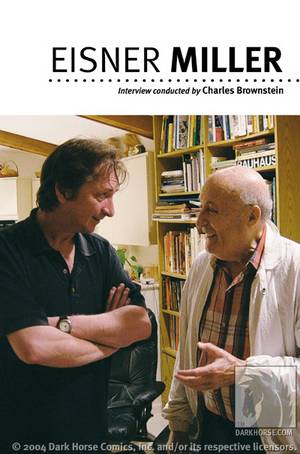
Eisner/Miller, interview between Frank Miller and Will Eisner, interview conducted by Charles Brownstein (2005): The legendary film text commonly known as Hitchcock/Truffaut (though that isn't its actual title) features French nouvelle vague director Francois Truffaut (aka the French Guy in Close Encounters of the Third Kind) conducting an exhaustive interview with Alfred Hitchcock. It's a terrific book.

This book, featuring an exhausting dialogue between legendary comic-book writer-artist Will Eisner (The Spirit, A Contract with God, Fagin the Jew) and semi-legendary comic-book writer-artist Frank Miller (The Dark Knight Returns, 300, Sin City), consciously emulates the earlier book in its title while severely underperforming in pretty much every other comparison between the two volumes.

Truffaut was a critic and a film historian as well as a writer-director, and he did tons of preparation and contextualization for his book, supplying a lengthy introduction that explained Hitchcock's body of work to the casual reader and structuring the interview chronologically so that the two men could work their way through Hitchcock's life and work from past to present.

Neither Miller nor interview "conductor" Charles Brownstein (the latter of whom is completely silent in the transcription of the interview) supply these things. A casual reader will have almost no idea why either Eisner or Miller is important to the history of comic books at the end of this book. Or care.

That casual reader won't make it to the end of the book unless he or she has a high tolerance for tedium. This is probably the worst conducted long-form interview I've ever read. Miller seems to have absolutely no clue as to how to ask follow-up questions or press a point, and the late Eisner was (famously) reticent about offering anything other than the most superficial analysis of his own or other people's work.

Eisner was a shrewd businessman at a time -- the 1940's -- when most comic-book writers and artists weren't. This comes up again and again, and Eisner reveals himself to be something of a prick whenever the topic of artists and writers who weren't shrewd businessmen (say, Superman creators Jerry Siegel and Joe Shuster, or writer-artist Jack Kirby) comes up. It's not a pleasant side of the man, but it's pretty much the only substantive thing that the 60,000-word interview reveals.

Miller, famously a champion of creator's rights since the 1980's, pretty much allows Eisner to go unchallenged in this area and others. Inadvertantly funny moments occur whenever Miller and Eisner clearly and emphatically disagree with one another while both stating and re-stating how they actually agree.

If I were cynical, I'd guess that this interview sat on the shelf for three years (it was conducted in 2002 but not published until 2005) because publisher Dark Horse was well aware of what a stink-bomb it had. But when Eisner died, the interview gained some heft as Eisner's last long-form discussion of his life and career, so onto the stands it went. It certainly seems like a rush job for something ostensibly three years in the making -- there isn't even an index. If I were cynical. Not recommended at all except as a sleep aid.

Sunday, September 11, 2011

Four

Stage Fright, written by Whitfield Cook, Alma Reville, James Bridie and Ranald MacDougall, based on a novel by Selwyn Jepson, starring Jane Wyman (Eve Gill), Marlene Dietrich (Charlotte Inwood), Michael Wilding ("Ordinary" Smith), Richard Todd (Jonathan Cooper), Alastair Sim (Commodore Gill), Sybil Thorndike (Mrs. Gill) and Kay Walsh (Nellie Goode) (1950): One of Hitchcock's lesser-known efforts is enjoyable but a bit overlong and draggy. Jane Wyman tries to save ex-boyfriend Richard Todd from being arrested for a murder he says he didn't commit. Shenanigans ensue. The cast -- especially Marlene Dietrich and Alastair "Scrooge" Sim -- is topnotch. Lightly recommended.


White Heat, written by Ivan Goff, Ben Roberts and Virginia Kellogg, directed by Raoul Walsh, starring James Cagney (Cody Jarrett), Virginia Mayo (Verna Jarrett), Edmond O'Brien (Hank Fallon) and Margaret Wycherly (Ma Jarrett) (1949): Classic gangster flick pits undercover cop O'Brien against crazy con James Cagney. And boy, does Cagney's character have mother issues! Some scenes play out like CSI: 1949, as the FBI uses the latest in high-tech tracking devices and crime-solving techniques to find the criminals before they pull off their next big heist. A lot of fun, with great performances by Cagney, O'Brien and Virginia Mayo. Look, Ma, top of the world! Highly recommended.


The Green Hornet, written by Seth Rogen and Evan Goldberg, based on characters created by George W. Trendle, directed by Michel Gondry, starring Seth Rogen (Britt Reid/The Green Hornet), Jay Chou (Kato), Cameron Diaz (Lenore Case), Tom Wilkinson (James Reid) and Christoph Waltz (Chudnofsky) (2011): Well, I laughed a lot, and I don't give a shit about the original radio-series Green Hornet, so any blasphemies committed upon it by the filmmakers didn't irk me. Seth Rogen makes an unlikely masked hero, but that's sorta the point. Lightly recommended.


30 Days of Night: Dark Days, adapted by Steve Niles and Ben Ketai from the comic book by Niles and Ben Templesmith, directed by Ben Ketai, starring Kiele Sanchez (Stella), Rhys Coiro (Paul), Diora Brand (Amber), Harold Perrineau (Todd), Mia Kirshner (Lilith), Troy Ruptash (Agent Morris) and Ben Cotton (Dane) (2010): This straight-to-DVD sequel to 30 Days of Night contains no original cast members. Good on them. The world's stupidest vampire hunters take on the world's stupidest vampires in Los Angeles. Something's gotta give! The movie may set the record for most aerial shots of L.A. in one movie, or at least in one vampire movie. Mia Kirshner looks sorta cool as vampire-queen Lilith. Not recommended.