John Wick: directed by Chad Stahelski and David Leitch; written by Derek Kolstad; starring Keanu Reeves (John Wick), Michael Nyqvist (Viggo Tarasov), Alfie Allen (Iosef Tarasov), Willem Dafoe (Marcus), Dean Winters (Avi), Adrianne Palicki (Ms. Perkins), and John Leguizamo (Aurelio) (2014): Fun revenge-action movie directed by a former stunt man/stunt director takes full advantage of Keanu Reeves' low-key charms.
The action sequences, whether car chases or hand-to-hand combat or lengthy shoot-outs, are all splendidly choreographed. This is in its way as pleasingly low-tech and old-school as Mad Max: Fury Road, and almost as much fun. There's also a refreshing amount of wit in the film's Hotel for Assassins, complete with strict house rules (Rule#1: No business on the premises!). The cast is top-notch, with Alfie Allen (Game of Thrones' Theon Greyjoy) as a suitably puerile and squirmy object of Keanu Reeves' wrath. Highly recommended.

The Lady in the Lake: adapted by Steve Fisher from the novel by Raymond Chandler; directed by Robert Montgomery; starring Robert Montgomery (Philip Marlowe), Audrey Trotter (Adrienne Fromsett), Lloyd Nolan (Lt. DeGarmot), Dick Simmons (Chris Lavery), and Leon Ames (Derace Kingsby) (1947): As an experiment, The Lady in the Lake is interesting in theory: much of the movie is told in the first person (which is to say, with a first-person camera) by Raymond Chandler's Philip Marlowe. Robert Montgomery both plays Marlowe and directs.
Alas, Montgomery simply isn't a good enough director to find ways to make the first-person camera work visually interesting, especially since the technology of the time severely limits the amount and speed of movement a camera was capable of. Montgomery's also woefully miscast as Marlowe, whose greatest portrayer will always be Humphrey Bogart but who has also been memorably played by Robert Mitchum, Eliot Gould, and James Garner, among others.
The four types of shots we see again and again include people talking to Marlowe without moving, Marlowe getting knocked out, Marlowe looking in a mirror, and Marlowe looking at his hands so we can see what he's doing with them. The Lady in the Lake does seem to have been watched by the Coen Brothers: a sequence in which Marlowe is chewed out in a police station by Bay City cops really seems to loom in the background of The Big Lebowski, though Marlowe escapes without taking a coffee mug to the head. Not recommended.
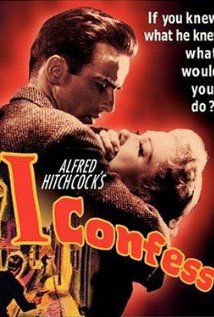
I Confess: adapted by George Tabori and William Archibald from a play by Paul Anthelme; directed by Alfred Hitchcock; starring Montgomery Clift (Father Logan), Anne Baxter (Ruth Grandfort), Karl Malden (Inspector Larrue), Brian Aherne (Willie Robertson), and O.E. Hasse (Otto Keller) (1953): Quebec City co-stars with Montgomery Clift in this moody, expressionistic Hitchcock thriller. Hitchcock's shot selection when it comes to Quebec is perhaps the most impressive thing about this movie, with looming churches, the nigh-cyclopean Chateau Frontenac, cramped streets, and all the shadows that night can provide.
Clift is striking and mournful as a Roman Catholic priest accused of a murder he didn't commit. But his Father Logan is royally screwed: not only did he hear the confession of the murderer, thus binding him with the Seal of the Confessional, but the murderer decides to frame Father Logan for that murder. And Logan's pre-priesthood romance with the now-married Anne Baxter has supplied stupid-but-stubborn cop Karl Malden with a motive for Logan to murder. The cinematography and editing make this a movie to study. The ending goes a bit cuckoo and a whole lot abrupt. Recommended.
 A Scanner Darkly: adapted by Richard Linklater from the Philip K. Dick novel of the same name; directed by Richard Linklater; starring Keanu Reeves (Bob Arctor); Robert Downey Jr. (James Barris); Rory Cochrane (Charles Freck); Winona Ryder (Donna Hawthorne) and Woody Harrelson (Ernie Luckman) (2006): Adapter/director Richard Linklater achieved at least three remarkable things with A Scanner Darkly: he created the most faithful movie adaptation of a Philip K. Dick novel or short story ever; he created an outstanding science-fiction film; and he maximized the limited acting ability of Keanu Reeves by casting Reeves as a burnt-out case in the midst of a drug-fueled mental breakdown.
Reeves plays Bob Arctor, a near-future California undercover government narc charged by his superiors with helping win the war against Substance D, a highly addictive illegal substance that rapidly causes irreversible brain damage in those addicted to it, partially by severing the connection between an addict's left and right brain hemispheres.
Arctor is deep undercover, sharing a house with two other addicts and buying Substance D from a third in increasingly difficult-to-supply mass quantities in the hopes of moving up the supply chain. The government knows what the main ingredient of Substance D derives from -- a small, blue-flowered plant -- but it doesn't know who is growing it, refining it, and putting it on the street.
Dick based much of A Scanner Darkly on his own drug experiences of the 1960's and 1970's, experiences which saw him committed to a mental asylum for a time, and experiences which caused him to interact with a large number of doomed and mostly doomed addicts. Indeed, the movie appends a portion of the novel's afterword to the end of the movie -- a roll call of the dead and damaged.
The hyper-colourful, rotoscoped animation Linklater uses here (he first used it in Waking Life) suits the material and the tone of that material -- the movie looks like a fever dream, a pulsating nightmare in which nothing is stable. All the principals deliver outstanding performances, including Reeves, and perhaps most notably Robert Downey Jr., who presents us with a jittery speed freak (Substance D appears to be at least partially an amphetamine) over-bursting with his own paranoid delusions and fantasies.
The title is a play on the Biblical phrase 'Through a glass, darkly': there are scanners in this movie, but they aren't the Cronenberg variety. Highly recommended.


