Showing posts with label science fiction. Show all posts

Saturday, November 21, 2020

Solaris, but not the good one

So glowy

Solaris (2002): adapted for the screen from Stanislaw Lem's novel and Andrei Tarkovsky's previous adaptation and directed by Steven Soderbergh; starring George Clooney, Natascha McElhone, Jeremy Davies, and Viola Davis: 


Ostensibly adapted straight from Polish sf writer Stanislaw Lem's 1960's novel, this version of Solaris really seems to have been adapted from Soviet film-maker Andrei Tarkovsky's early 1970's adaptation. Its emphasis on family matters and its changed ending both reflect the film, not Lem's much more coldly rational novel. 


But at least Tarkovsky's Solaris deals with Lem's main focus -- the unknowability of the universe. This movie can't even be bothered to explain the reasons the alien planet Solaris so fascinates and disturbs humanity. We never even see the surface, instead seeing the planet only as a trippy lightshow around which the space station orbits. Of course, in neither the novel nor Tarkovsky's version does the station truly orbit -- it floats inside the atmosphere, above Solaris's mysterious world-covering ocean.


George Clooney does what he can, but the script is far from good and Clooney himself is too ironic a screen star to make the rational, skeptical main character believable. Viola Davis, Jeremy Davies, and Natascha McElhone do what they can, which ultimately isn't much. Soderbergh turns Solaris into a triumphant story about love conquering death, which is not the emphasis of Tarkovsky's ending, and is found nowhere in Lem's original. The mediocre Event Horizon is a better English-language adaptation of Solaris, and that's really saying something.


Soderbergh and company do accomplish something remarkable, though. This Solaris is half the length of Tarkovsky's meditative, glacially paced original. But it feels twice as long. Not recommended.

Tuesday, June 25, 2019

Tuf Voyaging (1986) by George R.R. Martin

Tuf Voyaging (1986) by George R.R. Martin: A 'paste-up' novel of stories and novellas published over about a decade, Tuf Voyaging tells of several adventures of Haviland Tuf. Tuf lives several thousand years in the future, during George R.R. Martin's 'Thousand Worlds' universe in which humanity has spread out across the galaxy (that's the Thousand Worlds) after the collapse of its Federal Empire. 

Tuf starts off as a quirky but somewhat unsuccessful freighter captain. Personality-wise, Tuf sometimes seems like a first draft for Varys in A Song of Ice and Fire. However, circumstances detailed here put him in sole control of a 30-km-long seed ship, the last of its kind, built by that Federal Empire's Ecological Engineering Corps.

This seed ship, named Ark, can do just about anything biology-related. Thanks to vast libraries of genetic material, genetic manipulation machines, and other doodads, the Ark can unleash planet-destroying plagues, planet-saving biological miracles, or even a few telepathic cats. Tuf finally has a way to make money. And so he does.

This may be Martin's most traditionally Golden-Age science-fiction work. Tuf is quirky and a fairly solid judge of human character, and the stories themselves are the sort of 'science puzzle' stories made popular by writers that include Isaac Asimov and Arthur C. Clarke. Martin seems to be having a lot of fun with the biological puzzles Haviland Tuf faces, and so too the reader.

Even the discovery of the Ark rests on a puzzle being solved -- and Tuf figuring out how to survive that finding. He will then be confronted by a variety of puzzles on different worlds. The puzzles and the solutions are ingenious. It's all breezy science-fiction fun with a few serious points about over-population, religious mania, and cruelty to animals along the way. And, of course, the dangers of invasive species. Especially when that invasive species is humanity. This would make a fine TV series. Come on, guys! Highly recommended.

Monday, May 27, 2019

Dreamsongs Volume 1 (2004) by George R. R. Martin


Dreamsongs Volume 1 (2004) by George R. R. Martin:

This collection is generous and generously gifted with lengthy, illuminating essays by George R.R. Martin. Originally released in one volume in 2003, breaking it up into two volumes definitely helps with actually reading it without being crushed.

Volume 1 covers Martin's career from his days writing for the amateur press in the 1960's to the greatest days of his success as a writer of short stories and novellas in the mid-1980's. I think Martin was a better writer of predominantly science-fictional stories than he is a fantasy novelist, but your results may vary. In any event, this is a fine introduction to Martin's work for those who haven't read much beyond his A Song of Ice and Fire

The stories:

"Only Kids Are Afraid of the Dark (1967): Almost juvenilia. Superhero stuff for an amateur press.
"The Fortress" (1960s): A short story submitted as an essay in a history course. Interesting.
"And Death His Legacy" (1960s): Started life as the first in a projected series about a billionaire super-assassin before transforming into a cautionary tale about the limits of political violence.
"The Hero" (1971): Martin's first professional sale, a stinger about the future of warfare.
"The Exit to San Breta" (1972): Science fiction ghost story. Minor but enjoyable.
"The Second Kind of Loneliness" (1972): From Martin's short-lived "Star Ring" series, a meditation on isolation and madness.
"With Morning Comes Mistfall" (1973): An entry in Martin's loose-knit far-future history of humanity dubbed "A Thousand Worlds." Martin's first truly top-notch story.
"A Song for Lya" (1974): Martin's second top-notch sf story, also set in the Thousand Worlds universe, explores an alien religion and its strange attraction for some humans.
"This Tower of Ashes" (1976): More of a character piece set on yet another of the Thousand Worlds. Bad spiders!
"And Seven Times Never Kill Man" (1975): The title comes from Kipling; Martin's notes indicate that he parodies Gordon R. Dickson's Dorsai series in specific (and militaristic sf in general) here. Thousand Worlds.
"The Stone City" (1977): A more Lovecraftian or Clark Ashton Smith-style take on the Thousand Worlds. Really a subtle piece of cosmic, science-fictional horror.
"Bitterblooms" (1977): A more fabulistic piece set on one of the more isolated Thousand Worlds of humanity.
"The Way of Cross and Dragon" (1979): Excellent sf story exploring religion and its mutations in the far future of the Thousand Worlds.
"The Lonely Songs of Laren Dorr" (1976): Universe-hopping fantasy story was meant to start a series. It didn't, though Martin would re-use elements in his 1990's pilot "Doorways" (see Dreamsongs Volume 2).
"The Ice Dragon" (1980): Martin is pretty sure he created the idea of a literal ice dragon here. Not part of the Game of Thrones universe, though there are some similarities.
"In the Lost Lands" (1982: Another first piece in a never-continued series, set in a world that combines traditional sword-and-sorcery elements with post-apocalyptic settings.
"Meathouse Man" (1976): The most mournful and disturbing of Martin's three 'Corpse-Handler' sf stories is sometimes viewed as a precursor to Splatterpunk.
"Remembering Melody" (1981): Precise 'traditional' horror story.
"Sandkings" (1979): My favourite of Martin's stories, a terrific novella of science-fictional horror that features a thoroughly rotten protagonist and a fascinating alien species, the eponymous Sandkings. Also meant to be part of a series!
"Nightflyers" (1976/1980): Fine science-fictional horror novella set in the far-future Thousand Worlds timeline was thoroughly misused in both a 1980's movie and the recent SyFy Channel series.
"The Monkey Treatment" (1983): Somewhat traditional 'Be careful what you wish for' horror.
"The Pear-Shaped Man" (1987): Nice horror piece does not go quite where the reader fears it will. It goes someplace way more disturbing!

Overall: Highly recommended.

Monday, April 29, 2019

Nightflyers (1987) by George R.R. Martin

When bad covers happen...
Nightflyers (1987) by George RR Martin, containing the following stories:


  • Nightflyers (1980): Martin's acclaimed novella of horror and first contact was badly mangled by the recent SyFy Channel series, mercifully canceled after one season. Set thousands of years in the future, "Nightflyers" follows the efforts of an interstellar archaeology team to make First Contact with the mysterious Volcryn. The Volcryn fly between the stars at normal spatial velocities, avoiding star systems and faster-than-light travel. Why? And why have they been doing it for at least tens of thousands of years, flying outwards from the Galactic Core? Martin balances cosmic horror, a bit of grue, a sense of wonder, and a keen sense of irony once the final revelations arrive.

  • Override (1973): Enjoyable, minor Corpse-handler story. Martin's walking dead do so with artificial brains in their heads, all under the control of that handler. Yuck!

  • Weekend in a War Zone (1977): Dystopic, bleak satire of corporate outings. Would make a good half-hour Twilight Zone episode if they still made such a thing.

  • And Seven Times Never Kill Man (1975): Another story set in the Thousand Worlds universe shows us aliens vs. humans. And not just any humans, but the horrible sect of humans who are Martin's parody of/commentary on Gordon Dickson's militaristic Dorsai.

  • Nor the Many-Coloured Fires of a Star Ring (1976): The Star Ring was an FTL gateway created by dumping massive amounts of power into a pre-existing spatial rift. But in this story, the rift seems to open on a parallel universe.

  • A Song for Lya (1974): One of Martin's cleverest, most affecting stories. Again set in the Thousand Worlds universe, "A Song for Lya" follows the efforts of a telepathic duo to discover the secrets of a planet of aliens that has lived in peaceful cultural stasis for thousands of years -- and whose attractions now seem to be wooing humans to have brain-eating blobs put on their heads. Yes, it's the most melancholy episode of Futurama ever!!!


Once upon a time, George R.R. Martin was a writer of terrific short stories and novellas. His first novel, written with Lisa Tuttle, was a fix-up of previously published stories, as was a later novel, Tuf Voyaging

These stories all come from about two decades or more before Game of Thrones hit the book-stands. Some of them are from different universes Martin created -- the Star Ring universe, the Corpse-handler universe, and the Thousand Worlds of humanity thousands of years in the future. They all make for fine reading. Highly recommended.

Tuesday, March 13, 2018

The Minority Report and Other Stories (1987) by Philip K. Dick


The Minority Report and Other Stories (1987) by Philip K. Dick, containing the following stories:


  • Autofac (1955) 
  • Service Call (1955) 
  • Captive Market (1955) 
  • The Mold of Yancy (1955) 
  • The Minority Report (1956) 
  • Recall Mechanism (1959) 
  • The Unreconstructed M (1957) 
  • Explorers We (1959)  
  • War Game (1959) 
  • If There Were No Benny Cemoli (1963) 
  • Novelty Act (1964) 
  • Waterspider (1964) 
  • What the Dead Men Say (1964)  
  • Orpheus with Clay Feet (1987) 
  • The Days of Perky Pat (1963) 
  • Stand-By (1963)
  • What'll We Do with Ragland Park?  (1963) 
  • Oh, to Be a Blobel! (1964) 


A typically excellent collection of stories by Philip K. Dick, this text being part of the five-volume Collected Philip K. Dick first issued in 1987. There's a perceptive introduction from the late James Tiptree, Jr. (the writing name of Alice Sheldon) and notes by PKD on some of the stories culled from a couple of earlier Dick collections. One story from the early 1960's, "Orpheus with Clay Feet", gets its first publication here.

This hefty volume covers stories long and short from the 1955 to 1964. Dick's typical atypicality is in full flight here -- his protagonists are ordinary, often neurotic characters trapped in strange realities. The plots often defy anything resembling typical plotting, one of the things that makes Dick so difficult a nut to crack in film and TV adaptations.

"The Minority Report" is a pretty good example of why Hollywood almost never "gets" Dick. (Haha!) 

The central concept of Dick's story appears in the Spielberg/Cruise film, but pretty much everything else is different, and lesser. There is a Precrime division that uses precognitives to allow the police to arrest murderers before they murder. And the head of that division in one city is indeed flagged by Precrime as a Murderer-to-be. But that's about it when it comes to correspondences. And there's certainly none of the technological gimcrackery of the Cruise movie. Dick is almost never interested in presenting the visual wonder of machines. He's not about spectacle. 

Nor is there anything to do with freeing the Precogs -- in Dick's story, precognitives are the victims of terrible genetic mutation that leaves them essentially mindless conduits for the future, derisively referred to as "monkeys" by many of those in Precrime. There's nothing sentimental in Dick's story, no stirring speeches about free will. The protagonist is a frightened, flawed, but pragmatic man who does the right thing in the end. He's no Tom Cruise.

There are many stand-outs here, and a few fascinating oddities -- including a piece of metafiction ("Waterspider") starring sf great Poul Anderson and many other cameos from science-fiction writers of the 1950's and 1960's, themselves believed to be Precogs by the time-travellers who come back from the far future seeking their help.

Dick's fiction doesn't remain relevant because of accurate technological prediction. It remains relevant because Dick's observations and speculations about the social, psychological, and political effects of technology are startlingly prescient, primarily because they're based on what he saw around him. 

Stories about the social impact of Fake News ("The Mold of Yancy," "If There Were No Benny Cemoli") still resonate in the Trump Era because "fake news" was around in the 1950's and 1960's for Dick to ponder upon. "Novelty Act" posits an America involved in an endless, state-mandated talent show aimed at getting people to perform for the First-Lady-for-Life on TV. It seems weird right up to the point that it seems weirdly believable, even with its easy flights to Mars and 1950's conceptions of talent shows (the protagonist and his brother perform classical music... by blowing on jugs). 

Yes, it's Philip K. Dick's Jug-band Crisis.

As with any collection of PKD stories, The Minority Report and Other Stories crackles with wit, horror, and humanity. Some people do good things. Some people are just small and mean. Their rewards are not commensurate with their moral worth. Highly recommended.

Tuesday, November 28, 2017

Forbidden Planet (1956)

No scene like this in movie...
Forbidden Planet (1956): very loosely adapted from Shakespeare's The Tempest by Cyril Hume, Irving Block, and Allen Adler; directed by Fred Wilcox; starring Leslie Nielsen (Commander Adams), Walter Pidgeon (Dr. Morbius), Anne Francis (Alataira Morbius), Warren Stevens (Doc), Jack Kelly (Lt. Farman), Richard Anderson (The Chief), Earl Holliman (Cook), and Marvin Miller (Voice of Robby the Robot):

Forbidden Planet is a great, flawed movie. But the flaws mostly relate to the sexist culture that created it, and are somewhat curbed by the mostly ahead-of-her-time female character of Altaira, who's clearly smarter than all the men but her artificially brain-boosted father, a magnificent Walter Pidgeon.

Jarring the viewer most is a young, brown-haired Leslie Nielsen in the straightest of straight leading-man roles. But he's good, along with Jack Kelly as his second-in-command, Richard 'Oscar Goldman' Anderson as the Chief of Engineering, Anne Baxter as the somewhat liberated for the time daughter of Morbius, and Warren Stevens as the ship's Doctor.

The character dynamics wil remind one of the original Star Trek. The visual effects, a combination of traditional animation, models, and matte paintings, are still extremely impressive today. Robby the Robot is a hoot. His interactions with the dopey ship's cook seem like a prehistoric ancestor of similar interactions (and robot belches) in the Transformers series. Everything old is new again. Also, the Transformers never made 60 gallons of bourbon for anyone free of charge. That we know of. Recommended.

Tuesday, October 31, 2017

Blade Runner On a Train

The Girl On the Train (2016): adapted by Erin Cressida Wilson from the novel by Paula Hawkins; directed by Tate Taylor; starring Emily Blunt (Rachel), Haley Bennett (Megan), Rebecca Ferguson (Anna), Justin Theroux (Tom), Luke Evans (Scott), and Alison Janney (Detective Riley): 

Based on a best-selling psychological thriller, The Girl On the Train is neither thrilling nor psychologically believable. Unpleasant pretty people do unpleasant things. Someone gets murdered. Whodunnit? Who cares! Emily Blunt's portrayal of an alcoholic probably merits inclusion in the Hall of Fame for Unintentional Funny Bad Performances by Otherwise Capable Actors. Not recommended.


Blade Runner 2049 (2017): based on characters created by Philip K. Dick; written by Hampton Fancher and Michael Green; directed by Denis Villeneuve; starring Ryan Gosling (K), Dave Bautista (Sapper), Robin Wright (Lieutenant Joshi), Ana de Armas (Joi), Edward James Olmos (Gaff), Sylvia Hoeks (Luv), Jared Leto (Niander Wallace), and Harrison Ford (Rick Deckard): 

A slow-burn fever dream of a movie, and a worthy successor to the cult-favourite original. Ryan Gosling is pitch-perfect, while the visuals are marvelous. It doesn't quite equal the original because Jared Leto as the new 'Tyrell' is terrible in that specifically Jared Leto Hambone Way. More operatic scenery chewing from Rutger Hauer, or someone like Rutger Hauer, would have helped give the film more drama. Nonetheless, it's a haunting work at points, one that stays in the memory. Highly recommended.

Wednesday, July 19, 2017

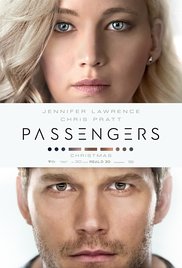
Passengers (2016)

Passengers (2016): written by Jon Spaihts; directed by Morgan Tyldum; starring Jennifer Lawrence (Aurora Lane), Chris Pratt (Jim Preston), Michael Sheen (Arthur the Android Bartender), and Laurence Fishburne (Gus Mancuso): There was a lot of (rhetorical) hand-wringing when Passengers hit theatres last winter over a particular decision made by Chris Pratt's character. And yes, it's a terrible decision. And the ultimate reaction of Jennifer Lawrence's character is going to be disturbing for a lot of people. But Passengers was still a lot more entertaining than I expected.

The film-makers even tried to go for a certain level of scientific accuracy, at least as we know it now. The Starship Avalon is a colony ship delivering 5000 passengers in some form of suspension to a colony world roughly 60 light years from Earth. The ship rotates those sections that require artificial gravity, as would we. And it's restricted to slower-than-light travel, as would we be. So kudos for that, though implausibilities creep in throughout as to how spin-generated AG would work.

The trip takes 120 years, so everyone onboard sleeps for most of it. Except something happens and Chris Pratt, a lovable mechanic, wakes up with 90 years to go. He's increasingly lonely. Then Jennifer Lawrence, a lovable writer, wakes up. Then some other stuff happens.

Passengers goes pretty much everywhere I expected it to go. But the set design and the CGI are actually interesting, and Lawrence and Pratt make for an engaging pair (along with lovable android bartender Arthur, played by Michael Sheen). There are a number of Idiot Plot moments, but not enough to destroy the viewing experience. And at least this is neither a superhero movie nor a giant epic. Jennifer Lawrence gets top billing, possibly because the plot requires her to strip down to her underwear or bathing suit every 20 minutes. Next time, make her the mechanic and Pratt the writer. Lightly recommended.

Thursday, December 24, 2015

Holiday Grab-Bag!


Mars Attacks!: adapted by Jonathan Gems, Scott Alexander, Larry Karaszewski, Martin Amis, and Tim Burton,  from the trading card series written and illustrated by Len Brown, Woody Gelman, Wally Wood, Bob Powell, and Norm Saunders; directed by Tim Burton; starring Jack Nicholson (The President/ Art Land), Glenn Close (First Lady), Annette Bening (Barbara Land), Pierce Brosnan (The Professor), Martin Short (The Press Secretary), Sarah Jessica Parker (Natalie), Michael J. Fox (Jason), Jim Brown (Byron), Natalie Portman (The President's Daughter), Lukas Haas (Richie Norris), Rod Steiger (General Decker), Pam Grier (Louise Williams), Jack Black (Bill Glenn Norris), Lisa Marie (Martian 'Girl'), Sylvia Sidney (Gramma), Tom Jones (Himself), and Janice Rivera (Byron's Busty Co-worker) (1996):

You may think Mars Attacks! is vicious until you see the insane 1950's trading cards it's based on. Holy crap! I wish the insanity got going a lot sooner in the film, or that ten minutes were trimmed from the first half. But it's still a triumph of a sort, a snarky 'FU!' to Hollywood blockbusters and good taste. Nods and homages abound, to the spinning flying saucers of Earth vs. The Flying Saucers, to This Island Earth, to Dr. Strangelove.  It's a witty, pissy movie. No wonder it bombed. Jim Brown is terrific as a heavyweight boxer turned Las Vegas greeter, and the rest of the cast is a hoot as well. Highly recommended.


Airplane!: written and directed by Jim Abrahams, David Zucker, and Jerry Zucker; starring Kareem Abdul-Jabbar (Murdock), Lloyd Birdges (McCroskey), Peter Graves (Captain Oveur), Julie Hagerty (Elaine), Robert Hays (Ted Striker), Leslie Nielsen (Dr. Rumack), and Robert Stack (Kramer) (1980): Airplane! established that Mad magazine's rapid fire, kitchen-sink approach to satire could thrive in the movies. Don't worry if a joke fails -- there's already another one on the way. The movie also retasked former dramatic actors Leslie Nielsen, Robert Stack, Peter Graves, and Lloyd Bridges as mostly deadpan comedians. For Nielsen especially, it was the start of a career resurgence. The movie also helped change NBA legend Kareem Abdul-Jabbar's public image from that of a humourless, standoffish sourpuss. Highly recommended.


Star Wars: The Force Awakens: written by Lawrence Kasdan, J.J. Abrams, and Michael Arndt; directed by J.J. Abrams; starring Harrison Ford (Han Solo), Mark Hamill (Luke Skywalker), Carrie Fisher (Princess Leia), Adam DRiver (Kylo Ren), Daisy Ridley (Rey), John Boyega (Finn), Oscar Isaac (Poe Dameron), and Andy Serkis (Supreme Leader Snoke) (2015): Yes, it borrows a lot of plot points from previous Star Wars films. And there are a couple of sequences in which necessary explanatory dialogue seems to have been left on the editing-room floor. But it's still a great deal of fun. And the casting of the young leads, especially Daisy Ridley and John Boyega, is terrific. 

I'd rate it far ahead of the three prequels and somewhat ahead of Return of the Jedi. And I'm optimistic that subsequent installments may be better. For some reason, I imagine J.J. Abrams breathing an Admiral Ackbar-style sigh of relief once the box office and the reviews started coming in. He's not an original film-maker, but he's one hell of a pastiche artist. Highly recommended.


ESPN 30 for 30: Four Falls of Buffalo: directed by Ken Rodgers, narrated by William Fichtner (2015): Often mournful, sometimes humourous re-evaluation of the Buffalo Bills NFL teams that went to an unprecedented four straight Super Bowls in the early 1990's -- and lost all four in another unprecedented feat. The movie certainly highlights the unfortunate fact that for a lot of people, finishing second is far worse than finishing 32nd. That this bizarre, heart-breaking, triumphant series of seasons happened to much-maligned Buffalo seems weirdly apt. One of the best of ESPN's usually excellent 30 for 30 documentaries, with tons of new interviews and lots of interesting archival footage. Highly recommended.


Holes for Faces (2013) by Ramsey Campbell, containing the following stories:

"Passing Through Peacehaven" (2011)   
"Peep" (2007)
"Getting It Wrong" (2011)
"The Room Beyond" (2011)
"Holes for Faces" (2013)
"The Rounds" (2010)
"The Decorations" (2005)
"The Address" (2012)
"Recently Used" (2011)
"Chucky Comes to Liverpool" (2010)
"With the Angels" (2010)
"Behind the Doors" (2013)
"Holding the Light" (2011)
"The Long Way" (2008)


Excellent collection of horror stories from the 21st century, with the venerable Ramsey Campbell -- first published in the 1960's by Arkham House --  demonstrating that he's still a master of both terror and poignance. Many of these stories deal with the effects of childhood trauma as remembered and re-experienced by an adult. Sometimes the antagonist is a supernatural menace, though in many of the stories, the problem could actually be a delusion. Throughout the stories, Campbell's often near-hallucinatory descriptions of people, things, and events keep the level of unease high. 


The stories also deal with children facing supernatural and non-supernatural terrors, perhaps none more acutely than the increasingly confused 13-year-old protagonist of "Chucky Comes to Liverpool." Here, his mother's involvement in a community campaign against horror movies -- and her obsessive 'protection' of him from all evil media influences -- causes major psychological problems. It's a fine story that works even better if one has read Campbell's essays on some of the censorship 'debates' he attended during various English campaigns against horror movies, some of them hysterically focused on the Chucky franchise.


The effects of old age are the focus of several stories, sometimes aggravated by those recurring childhood traumas, sometimes twinned with a separate character facing new childhood trauma. There are parents inflicting psychological traumas on their children. And there are trains and train stations. Seriously. 


Sometimes the train is the problem, sometimes the station, sometimes both... and sometimes not being able to find a train station leads one into dire supernatural peril. Given the focus on (as the back cover says) "Youth and age," the emphasis on trains and train stations, on arrivals and departures, seems only natural. There may be non-human and formerly human monsters throughout the collection, but they're mostly seen only in vague half-glimpses of terrible import. Their occasional complete manifestations, when they come, can be shocking, but it's the reactions of the various characters to the supernatural, or the seeming supernatural, that makes the stories so strong. We may not all meet ghosts, but we all know guilt and fear and regret. Or a hatred of Physical Education classes. Highly recommended.

Thursday, October 8, 2015

Hitchcock, Ballard, ... Gad?

Dial 'M' for Murder: adapted by Frederick Knott from his own stage play; directed by Alfred Hitchcock; starring Ray Milland (Tony Wendice); Grace Kelly (Margot Wendice), Robert Cummings (Mark Halliday), John Williams (Chief Inspector Hubbard), and Anthony Dawson (Swann) (1954): Mostly minor Hitchcock has the cast but lacks a top-rate script: if you didn't know it was based on a play, you'd figure it out by the second act. Ray Milland's cunning plan to kill wife Grace Kelly by proxy turns out to have too many moving parts -- or perhaps too few. It's a nice time waster, and all of the leads are fine, including John Williams as an increasingly Columbo-esque English policeman. Originally shown in 3-D, only the repeated establishment of an extreme foreground in most shots overtly acknowledges the process. Lightly recommended.


The Wedding Ringer: written by Jeremy Garelick and Jay Lavender; directed by Jeremy Garelick; starring Kevin Hart (Jimmy Callahan), Josh Gad (Doug Harris), Kaley Cuoco (Gretchen Palmer), and Jorge Garcia (Lurch) (2015): Sloppy but engaging buddy comedy manages to graft the narrative apparatus of a Heist movie onto a wedding scenario. Josh Gad plays a lovable, insanely wealthy tax attorney who has no friends -- not even one to be the Best Man at his wedding. Enter Kevin Hart as a man who sells his services as a Best Man to the friendless. And the services of whatever people he can round up to fill the roles of Gad's imaginary groomsmen, Gad having invented and named those groomsmen and the imaginary Best Man to his fiancee and the wedding planner prior to engaging Hart's services. There are rough spots and sections that fall flat, but overall this is a decent, lightweight comedy buoyed by the charms of both Hart and Gad. Recommended.


The Terminal Beach (1964) by J.G. Ballard, containing the following stories: A Question of Re-Entry  (1963); The Drowned Giant  (1964); End-Game  (1963); The Illuminated Man  (1964); The Reptile Enclosure  (1963); The Delta at Sunset  (1964); The Terminal Beach  (1964); Deep End  (1961); The Volcano Dances  (1964); Billennium  (1961); The Gioconda of the Twilight Noon  (1964); and The Lost Leonardo  (1964).

Icy, engaging collection of early 1960's short stories from J.G. Ballard. Many of the stories are at least nominally science fiction. All of them are Weird, though in several cases this Weirdness is entirely a question of tone: nothing overtly fantastic or science-fictional occurs in five of the twelve stories. Nonetheless, even those stories disturb one enough that they straddle the line between the strange and the horrific.

Ballard was only a couple of years away from his avant-garde, experimental period. None of the stories included here are challenging in a structural sense. Several challenge the reader's perceptions of genre, however, along with one's ability to navigate subjective narration and altered states of consciousness. Ballard's concern with the fragility of the human psyche manifests itself again and again in various ways. So, too, the apocalypse, always observed in a cool and somewhat detached manner by either his narrators or the third-person narrative voice. 

But as dry and cool a voice as Ballard can be, behind all those narrative masks exists the mind of an aesthete. The end of the world (if that's what it is) is a hauntingly beautiful place in "The Illuminated Man." Thoughts on art, and the art of Leonardo da Vinci, dominate the quietly horrifying "The Gioconda of the Twilight Noon" and the jolly fantasy "The Lost Leonardo."   And a description of the decay of the body of a mysterious giant takes up the bulk of "The Drowned Giant," a description that haunts and troubles even as the story questions the very nature of the fantastic and people's reactions to unusual events. 

One could call "The Drowned Giant" a horror story about familiarization and the ever-encroaching Un-fantastic. So too "The Gioconda of the Twilight Noon" and "The Delta at Sunset" with their mentally disturbed narrators seeking an escape into a fantastically distorted hallucination that surpasses the 'real' world in scope and beauty, the same 'real' world that reduces the drowned giant to a debased and dismantled normativity. In all, a fine collection. Highly recommended.

Sunday, August 16, 2015

Those Amazing Robots

I, Robot (1950) by Isaac Asimov, a short-story cycle/paste-up novel consisting of the following stories:


  • Introduction (I, Robot)(1950)
  • Robbie (1940)(aka Strange Playfellow)
  • Runaround (1942)
  • Reason (1944) 
  • Catch That Rabbit (1947)
  • Liar!   (1941)
  • Little Lost Robot (1944)
  • Escape!   (1945) 
  • Evidence   (1946) 
  • The Evitable Conflict   (1950)

Isaac Asimov's Three Laws of Robotics have infiltrated human consciousness, known at least partially even to people who've never read Asimov or even seen the Will Smith movie loosely based on this paste-up novel. Asimov's editor at Astounding in the 1940's, the great John W. Campbell, Jr., helped Asimov formulate the Three Laws. And the first publisher of this paste-up lifted the title from an Eando Binder story that helped inspire Asimov, against Asimov's wishes.

However, Asimov codified for many a rational approach to robots and computers that defied the way artificial creations had generally been depicted all the way back to Frankenstein. Robots were created by humans and could thus be made safe. It was all a matter of programming. In a world in which cars didn't have seat-belts, it was actually a weirdly gigantic cognitive leap.

While we don't have helpful, anthropomorphic robots yet, we do have smartphones and smarthomes and smartcars. And Asimov's robots still work as a stand-in for any technological marvel become mundane through overuse, or potentially sinister through technological evolution. Many of these stories detailing the rise of the robots work as mystery stories, as the intrepid investigators and robopsychologists of U.S. Robots and Mechanical Men, Inc. try to figure out why a new and improved robot is acting screwy.

Screwy as they may act, though, only one of our robots comes to pose a threat to humanity, and that's thanks to the military changing its programming, to the horror of the closest thing this novel has to a human protagonist, the brilliant robopsychologist Susan Calvin. Calvin is one of science fiction's first female protagonists to also be a scientist and not, say, the wife or girlfriend of a scientist. This is quite a leap for Asimov and the genre. Calvin's oft-cited asexuality can get a bit annoying -- can't smart girls have romance? -- but it nonetheless works as a welcome tonic to standard portrayals of women, in or out of the science-fiction genre, in the 1940's.

The world Asimov postulates hasn't come to be, though portions of it may, if we have any sense. And as the stories progress, the larger robot brains become stationary -- become computers. The last 'robot' in the story, dubbed The Machine, is a benevolent world-organizer. I'd guess that Person of Interest creator Jonathan Nolan, working on an adaptation of Asimov's Foundation, was tipping a hat to Asimov with that series' benevolent A.I., known only also as The Machine.

Asimov's robots, in all their endearing solicitude and helpfulness, may endure in some form or another forever. Certainly the work will, and its continuing influence on almost anyone who writes about artificial intelligence. The stories also tackle anti-robot prejudice (people on Earth fear that human-form robots will take their jobs, and so only non-human-form robots have the run of Earth... which wouldn't save anyone's jobs, now that I think about it, though that's partially the point about irrational fears). Asimov even intuits the rising tendency of modern tech companies to 'lease' rather than sell their products (albeit those products tend to be songs and software, not helpful robots) -- U.S. Robots and Mechanical Men lease their robots but never sell them.

Like many older works of science fiction, I, Robot has its moments of comically wrong-guessing and wince-inducing characterization. But it holds up beautifully as both a fast-paced series of adventures and as an exploration of how humanity and technology inter-relate over time and progress. Highly recommended.

Saturday, August 15, 2015

Gateway to the Stars

The Gateway Saga 2: Beyond the Blue Event Horizon by Frederik Pohl (1980): Frederik Pohl's first Gateway novel won pretty much every major SF award after it came out in 1977. This second book didn't, though it's still a fine piece of work, especially for those who want psychological depth in their Space Opera. 

We pick up the story 20 years after Gateway, with that novel's protagonist, Robinette Broadhead, now a comfortable millionaire on an increasingly resource-starved future Earth. He now funds space expeditions to find more of the technology of the Heechee. The Heechee were an extremely advanced alien race that left technology lying around the solar system (and the galaxy) after they disappeared half-a-million years ago.

Humanity started exploiting that technology after the first Heechee artifacts were found in artificial tunnels on Venus about 50 years before this novel. But humanity doesn't know how much of the technology works, especially the faster-than-light stardrives on the remaining Heechee spacecraft. 

These spacecraft, mostly housed at the carved-out asteroid dubbed Gateway, can be programmed with unknown destinations and sent out into the galaxy. Desperate 'prospectors' pay into the Gateway Corporation for a chance to ride on these ships. Sometimes they come back with new artifacts or useful locations; sometimes they come back with nothing; sometimes they don't come back, or come back dead.

Robinette's fortune was made by the disastrous but lucrative discovery of a non-rotating black hole, a discovery that dropped everyone but Robinette into said black hole. Now, he's sent an expedition to a newly discovered Heechee vessel in our Oort cloud. It seems to be a Heechee food factory, using carbon, hydrogen, oxygen, nitrogen, and trace elements found in the cometary halo around our solar system to make a nearly inexhaustible supply of food. It could solve Earth's food problems. But where is the factory periodically shipping its food?

Well, there's the question. The Gateway books are the much smarter father to such SF series as Stargate SG-1 and Babylon 5 in which humans seek out ancient alien technology, often using it without any idea how it works. Broadhead and the other sympathetic characters of this novel, including Wan, the most lost of all Lost Boys, and an ancient machine consciousness that was once a living, non-human (is it a Heechee?) being, are skilfully drawn. 

There's less sense of the unknown in this second book, as Pohl begins to answer more questions than he asks. But the big questions, Where Did the Heechee Go and Why Did They Go There?, only begin to be answered here. The answer is a big one, but it awaits the sequel. Recommended.


The Gateway Saga 3: Heechee Rendezvous by Frederik Pohl (1984): The original Gateway Trilogy wraps up here as the mysterious Heechee finally put in an appearance 500,000 years after they seemingly vanished from the universe. The action of the third book picks up about 20 years after the second, with trilogy protagonist Robinette Broadhead beginning to show the effects of old age despite having a really terrific health plan.

Among Pohl's achievements here is a prediction of our current Cloud-based computer world, though in Pohl's world processing comes from a gigantic global pool upon which all computers can draw. That's some network! This future Earth's health care, though, hasn't been so predictively accurate, perhaps because Broadhead's health problems are such a key part of the narrative.

Many of the mysteries first posited in Gateway back in 1977 are solved here, most notably the reason for the Heechee's long disappearance. Unfortunately, the narrative bogs down again and again with Robinette Broadhead and his improbably beautiful, hyper-intelligent, and financially successful wife. She's part wish fulfillment and part comic relief, the latter because of her Boris-and-Natasha manner of speaking English. What larks, Pip!

Indeed, the trials of Broadhead and Wife seem to fascinate Pohl a lot more than the science fictional mysteries he himself created. The ending, when it comes, is rushed, somewhat perfunctory, and clearly left open-ended for yet another sequel. There would be three more Gateway novels, if you're counting.

The novel really is a must-read if one has read the first two Gateway books, despite its immense and multitudinous flaws. The tendency of the narrative to spin off into interpersonal whoopsy-cutesiness reminds me of similar problems in Robert Heinlein's later-career novels; Pohl composed the Gateway Trilogy between the ages of 57 and 64, along with a boatload of other novels. 

The going never gets as bad as it does in Heinlein's worst moments (see: The Number of the Beast), but the going, she is rough at times. Pohl's decision to transform a character from the previous novel into an annoying sociopath doesn't much help things, though it does pose an interesting question as to why he did so. My guess would be that he had a conversation with a psychologist who suggested that the character's upbringing, as constructed by Pohl, would almost certainly create a near-monstrous sociopath. But it's too bad -- and the scenes with that character are almost unreadable.

Oh, and there are black holes, weird black holes, artificial black holes, and various space fleets and space whales and thingamajigs. Despite all the lavish praise heaped by the novel on Broadhead's wife, the novel also posits two alien species with major downsides for females: Heechee women go into heat and, if they don't have sex while in heat, have a pronounced tendency to die; a second race not only has non-sentient females, but non-sentient females who are a food source for the (sentient) males as well as breeding stock. Well, alrighty, then! Lightly recommended.

Monday, July 20, 2015

J.G. Ballard and the Decaying Future

The Best Short Stories of J.G. Ballard (1978) by J.G. Ballard (Introduction by Anthony Burgess), containing the following stories: "The Concentration City" (1957); "Manhole 69" (1957); "The Voices of Time" (1960); "Chronopolis" (1960); "Billennium" (1961); "Deep End" (1961); "The Overloaded Man" (1961); "The Subliminal Man" (1962); "Thirteen for Centaurus" (1962); "End Game" (1962); "The Cage of Sand" (1962); "The Garden of Time" (1962); "The Drowned Giant" (1964); "The Terminal Beach" (1964); "The Atrocity Exhibition" (1966); "The Cloud-Sculptors of Coral D" (1967); "The Assassination of John Fitzgerald Kennedy Considered as a Downhill Motor Race" (1966); "Plan for the Assassination of Jacqueline Kennedy" (1967); and "Why I Want To Fuck Ronald Reagan" (1968)

The great British writer J.G. Ballard had a writing career that spanned more than 50 years before his death in 2009. He turned some of his experiences as a boy in a WWII Japanese internment camp in China into the 1980's novel Empire of the Sun, filmed by Steven Spielberg in the late 1980's. His odd late 1960's novel Crash, about people who are sexually aroused by car crashes and the wounds caused by them, was oddly filmed by David Cronenberg in 1996. Well, there's some range right there. He also wrote more than a dozen other novels in a variety of genres.

Ballard was also a prolific and terrific short-story writer, beginning in the 1950's. This volume, originally published in the 1970's, obviously omits Ballard's later work. There is a two-volume Complete Stories in print for those who want more.

Ballard was one of those nominally science-fiction writers who really transcended genres because of his stylistic, thematic, and structural complexity. The stories included here would be in many cases classified as 'Weird' now, or even as horror in a couple of cases. Absurdism, cut-and-paste, dystopia, fable, fin de siecle fantasy -- they're all here, often in the same story. Philip K. Dick and M. John Harrison's works are probably most like Ballard's, and as those two writers aren't much alike at all... well, you get the idea. These are J.G. Ballard stories, and they're mostly terrific.

Ballard's concerns throughout these stories touch upon certain things again and again. Many of the futures he depicts are run-down, sometimes to absurdly satiric and telling degrees. The stories set in the then-present-day, or the then-near future, often portray increasingly mechanized and bureaucraticized societies. "The Subliminal Man," for example, may not be a perfect prediction of the future as seen from the early 1960's, but many of its observations and extrapolations of the future of cars, advertising, and industrial America are somewhat harrowingly spot on. 

Certainly many of these stories qualify as science fiction. Some of them even have rocket ships in them! Though generally those rocket ships are either shams or occupied by dead astronauts. Strange ideas bubble and bend. 

But as weird as some of the ideas get in the stories that are science fiction, most contain enough actual science to seem plausible, if not possible. Ballard wasn't a writer of 'hard science fiction,' but he had a broad knowledge of both the hard and soft sciences. And when dealing with science and technology, his interests remained focused on the personal, social, and cultural effects of changed circumstances caused by scientifically enabled innovation and exploration. Many of the stories go beyond the initial effects of innovation and exploration all the way to the other end -- to the exhaustion of an idea, its depletion, or in a couple of cases (most notably in "Chronopolis") to humanity's Bartleby-esque decision to not do a thing, or to stop doing it.

The more apocalyptic science-fiction stories show worlds slowly grinding out in decay and over-population, in new diseases, in infinite ranks of urban development, in the loss of all water on Earth. There aren't really many heroes in Ballard's work -- if so, they're supporting characters, and they're either already dead or about to be. His people are set off against the Sublime Giganticism of Time and Space; so, too, is humanity so set off. They are all dwarfed. They are not going to win. But they may not lose, either.

As downbeat as the stories can be, they're not depressing. Ballard's wit keeps things from bottoming out, as do the cleverness of his ideas and the occasional stubborn refusal of some of his characters to simply lie down and die. They keep going, seeking understanding, until they're overwhelmed or finally gifted with some chance out from a terrible situation. Some of the stories are funny -- "Billennium" is a surprisingly jaunty story about over-population and the ways in which human concepts of spaciousness and privacy are endlessly malleable. 

Striking images abound, whether of infinite cities or cloud-carving gliders or Martian dunes brought home to Florida. "The Drowned Giant" seems more like a Gabriel Garcia Marquez story than anything else, but with a British spin. "The Garden of Time" seems like a less baroquely written Clark Ashton Smith or Jack Vance story set in a weirdly magical, decayed, medieval setting of the far future's Dying Earth. An endless wave of barbarians advance on a beautiful house, a beautiful garden, a beautiful couple. 'When' and 'why' aren't questions that the story will answer. The imagery and the melancholy of the story, a melancholy for the dying future, set the Sublime and the nostalgic against each other.

And the late 1960's stories that end the volume, including "The Atrocity Exhibition" (1966), "The Assassination of John Fitzgerald Kennedy Considered as a Downhill Motor Race" (1966), "Plan for the Assassination of Jacqueline Kennedy" (1967), and "Why I Want To Fuck Ronald Reagan" (1968) see Ballard moving into the fragmented, cut-and-paste, self-reflexive world of post-modernism (and William S. Burroughs). They're also very funny at points. Especially the one about Ronald Reagan, the image of whose head, affixed to female bodies, inspires elevated lust in Republican loins. And when you replace an image's genitalia with an image of Reagan's head -- well, watch out! Highly recommended.

Sunday, June 21, 2015

Extinction is Extinction

The Genocides by Thomas M. Disch (1965): It's 1980. Earth has been under siege for nearly eight years by giant, fast-growing plants. The cities have fallen. The environment is collapsing as the plants destroy all other plant species and the animals that rely upon them as a result. Basically, humanity has become a rat hiding in fields of 600-foot-tall corn. And now whoever or whatever sent the plants has sent out the exterminators.

To say that Thomas Disch's first novel is an astonishingly bleak end-of-the-world novel is an understatement. We begin in terrible shape. Things don't get better. The plot focuses on a small Minnesota farming community on the shores of Lake Superior. Well, not so much shores. The plants have been relentlessly draining the Great Lakes for years.

So the town of Tassel, much of its original location overrun, has moved to the newly draining bottom of Lake Superior. There, Anderson, the Christian fundamentalist patriarch of the town, attempts to push back the plants and feed his town by growing corn. Just keeping the corn going requires a maximum effort by the village. Anderson believes they are being tested by God. But if they are, then God has gone silent. Or his answer is simply 'No.'

Disch invests this short, terse novel with effectively chosen moments of Biblical imagery and language and the occasional quote. But The Genocides is about the failure of all of humanity's institutions in the face of a sublime and indifferent menace, not a world in which a Christian God actually exists. Or any other gods. 

The occasional scene of terror gives way to scenes of fumbling, racing panic. Our protagonists can only flee or die. Or flee and die. It's a rich, full life. Their numbers dwindle. Winter comes. Internal tensions begin to destroy Tassel almost as effectively as the invasion. Will whatever is behind all this ever show its face? Good question. 

Even at this young age, Disch was a skilled stylist and an occasionally sardonic chronicler of human frailties. Some of Anderson's choices as a leader are understandable yet almost unspeakably grotesque, none moreso than a sort of Uber-Calvinist imitation of communion. We may become invested in whether or not some of the other characters survive, but it's an investment kept at a remove: it's doom alone that ultimately counts.

Disch was never known as a technically inclined science fiction writer, but the science of The Genocides still seems ruthlessly pragmatic and sound. The plants, devoid of personality and agency, nonetheless become an extraordinarily effective foil for humanity's own inhumanity, and for humanity's world-reshaping mistakes. The Earth is at the mercy of the ultimate invasive species. The crops must grow. The weeds and the vermin must go. Highly recommended.

Saturday, June 20, 2015

Evolution and Extinction

Childhood's End by Arthur C. Clarke (1953/This revised edition 1990): Arthur C. Clarke's most famous novel still seems impressive more than 60 years after its initial publication. It's a novel about guided evolution, and evolution as a 'progressive' system, that yields a conclusion that's simultaneously depressing as all Hell and lyrically triumphant.

It's an early image in the novel that stays with people, and has been intentionally or unintentionally copied in such TV and movie works as the original V miniseries, Independence Day, and Skyline. Absolutely enormous alien spacecraft show up one day over the major cities of the Earth. And then the aliens start to talk to us, though they refuse to show themselves to anyone.

The aliens are soon known as the Overlords. With their guidance and technological expertise, Earth soon enters a Golden Age of peace and prosperity, though there are a few growing pains. The first section of the book explores these early stages through the person of the United Nations President who becomes the only liaison with the Overlords allowed to enter their ships. But even he doesn't know what an Overlord looks like. When he finds out, he keeps the secret. But even that secret will turn out not to be what it seems.

Once the Overlords finally start mingling with humanity, 50 years after their arrival, they continue to help run the Earth. And while they're at it, they keep humanity from pursuing anything like a space program. Why? Are the stars really not meant for Man, as one character opines? And why are the Overlords so curious about tales of psychic phenomena?

Well, eventually we'll learn. Some very cold winds begin to blow as the novel approaches its end. One of the oddities of the original publication, Clarke notes in his afterword to this revised 1990 version, was that Clarke put a disclaimer at the front to note that he didn't agree with one of the book's central tenets (The stars are not meant for man). And he also notes that by 1990 he no longer really believed that evolution would feature some of the paranormal powers shown here. Clarke had been hoaxed by that great hoaxing spoon-bender Uri Geller in the interim, and subsequently learned how he had been hoaxed.

When people talk of cosmic science fiction, this novel would be one of those things they'd be talking about. It's a novel about the fate of humanity and the fate of the Earth. It's also a novel about evolution and extinction -- including the extinction of the individual consciousness. And watching over it all, those enigmatic Overlords, who have become by the end peculiarly sympathetic and perhaps even heroic in the face of their own insignificance. Highly recommended.

Saturday, April 4, 2015

Exorcising the Future

Looking for Jake and Other Stories (2005) by China Mieville, containing the following stories:

"Foundation" (2003); "The Ball Room" (2005); "Reports of Certain Events in London" (2004); "Familiar" (2002); "Entry Taken from a Medical Encyclopedia" (2005); "Details" (2002); "Go Between" (2005); "Different Skies" (1999); "An End to Hunger" (2000); "'Tis the Season" (2004); "Jack" (2005); "On the Way to the Front" (2005); and "The Tain" (2002).

The lessons we're supposed to learn from many of these stories are so up-front, so undigested into narrative form, that Mieville sometimes seems to be earnestly auditioning for a socialist Twilight Zone TV series. "The Monsters are Due in Buckingham Palace."

Mieville is a fine writer. At novel length, the message becomes part of the narrative, for the most part, and effectively so, at least in the four novels I've read. So, too, the post-modernist tic of foregrounding the artificiality of the story throughout the telling of that story, which can be an annoyance in the longer works, but a minor one. 

Of the stories here, though, Mieville abandons both overt message and foregrounded artificiality only rarely. "Details," his much-reprinted story from an H.P. Lovecraft-themed anthology, is a brilliant piece of contemporary Cthulhu Mythos-making.  Its settings and characters are grounded in the normative and the mundane; its implications are cosmic and disturbing. I also quite like "The Ball Room," which subtly weaves questions about racial identity and immigration and corporate ethics into a sharp, smart horror story.

Of the other stories, "Jack" works best if you've had some experience with the world of New Corbuzan, that epic-steampunk city of three of Mieville's novels. "The Tain" and "Looking for Jake" are both (intentionally) attenuated, elliptical tales of existential invasion by mysterious forces from Outside. London falls, and not the one in Ontario, Canada.  

The rest are either funny and slight, grim and slight, or bleakly funny and slight. They almost remind me more of some of the more didactic short fiction of frequent Twilight Zone contributor Charles Beaumont than anyone else -- Beaumont of "The Howling Man," punching you in the face with allegory, inexplicably made more subtle for Serling's TV version of the story. Uneven but recommended.


The Caves of Steel by Isaac Asimov (1952): Sometimes one forgets how much social critique there was in the works of quintessentially American, quintessentially Golden-Age-of-Science-Fiction writers such as Isaac Asimov. Asimov never attempted anything resembling complex literary style and his characterizations could often be rudimentary. It really didn't matter unless one or both of those things are deal-breakers for a reader: the ideas were the thing, sometimes developed, sometimes simply spun off on the way to another idea.

The Caves of Steel is a remarkably seminal version of what we'd now call a genre mash-up -- the mystery novel and the science-fiction novel. On a crowded and somewhat dystopian Earth of about 1100 years into the future, someone murders a roboticist visiting Earth from one of the long-self-emancipated  colony worlds. 

This murder is bad for a number of reasons, not least of which being that the colony worlds are far, far, far more technologically and militarily advanced than Earth. Many -- both Terran and sympathetic Spacer -- fear retaliatory invasion, even though 'Spacers' as they're called by Terrans really hate spending time on Earth or among Earth humans, whom they seem to regard as being diseased and unclean.

So the New York City police commissioner puts Elijah 'Lije' Bailey, C-5 level detective in the New York City Police Department (though New York City now occupies pretty much all of New York State and New Jersey as well) on the case. But he'll have to work with a Spacer detective. That detective is R. Daneel Olivaw. The 'R.' stands for 'Robot.' 

Relatively primitive robots are being forced into the Earth work-force by the Spacers through pressure on the Earth's government, ostensibly to make the lives of Terrans better. Earth people tend to hate robots because they take people's jobs. But the Spacers have also refined robots over the centuries, relying on them as important parts of their relatively unpopulated worlds, making them in a wide variety of shapes and sizes -- including Olivaw's type, which can pass for human unless subjected to quite a  bit of specialized scrutiny.

The commissioner trusts Bailey's tact and his detective skills. Bailey may dislike both Spacers and robots, but he's got an open mind -- for a Terran. So off go Bailey and Olivaw, to solve a crime with no apparent physical evidence. The mystery is pretty solid. Bailey makes some mistakes along the way, and we're treated to more than one pretty good explanation of what turns out to be faulty reasoning. 

Was Asimov 'right' in his predictions? Well, probably not -- the assumptions made for why robots cannot kill human beings seem pretty ludicrous in the light of the last 60 years of computer evolution. Asimov's Three Laws of Robotics are an integral part of his long-lived robotic universe (by the time The Caves of Steel came out in 1953, Asimov had been writing about his Three Laws robots for more than a decade, and he'd keep writing about them until his death in 1992). They don't seem plausible now, at least in the sense that robots in Asimov's universe simply can't be programmed without the laws for reasons explained in the novel.

Asimov's hive-like, overpopulated Earth does seem a lot more plausible, especially after another 1100 years of resource usage. Asimov's future Earth lives on the constant edge of complete collapse due to resource exhaustion and an increasingly over-strained infrastructure. Earth has also undergone a sort of acculturated agoraphobia: human beings are afraid to go outside of the domed-in cities. So afraid that to Bailey, it seems reasonable to exclude the idea that a person could have walked across open land as part of the murder plot. 

It's a lot of fun to see Asimov explore the sorts of social conventions that might arise after hundreds of years living in a quasi-communal mega-city. The gender conventions of public washroom behavior become important in a world where 95% of all people only have access to public washrooms (or 'Personals' as they're called in the novel). So, too, does importance attach to some of the games played by teenagers on the massive moving sidewalks that move people around New York (and every other mega-city). Bailey's memories sketch in the peculiar, over-populated homogeneity of the future Earth throughout the novel: one such memory involves a trip to the New York City zoo to see sparrows, cats, and dogs. 

This Earth has been emptied out of almost everything that doesn't serve a purpose. The population's diet consists to a great extent of products made from a multitude of varieties of genetically engineered yeast. Petroleum has been exhausted. Uranium and other fissionable materials may soon be exhausted, as will coal. The powers that be discuss various forms of solar power, but no one has the will to build them. No one has the will to walk outside, much less the will to colonize new worlds or create and deploy new technologies.

There's a certain amount of serious thinking going on for a mystery novel -- about how civilizations fall, and about how their fall can be prevented. Both Earth and Spacer society need radical revision to survive. It's the robots that may be the key -- rational, cool-minded, and incapable of causing harm to humans. And Bailey and Olivaw would have more crime-solving to do. Highly recommended.

Sunday, November 9, 2014

Planes, Trains, and Operating Systems

Non-Stop: written by John W. Richardson, Ryan Engle, and Christopher Roach; directed by Jaume Collet-Serra; starring Liam Neeson (Bill Marks) and Julianne Moore (Jen Summers) (2014): Competent, enjoyable thriller featuring Liam Neeson as an air marshal with a troubled past who needs to overcome his own character flaws to save a passenger plane from a terrorist. The movie plays pretty fair with its 'bottle-show' premise -- all the major action takes place on a passenger plane in flight.

Airplane movies tend to be scientifically loopy, and this one is no exception, but Neeson, Julianne Moore, and most of the rest of the cast keep things interesting while the writers and director keep things moving, though occasionally in the exact opposite way they should from the standpoint of physics or basic geography. Lightly recommended.


Her: written and directed by Spike Jonze; starring Joaquin Phoenix (Theodore), Chris Pratt (Paul), Rooney Mara (Catherine), Scarlett Johansson (Samantha), and Amy Adams (Amy) (2013): Really a brilliant piece of near-future science fiction from director Spike Jonze, who writes his own screenplay here for the first time. There are echoes of Philip K. Dick in the film's preoccupation with the question of what constitutes a human being, and in Joaquin Phoenix's lead character, a troubled, decent, normal human being still suffering in the aftermath of a failed marriage.

The filmmakers have done a marvellous job of building the future world through slightly skewed fashion, odd future jobs, and a host of other things. Science fiction is also often about the present-day regardless of its setting, and certainly the movie comments on all the mediated, tech-boosted interactions of modern human beings and their assortment of smart-phones, tablets, and gizmos.

Phoenix is wonderfully modulated and understated as the protagonist, while Amy Adams shines as his best friend. Scarlett Johansson voices the newly released artificial intelligence that Phoenix buys to coordinate all his gadgets (things are pretty integrated in the future). Released from her body, Johansson gives what may be her best performance.

While the movie deals extensively with relationships and connectedness, it also moves towards something more epic by the end of the film. What would intelligent beings capable of thinking a million times faster than humanity think of us? How fast would they evolve? And didn't any of the beta-testing reveal that the AI's were capable of theoretically infinite intellectual growth? Is that V'ger on my phone? Highly recommended.

Saturday, February 18, 2012

Grimjack

Grimjack Omnibus Volume 1: written by John Ostrander; illustrated by Tim Truman with John K. Snyder III and Len Elmore (1983-85; collected 2010): Science fiction -- or at least science fantasy -- maintained quite a presence in non-super-hero comic books of the 1980's, especially at publishers other than DC and Marvel striving to find an audience of their own, preferably a more adult one. First Comics, original publisher of Grimjack, probably released more well-regarded science-fiction titles than anyone.
Created by John Ostrander and Tim Truman, Grimjack follows the adventures of hardboiled mercenary John "Grimjack" Gaunt in the "pandimensional" city of Cynosure, a nexus where all the dimensions meet and mingle. Cynosure is pretty much the most wretched hive of scum and villainy in the galaxy, allowing Grimjack plenty of opportunities to make money or die trying.

Grimjack's most obvious comic-book antecedent is DC's Jonah Hex, another scar-faced bounty hunter with an occasional heart of gold when it comes to certain clients. John Gaunt's a lot more introspective than Hex, however, as his narration allows us to see -- indeed, the narration places Gaunt more in the tradition of hardboiled detectives than hardboiled mercenaries.

Cynosure itself allows Ostrander and Truman to play with a variety of genres, thanks to the overlapping dimensions, putting Gaunt into everything from a tribute to Sergio Leone Westerns to a world of funny animals threatened by an invasion of killer rabbits. It's a lot of fun, despite the fact that Truman -- already a solid draftsman and detailed renderer of the human form -- has always seemed to have an aversion to drawing human beings capable of smiling. So it goes.

The time when non-tie-in science-fiction comic books had a major presence at the comic-book store seems to have ended long ago; this is an enjoyable reminder of the decade when it seemed like the successful expansion of comic books into every mainstream genre was only a matter of time. Recommended.