Showing posts with label Jennifer Lawrence. Show all posts

Tuesday, June 18, 2019

X-men: Dark Phoenix (2019)

X-Men: Dark Phoenix (2019): written and directed by Simon Kinberg; based on characters and situations created by Jack Kirby, Stan Lee, Len Wein, Dave Cockrum, Chris Claremont, John Byrne, and otrhers; starring James McAvoy (Professor X), Michael Fassbender (Magneto), Jennifer Lawrence (Raven), Nicholas Hoult (Beast), Sophie Turner (Jean Grey/ Phoenix), Tye Sheridan (Cyclops), Alexandra Shipp (Storm), Evan Peters (Quicksilver), Kodi Smit-McPhee (Nightcrawler), and Jesicca Chastain (Vuk):

X-Men: Dark Phoenix wasn't terrible. Certainly not enough for all the now-cliched Internet agita about it. Spoilers ahoy!

I wonder if it suffered at the box office in part because it uses Hollywood's ubiquitous Daddy-Daughter trope in a negative sense. Young Jean "Phoenix" Grey is abandoned by her father after Jean accidentally kills her mother because she hates the music Mom is playing on the car radio. Professor X chooses not to tell Jean that her father is still alive after the accident. This seems to me to be a good idea as Jean is only 8 and is traumatized. He slips up by never telling her as a teen or adult that her father is alive, but in his defense, Professor X is a busy man!

The main problem is that once Disney's acquisition of Fox was imminent, Disney clearly told Fox to change the ending of Dark Phoenix because it was similar to the ending of Captain Marvel -- Jean Grey was supposed to destroy a giant alien spaceship that had come to try to acquire the Phoenix Force for itself, saving the Earth and (seemingly) sacrificing herself in the process. This led to reshooting the climax a year after filming had originally ended.

The film-makers changed this woman vs. spaceship battle to a battle between the aliens on one side and the X-Men and human soldiers on the other side, all on a prison train. 

Because nothing says epic sci-fi confrontation more than a battle in and around the apex of 19th-century travel technology.

Of course, this led to an interesting plot hole. Is the spaceship still in orbit? Because the answer would seem to be 'Yes,' given that we saw the aliens come to Earth in the now obligatory meteorite-like landing pods.

So it goes.

Perhaps needless to note at this point, there's no Daddy-Daughter issues in the original comic book Dark Phoenix Saga. Jean's parents are loving and accepting of her mutant powers, and when she gains the Phoenix powers, the saga plays out as a cautionary tale about absolute power corrupting absolutely, along with self-sacrifice. Realizing that the Phoenix Force could never be controlled, Jean commits suicide. Or does she? That was a story for another day!

Lightly recommended.


Wednesday, July 19, 2017

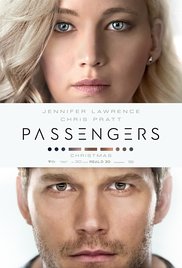
Passengers (2016)

Passengers (2016): written by Jon Spaihts; directed by Morgan Tyldum; starring Jennifer Lawrence (Aurora Lane), Chris Pratt (Jim Preston), Michael Sheen (Arthur the Android Bartender), and Laurence Fishburne (Gus Mancuso): There was a lot of (rhetorical) hand-wringing when Passengers hit theatres last winter over a particular decision made by Chris Pratt's character. And yes, it's a terrible decision. And the ultimate reaction of Jennifer Lawrence's character is going to be disturbing for a lot of people. But Passengers was still a lot more entertaining than I expected.

The film-makers even tried to go for a certain level of scientific accuracy, at least as we know it now. The Starship Avalon is a colony ship delivering 5000 passengers in some form of suspension to a colony world roughly 60 light years from Earth. The ship rotates those sections that require artificial gravity, as would we. And it's restricted to slower-than-light travel, as would we be. So kudos for that, though implausibilities creep in throughout as to how spin-generated AG would work.

The trip takes 120 years, so everyone onboard sleeps for most of it. Except something happens and Chris Pratt, a lovable mechanic, wakes up with 90 years to go. He's increasingly lonely. Then Jennifer Lawrence, a lovable writer, wakes up. Then some other stuff happens.

Passengers goes pretty much everywhere I expected it to go. But the set design and the CGI are actually interesting, and Lawrence and Pratt make for an engaging pair (along with lovable android bartender Arthur, played by Michael Sheen). There are a number of Idiot Plot moments, but not enough to destroy the viewing experience. And at least this is neither a superhero movie nor a giant epic. Jennifer Lawrence gets top billing, possibly because the plot requires her to strip down to her underwear or bathing suit every 20 minutes. Next time, make her the mechanic and Pratt the writer. Lightly recommended.

Monday, November 7, 2016

Eight is Enough

Dracula (1931): adapted by Hamilton Deane and John L. Balderston from the play by Garrett Fort adapted from the novel by Bram Stoker; directed by Tod Browning; starring Bela Lugosi (Dracula), Helen Chandler (Mina), David Manners (John Harker), Dwight Frye (Renfield), and Edward Van Sloan (Van Helsing): This stagey, bloodless Dracula was a big hit in 1931. It has the hallmarks of early sound film -- that super-heavy, static sound camera pretty much necessitated a nearly immobile, stagey shot. 

Bela Lugosi is great, especially in the first section set at Castle Dracula. Dwight Frye is a hoot as Renfield, the foundational figure for so many crazed characters to come in horror movies. Once the action moves to England, things become a bit tedious. And the censorship people ensure that Dracula dies off-screen with barely an "Argh!" to mark his passing. F.W. Murnau's bootleg Dracula, Nosferatu (1922), is a far superior work, as are many of the later adaptations. Still, Lugosi remains a bracing presence. Recommended.


John Carpenter's Vampires (1998): adapted by Don Jakoby from the novel by John Steakley; directed by John Carpenter; starring James Woods (Jack Crow), Daniel Baldwin (Montoya), Sheryl Lee (Katrina), Thomas Ian Griffith (Valek), Tim Guinee (Father Guiteau), and Maximillian Schell (Cardinal Alba): One of John Carpenter's crappier offerings. Oh, sure, it has its moments. But it's crippled by a totally uninteresting vampire antagonist (Thomas Ian Griffith), sloppy writing, and the perplexing choice to have Daniel Baldwin play a character named 'Montoya,' complete with dyed-black hair to, I suppose, trick the audience into thinking Baldwin is Hispanic. The treatment of women is a bit... problematic, given that women in this movie are either prostitutes or vampires (or in Sheryl Lee's case, both).  I was entertained, but not a lot. Lightly recommended.


Krampus (2015): written by Michael Dougherty, Zach Shields, and Todd Casey; directed by Michael Dougherty; starring Adam Scott (Tom), Toni Collette (Sarah), David Koechner (Howard), Emjay Anthony (Max), and Conchata Ferrell (Aunt Dorothy): Michael Dougherty's ode to Gremlins isn't as good as Gremlins (which was also set at Christmas), which may be more an indictment of studio interference than anything else. Krampus, which visits the Germanic anti-Santa Claus on a small American town that has forgotten the meaning of Christmas, needs sharper editing in its first half, which seems to run on forever while we wait for Anti-Claus to show up.

Thankfully, Krampus and his twisted minions -- horrible snowmen, horrifying toys, homicidal gingerbread men, and a really nice looking evil Christmas-tree Angel -- do arrive to scare and stalk Adam Scott's family, who are too angry and fractious for The True Meaning of Christmas to take hold. There are some lovely effects both mechanical and CGI animating the various monsters, including Krampus itself. And there's a real sense of menace as things roll towards the end.

Depending on one's interpretation, Krampus either manages a treacly happy ending, a slightly menacing happy ending, or a refreshingly bleak ending in which not even a baby is safe from damnation. Seriously. At 100 minutes, Krampus feels about 15 minutes too long and two sugar packets too sweet for some stretches. But I still enjoyed it. I also enjoyed that it offers an odd commentary on this year's U.S. election: Republican or Democrat, Krampus is taking none of your self-serving bullshit if you're committed to a world where only money matters. Recommended.


The Forest (2016): written by Nick Antosca, Sarah Cornwell, and Ben Ketai; directed by Jason Zada; starring Natalie Dormer (Sara/ Jess Price) and Taylor Kinney (Aiden): Dull film set mostly in Japan's 'Suicide Forest' (but filmed in Serbia) wastes a solid turn by Natalie Dormer as twin sisters. That this movie is actually inferior to the straight-to-cable, bafflingly titled The Last Halloween/ Grave Halloween is an extraordinary feat of wasted opportunity. Among other things, features characters following a river by walking away from said river at a 90-degree angle. OK! Not recommended.


Joy (2015): written by Annie Mumolo and David O. Russell; directed by David O. Russell; starrimg Jennifer Lawrence (Joy), Robert De Niro (Rudy), Bradley Cooper (Neil Walker), Diane Ladd (Mimi), Edgar Ramirez (Tony), Virginia Madsen (Terry), Isabella Rossellini (Trudy), and Dascha Polanco (Jackie): Another enjoyable David O. Russell/Jennifer Lawrence/Bradley Cooper movie, not up to the standards of American Hustle or Silver Linings Playbook but still solid, quirky drama. 

It's all expressionistically based on a real person, nearly broke new Jersey housewife Joy, who's suppressed her creative and financial acumen for much of her adult life until she invents a new type of mop. With some aid and a lot of the exact opposite of aid from family members and friends, she eventually becomes a home-shopping success. 

The acting is fine -- fine enough that it sometimes takes time to register what utter dinks Joy's father (De Niro), his new girlfriend (Rossellini), and Joy's half-sister can be, and are, most of the time. A story of female empowerment through engineering and financial acumen is a pretty unusual thing. And the legal ins and outs of patent law end up being pretty gripping. The ending needs more work, and the partial-flashback-with-narration structure never quite seems to gel. Nonetheless, Lawrence is splendid, as is most of the supporting cast. Recommended.


Jack Reacher (2012): adapted by Christopher McQuarrie from the novel One Shot by Lee Child; directed by Christopher McQuarrie; starring Tom Cruise (Jack Reacher), Rosamund Pike (Helen), Richard Jenkins (Rodin), David Oyelowo (Emerson), and Werner Herzog (The Zec): Surprisingly fun thriller with 5'7" Tom Cruise playing novelist Lee Child's 6'4" hero Jack Reacher. The Usual Suspects screenwriter Christopher McQuarrie knows how to write a decent script and how to direct it. A long cameo appearance by Robert Duvall is a bit wonky. Surprisingly for a modern thriller, there's neither any real development of a love interest for Reacher -- he and Rosamund Pike remain platonic pals -- nor any touchy-feely character development for Cruise's character. He's just a hyper-competent guy living off the grid. Recommended.


Jack Ryan: Shadow Recruit (2014): written by David Koepp and Adam Cozad, based on characters created by Tom Clancy; directed by Kenneth Branagh; starring Chris Pine (Jack Ryan), Keira Knightley (Cathy Muller), Kevin Costner (Thomas Harper), and Kenneth Branagh (Viktor Cherevin): Paramount attempts to reboot the Jack Ryan franchise by moving the characters about 40 years forwards in time and turning Ryan from a naval expert to a financial wizard. The first half actually goes pretty well, with Chris 'NuCaptain Kirk' Pine playing Ryan as a sort of Captain Kirk of the banking system. Indeed, the relationship between Pine and his CIA recruiter-turned-controller Kevin Costner plays an awful lot like the Kirk/Pike relationship in the 2009 Trek reboot. Kenneth Branagh, slumming again, does an able job. But the script goes completely awry in the second half, degenerating into an endless car chase that satisfies not at all. And let's face it -- computer-based financial warfare just isn't as interesting in a cinematic sense as a submarine chase. Ultimately, not recommended.


The Hound of the Baskervilles (1959): adapted by Peter Bryan from the novel by Arthur Conan Doyle; directed by Terence Fisher; starring Peter Cushing (Sherlock Holmes), Andre Morrell (Doctor Watson), Christopher Lee (Sir Henry Baskerville), Marla Landi (Cecile Stapleton), Ewen Solon (Stapleton), and Francis de Wolff (Dr. Mortimer): Zippy, relatively faithful Sherlock Holmes movie casts an energetic though diminutive Peter Cushing as the great detective and Christopher Lee as the target of the Baskerville curse. This came from Hammer Films, generally best known for horror in the 1950's and 1960's -- indeed, the interiors of Baskerville Hall previously served as Dracula's home in Horror of Dracula. As usual for Hammer, the movie looks great and moves with great pace to its conclusion. It's a shame Hammer didn't make more Holmes movies. Recommended.

Friday, June 6, 2014

Needs More Quicksilver

X-Men: Days of Future Past: adapted by Simon Kinberg, Matthew Vaughn, and Jane Goldman from the comic-book story by Chris Claremont, John Byrne, and Terry Austin; directed by Bryan Singer; starring Hugh Jackman (Wolverine), James McAvoy/Patrick Stewart (Charles Xavier), Michael Fassbender/Ian McKellan (Magneto), Jennifer Lawrence (Raven/Mystique), Ellen Page (Kitty Pryde), Peter Dinklage (Trask), Shawn Ashmore (Iceman), Halle Berry (Storm), Nicholas Hoult (Beast), Omar Sy (Bishop), Evan Peters (Quicksilver), Daniel Cudmore (Colossus), Bingbing Fan (Blink), Adan Canto (Sunspot), and Booboo Stewart (Warpath) (2014):

A relatively sprawling movie adapted from a 34-page comic-book story from the early 1980's which itself took its title from a Brian Eno album, X-Men: Days of Future Past follows up the good work done by X-Men: First Class in making X-Men movies enjoyable again after the debacle that was the Brett Ratner-directed X-Men: The Last Stand and the twin thuds of the solo Wolverine movies.

Brian Singer, who directed the first two X-Men movies that really kicked off the Marvel Movie Juggernaut starting in the year 2000, returns to the series with his limited colour palette and earnest tone. Well, mostly earnest. The best scene in the movie features some very funny super-heroics set to Jim Croce's "Time in a Bottle."

It's the best scene from any Bryan Singer movie, ever, and so show-stopping that the rest of the movie seems somewhat workmanlike by comparison. If anyone had said before the movie's release that the mutant speedster Quicksilver would steal the movie in a good way, I think that person would have been committed. But he's great. The movie needs more of him. Hell, the X-Men needed more of him by the conclusion.

Time travel drives the plot here. The original comic-book story predated both Back to the Future and The Terminator movies, so save your comments on who's stealing from whom. Wolverine, everybody's favourite veiny Canadian mutant, must travel from the dystopic near-future to the early 1970's to save mutants and humanity alike from a dire fate at the hands of a bunch of levitating sand-crawlers that disgorge endless streams of killer robots. Once in the past, Wolverine teams up with the young versions of Professor X and Magneto; in the future, they stand together despite their differences in the past.

Jennifer Lawrence is given a lot to do this time, as the plot hinges on what her character. Mystique, decides about her path in life. Sometimes she's in her scaly blue body-suit and sometimes she looks like Jennifer Lawrence. So it goes. Much super-heroing and angsting ensues, all of it in the mode that Chris Claremont, John Byrne, and Dave Cockrum brought to those 1970's and early 1980's X-Men adventures.

Not everything works, and the plot could use about one fewer transAtlantic trip towards the end, but enough works to make things pretty enjoyable. Peter Dinklage is a bit wasted as a one-note villain, but he does what he can. And the design on the future Sentinels really is top-notch. They're actually scary. Recommended.

Wednesday, December 4, 2013

Dancing in the Dark

Silver Linings Playbook: adapted by David O. Russell from the novel by Matthew Quick; directed by David O. Russell; starring Bradley Cooper (Pat), Jennifer Lawrence (Tiffany), Robert de Niro (Pat Sr.), Jacki Weaver (Dolores), and Chris Tucker (Danny) (2012): While not the most realistic depiction of mental illness in movie history, Silver Linings Playbook does have its heart in the right place insofar as Bradley Cooper's character really does need to take his meds. Jennifer Lawrence, not so much. And ballroom dancing isn't presented as a cure for all forms of mental illness, though at times it seems awfully close.

Lawrence, who won the Best Actress Oscar for 2012 for her role in this movie, is very good. She's developed some sort of weird muscle control that gives her a mask-like face at times, the features softening at others. Is it acting or is it Botox? I don't know. But it works with the character, whose depression precedes the death of her husband, after whose death things fall completely apart.

Cooper is also excellent. He nails the delusional rhythms of mania, the boundless delusional energy. And he conveys the subsequent exhaustion nicely as well. He's a sharp actor with surprising depths. He sells certain aspects of his mental problems without recourse to exposition, and rings true throughout. Robert de Niro is anachronistically measured and controlled as Pat's occasionally delusional, OCD-afflicted father, and Jacki Weaver shines as Pat's long-suffering mother, who seems to be the only fully sane person in the movie.

The fairy-tale quality of Silver Linings Playbook probably irked a lot of people who deal with mental-health issues on a daily basis. And it really is a fairy tale, though thankfully one with a certain measure of permanent darkness. Most of the comedy flows from plausible scenarios -- I especially liked Pat repeatedly waking his parents up at 3 a.m. to rant about a novel he'd just read. And Pat's obsession with his estranged wife's high-school English course syllabus rings true as well, something that's funny from the outside but also a symptom of deep mental distress.

Ultimately, Silver Linings Playbook is a romantic comedy about severely screwed-up people, and if it's not truly realistic, it's still a more laudable portrayal of characters with mental-health problems than, say, the ludicrous A Beautiful Mind. Recommended.