Showing posts with label boris karloff. Show all posts

Saturday, September 10, 2016

Suspense and/or the Lack Thereof

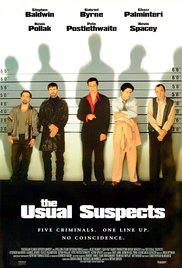
The Usual Suspects (1995): written by Christopher McQuarrie; directed by Bryan Singer; starring Stephen Baldwin (McManus), Gabriel Byrne (Keaton), Benicio Del Toro (Fenster), Kevin Pollak (Hockney), Kevin Spacey (Verbal), Chazz Palmintieri (Dave Kujan), Pete Postlethwaite (Kobayashi), and Giancarlo Esposito (Jack Baer): Still the best thing writer Christopher McQuarrie and director Bryan Singer have ever done, 21 years later. 

And that's OK because among the peaks and troughs of the Tarantino Wave of the early-to-mid-1990's, The Usual Suspects is a very high peak indeed. A delightful, violent romp that also serves as a meditation on the telling and receiving of stories, The Usual Suspects never lags and gets the best out of both able actors (Gabriel Byrne, Kevin Spacey) and otherwise undistinguished actors whose best work appears here (Stephen Baldwin, Kevin Pollak). Benicio del Toro is nearly unrecognizable physically and, thanks to some extremely odd speech patterns, aurally. Highly recommended.


Don't Breathe (2016): written by Fede Alvarez and Rodo Sayagues; directed by Fede Alvarez; starring Stephen Lang (The Blind Man), Jane Levy (Rocky), Dylan Minnette (Alex), and Daniel Zovatto (Money): Admirably tense, terse thriller set in the post-apocalyptic wasteland of present-day Detroit. The creative minds behind the solid remake of Evil Dead go with a bit less gore and grue here, though more than one scene is Not For The Squeamish

The young actors are good as three sympathetic burglars who pick the wrong house, while Stephen Lang (Avatar's nutty Colonel) is extraordinarily menacing as the blind, buff homeowner whose house our unfortunate trio break into in search of a hidden cache of Get Out of Detroit cash. The movie may invert the central premise of classic 1960's thriller Wait Until Dark, but it's also a horrifying reimagining of The Treasure of the Sierra Madre. Brutal but never exploitative. Highly recommended.


Black Sabbath (I tre volti della paura) (1963): adapted from works by Ivan Chekhov, F.G. Snyder, and Aleksei Tolstoy by Mario Bava, Alberto Bevilacqua, and Marcello Fondato; starring Boris Karloff (Gorca/Narrator) and others: Something of a stinker of an Italian anthology horror film from the early 1960's, redubbed for English-speaking audiences. Boris Karloff is fine as both frame narrator and Vourdalak in the third segment. 

The first segment actually goes pretty well until the film-makers unwisely over-use their initially effective Dead Witch Dummy (TM). The second sequence sucks. The third sequence, in which a vampire-like Vourdalak terrorizes a travelling nobleman and a family of peasants, is utterly ridiculous in its plot. It's like a training film on what not to do when menaced by the Undead. Or a cautionary tale about the plague of narcolepsy that ravaged Eastern Europe in the early 19th century. Not recommended.


Spectre (2015): written by John Logan, Neal Purvis, Robert Wade, and Jez Butterworth; directed by Sam Mendes; starring Daniel Craig (James Bond), Christoph Waltz (Blofeld), Lea Seydoux (Madeleine), Ralph Fiennes (M), Ben Whishaw (Q), Naomie Harris (Moneypenny), and Andrew Scott (C): Spectre is a lot like the Roger Moore Bond movies, except for the fact that it's grim rather than light-hearted. And perhaps even more improbable than even the last couple of lousy Moore Bonds. Daniel Craig looks ready to quit the role, and the film-makers don't seem to have written a movie so much as hastily assembled a series of flawed action sequences. 

This lumpy, careless James Bond moves through a world which is either intensely over-crowded or populated by no one but himself, his unlikely love interest, and whoever's trying to kill him. Christoph Waltz does his best to menace in a non-menacing role as an unconvincingly retconned Blofeld, while Andrew Scott, so great as Moriarty to Benedict Cumberbatch's Sherlock Holmes, is mostly wasted as a nefarious British bureaucrat/technocrat. If I never see another climax to an action movie that involves doing something with a computer, it will probably be too soon. Though I did like an earlier action sequence that terminates with the fiery revelation that the bad guys have built their secret HQ out of gas pipelines and exploding wood. Not recommended.


Hitchcock/ Truffaut (2015): written by Kent Jones and Serge Toubiana; directed by Kent Jones; narrated by Bob Balaban: It's too short and it doesn't name the directors who discuss Hitchcock throughout the documentary until the end credits. But it's still great to revisit the monumental Hitchcock/Truffaut book, initially compiled and published in 1966 from a series of interviews Francois Truffaut conducted via translator with Alfred Hitchcock in 1962. Young (Wes Anderson) and old (Martin Scorsese) alike hold both the book and Hitch himself in monumental regard. 

The movie introduces the viewer to several key moments in the text, with special attention paid to Notorious, The Birds, Psycho, and Vertigo. It might help to read the book either immediately before or after seeing the documentary. It's impossible to imagine any contemporary, commercial film-maker being as visually and thematically complex as Hitchcock turned out to be over his 50-year film-making career. He's the Great White Whale of movies, the immensely popular and complex artist. Highly recommended.

Thursday, February 18, 2016

Secret Movie

Ancient Images (1989) by Ramsey Campbell: Probably the sleekest, most thriller-like novel in the prolific Ramsey Campbell's catalogue, Ancient Images is a story of detection with occult elements that begin to dominate as the novel progresses. 

It's 1988 in London, England. Metropolitan TV film editor Sandy Allan witnesses the baffling, apparent suicide of her friend and mentor, a film historian who had just announced that he'd secured a copy of a long-lost 1938 Boris Karloff and Bela Lugosi British horror film. But the film isn't in Sandy's mentor's ransacked apartment. 

In order to help deal with her trauma, Sandy uses the mentor's notebook to reconstruct a list of people to contact about the film. She takes holiday time and with the help of an American film writer sets out to see if she can track down another copy of the film.

Her quest takes her across much of England. Many of the actors and production staff remain alive 50 years later. Not so much the director, who died in a car crash mere days after the completion of filming.  

Campbell does such a fine job of describing the fictional film that one starts to wish it were real -- if so, it would be one of Karloff and Lugosi's finest on-screen team-ups. Along the way, Campbell deals with anti-horror, censorship crazes in Great Britain in both the 1930's and 1980's. The English peer responsible for the initial quashing of the film invoked the good of the British people back in 1938 as to why this horror film -- and horror films in general -- shouldn't be allowed in Great Britain. In 1988, the 'Video Nasties' censorship hysteria is in full-blown inferno.

But Sandy won't be dissuaded, despite increasingly weird goings-on, the mysterious death of her cats Bogart and Bacall, and a growing sense of being followed. Campbell has noted that Sandy is perhaps his least tortured, most 'normal' protagonist. This aids in the generation of suspense -- she's not the sort of Campbell character who would believe in even the possibility of the supernatural. All those times she thinks she sees something at the edge of vision -- well, they can be explained away. Can't they?

Its likable, uncomplicated protagonist and its detective-thriller architecture make Ancient Images Campbell's most accessible book to non-horror readers, in my humble opinion. It's a terrific ride with a tense climax. Highly recommended.

Monday, October 13, 2014

Misapplied Titles

The Devil Commands: adapted by Robert Andrews and Milton Gunzburg from the novel The Edge of Running Water by William Sloane; directed by Edward Dmytryk; starring Boris Karloff (Dr. Blair), Cy Schindell (Karl), Amanda Duff (Anne), Anne Revere (Mrs. Walters) and Richard Fiske (Richard) (1941): Moody, atmospheric horror film with Karloff as a Mad Scientist, or more accurately a sane scientist driven mad by his wife's death and the subsequent revelations about the afterlife as revealed by his investigations into brain function.

Frame narration from Karloff's daughter doesn't really help with suspense, but the movie as a whole is enjoyable. Karloff is more mournful and far less threatening than usual as the increasingly loopy scientist who believes that he can build a machine to communicate with the dead in general and his wife in particular. And what a machine! The final form of his 'Dead Set' really makes the whole movie worthwhile. It's Vacuum-Tube Gothic.

Other elements are perhaps a bit more rote, from the grieving daughter and her boring love interest to the wily sheriff. Karloff's hulking henchman Karl possesses a bit more pathos than most such characters, as we see the accident that 'creates' him. An unscrupulous 'fake' medium who turns out to have real psychic powers (shades of Ghost!) rounds out the major players.

Director Edward Dmytryk is better at mood and atmospherics than he is pacing -- the whole thing drags a bit, which shouldn't really happen with a 65-minute movie. Nonetheless, a grim and surprisingly downbeat movie for its time. Recommended.


The Tomb (2nd revised edition) by F. Paul Wilson (2004/ previously published in different form in 1984 and 1998): Originally the first appearance of Wilson's Repairman Jack character, The Tomb would later be substantially revised, along with a number of other Wilson novels, as the writer fleshed out his Adversary Cycle and the Repairman Jack series that wove in and out of that Cycle.

But originally, this was a 1984 one-off. There wouldn't be another Jack novel for about a decade. In the revised version, its timeline moved up to the 21st century, The Tomb has been retconned into the 21st century.

Jack is a sort of altrusitic, libertarian superman. Or supercompetentman. He's off the grid. He fixes problems for people, sometimes violently, sometimes not. 'The Tomb' wasn't Wilson's preferred title -- it was meant by the publisher to echo the title of Wilson's previous hit, The Keep, even though there's no actual tomb in the novel. Instead, there are mysterious disappearances in New York, flashbacks to mid-19th-century India, and terrible things hidden inside a mysterious freighter. There are monsters. Smelly, seemingly invincible monsters.

The good parts of The Tomb are very good: Jack's investigation is suspenseful, and both the historical sections and the horror sections of the novel are skilfully written. About three-quarters of the novel is thus an occasionally thoughtful page-turner. Unfortunately, about one-quarter of the novel focuses upon the love of Jack's life, Gia, and her idiot daughter Vicky. But by God, even though Wilson doesn't write children well doesn't mean he's not going to keep trying! And ditto for Gia, whose personality consists of about equal parts worrying about Vicky and mulling over Jack. That's all you're going to get, so don't wait around for wit. Well, she really enjoys cleaning things. I kid you not.

Vicky may be central to the plot, but you can still skim much of the material focused upon her and her mother. They're a tremendously dull pair (and will continue to be dull yet hazardous for every Repairman Jack novel) when they're not getting into trouble. And when Vicky gets into trouble late in this novel, it's through doing something stupid that spins off from Jack doing something stupid by not fully explaining something because if he'd fully explained something, we wouldn't have a hostage for the second climax of the novel. Oh, well. A lot of the Gia/Vicky sections don't feature Jack, meaning that skimming is pretty easy. Real, real easy. Recommended.

Friday, October 3, 2014

Old-Time Religion

The Mummy: adapted by John Balderston from a story by Nina Wilcox Putnam and Richard Schayer; directed by Karl Freund; starring Boris Karloff (Imhotep) and Zita Johann (Helen Grosvenor) (1932): The first Universal Frankenstein movie had made Boris Karloff a big enough star by the time The Mummy was released that the legend 'Karloff!' dominated the posters. And Karloff and the set design are really the stars here -- Karloff's co-stars are a terribly forgettable lot. I've forgotten them already.

Of course, Karloff only appears in full mummy regalia for a couple minutes. For the rest of it, he's sinister but human-looking as the resurrected Egyptian priest Imhotep, mummified alive for the crime of loving the Pharoah's daughter. But you can't keep a good monster down.

Inspired by stories of the Curse of King Tut's Tomb, The Mummy sends Karloff on a tour of vengeance and love, as he seeks the reincarnation of his lost love. Yes, reincarnation. Not something the Ancient Egyptians were known for believing in, but what the Hell. Who can tell Hinduism from Egyptian mythology? You might as well just worship Hawkman!

Karloff is great as Imhotep. In one of his first full speaking roles as a horror star, Karloff seems to intuitively understand something that a lot of early sound actors did not: Less is More on the big screen. He has that great Grinch Karloff voice, and he knows how to use it -- for the most part, insinuatingly, softly. His movements are slow and patient, befitting a 3700-year-old man-mummy. Every time I see Karloff in a movie, major or slight, I'm again impressed by what a natural-seeming, finely tuned screen actor he was. I can pretty much happily watch him in anything. Recommended.


Philomena: adapted by Steve Coogan and Jeff Pope from the book by Martin Sixsmith; directed by Stephen Frears; starring Judi Dench (Philomena), Steve Coogan (Martin Sixsmith), Michelle Fairley (Sally Mitchell), and Anna Maxwell Martin (Jane) (2013): Steve Coogan shines again in a road trip movie, this one teaming his writer/reporter character with Judi Dench's eponymous Philomena as they embark on a mostly true story of lost children and Irish Roman Catholicism.

50 years before the main, early 21st-century events of the movie, young Philomena gave birth out-of-wedlock to a son. At the time, she was a prisoner in all but name of a Roman Catholic girls' reformatory run by nuns. In exchange for laborious work, the girls -- many of them in their early teens and pretty much all of them sent to the reformatory by relatives ashamed of their pregnancies -- got room, board, and one hour a day with their children. And then the children were put up for adoption.

Director Stephen Frears depicts the horrors of the past with a deft touch. He also uses identifiably 'old' media to depict many of Philomena's memories and conjectures about things she never witnessed: washed-out tones of old photos, 8 mm home movies, washed-out home video. The present sees the unlikely pair of grouchy, atheistic lapsed Catholic Coogan and (almost) perennially cheerful Philomena strive to discover what happened to Philomena's son. The former reformatory is politely non-commital. And lo, all the papers indicating the destinations of the adopted children burned in a mysterious fire!

The writing, partially by Coogan, is a delight. Both characters are right in their own ways at certain times -- Philomena may scold Coogan's Martin Sixsmith for his anger and cynicism, but it's that anger that gets the answers to certain questions. And the actions of the reformatory and its inheritors are absolutely dire and loathsome. Philomena's apologies for the actions of the Roman Catholic hierarchy wear a bit thin at times, but are nonetheless depicted as being an essential component of the more admirable facets of her character. Dench is a delight. Coogan is a delight. Maybe they should add Philomena to Coogan's next The Trip movie. Highly recommended.

Monday, January 13, 2014

Secret World

The Secret Life of Walter Mitty: based on the short story by James Thurber, written by Philip Rapp, Everett Freeman, and Ken Englund; directed by Norman Z. McLeod; starring Danny Kaye (Walter Mitty), Virginia Mayo (Rosalind van Hoorn), Boris Karloff (Dr. Hollingshead), Fay Bainter (Mrs. Mitty), Ann Rutherford (Gertrude Griswold) and Thurston Hall (Bruce Pierce) (1947): Hit film of 1947 follows James Thurber's short story almost verbatim for the first 20 minutes or so until it (necessarily) expands into a narrative involving spies, art theft, and a Nazi mastermind named The Boot.

The patience of some people (including James Thurber) was tested by the inclusion of several musical set-pieces for star Danny Kaye. Fast-paced, comical, tongue-twisting songs were Kaye's speciality, and he performs two here in their entirety. If you hate them, fast forward.

Kaye plays well-meaning, eternally day-dreaming Walter Mitty with real charm. The rest of the cast is solid as well, with Virginia Mayo as a love interest who pulls the engaged and somewhat infantilized Mitty into the world of espionage and, ultimately, adult-hood. Boris Karloff makes a great villain, as always, and ubiquitous character actor Thurston Hall sputters and fulminates nicely as Mitty's magazine-editor boss.

One of the things that marks this as a non-contemporary Hollywood movie is that Mitty's awakening doesn't turn him into a superheroic Everyman. He has to use his brains and a bit of luck when the plot reaches full boil. Adulthood didn't require hypercompetent ultraviolence in 1947. Recommended.

Tuesday, November 20, 2012

Duets

21 Jump Street: based on the television series created by Stephen J. Cannell and Patrick Hasburgh, written by Michael Bacall and Jonah Hill; directed by Phil Lord and Christopher Miller; starring Jonah Hill (Schmidt), Channing Tatum (Jenko), Brie Larson (Mollie), Dave Franco (Eric), Rob Riggle (Mr. Walters) and Ice Cube (Captain Dickson) (2012): Hilarious comedy reboot of the not-so-good 1980's TV series that introduced Johnny Depp and Richard Grieco to the world. Cops pretend to be teenagers and bust crimes at a high school. What could go wrong?

Almost obsessively filthy-mouthed, the movie makes good use of Jonah Hill's weirdly earnest nebbish personality by setting it off against Channing Tatum's seemingly dumb but well-meaning jock. They weren't friends in high school, but they become so in police academy. And now they're assigned to take down the suppliers of a dangerous new super-drug at a local high school. Will they also purge the demons that have haunted them since senior year?

Ice Cube swears and fulminates as the captain. Dave Franco stirs up echoes of the early, burn-out charm of his older brother James. Actors from the TV series make surprise cameos. Hill again shows his gift for slapstick, but Tatum also demonstrates comic timing and physical prowess. Who knew he was funny? Oh, and a guy gets his dick shot off. Also, Korean Jesus. Recommended.


The Raven: written by Richard Matheson, based on the poem by Edgar Allan Poe; directed by Roger Corman; starring Vincent Price (Craven), Peter Lorre (Bedlo), Boris Karloff (Scarabus), Jack Nicholson (Rexford Bedlo), Hazel Court (Lenore) and Olive Sturgess (Estelle Craven) (1963): Screenwriter Richard Matheson is an American treasure for his short stories, novels, and screenplay work, pretty much all in the thriller, horror, and fantasy genres. You can look him up.

Here, he takes Edgar Allan Poe's poem and turns it into a horror-comedy about dueling wizards (Karloff and Price), a snivelling second banana (Lorre), and a shockingly young Jack NIcholson as a young romantic lead. The wizard's duel is witty and surprisingly good-looking given the technical and budgetary limitations the film faced. Roger Corman's direction is relatively sharp. The acting is pretty much all first-rate, with Karloff uncharcteristically loose and funny as the nefarious Scarabus.

Price is great as he usually was. Holy crap, though, The Raven really highlights his height -- Price, an uncharacteristic-for-Hollywood 6'4" towers over 5'11" Karloff and dwarfs the 5'5" Lorre. Everyone seems to be having a good time, and Matheson even sneaks in a reference to The Day the Earth Stood Still, a movie he had nothing to do with. The only creepy moments involve the really nice make-up design on a couple of corpses. And by 'nice', I mean 'grotesque.' Recommended.

Tuesday, October 16, 2012

Et Tu, Brain?

Black Friday: written by Curt Siodmak and Eric Taylor; directed by Arthur Lubin; starring Boris Karloff (Dr. Ernest Sovac), Stanley Ridges (Kingsley/'Red' Cannon), and Bela Lugosi (Marnay) (1940): A relatively late Karloff/Lugosi team-up marred by the incredibly stupid decision of the producers to re-cast the movie, putting the little-known Stanley Ridges into the 'monster' role originally intended for Karloff. Lugosi got moved from the Karloff role into a supporting bit as a gangster.

Why? Theories abound. Lugosi was having problems with heroin addiction at the time, and in this B-movie he flubs several lines that nonetheless remain in the final cut. However, it's generally believed that the studio didn't like Karloff's performance as the dual-brained Kingsley/'Red' Cannon figure. So it goes.

Karloff is apparently an Eastern European surgeon with a slight British accent (yes, they didn't change the character name when they moved Lugosi out of the role). His English professor buddy gets run over by a gangster. The gangster breaks his back; the professor breaks his brain.

So Karloff replaces part of his friend's brain with gangster brain. Or maybe all of it. The movie is a bit shifty on the whole issue of how much brain goes where. In any case, I assume Karloff used the screw-top brain surgery method on his pal, given that he's back to looking completely normal two months later.

Soon gangster and English professor war for possession of the same body. One of the side effects of the brain surgery appears to be the ability to control one's hair colour. Man, brain surgery is awesome! I wish I could have brain surgery so that I could figure out why this movie is entitled Black Friday.

Screenwriter Curt Siodmak would return to this sort of exercise in human duality in the much better Donovan's Brain. Here, it's pretty hard to believe that the professor can go on a killing spree. I might be able to believe that Karloff could beat the hell out of half-a-dozen hardened criminals. With Ridges in that role, one can only assume that having half your brain replaced gives you super-strength. Ridges is OK in the role -- he's just a disappointment compared to what Karloff might have done with it. Lugosi is completely wasted, never sharing a scene with Karloff, and never convincing in any way as a gangster. Lightly recommended.

Friday, April 6, 2012

Radium Exit

The Invisible Ray: written by Howard Higgin, Douglas Hodges, and John Colton; directed by Lambert Hillyer; starring Boris Karloff (Dr. Janos Rukh) and Bela Lugosi (Dr. Felix Benet) (1936): Borderline crazy scientist Karloff discovers 'Radium X' in Africa, a space-born mineral with both healing and killing powers. Lugosi's character figures out how to heal people with it; Karloff's character goes another way. Fun melodrama with some striking visual effects for its time, and strong performances from both Karloff and a refreshingly non-scenery-chewing Lugosi. Bears some resemblance to H.P. Lovecraft's 1928 story "The Colour Out Of Space." Recommended.

Sunday, March 11, 2012

Black Raven


The Raven, 'inspired' by the poem by Edgar Allan Poe, written by David Boehm, Florence Enright, Michael L. Simmons, Dore Schary, Guy Endore, Clarence Marks, Jim Tully, and John Lynch; directed by Louis Friedlander; starring Boris Karloff (Edmond Bateman) and Bela Lugosi (Dr. Richard Vollin) (1935): Bela Lugosi's increasingly buggy surgeon loves the work of Edgar Allan Poe.

He loves it all so much that he's built a hidden torture chamber in his house filled with torture machines suggested by Poe's short stories and poems. He keeps stuffed ravens everywhere. And he loves quoting Poe. The nine-hundred writers who worked on this hour-long movie really went all out in the 'Inspired by Edgar Allan Poe' department.

There's even a modern-dance sequence that interprets Poe's poem "The Raven." They don't make horror movies like this any more.

Lugosi's Dr. Vollin becomes obsessed with the young dancer he saves with his surgical skill. With the unwilling help of escaped murderer Karloff (who gets the more sympathetic role here), he intends to revenge himself on everyone who's wronged him in the first fifteen minutes of the movie. Much hilarity and scenery-chewing ensues, along with some woeful comic relief, some ingenious death traps and hidden rooms (and rooms with hidden properties), and one of Karloff's subtlest performances.

As a strange bonus, Karloff's character ends up looking a lot like the inspiration for the Batman villain Two-Face, just as the protagonist of an earlier horror movie, The Man Who Laughs, is the spitting image of The Joker. Recommended.

Fear of a Black Cat

The Black Cat, written by Peter Ruric and Edgar Ulmer, 'inspired' by the short story by Edgar Allan Poe; directed by Edgar G. Ulmer; starring Bela Lugosi (Dr. Werdegast) and Boris Karloff (Poelzig) (1934): Karloff and Lugosi made seven movies together for Universal in the 1930's. This is the best of them, thanks in large part to B-movie auteur Edgar Ulmer's direction and set design. Lugosi's Werdegast was a Hungarian soldier imprisoned by the Russians for 18 years after World War One; Poelzig was his nemesis, a Russian military officer.
Lugosi's unusually heroic (for him) character tries to save an American couple from the Satanic Poelzig, now living in a Hungarian military fort turned into a manion, while also trying to discover the fate of his wife and child at the hands of the former enemy military commander.

The set design, lighting, and costuming all present a sort of Art Deco Gothic look that suits the material. Poelzig really is the leader of a Satanic cult. He also married Werdegast's wife after his imprisonment. And where is the daughter?

As with every one of the Karloff/Lugosi collaborations I've seen, the romantic leads are bland and forgettable, and the comic-relief bits are excruciating. Thankfully, Karloff and Lugosi aren't. Lugosi is uncharacteristically subdued here, possibly because he finally gets to play the hero. The movie looks great and has some nice, snappy dialogue ("Even the phone is dead" being my favourite one-liner). And there are dead women preserved in giant glass bottles and a high-stakes chess game! No killer apes, though.

The Poe elements are almost non-existent, limited pretty much to hints of heterosexual necrophilia and a black cat that wanders through at points to scare Werdegast, who suffers from fear of cats. Highly recommended.