Showing posts with label frank miller. Show all posts

Saturday, June 16, 2018

The Dark Knight III: The Master Race

SUPER BEST FRIENDS AGAIN !!!

The Dark Knight III: The Master Race (2016-2017/ Collected 2017): written by Brian Azzarello and Frank Miller; illustrated by Andy Kubert, Klaus Janson, Frank Miller, Eduardo Risso, John Romita Jr., Brad Anderson, and Alex Sinclair: Rumours are that Frank Miller had very little to do with the writing of this follow-up to The Dark Knight Returns (1986-87) and The Dark Knight Strikes Again (2001-2002). His art duties involve the inking of a few covers and drawing inter-chapter 'mini-comics' that contextualize portions of the main story. 

The main story is credited as 'Story by Frank Miller and Brian Azzarello.' Penciller Andy Kubert and inker Klaus Janson (inker of The Dark Knight Returns) do a fair job of maintaining their own styles while also paying homage to Miller's art style circa 1986. Miller's art in the mini-comics is sort of awful at points, reaching a nadir when he hinges the Atom's legs backwards, having apparently forgotten how knees work.

Taking up three years after The Dark Knight Strikes Again and six years after The Dark Knight Returns, DKIII again features aging versions of DC's major superheroes in a near-dystopic future. Events conspire to team up Batman, Superman, Wonder Woman, and many others to oppose a new global threat. One of the signs that Miller may not be writing much of the book is that Superman comes across pretty well for once, even saving Batman's life at one point. It's a shocker. 

Azzarello, if he scripted most of this, supplies lots of tough-guy and tough-girl introspection alongside all the fist fights and explodey-ness. Kubert and Janson give us suitably over-sized heroes and villains, innocents and grotesques and all that jazz. The whole thing goes down smoothly and way, way faster than the original The Dark Knight Returns and its intermittently densely packed pages of dialogue and exposition set off by full-page spreads. There's still satire here, particularly of both Obama and Trump, but it's pretty boilerplate stuff. 

Azzarello, not really known for writing superhero punch-ups, has written a giant superhero punch-up. It's enjoyable, certainly far more enjoyable than the clumsy and misanthropic Dark Knight Strikes Again, though no touch on the original. Miller's far-right politics seems to manifest in the idea of Kryptonian cultists who look and act a lot like stereotypical Muslim fundamentalists, but the comparison is never pushed too far (and these fundamentalists appear to believe in gender equality). In all, lightly recommended.

Tuesday, August 4, 2015

Super-children of the 1990's

Judgment Day: written by Alan Moore; illustrated by Rob Liefeld, Gil Kane, and others (1997/Collected 2003): One of those Alan 'Watchmen' Moore-penned volumes from the 1990's that always seem vaguely anomalous, coming as they do from Moore's time writing for Rob Liefeld's 'wing' of Image Comics that would spin off into its own separate publishing company during Moore's time writing for a couple of the Image 'wings.' This one involves Liefeld's superhero team Youngblood, there from the beginning of Image Comics in 1992. Moore's job seems to be to give the whole thing a veneer of artsiness unknown to Liefeld's output. Well, if not artsiness than at least metafictionality. 

The best parts of this series, which see a member of Youngblood put on trial for murder, involve flashbacks drawn by various artists. Most of the flashbacks are pastiches, often satiric in tone and content, of decades of comic-book titles and characters, from Old West heroes to Conan the Barbarian adaptations. And the whole plot revolves around a magical book that seems to prefigure Moore's really metafictional work in his own later title, Promethea. Moore was winning writing awards for his work on Liefeld's Superman homage Supreme at the same time, and Supreme shows up here as well. 

The whole thing goes down pretty smoothly, with some nice artwork -- especially that of Grandmaster Gil Kane on a couple of sections. This volume is both a curiosity and a harbinger of Moore work to come. Exaggerated claims of Watchmen-level relevance in the publisher's foreword  do seem both forced and gormless -- superheroes have been put on trial in one way or another prior to Judgment Day, from Batman in the 1940's to the Justice Society of America in the 1980's. Liefeld's art contributions are unusually awful and off-model at certain points -- his version of Erik Larsen's Savage Dragon is especially off, but the book is rife with characters with weird, up-turned nostrils and tiny, tiny feet. Recommended.


Spawn: Origins Volume 1: written and illustrated by Todd McFarlane (1992/ Collected 2009): Canadian writer-artist Todd McFarlane left Marvel Comics in 1992 along with five other creators to create creator-owned comic company Image. McFarlane, a popular Marvel artist on Spider-man and Hulk, soon launched Spawn. It rapidly became Image's best-selling title. Moreover, it became the best-selling superhero comic in North America for a few years, helping break the hold DC and Marvel had on the comic-book-buying public.

If you want to see what the fuss was about, these relatively recently released Spawn: Origins volumes are the way to go if you can find them remaindered. And boy, have I seen them remaindered for up to 80% off cover-price. They're certainly enjoyable in a pulpy way. McFarlane's greatest strength as an artist lies in full-page and double-page spreads; his weakness lies in panel-to-panel continuity, which sometimes degenerates to incomprehensibility. But the spreads are great. So too Spawn's cape and chains, which are less costume elements than they are design elements on a page. 

McFarlane isn't much of a writer, but it's at least competent superhero schlock. Spawn is basically a Marvel hero whose reasons to be angsty have been turned up to 11. A former heroic CIA Black Ops soldier, Al Simmons was killed by one of his own compatriots on the job under orders from his superior. Now he's back from the dead. Well, sort of. Really, he's still dead. He's just ambulatory and has super-powers. But he's also partially amnesiac. He's been gone for five years. And he owes Hell... something. Oh, and under his costume (which is actually a living supernatural symbiote), he looks like a mummy who stayed in the oven too long. Good times! And his widow married his best friend! And both Heaven and Hell keep trying to kill him! And he lives with a bunch of homeless people in New York's Bowery! Oh, Spawn. Spawn Agonistes! Recommended.


Spawn: Origins Volume 2: written and illustrated by Todd McFarlane with writing by Alan Moore and Frank Miller (1992-93/ Collected 2009): Todd McFarlane started to bring in guest writers with the issues collected in this second volume. Two issues that chronologically should appear herein but don't also included guest writers -- Neil Gaiman on one issue that would lead to more than a decade of legal battles between Gaiman and McFarlane, and Dave Sim on a metafictional odyssey co-starring his talking aardvark Cerebus. 

We do get Alan Moore and Frank Miller riffing on Spawn in issues that are much better written than McFarlane's efforts. So it goes. The whole volume entertains, McFarlane's art is very strong, and we get a storyline continued from the previous volume featuring antagonist Overtkill, one of the two or three most stupidly named super-characters of that baroque early 1990's age of super-powered characters with increasingly stupid names and increasingly cluttered costumes. Recommended.

Tuesday, March 18, 2014

Spider-men and 'Spides'

Dicks Volume 1: written by Garth Ennis, illustrated by John McCrea (1989-90, 1997, 2002): One of the earliest collaborations between the dynamic duo of Ennis and McCrea (Hitman) takes us through the hyper-violent, occasionally supernatural adventures of two Belfast screw-ups.

Your degree of enjoyment will depend a lot on how funny you think Ennis and McCrea are when they get all hyper-violent and super-offensive. I think they're funny, and the dense Belfastian slang just adds to the humour. Recommended.


Spider-man: The Original Clone Saga: written by Gerry Conway, Bill Mantlo, Len Wein, and Archie Goodwin; illustrated by Ross Andru, Sal Buscema, Jim Mooney, Frank Miller, and others (1974-75, 1979-80, 1989-91; collected 2011): The 'Original Clone Saga' comes in at about 500 pages, which works out to about two-dozen comic books spread out over nearly 20 years. However, it would also spawn what is probably still the longest Spider-man narrative in history. That would be the redundantly titled 'Clone Saga Epic.'

The 'Clone Saga Epic' was much-hated when it occupied every issue of every Spider-man title for a couple of years in the 1990's. The 'Original Clone Saga' (TOCS?) is really three story arcs that occur with several years separation between each one.

The first gives us the story of the attempts by somebody to drive Spider-man crazy by convincing him that murdered love Gwen Stacy is actually still alive. The second traces the strange story of Spider-villain Carrion. And the third...well, the third is one of those 'Everything you knew was wrong!' scenarios that, in the process of ostensibly making a previous story make more sense, actually causes that story to become completely goofy.

Nonetheless, this is an enjoyable survey of three different times in the publishing career of Spider-man. And the third arc, written by Gerry Conway, who also wrote stretches of the first arc, may actually be a parody of the 'Everything you knew...' trope that super-hero comic books have deployed since almost the beginning of superhero comics. Because if it's a parody, it's a funny one in which a new explanation that's supposed to make more sense than the old one actually requires much more suspension of disbelief.

The art is competent and, in stretches, quite enjoyable (though Frank Springer makes a terrible inker for Frank Miller -- their styles just don't work together). I especially like Ross Andru's Spider-man, though he, like Miller, is not always served well by his inkers. And the writing gives us, for the most part, that angst-ridden but dedicated Spider-man we know and love. Recommended.

Friday, January 31, 2014

Suckdevil

Daredevil: The Man without Fear: written by Frank Miller; illustrated by John Romita Jr. and Al Williamson (1993): What a dreadful piece of high-gloss hackery this miniseries is! Writer Frank Miller returns to the character he made essential reading in the early 1980's and pretty much carpetbombs everything that made Daredevil a sympathetic, tortured superhero in the process of completely rearranging and reimagining Daredevil's origins.

Events and characters become grotesque parodies of their earlier selves. Elektra is now crazy from the beginning, and has somehow gained so much heft that she resembles Jack Kirby's Big Barda more than her previous renditions. The pre-Daredevil Matt Murdock intentionally and unintentionally kills several people. Events that once occurred while Daredevil was actually Daredevil now occur before he adopted the costume.

Miller's guru-figure Stick, retconned by Miller into DD continuity in the early 1980's run, has now been retconned into an entire training sequence lasting months or even years for the young Murdock. And more Stick is not some sort of bonus -- he was already one of the most tedious Yoda figures ever inflicted on a hero. Now moreso.

John Romita Jr.'s art is a weird study here, as he occasionally evokes Miller's own artwork in certain sequences and panels. One really jarring panel sees Romita Jr. referencing Ronin-era Miller. It's jarring because Ronin-era Miller had just devoured French comics great Moebius's work and was in the process of regurgitating it all over the page; it's an homage of an homage. Romita Jr.'s work is competent, but it also isn't entirely 'him' -- and the Miller influences aren't organic at all, instead leaping to prominence on one page and then vanishing on the next.

It's the cynicism and meanness of this book that I suppose rankles the most. The characters are almost universally loathsome. A new, young, teenaged girl/sidekick gets added to Murdock's story, I'm assuming because Miller hadn't yet got his female Robin from 1986's The Dark Knight Returns out of his system. At least she doesn't suit up.

And boy, do Miller's previous tendencies to portray women as madonnas and/or whores get ramped up here. That and perhaps the world record for most uses of the word 'scent' in a superhero comic book. What a cruddy, cruddy book. Not recommended.

Tuesday, August 27, 2013

The Good, The Bad, and the Screwy

Hail the Conquering Hero: written and directed by Preston Sturges; starring Eddie Bracken (Woodrow Truesmith), Ella Raines (Libby), Raymond Walburn (Mayor Noble), William Demarest (Sgt. Heppelfinger) and Franklin Pangborn (Committee Chairman) (1944): Writer-director Preston Sturges had a run of movies during World War Two that may be unparalleled for quantity and quality among Hollywood comedy directors. Six years, about a dozen movies, and then a tremendous drop-off in quality -- but what a six years!

I'd rank Hail the Conquering Hero right up with Sullivan's Travels and The Palm Beach Story in Sturges' brief but mighty All-Star run. Eddie Bracken plays a young man with a war hero father from WWI whom he never met and a reputation to live up to. But his hay fever gets him kicked out of the Marine Corps.

Ashamed, Bracken tells his mother he's in the Marines anyway and hides out in San Diego for a year, until his kind act of buying a bunch of moneyless Marines drinks and food at a bar sets off a chain of events that leads his entire town to believe he's a war hero. And then a bunch of people decide to run him against the venial Mayor they already have.

Bracken is good as a kid who's pushed by events into worse and worse situations, and Sturges's crack team of character actors -- William Demarest as a sergeant who fought alongside Bracken's father chief among them -- are terrific as well. There's a moral at the end, a surprisingly pointed one that probably wouldn't make it into a Hollywood movie today. Throughout, the performances and the dialogue sparkle. Highly recommended.


Robocop 2: written by Frank Miller and Walon Green, based on characters created by Edward Neumeier and Michael Miner; directed by Irvin Kershner; starring Peter Weller (Robocop/Alec Murphy), Nancy Allen (Anne Lewis), Belinda Bauer (Dr. Juliette Faxx), Tom Noonan (Cain), Galyn Gorg (Angie), Gabriel Damon (Hob), and Dan O'Herlihy (The Old Man) (1990): There's 25 minutes of good-to-great in Robocop 2 and about 75 minutes ranging from bad to embarrassingly racist, sexist, or just plain awful.

The movie features some of the worst acting I've ever seen in a major motion picture. It's truly astounding. Belinda Bauer and Galyn Gorg (!) are especially terrible as a mad scientist and a drug lord's main squeeze, but there's lots of other bad thespianism as well. The writing is intermittently dreadful, and the tone is so jarringly all over the place that the movie sometimes seems to have been made by three different groups. One group loves satire, another loves action, and the third keeps intruding with bits of mawkish sentimentality in inappropriate places.

But some of the satire is pretty good, especially that of corporate mores. Old Detroit is bankrupt! And its mayor is an unbelieveably awful Stepin Fetchit African-American who, in one of those mawkish moments, suddenly gives a rousing speech about community values before lapsing back into eye-popping a-scaredness. Ameliorating the racism is the basic fact that pretty much everyone in Robocop 2 is scum with the exception of most of the cops and a couple of other people. Otherwise, though, why Robocop bothers saving anyone is a question best left unasked.

Also, the movie looks like it was filmed on videotape for long stretches. It's hard to believe that the director is Irvin Kershner, beloved director of The Empire Strikes Back, the best-looking of all the Star Wars films when it comes to cinematography. This film looks awful. It makes the intentionally cruddy looking They Live look like The Godfather by comparison.

The stop-motion stuff, though, is a lot of fun, and the design of Robocop 2, who is actually the antagonist as well as the title, is pretty keen. The two Robocops have a lengthy, enjoyable superhero battle that will probably cause you to wonder why the police don't make their armor out of whatever Robocop 2's wearing. He's nigh-indestructible! I love stop-motion cyborgs punching each other! The battle is awesome!

Throughout, Peter Weller does his best to imbue Robocop with some semblance of character, much of it through body language rather than dialogue or facial movements (after all, with the helmet on, only Weller's mouth is visible). He's a trooper. As bad as much of it is, it's still better than about 75% of the CGI-heavy superhero movies released with increasing frequency and decreasing effect (and affect) today. Not really recommended, but I'll probably watch it again someday.


Beat the Devil: written by Truman Capote and John Huston, based on the novel by James Helvick; starring Humphrey Bogart (Billy Dannreuther), Gina Lollobrigida (Maria Dannreuther), Jennifer Jones (Mrs. Gwendolen Chelm), Edward Underdown (Harry Chelm), Robert Morley (Peterson) and Peter Lorre (Julius O'Hara) (1953): Oddball cult favourite that parodies movies like director John Huston's own The Maltese Falcon. Apparently, few realized it was a parody at the time, so its purposeful aimlessness seemed instead like accidental plotlessness.

The whole thing features a gang of criminals looking to acquire mining rights for uranium in Africa through a certain amount of skullduggery and offscreen murder. They've retained scoundrel Bogart to help secure these rights once they reach Africa. But when the film begins, they're stuck in Italy waiting for their ship's engine to be repaired. An impoverished Brit pretending to be landed gentry attracts Bogart's eye, as does his wife. And Bogart's wife has eyes for the Brit.

And then...well, the plot-oriented parody pretty much centres on the fact that things remain completely stalled for the first hour of this 90-minute movie. And then they stall again on the cruise to Africa. And then the movie finishes in a rush.

One's enjoyment of Beat the Devil will pretty much depend on how enjoyable one finds the actors (including long-time Bogart co-star Peter Lorre as a fugitive Nazi who's adopted an Irish last name) and the dialogue, and, finally, how much one appreciates the structural parody of movies focused upon the acquisition of an object or piece of land by competing groups of crooks. I enjoyed it, but I'm not sure I'd ever watch it again. Recommended.

Wednesday, September 21, 2011

Neither Hitchcock Nor Truffaut

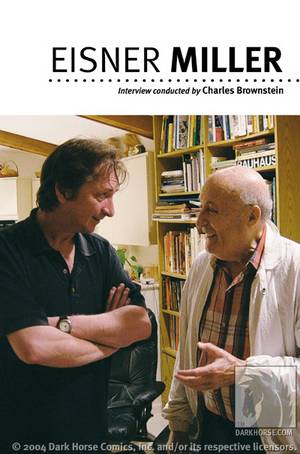
Eisner/Miller, interview between Frank Miller and Will Eisner, interview conducted by Charles Brownstein (2005): The legendary film text commonly known as Hitchcock/Truffaut (though that isn't its actual title) features French nouvelle vague director Francois Truffaut (aka the French Guy in Close Encounters of the Third Kind) conducting an exhaustive interview with Alfred Hitchcock. It's a terrific book.

This book, featuring an exhausting dialogue between legendary comic-book writer-artist Will Eisner (The Spirit, A Contract with God, Fagin the Jew) and semi-legendary comic-book writer-artist Frank Miller (The Dark Knight Returns, 300, Sin City), consciously emulates the earlier book in its title while severely underperforming in pretty much every other comparison between the two volumes.

Truffaut was a critic and a film historian as well as a writer-director, and he did tons of preparation and contextualization for his book, supplying a lengthy introduction that explained Hitchcock's body of work to the casual reader and structuring the interview chronologically so that the two men could work their way through Hitchcock's life and work from past to present.

Neither Miller nor interview "conductor" Charles Brownstein (the latter of whom is completely silent in the transcription of the interview) supply these things. A casual reader will have almost no idea why either Eisner or Miller is important to the history of comic books at the end of this book. Or care.

That casual reader won't make it to the end of the book unless he or she has a high tolerance for tedium. This is probably the worst conducted long-form interview I've ever read. Miller seems to have absolutely no clue as to how to ask follow-up questions or press a point, and the late Eisner was (famously) reticent about offering anything other than the most superficial analysis of his own or other people's work.

Eisner was a shrewd businessman at a time -- the 1940's -- when most comic-book writers and artists weren't. This comes up again and again, and Eisner reveals himself to be something of a prick whenever the topic of artists and writers who weren't shrewd businessmen (say, Superman creators Jerry Siegel and Joe Shuster, or writer-artist Jack Kirby) comes up. It's not a pleasant side of the man, but it's pretty much the only substantive thing that the 60,000-word interview reveals.

Miller, famously a champion of creator's rights since the 1980's, pretty much allows Eisner to go unchallenged in this area and others. Inadvertantly funny moments occur whenever Miller and Eisner clearly and emphatically disagree with one another while both stating and re-stating how they actually agree.

If I were cynical, I'd guess that this interview sat on the shelf for three years (it was conducted in 2002 but not published until 2005) because publisher Dark Horse was well aware of what a stink-bomb it had. But when Eisner died, the interview gained some heft as Eisner's last long-form discussion of his life and career, so onto the stands it went. It certainly seems like a rush job for something ostensibly three years in the making -- there isn't even an index. If I were cynical. Not recommended at all except as a sleep aid.

Thursday, September 23, 2010

These Zombies Are Making Me Thirsty


Books:
World War Z by Max Brooks (2007): Oh, zombie, where is thy sting? Brooks' novel was a sensation a few years back, in part because it unfolds the story of the great Zombie war within a fictionalized oral history modelled on Studs Terkel's structured oral histories of World War II, the Great Depression and other major American events. It's a clever conceit, though moving from narrator to narrator (and country to country) works against the development of suspense at points, much less horror.

More than 40 years after George A. Romero's Night of the Living Dead started our never-ending fascination with zombies, the rightness of some of Romero's choices related to the wrongness of some of the choices of other zombie chroniclers only stands out more. Brooks goes with what's now become the almost cliched viral/rabies model of zombieism -- zombieism is spread by bite or by zombie body matter getting into an exposed cut or otherwise somehow getting into one's bloodstream. This probably seems like a good idea, but the number of pandemics in human history spread through these means is, roughly, zero. It's just not that effective a means of viral or bacterial propagation, which is why we don't all have rabies right now.

Romero, of course, never explained what was actually causing zombies in his first two zombie movies. More importantly, there was no 'Patient Zero' style beginning point -- one day, everyone who ever died and had enough flesh left on his or her bones to allow for mobility rose from the grave. And everyone who died after that, regardless of cause of death, would also rise from the dead. Now that's a disease vector that could overwhelm civilization!

Brooks' viral model, on the other hand, doesn't bear too much hard thinking because one realizes that between the limits of propagation and the modest limits of his zombies' intelligence (they are, if anything, much stupider than Romero's slow-moving hordes), most of the book's apocalyptic scenarios would be impossible. How do these slow-moving hordes which have a tendency to fall off, into or over any obstacle in their way manage to form up into gigantic masses of tens of millions of zombies in the American Midwest and other locations? I have no idea. It seems to me that these zombies would probably end up at the bottom of every cliff, hill, overpass and canyon in the world. So it goes. Several weeks into the zombie war, one would imagine the Grand Canyon would be full of zombies.

There are a lot of pleasures in this book, and the verisimilitude Brooks achieves with his technical research into weapons and various survival issues is impressive, but the whole thing falls apart if one thinks too hard about those million-zombie armies. So don't. Recommended.


The New Lovecraft Circle, edited by Robert M. Price (1996): Gleaned from thirty years of the second wave of Lovecraft-inspired horror writing, Price's anthology is sort of Fundamentalist Lovecraft. Many of the stories follow the same first-person narrative model of many of Lovecraft's major Cthulhu stories, with one man recounting the zany events and evil tomes of forbidden knowledge that led him to some terrible revelation or other. I tend to prefer somewhat looser interpretations of the Cthulhu Mythos, but there are some genuine thrills and chills here, along with some early Ramsey Campbell Lovecraft pastiches that I'd otherwise have to pay a couple of hundred bucks to read in his out-of-print first collection.

One of the problems a lot of the writers have is their overwhelming desire to roll out one of the Big Guns of Lovecraft's evil pantheon of alien gods, especially sea-dwelling Cthulhu, who's supposed to be in the South Pacific but who pays visits to New England and California prior to being vanquished by the usual dodgy means. A lot of the stories fall more into the August Derleth Cthulhu mode, in which the Cthulhu Mythos becomes a source for modern high fantasy and not for horror. There's nothing technically wrong with this approach, but it does mean that wonder and terror are a bit thin on the ground at times. Recommended for completists.


Comics:


Daredevil: Born Again, written by Frank Miller, illustrated by David Mazzuchelli (1986; collected numerous times): Miller (300, Sin City) came to prominence as writer and artist on Daredevil in the early 1980's. After a few years away, he returned to team with Mazzuchelli on what remains one of the great 'reset button' narratives in superhero comics history. Basically, criminal mastermind Kingpin discovers Daredevil's secret identity and proceeds to destroy his life. And that's just the first issue.

There are small story-telling glitches here and there that the editor should have fixed at the time (why Miller makes super-soldier Nuke blind like Daredevil but without the radar senses makes sense metaphorically but not literally), but overall this is 'the' Daredevil story, or at least 'the' Frank Miller Daredevil story. The hero gets stripped down to his basics, losing a lot of accumulated psychological baggage along the way, and even gets his first girlfriend back (Karen Page), albeit in dire straits herself.

One can see Mazzuchelli's art develop from issue to issue, sloughing off standard super-hero tics and moving towards the more European style he'd use when he soon hereafter collaborated with Miller on Batman: Year One. It's really all about faces and mood with Mazzuchelli at this point in his career, suiting a book that has a lot of explosions but which relies on character development for most of its major kicks.

The Kingpin has never been more demonic, and Miller also manages the neat trick of making the Avengers god-like again when he briefly drops them into the narrative -- they don't really belong in Daredevil's urban vigilante world, and that's the point, though a world-weary Captain America does lend Daredevil a helping hand in the last two issues. This is grim and gritty stuff from a time before endless dark reimaginings of superheroes had made "grim and gritty" a pejorative. Highly recommended.


El Diablo, written by Brian Azzarello, illustrated by Daniejel Zezelj (2001): This four-issue miniseries sees Azzarello reimagine one of DC's obscure Western characters as a possibly supernatural avenger. We don't really know, in the end, because El Diablo (if it is him) is only onstage for about three panels and never speaks, though he does hiss. And kill a whole lot of people. Or does he? Yes he does.

The narrative provides us with two big shocks and a lot of little ones, playing out like an expanded version of an old EC or even Jonah Hex morality tale, complete with a blackly comic (and just) ending. Zezelj's artwork is suitably murky throughout, sometimes to the point of resembling woodcuts more than pencil-and-ink. Recommended.

Sunday, December 6, 2009

Spiritus Mundane

The Spirit starring Gabriel Macht, Samuel L. Jackson, Scarlett Johannsen and Eva Mendes, directed by Frank Miller (2008): With adaptations of Miller's comics 300 and Sin City having scored high on the Hollywood coolness factor (though personally I find 300 boring and not a little detestable), it was probably inevitable that he'd get to direct a film himself, especially as he was listed as co-director on Sin City.

Why the powers that be decided to have him co-write and direct an adaptation of Will Eisner's beloved and seminal Spirit series from the 1940's is a good question. Miller interviewed Eisner for Eisner/Miller (a nod to Hitchcock/Truffaut), and has been compared to Eisner throughout his career. This movie, though...whew, what a mess. An enjoyable mess, but a mess nonetheless.

The original Spirit series is justifiably famous for the way it pushed the early boundaries of 'how' comic books worked both structurally and narratively. In a lot of Spirit stories, the eponymous hero -- a cop left for dead who's returned as a hero -- is secondary to a short story about another character. In others, the Spirit is essentially second-banana to some boundary-pushing on the graphics front, perhaps no better epitomized than in the increasingly complicated splash pages in which the Spirit's name would be worked into some complicated representation of the story one was about to read.

The Spirit was also fairly tongue-in-cheek about heroics and super-heroics -- the Spirit's only 'power' was his ability to take a beating. The Eisner Studios surrounded its hero with a variety of femme fatales with suggestive or even simply comic names (Sand Saref and Plaster of Paris both show up in the movie), rendered in full 40's vavavoomity.

Basically, if you want an idea of what made The Spirit special, pick up DC's The Best of the Spirit. It'll run you less than $20, and it's a darned good volume. But the movie...

First off, the unknown Gabriel Macht -- who plays The Spirit -- isn't to blame for this mess. I actually thought he did a pretty good job with the messily characterized hero that was written for him, a hero whose portrayal jumps all over the map, from campy to straight to satire to, well, I don't know what. It's a godawful mess of writing, as if Miller couldn't decide whether he loved the material or hated everything about it and comic books in general, a sourness that's certainly been there in Miller's comics work for a couple of decades now.

The movie looks great at points. The femmes fatale look great. The narrative is silly and jumbled. Samuel Jackson is a nightmare of tics and yelling as super-criminal The Octopus, a character we never actually saw (except for a cigarette) in the Spirit series, and which we see way too much of here. There's some gratuitous Nazi stuff that makes no sense. And the whole thing has been lifted out of its era and plunked down into one of those anomalous movie landscapes in which cellphones and massive helicopters exist side-by-side with 40's clothing, hairstyles and faux-40's-noir dialogue.

All in all, a mess. Enjoyable at points, but a mess.