100 Issues of Astro City! (1995-2017): written by Kurt Busiek; illustrated by Brent Anderson, Alex Ross, and others: 100 issues of Astro City over 22 years and at least three publishers. That's quite a milestone in today's rapid cancellation comics marketplace.
Writer Kurt Busiek helped implement a sort of 'soft' revisionism in superhero comic books with Astro City. The series has always paid fond homage to the super-heroes and pulp heroes of a hundred years (and more!) of publishing. But it's done so with character-driven stories and a meticulously worked-out history.
The basic set-up for Astro City was that the eponymous city, near the slopes of Mount Kirby, held within it super-heroes who paid homage to the super-heroes of American comic-book history without simply being slavish pastiches of those super-heroes. Samaritan, for example, is Astro City's nod to Superman -- but as established early in Astro City's run, he's his own man, with his own origins and his own dreams, day-time and otherwise. Nonetheless, he fights evil just like Superman: there's nothing cynical or calculated about Samaritan.
Other characters who hew close to their sources include the Silver Agent (Captain America) and Winged Victory (Wonder Woman). But both get to have finely observed, multi-issue stories about them over the course of Astro City's run. Indeed, the Silver Agent's fate is the thread that unites the entire year-long The Dark Age storyline.
Astro City give us heroes with problems, but it also shines a sometimes amusing, sometimes poignant light on a world in which not everyone with super-powers or super-technology wants to be a super-hero (or super-villain). It travels to small towns to check out the hero life there. It tracks super-hero families over the course of generations. It examines how life in the different boroughs of Astro City works -- things differ, especially in the borough that's home to supernatural beings and watched over by the mysterious hero dubbed The Hanged Man. One of its most poignant characters is Steeljack, a small-time super-villain who basically fell into super-villainry and then spends a couple of storylines (and 20 years or so) trying to claw his way out of it.
It's been a great ride, one I hope continues. Busiek and primary Astro City artists Brent Anderson (interiors) and Alex Ross (covers) have created something that now looms, like Mount Kirby, as a testament to what good writing and artwork can do with super-heroes. One never feels cheated by Astro City on the writing or artistic fronts. Anderson, who started his career very much in the vein of Neal Adams, has become an artist now more in the role of long-time Superman artist Curt Swan, an artist who can comfortably depict both the mundane and the cosmic, sometimes within the same panel.
And Busiek gives full textual value: unlike the vast majority of modern super-hero comics, an issue of Astro City takes more than three minutes to read. That isn't to say that Astro City is text-heavy -- instead, its text/art balance is more in keeping in line with mainstream superhero comics prior to the oughts, when 'decompression' became first the superhero buzz-word and then the stranglehold.
The richness of Astro City also lies in the way it comments on super-hero stories while presenting super-hero stories that work on a prima facie level. The Samaritan's arrival in 1986 corresponds to the year DC Comics hired writer-artist John Byrne to reboot Superman. The lengthy Dark Age storyline comments on the periodic veers of mainstream super-hero comics into grim and gritty territory. Various place names, including that looming Mount Kirby, celebrate comics creators. Nonetheless, Busiek's characters are their own people even as they also evoke famous super-heroes and super-villains.
Perhaps the greatest subversiveness of Astro City is that it presents hope (or perhaps Hope) and goodness as being valid concepts, no matter how bad things may seem. It's the finest long-form super-hero comic ever presented. Long may it run! Highly recommended.
Batman (Detective Comics) Archives Volume 2 (1941-42/Collected 1991): written by Bill Finger and Don Cameron; illustrated by Jerry Robinson, George Roussos, Bob Kane, Fred Ray, and others: The Batman Mythos begins to mature with great rapidity in this second archive of stories from Detective Comics (where Batman premiered in 1939). Robin is part of the team, the Joker and the Riddler are recurring villains, and the origin of Two-Face appears here.
As Batman co-creator Bob Kane (with writer Bill Finger, finally being credited by DC in 2016, more than 40 years too late for the long-deceased Finger) doing less and less artwork, Batman's art gets progressively better because frankly, Bob Kane sort of sucked when he wasn't swiping other people's art. Jerry Robinson is on-board for the Joker, a character he co-created, while also supplying a much more pleasingly cartooned, detailed, and often funny Batman and Robin. George Roussos supplies his usually capable inks, complete with his ever-present giant moons.
The stories, most written by Finger, are at their best when they pit Batman against his growing rogue's gallery. Batman vs. mobsters is sort of boring. Batman vs. a mind-reading scientist, the Joker, or the Penguin is pretty great. One of the things to note about the early Batman is how text-heavy and panel-heavy it is. Kids were much faster readers in 1941! One wishes at times that the art was allowed to breath at times with fewer panels per page, but it would be years before this was true in the superhero comic book except in rare exceptions drawn by the Eisner or Simon&Kirby Studios. Recommended.

The Boy Commandos Volume 1 (1941-42/Collected 2010): written and illustrated by Joe Simon and Jack Kirby: Terrible, muddy colour reproduction caused by somebody who doesn't know how to use a colour scanner makes for some tough pages in this collection. Still, it's rewarding to read one of the first 'kid gang' comics. And what a gang! Co-writer-artists Joe Simon and Jack Kirby basically serve up Our Gang with Heavy Weaponry in the Boy Commandos, as a bunch of prepubescent boys run around Europe and Asia machine-gunning the crap out of the Axis powers.
And they're sanctioned by the Allied military!
The Boy Commandos are a multi-national group nominally led by adult Captain Rip Carter. Their adventures are wild and woolly, and a lot more fun than those of most adult WWII comic-book characters. One can see how the 'kid gang' comic became a popular one in the 1940's before fading out around the end of WWII. Recommended. Boy, this needs to be colour-adjusted, though.

Essential Fantastic Four Volume 2 (1963-1965/Collected 1995): written and illustrated by Stan Lee and Jack Kirby; inked by Chic Stone, George Roussos, Vince Coletta, and Frank Giacoia: The Stan Lee/Jack Kirby Fantastic Four (the stretchable Mr. Fantastic, Invisible Girl, Human Torch, and super-strong Thing) starts to become a more recognizable, traditional superhero comic in this second collection of the FF's 1960's stories, in glorious B&W because this is an Essential B&W collection. They fight fewer monsters and more traditional super-villains. They also fight the Infant Terrible in a story that whoever wrote the Trelayne episode of the original Star Trek may have prior to penning "The Squire of Gothos."
The FF's goofiest, funniest enemies from their first volume of adventures -- the Red Ghost and his Super-Apes (!!!) -- do appear here in all their ridiculous glory. The Watcher, the Blue Area of the Moon, Doctor Doom, Prince Namor, the Super-Skrull, and the Mole Man return; Dragon Man, the Hate Monger, Mr. Gideon, the Frightful Four (including yet-to-be-revealed-as-Inhuman Medusa), and Franklin Storm debut.
Team-ups with Doctor Strange, the Avengers, the X-Men, and a brief Peter Parker cameo sell the interconnectedness of the growing Marvel Universe to the reader. There are many stand-out stories here. Probably my favourite pits the mighty, wise-cracking Thing against a maddened, more-mighty Hulk for page after page of terrific superhero combat. The Thing's later pummeling of Dr. Doom is also a personal favourite, drawn with succinct power by Jack Kirby.
Stan Lee is typically bombastic and melodramatic throughout, with the slapstick antics of the eternally bickering Thing and Human Torch to add humour. The inking of Kirby's pencils starts off rough with George Roussos, who's a terrible fit with Kirby. It picks up with Chic Stone. Joe Sinnott's masterful inks of Kirby on the FF are still a year or so away by the end of this volume. Highly recommended.
Thor: Godstorm (2001-2002; collected 2011): written by Kurt Busiek; illustrated by Steve Rude and Mike Royer: Fun homage by Busiek, Rude, and late-career Jack Kirby inker Mike Royer to the sort of story normally found in Stan Lee and Jack Kirby's run on The Mighty Thor in the 1960's. Thor's battle with the sentient thunderstorm Godstorm occurs in three different eras as depicted in the story.
Busiek does that thing he does in which his writing is both homage (to Stan Lee) without being overly imitative of Lee's melodramatic verbiage. Steve Rude gives us his own action-packed, sometimes cartoony pencils, made to look just a bit more Kirbyesque than usual by Rude and inker Royer. My only complaint here would be that I'd like more of Busiek, Rude, and Royer's Thor. It's swell. Highly recommended.
JLA: Tower of Babel (2000/ Collected 2001): written by Mark Waid, D. Curtis Johnson, John Ostrander, and Christopher Priest; illustrated by Howard Porter, Drew Geraci, Eric Battle, Ken Lashley, Prentis Rollins, Ron Boyd, Mark Pajarillo, Walden Wong, Steve Scott, and Mark Probst: Mark Waid began his run on JLA [Justice League of America] back in the year 2000 by pitting the League against its greatest enemy yet.
Of course, that enemy was a founding member of the League itself who came up with secret contingency plans to take out every member of the League in the event of an emergency. Unfortunately, that founding member's security wasn't as secure as the member believed. A super-villain gets the information and uses it, crippling the world's mightiest heroes as part of a plan to wipe out as much of humanity as possible so as to save the Earth.
Who is that member? Well, technically it's a spoiler. All I'll say is that it isn't Aquaman.
Waid's contemporary Silver-Age grooviness and knack for superhero characterization and plausibly implausible super-scientific threats make this particular story arc sing. Departing JLA penciller Howard Porter handles most of the art duties in his usual craggy, energetic style.
The fill-in issues and stand-alone stories by other hands collected here are all very enjoyable as well, especially the opening story penned by D. Curtis Johnson, which reads like a lost JLA story from the Denny O'Neil era of the 1970's. Highly recommended.
JLA: Syndicate Rules (2004-2005/ Collected 2006): written by Kurt Busiek; illustrated by Ron Garney and Dan Green: Among other things, the Syndicate Rules arc is a sequel to JLA/Avengers, also written by Kurt Busiek. This is never stated completely outright because DC doesn't have the rights to actually name the Avengers in a DC-only book, but there it is regardless. And it's really a fine sequel to that gigantic, over-stuffed, bombastic, hyper-enjoyable DC/Marvel crossover. We even get two artists then mainly associated with Marvel, Ron Garney and Dan Green, on the art duties.
This is also a follow-up to Grant Morrison and Frank Quitely's JLA: Earth-2 graphic novel, which introduced new versions of the evil, alternate-Earth Crime Syndicate of Amerika to the early-oughts DC Universe. They're evil, anti-matter versions of Superman, Wonder Woman and company first introduced way back in the 1960's when Gardner Fox and Mike Sekowsky did the Justice League of America.
Anyway, Busiek is one of the masters of extrapolating and expanding and expounding upon comic-book continuity without making that continuity ponderous or onerous. And he's an expert at the necessary short-hand of mainstream superhero characterization. Syndicate Rules rings some interesting variations on old JLA/CSA stories while also adding new dimensions to this inter-dimensional tussle. Busiek also manages to give Silver-Age Green-Lantern-foes The Weaponers of Qward an interesting back-story while also making them a real threat to villains and heroes alike.
Ron Garney and inker Dan Green do nice work on what for them were unfamiliar characters at the time. This is an extremely action-packed saga, and Garney and Green render the action in convincing, epic fashion throughout. An enjoyably rousing, clever, and beautifully plotted story arc. Highly recommended.
 The Savage Sword of Conan the Barbarian Archives Volume 1: written by Roy Thomas, Lin Carter, and Robert E. Howard; illustrated by Barry Windsor-Smith, John Buscema, Tony DeZuniga, Pablo Marcos, Tim Conrad, Jim Starlin, and others (1971, 1973-75; collected 2007): This first reprint volume of Marvel's black-and-white Conan comics magazines that started in the 1970's peaks right at the beginning, with quintessential Conan comic-book artist Barry Windsor-Smith illustrating several tales. He's terrific on what's almost a vignette about a teen-aged Conan, "The Frost Giant's Daughter." And he hits an all-time high with an adaptation of the Conan novella "Red Nails." There's a reprint volume devoted entirely to Windsor-Smith's colour and black-and-white Conan work for Marvel, if you're so inclined.
The rest of the volume, almost entirely written by long-time Conan scribe/adapter Roy Thomas, is mostly high quality as well. Thomas' Conan was always more stereotypically heroic than Robert E. Howard's original, but he can still be a bit of a jerk at times. Highlights include the oft-imitated crucifixion of Conan from an adaptation of Howard's "A Witch Shall Be Born" and an original team-up with Howard's female barbarian Red Sonya. John Buscema, who penciled more Conan stories at Marvel than anyone else, gives us his older-looking Conan throughout, with Tony DeZuniga and others ably inking Buscema or drawing him themselves. It's too bad these volumes weren't reprinted at their original magazine-page size, though -- the art and lettering can get a bit cramped at points in the comic-book-page dimensions of the collection. Recommended.

Dr. Spektor Volume 1: written by Mark Waid; illustrated by Neal Edwards and Christian Ward (2014): Enjoyable reboot of a Silver Age Gold Key hero about whom I know absolutely nothing. Veteran scribe Mark Waid gives us a master of the mystic arts who's also a TV personality and a bit of a knob. The art is competent, though never particularly mystical or surreal. It's a book about a magician that could use an injection of the surreal and the non-representational on the artistic side. Lightly recommended.

Superman: Camelot Falls Vol. 1 and 2: written by Kurt Busiek; illustrated by Carlos Pacheco and Jesus Merino (2006-2007; collected 2009): Lengthy Superman story that appeared intermittently in about a year-and-a-half's worth of Superman comics gets collected here, with art primarily by Carlos Pacheco and story by Kurt Busiek. It's among the finest Superman stories of the last 25 years in both art and story. Pacheco is a clean, dynamic penciler with just the right hint of whimsy in his art. Busiek's Superman is forthright and stalwart though occasionally plagued by doubt.
Busiek riffs on a Superman story from the early 1970's, "Must There Be A Superman?", as Superman discovers that the presence of he and his fellow heroes will ultimately lead to the destruction of all human life on Earth. Or will it?
Busiek brings back Atlantean super-magician Arion to present a superhero-tinged version of Vico's cyclical view of history. There will always be a Rise, there will always be a Fall, there will always be another Rise, and so on, but the prevention of that Fall by Superman and friends will cause the Fall to build in power until when it comes, there will be no subsequent Rise again. Humanity will perish in the turbo-charged wave of darkness. Arion wants Superman to retire intentionally so this future won't come to pass. But if Superman won't retire, Arion will retire him forcibly and then start the next wave of darkness himself before it builds any further. To Arion, the ends justify the means, no matter how many billions must die to ensure humanity's survival.
It may sound grim, but Busiek keeps things hopeful throughout: Arion may be wrong. And Superman remains heroic and dedicated to preserving life, as he should. Busiek introduces a new villain for Superman, Khyber, who grows on one over the course of the story. He is in many ways an attempt to give Superman his own Ra's Al Ghul, an immortal enemy with designs on global domination and a patience born of immortality. Only the name, which seems to be an attempt to meld the historic and ongoing importance of the Khyber Pass with the sounds-similar 'Cyber,' is a bit vexing. Well, unless Busiek is playing with the Cockney rhyming slang construction of "Khyber Pass" as a stand-in for "Ass" (or "Arse"), which would be hilarious. In all, recommended.
 Dreadstar Omnibus Volume 1: written by Jim Starlin; illustrated by Jim Starlin, Al Milgrom, and Josef Rubinstein (1983-84/This collection 2014): The Golden Age of long-form science fiction/fantasy came for American comic books in the 1980's with such great series as Grimjack, Nexus, Time Spirits, Aztec Ace, American Flagg, and Dreadstar. Writer-artist Jim Starlin's Dreadstar first appeared in serialized form in Marvel's Epic magazine before getting its own book from Epic Comics once that first storyline had been completed. So while this is the first omnibus reprint, there is a real first volume also available that one should start with unless one is familiar with the story.
There are certain boilerplate elements in Dreadstar's story -- evil galactic empires, heroes with energy swords, masked villains. Starlin manages to transcend them as he goes along. The fight scenes are often quite nicely choreographed. The supporting characters are sympathetic and interesting. Dreadstar himself remains a mournful piece of beefcake throughout the series, but the aforementioned supporting characters keep us from dwelling too much on his limitations. Starlin did much the same thing at Marvel in the 1970's with Warlock, whose supporting characters supplied the characterization while the protagonist supplied the cosmic angst.
One of the better issues included here gives the background to the villain of the piece, the Lord High Papal, leader of the genocidal, church-based empire named the Instrumentality (a nod to the science fiction of Cordwainer Smith). Starlin also shows more of a sense of humour in this series than he generally did, and a lighter hand when it comes to speechifying. His choices in names are still halfway-hilarious sometimes: an evil race named the Zygoteans still cracks me up.
The 12 issues collected here really are enjoyable, certainly moreso than the vast majority of superhero comics from the same era. Beware, though -- the story doesn't really end with the last issue, and the next omnibus isn't due until next year. Though you could always go looking for back issues. Recommended.
The Avengers: The Kang Dynasty: written by Kurt Busiek; illustrated by Alan Davis, Kieron Dwyer, Ivan Reis, Brent Anderson, and others (2001-2002/Collected 2002): Writer Kurt Busiek ended his late 1990's/early oughts run on Marvel's The Avengers with a gigantic bang -- nearly a year-and-a-half arc pitting the Avengers against their time-traveling foe Kang the Conqueror. It's mostly a blast, though a muted one towards the end as the events of 9/11 overtook the events depicted in the story, leading to a final-issue requiem for those fallen to Kang's invasion that reflects the sorrowful poster-boards of post 9/11 Manhattan, with photos of the lost and missing.

Otherwise, Busiek and his rotating band of artists keep an astounding number of characters and situations in the air. The Avengers comic book has always had a luxury the Avengers movies never will have -- the space to develop a long list of characters, rather than a core group of six or seven. You may not like the minor heroes of this Avengers line-up, but Busiek does a fine job of making them important within the epic scope of the story. Whether it's the big-time Thor or the little-known Triathlon, everyone has a part to play in saving the Earth. It's too bad that the saga couldn't have gotten one or at most two artists for its entire length. Nonetheless, Alan Davis, Kieron Dwyer, Ivan Reis, and Brent Anderson do stand-out work on their portions of the saga. Recommended.

Justice League United: The Infinitus Saga: written by Jeff Lemire; illustrated by Neil Edwards, Jay Leisten, and Keith Champagne (2014-2015): Mostly fun six-issue Justice League United arc that brings the 'real' Legion of Super-heroes (LSH) from the 31st century back into action in the DC Universe. Each issue, the head-shots of featured characters surrounding the title page become more and more numerous in what must have been a conscious bit of fun. And it works, among other things.
That Lemire and company make the new DCU's reboot of classically kitschy Silver Age hero Ultra the Multi-Alien into something compelling is amazing enough. That they manage to link him to a re-imagined Infinite Man (an LSH foe originally from the 1970's) is really quite clever. There's maybe about 20% too much fighting, but it's fun to see such oddball-yet-effective LSH members such as Bouncing Boy back again, bouncing for justice. Recommended.
Astro City Volume 8: Shining Stars: written by Kurt Busiek; illustrated by Brent Anderson and Alex Ross (2007-2011; Collected 2012): The eighth volume of Kurt Busiek, Alex Ross, and Brent Anderson's warm, complex, and intensely metafictional superhero saga visits with heroes major and minor, supplies the powerful Samaritan with a worthy arch-nemesis, and fills in some (but not all) of the blanks surrounding the mystery of the Silver Agent's time-jumping that's been a recurrent plot point throughout the Astro City saga.
Astro City is, of course, every superhero city rolled into one, with Mount Kirby looming over it and various town districts paying homage to some of the major American comic-book genres from across the decades. Busiek's brilliance in the Astro City stories has come with a focus on what the Man (and Woman) on the Street feels like during various superhero shenanigans, what people with relatively ordinary wants and needs do with their lives when they find themselves with powers, and how heroes and villains actually feel about things.
Most of this volume is dedicated to stories in the third category, albeit with major nods to the other two. A two-parter about the graduation of superheroine Astra from college also explores what it's like being the non-powered boyfriend of a super-celebrity; an exploration of the life of somewhat bizarre, life-sized super-Barbie Beautie also delves into the family lives of supervillains and superheroes.
We also get a two-parter that finally explains the origin and (possibly) final fate of the Silver Agent, Astro City's tragic, time-hopping hero -- the story also offers a fairly dense bit of metafiction that riffs on Captain America, the Legion of Super-heroes, and the Green Lantern Corps, though one doesn't need to know any of that to follow the story.
The opening story is also a dandy, as it gives Astro City's Superman-analogue Samaritan a suitably obsessed and suitably powered arch-nemesis, the Infidel, an immortal alchemist/magician whose powers stem from the same source as the Samaritan. This story also has its metafictional pleasures, with its homage to the Arch-Frenemy relationship of Lex Luthor and Superman during the so-called late Silver and Bronze Ages of Superman's history, but it remains its own story, with its themes and plot fully capable of standing independent from any need for a knowledge of the history of comic books.
Brent Anderson brings a solid artistic presence as usual, balancing super-heroics, the cosmic, and the ordinary with his usual somewhat understated elan; while Anderson started off looking a lot like Neal Adams, he now seems to be the logical successor to long-time Superman artist Curt Swan, who always manage to ground Superman in some sense of the normative regardless of the cosmic scale of the action being depicted. Alex Ross' covers and character designs are, as usual, superb. Recommended.
The Unwritten Volume 9: The Unwritten Fables: written by Mike Carey and Bill Willingham; illustrated by Peter Gross, Mark Buckingham, and others (2013): With the last story arc of The Unwritten debuting in January 2014 in a whole new, restarted book, this volume brings the original run to an end in what is a bit of a curious fashion, a crossover with DC/Vertigo's other long-running series about myths and stories, Bill Willingham's Fables.
Despite not having read Fables for several years, I didn't have any problem following the basics of this crossover. But it still didn't exactly work. I have no idea why the antagonist of the series, Dark, is such a world-destroying badass, at the beginning or the end of the arc. I don't much care about any of the characters other than our Unwritten regulars, who only actually appear in the first and last issues. Well, technically only Tom Taylor appears. I think. Or maybe not.
There are still many fine moments herein, including some truly awful stuff involving a witch's last ditch gambit to save all of existence (Dark's arrival makes for strange bedfellows), and a very moving final sequence that sets up The Unwritten: Apocalypse with, well, a preliminary apocalypse. Still, this arc remains something of an oddity, the least satisfying storyline from The Unwritten's excellent run. Lightly recommended.
Astro City: Through Open Windows: written by Kurt Busiek; illustrated by Brent Anderson and Alex Ross (2013): Busiek's Astro City returns, complete with interior artist Anderson and cover artist Ross, in fine style. While a major story arc gets set up in the first issue, the book mostly focuses on stand-alone stories and short arcs.
Life in the superpower-filled universe of Astro City is a fascinating affair, both metatextual (Busiek creates analogs for virtually every comic-book character you can think of) and emotionally satisfying (the analogs rapidly become their own characters, while the lives of what would be minor characters in a typical superhero book are richly explored).
For instance, the first few issues deal with the exciting adventures of someone who staffs the Hot-line for this Earth's version of the Justice League or the Avengers. Busiek gets to world-build here in what seems to be a perfectly reasonable fashion (I mean, a hotline's going to need staff, isn't it?) while offering a groundlevel view of life on a world packed with supernatural superscientific shenanigans.
Brent Anderson's interior art, superheroic without being super-exaggerated, is as good as ever, which is to say absolutely perfect for the writing of Busiek. There's a nice balance of the mundane and the Super-loopy throughout Anderson's Astro City work.
We also get a look at what people with superpowers who don't want to either fight crime or commit crime do with their lives (find jobs that can use their specialized skills), and look in on a retired super-speedster. Meanwhile, the Over-Arc involving mysterious observer The Broken Man offers glimpses of some world-shattering Crisis to come. Recommended.
Astro City Volume 3: Confession: written by Kurt Busiek; illustrated by Brent Anderson, Willie Blyberg, and Alex Ross (2000): The third collection of Busiek, Anderson, and Ross's postmodern superhero opus brings us one previously introduced storyline (the imminent alien invasion of giant shape-changing cockroaches teased in a story collected in the previous volume, Family Album) and one major new one, the story of crime-fighting duo Confessor and Altar Boy, as told by Altar Boy.
Told from the POV of Altar Boy, who comes to Astro City looking to become a superhero and ends up being trained by the mysterious Confessor, an urban vigilante who may or may not have superpowers, Confession is a solid story of this odd world of superheroes. It hints at revelations about the past that are still to come, most notably the mystery of the Silver Agent and Astro City's Dark Age of the 1970's and 1980's.
Confession also sketches in some of the quasi-mundane details of life in a city teeming with superheroes and supervillains. Not only are there superhero bars and hangouts, but there are such bars and hangouts for specific types of superheroes and supervillains.
Tensions reminiscent of the Dark Age begin to multiply in Astro City as mysterious killings begin to occur periodically in and around the city's supernatural borough, despite the best efforts of heroes supernatural, super, and unpowered to apprehend the killer or killers. Some people begin loudly agitating about the failure of the superheroes. And Altar Boy begins to have doubts about his mysterious mentor. All the threads get tied up in a satisfying climax that sheds new light on the history of the city and its heroes. Recommended.
Astro City Volume 5: Local Heroes: written by Kurt Busiek; illustrated by Brent Anderson and Alex Ross (2004-2005): After two straight collections of book-length stories, Astro City returns to one- and two-issue outings both in the city and far beyond it, in the present-day and decades in the past. There's a charming story about the sort of superheroes found in small towns and rural areas. Another story deals with retirement and aging by looking in on a former superhero who operated in the 1960's and 1970's, and his reasons for retiring.
And there's a sad but metafictionally astute story that riffs on the bizarre pas de deux of Superman and Lois Lane during the 1950's and 1960's, when it seemed like half of all Superman stories involved some combination of Lois trying to discover his secret identity and Superman doing weird and often dickish things to throw her off his trail. Busiek's writing and the art by Anderson on the interiors and Ross on covers and designs are all very satisfying. Recommended.
Astro City Volume 1: Life in the Big City: written by Kurt Busiek; illustrated by Brent Anderson and Alex Ross (1995-96): The first Astro City collection immediately sets the template for the entire series, in which meta-commentary on the history of American superhero comics helps structure tales of Astro City, the New York of another world where super-heroes have been kicking around for decades.
Astro City stands apart from most such 'adult' examinations of superhero comics because it's not deconstructionist, it's not satiric, and it's not a 'realistically' hyper-violent reimagining of children's characters. Superheroes are, for the most part, good in the way they once were, but that doesn't mean they're uncomplicated.
And while annotations on the various homages and references herein could fill their own book, the 'meta' can safely be ignored in order to enjoy a good story. One doesn't need to know that Busiek has used a Who's Who of comic-book-creator names for the streets, subdivisions, and locations of his imaginary world. Or that characters and situations homage famous comic-book characters and situations, not to mention historical publication eras.
Busiek manages the tricky feat of filling an intensely meta-fictional book with sympathetic characters, cosmic moments, and pointed bits of commentary that stay just this side of satire. And he jumps right into the two-fold narrative approach that will dominate the book for its existence. The stories of Astro City will sometimes center on what ordinary, non-powered people feel like given that they live in a world teeming with super-powered beings. And the stories will sometimes focus upon what those super-heroes and super-villains are like not only behind the masks, but in the mundane aspects of their private lives. These two approaches made Astro City unique at the time it started, as did its lack of cynicism and hyper-violence.
The twinned artists of Astro City -- cover artist and designed Alex Ross and interior artist and designer Brent Anderson -- form a fascinating study in contrasts. Anderson still fits roughly into the Neal Adams school of hyperrealism, but he's tempered his approach over the years to become a fine renderer of the mundane and the commonplace. The faces of his characters are distinctive and unique, a necessity for this sort of book, and while he can portray freaky cosmic battles with some alacrity, he keeps the characters involved in those moments rooted in the real.
Ross, on the other hand, may model his photorealistic painted figures on real people, and he may obsess over how a costume would actually look if it were made from real-world materials, but he's nonetheless at his best setting these sometimes discomfortingly 'real' looking characters against gigantic, earth-shattering situations. He can do the small moments, but it's the uncanny effect of photo-realistic characters in the middle of events that couldn't possibly have been photographed that's his strongest suit. They are both in rare form here. Highly recommended.
 Astro City Volume 3: Family Album: written by Kurt Busiek; illustrated by Brent Anderson, Willie Blyberg, and Alex Ross (1997-98): One- and two-issue stories flesh out some of the world of Astro City. The mystery of what happened to good-guy The Silver Agent in the 1970's begins to deepen, but this occurs in the background for the most part.
We instead focus on the travails of generational superhero Jack-in-the-Box (partially a nifty homage to Steve Ditko-designed crime-fighters Spider-man, the 1960's Blue Beetle, and The Creeper, but with a distinctive personality and look all his own); the attempts of third-generation super-heroine Astra to find out what normal pre-teen girls do at school and in play; and the weird life of Loony Leo, a Humphrey-Bogart-like animated lion brought to life by a super-villain and then stuck living in the 'real' world for decades. In all, a perfect gateway book to the Astro City universe. Highly recommended.
 Astro City Volume 6: The Dark Age, Part One: Brothers & Other Strangers: written by Kurt Busiek; illustrated by Brent Anderson and Alex Ross (2007-2008): Charles and Royal Williams were just kids when they lost their parents in 1959 to a murderous henchmen of the super-villain organization Pyramid. They've had a grudge against that henchman, and against good guy Silver Agent for not saving their parents the way heroes are supposed to, ever since.
Careers as a cop and as a minor criminal, respectively, parallel the descent of Astro City into what residents would later call the Dark Age, a period spanning the 1970's and early 1980's when heroes, villains, and the general population became increasingly violent and disaffected. And while we follow the Williams brothers as they gradually formulate a plan to find that henchman, we also finally begin to learn the tragic story of the Silver Agent himself, hinted at pretty much since the beginning of the Astro City series. Highly recommended.
 Astro City Volume 7: The Dark Age, Part Two: Brothers in Arms: written by Kurt Busiek; illustrated by Brent Anderson and Alex Ross (2008-2010): The quest of the Williams brothers for vengeance against the man who murdered their parents builds to an apocalyptic climax, with their personal revenge drama interweaving with the increasingly dire state of Astro City itself. New vigilantes stalk the streets as the 1980's begin, happy to maim and kill criminals, while the older heroes either retire or seem to become irrelevant.
But the time-hopping Silver Agent has promised that everything will get better, even though he may need the help of the grudge-holding Williams brothers, who believe him to be a failure for not saving the lives of their parents twenty-five years earlier, to secure that better tomorrow. This volume probably marks the most pointed commentary of the entire Astro City series when it comes to 1980's and early 1990's trends in superhero comics -- the names get goofier and sometimes redundant ('Lord Sovereign'), the costumes get fussily complicated, and the heroes become ultra-violent.
The meta-commentary, and the complicated plot, both sometimes undercut the more under-stated strengths of the Astro City series, but Busiek and company nonetheless manage to satisfyingly conclude the 16-issue storyline. Recommended.
Captain America: War and Remembrance: written by Roger Stern and John Byrne; illustrated by John Byrne and Josef Rubinstein (1980; collected 2010): One of the three or four highest of the high points for the patriotic Captain America's comic-book career. Some sort of bizarre (and typical) infighting at Marvel Comics in 1980 truncated Roger Stern and John Byrne's run on Captain America at nine issues, which is a shame, though Stern would move over to a fine run on Spider-man while Byrne would soon be writing and drawing the Fantastic Four.
Standalone high points include a retelling of Cap's origin that attempts to fix some pretty odd continuity problems that had accreted over the years, problems that Stern and Byrne also address in an earlier story in the volume. They send Cap out against familiar villains (Batroc, the French mercenary), villains commonly associated with other super-heroes (the Fantastic Four's Dragon Man and Thor's Mr. Hyde), and Cap villains from long ago (Baron Blood, a World War Two vampire enemy of Cap's from the then-recently cancelled WWII supergroup book The Invaders).
Everything included here is extremely good superhero stuff, but the Baron Blood two-parter is probably the finest thing in the collection. It's also one of the finest pieces of superhero adventure Stern and Byrne ever created together or separately. Josef Rubinstein's heavier inks are perfect here for Byrne's pencils in a way that a more fan-praised Byrne inker such as Terry Austin would not have been, making thing moody and shadowy when needed. Byrne and Rubinstein manage a real sense of menace throughout the two-parter, and the whole thing is satisfyingly dense on the narrative level. I'd imagine a 2013 retelling would run about 12 issues and be about 1/12th as satisfying.
Stern and Byrne work well together -- Stern is a master of keeping readers caught up with events of previous issues without bogging the story down in exposition, and he and Byrne structure some fairly stunning action scenes here, with the best being Cap's last battle with Baron Blood. Highly recommended.
Astro City Volume 4: The Tarnished Angel: written by Kurt Busiek; illustrated by Brent Anderson, Willie Blyberg, and Alex Ross (1997-98): The fourth collection of Busiek and Anderson's great Astro City series focuses on a small-time supervillain dubbed The Steel-Jacketed Man, or Steeljack, as he gets out of prison after 20 years and tries to go straight. In a way, this is an extended homage to the Lee/Ditko Spider-man story "A Guy Named Joe," about a similar small-time hood, though Busiek's character actually craves some form of redemption for the disappointments his criminal life visited upon his now-deceased mother.
While the entire Astro City series is intensely metafictional in its characters, settings, and storylines, Busiek nonetheless frames the metafictional elements within stories of loss, discovery, redemption, and betrayal. It's a sort of metafiction of sentiment rather than commentary (ironic or otherwise) on the history of superhero comic books. Samaritan may be the Astro City analog of Superman, and his first appearance may coincide both in year and in event with John Byrne's Superman reboot at DC in 1986, but he's also his own character through whom Busiek can explore issues of character and motivation in a fantastic context.
Steeljack's story plays out as an homage to hardboiled detective fiction, but with superheroes and supervillains. Someone has been killing minor supervillains, so the residents of Kiefer Square, a slum area populated by supervillains and their families, decide to pay Steeljack to investigate the murders, hoping that his nigh-invulnerable living-steel body may keep him alive long enough to solve the mystery. A plot oriented around the killing of minor villains also riffs on the hero-killer plot of Watchmen.
The story then follows Steeljack, with the sort of copious first-person narration from his viewpoint that will be a familiar device to anyone who's seen a hardboiled detective movie or read a novel. Plagued by doubt and loss, Steeljack makes for a sympathetic protagonist even as he also functions as a fairly potent evaluation of mainstream supervillains. Why don't some of these people go legit and make money from their inventions and powers rather than endlessly robbing banks and getting caught?
Why indeed. They are trapped in a social loop of poverty and crime, as are criminals in the real world, but criminals in the real world aren't invulnerable or possessed of super-technology or super-strength. Some of Steeljack's most poignant moments come in pondering this fantastic problem: why did he allow himself to slip into the life of a sueprvillain? And is there any way out?
Brent Anderson's art is, as always, perfect for the series, fairly naturalistic (especially when compared to a lot of younger artists and artistic approaches at DC and Marvel), rooted in character and telling detail, but also quite dynamic when the story calls for it. Alex Ross's covers are their usual source of painterly goodness. Highly recommended.
Superman: Secret Identity: written by Kurt Busiek; illustrated by Stuart Immonen (2004): Busiek takes a decidely Meta concept inspired by a Superman comic book of the 1980's and extrapolates it into a moving tale about the Man of Steel. In a weird way, OUR Man of Steel.
The Superman team-up series DC Comics Presents offered an odd story towards the end of its run in the 1980's. In it, the Superman of DC's main Earth, Earth-1, met the Superboy of Earth-Prime. But the thing was, Earth-Prime was, in DC's multiverse, 'our' Earth, one without superheroes, one upon which all of DC's heroes were simply characters in comic books. That included Superboy and Superman. So Superboy of Earth-Prime found himself with superpowers on an Earth where he was already a fictional character.
Borges, eat your heart out!
Busiek takes this initial concept and, not in a situation to write an ongoing, in-continuity series about Superboy-Prime, instead writes a non-continuity story that follows a Superboy from a world where he's a fictional character through the course of the super-powered portion of his lifetime.
This Superboy has been teased for years because his parents thought it would be cool to name a male baby with the last name Kent who hails from a small town in Kansas (Pickettsville, not Smallville)...Clark. And one night, when he's 13, Clark suddenly wakes up with a pretty fair approximation of all of Superman's powers.
What follows is a really charming story which allows Busiek to explore the aging of a superhero. Most 'adult' superhero books explore either the beginning or the end of their hero's career. Busiek's best work lies here in exploring the middle -- adulthood, parenthood, grandparenthood. His Superman, who consciously adopts the classic costume in part because it means people who see him won't be believed, operates in secrecy, leery of a U.S. government that apparently wants to dissect him.
But as a fundamentally decent person, Clark continues to help people, despite the risk of being followed home. His powers aren't great enough to always protect him from being knocked unconscious, but he keeps going anyway. And perhaps the government will eventually decide that he's not a threat -- or develop superheroes of its own.
Busiek and artists Immonen, who's never done better work than he does here, do a lovely job of pointing out the ways in which it would be great to be Superman, both through the soaring, two-page vistas that periodically appear to show the world as Superman sees it, and through the little things that he takes for normal, such as being able to go to any restaurant in the world whenever he wants to. It's a great take on Superman, wonderfully told, with expressive character work by Immonen. Recommended.
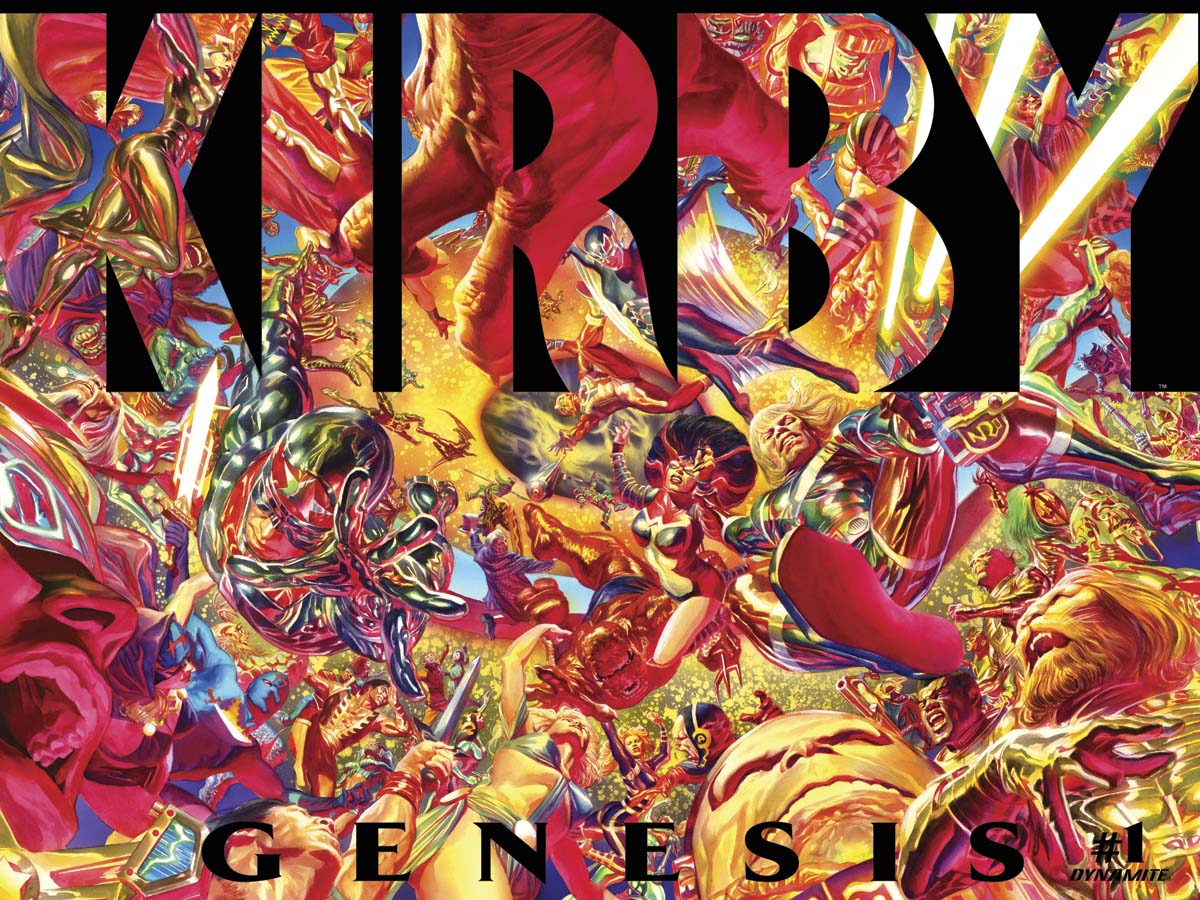
Kirby: Genesis Volume 1: written by Kurt Busiek and Alex Ross; illustrated by Alex Ross and Jack Herbert (2011-2012): This sprawling, hyper-dense assembly of characters and concepts created by, and owned by, the late, great writer-artist Jack Kirby ends up being quite a bit of fun, though it takes an issue or two to get its traction.
So far as I understand it, the goal here was to introduce pretty much every character in the Kirbyverse in one epic miniseries. Mission accomplished. Early on, it feels a bit like a roll call (or maybe a role call). As the story progresses, Busiek's strengths as a humanistic chronicler of superheroes get a chance to breathe, though the story nonetheless adheres to the kitchen-sink approach of some of Kirby's later books: characters and concepts pile up on the page. This is the opposite of decompressed storytelling.
The mesh of Jack Herbert and Alec Ross's art works pretty well for the most part, with Herbert supplying the more traditional pen-and-ink drawing and Ross (and his painted, hyper-realistic art) moving in and out of the narrative with full-and-double-page spreads for the really epic moments. Many of Kirby's tropes are here, from space-gods to misunderstood monsters, along with character designs from a never-implemented reimagining of Marvel's (and Kirby's) Thor that are really something to see in action. Recommended.