Showing posts with label conan the barbarian. Show all posts

Tuesday, September 1, 2015

Vico, Vico

The Savage Sword of Conan the Barbarian Archives Volume 1: written by Roy Thomas, Lin Carter, and Robert E. Howard; illustrated by Barry Windsor-Smith, John Buscema, Tony DeZuniga, Pablo Marcos, Tim Conrad, Jim Starlin, and others (1971, 1973-75; collected 2007): This first reprint volume of Marvel's black-and-white Conan comics magazines that started in the 1970's peaks right at the beginning, with quintessential Conan comic-book artist Barry Windsor-Smith illustrating several tales. He's terrific on what's almost a vignette about a teen-aged Conan, "The Frost Giant's Daughter." And he hits an all-time high with an adaptation of the Conan novella "Red Nails." There's a reprint volume devoted entirely to Windsor-Smith's colour and black-and-white Conan work for Marvel, if you're so inclined.

The rest of the volume, almost entirely written by long-time Conan scribe/adapter Roy Thomas, is mostly high quality as well. Thomas' Conan was always more stereotypically heroic than Robert E. Howard's original, but he can still be a bit of a jerk at times. Highlights include the oft-imitated crucifixion of Conan from an adaptation of Howard's "A Witch Shall Be Born" and an original team-up with Howard's female barbarian Red Sonya. John Buscema, who penciled more Conan stories at Marvel than anyone else, gives us his older-looking Conan throughout, with Tony DeZuniga and others ably inking Buscema or drawing him themselves. It's too bad these volumes weren't reprinted at their original magazine-page size, though -- the art and lettering can get a bit cramped at points in the comic-book-page dimensions of the collection. Recommended.


Dr. Spektor Volume 1: written by Mark Waid; illustrated by Neal Edwards and Christian Ward (2014): Enjoyable reboot of a Silver Age Gold Key hero about whom I know absolutely nothing. Veteran scribe Mark Waid gives us a master of the mystic arts who's also a TV personality and a bit of a knob. The art is competent, though never particularly mystical or surreal. It's a book about a magician that could use an injection of the surreal and the non-representational on the artistic side. Lightly recommended.


Superman: Camelot Falls Vol. 1 and 2: written by Kurt Busiek; illustrated by Carlos Pacheco and Jesus Merino (2006-2007; collected 2009): Lengthy Superman story that appeared intermittently in about a year-and-a-half's worth of Superman comics gets collected here, with art primarily by Carlos Pacheco and story by Kurt Busiek. It's among the finest Superman stories of the last 25 years in both art and story. Pacheco is a clean, dynamic penciler with just the right hint of whimsy in his art. Busiek's Superman is forthright and stalwart though occasionally plagued by doubt. 

Busiek riffs on a Superman story from the early 1970's, "Must There Be A Superman?", as Superman discovers that the presence of he and his fellow heroes will ultimately lead to the destruction of all human life on Earth. Or will it? 

Busiek brings back Atlantean super-magician Arion to present a superhero-tinged version of Vico's cyclical view of history. There will always be a Rise, there will always be a Fall, there will always be another Rise, and so on, but the prevention of that Fall by Superman and friends will cause the Fall to build in power until when it comes, there will be no subsequent Rise again. Humanity will perish in the turbo-charged wave of darkness. Arion wants Superman to retire intentionally so this future won't come to pass. But if Superman won't retire, Arion will retire him forcibly and then start the next wave of darkness himself before it builds any further. To Arion, the ends justify the means, no matter how many billions must die to ensure humanity's survival.


It may sound grim, but Busiek keeps things hopeful throughout: Arion may be wrong. And Superman remains heroic and dedicated to preserving life, as he should. Busiek introduces a new villain for Superman, Khyber, who grows on one over the course of the story. He is in many ways an attempt to give Superman his own Ra's Al Ghul, an immortal enemy with designs on global domination and a patience born of immortality. Only the name, which seems to be an attempt to meld the historic and ongoing importance of the Khyber Pass with the sounds-similar 'Cyber,' is a bit vexing. Well, unless Busiek is playing with the Cockney rhyming slang construction of "Khyber Pass" as a stand-in for "Ass" (or "Arse"), which would be hilarious. In all, recommended.

Tuesday, November 20, 2012

It Only Seems Like Eternity

The Chronicles of Conan Volume 16: The Eternity War and Others: written by Roy Thomas and J.M. de Matteis; illustrated by John Buscema, Bob McLeod, and Ernie Chan (1980; collected 2008): Workmanlike Dark Horse reprints of Conan adventures originally published by Marvel Comics in the early 1980's. The only item of historical note is that this collection bridges the transition from writer Roy Thomas to other writers on the Conan colour comic book.

Thomas had written the Marvel Conan pretty much by himself since the comic started publication in 1970. But 1979-1980 saw Thomas out at Marvel and in at DC, where he'd soon be writing his self-created sword-and-sorcery book, Arak, Son of Thunder. While two Conan Annuals present some of Thomas' last Conan work for the next ten years or so, a young J.M. de Matteis does nothing to embarass himself here on the included issues of the monthly book: but Marvel's Conan was, like a a lot of other Marvel comics of the time, pretty bland gruel.

Long-time Conan artist John Buscema was only doing breakdowns by this point, leaving it to other inkers to put perhaps too much of a hard edge on the final art (Buscema was apparently chronically dissatisfied with Ernie Chan's work as an inker/finisher which, given the eternal perversity of Marvel Comics, probably explains why Chan finished so much Buscema work). Chan would be a good inker for Buscema if super-heroes were involved but on Conan a lighter hand (or maybe a moodier one like Alfredo Alcala) would have added some sorcery to the cleanly, blandly depicted swordplay.

I'll tell you, though, Buscema really had problems with drawing horses. And don't get me started on the Manotaur, a creature as badly designed as its name was badly chosen. Only recommended for Conan completists.

Thursday, November 15, 2012

Skulls and Bones

Solomon Kane: Skulls in the Stars: written by Robert E. Howard and Ramsey Campbell containing the following stories: "Skulls in the Stars:, "The Right Hand of Doom", "Red Shadows", "Rattle of Bones", "The Castle of the Devil", "The Moon of Skulls", "The One Black Stain", "Blades of the Brotherhood." (1928-1968; Collected 1979): Solomon Kane was Conan-creator Robert E. Howard's 16th-century Puritan monster-fighter whose adventures ranged from the English moors to deepest, darkest, most fictional Africa, there not actually being a lot of vampire cities in real Africa. That we know of. Because Solomon Kane wiped them all out.

Unlike Conan, whose battles against evil came mostly came as a by-product of his battles for money and power, Kane intentionally sought out evil. Howard is already more canny at a young age (the Kane stories were all written before the age of 25) than many pulp writers ever are: there are a number of fascinating writerly observations about Kane's personality throughout these tales, most of them about Kane's non-self-aware fanaticism and its pros and cons when it comes to fighting evil.

Kane is obsessive, and his faith is unshakeable -- and it often seems that that unshakeable faith brings powerful forces to his aid when he needs it. He can, however, fight his way out of almost any situation. And unlike Conan, he has the benefits of gunpowder and muskets.

Ramsey Campbell does a nearly seamless job of finishing up one Kane fragment ("The Castle of the Devil") in this late 1970's collection. The rest of the stories (and one poem) were finished by Howard himself, with the remaining Kane stories and fragments in a second volume. The adventures here aren't quite as fantastic as those in the second volume. Kane fights 'normal' brigands in one story, while in another the foes are human and the help from an African magician the only magical part of the narrative.

Howard's racism is noticeable throughout, though later stories set in Africa would make Africans much more sympathetic as Kane battled to save tribespeople from supernatural threats (again with the help of the canny African magician he first meets here). The action is involving, the portrayal of Kane fascinating, and the events sometimes move into the realm of the epic. Highly recommended.

Thursday, August 23, 2012

Horrotica

Walk on the Wild Side: The Best Horror Stories of Karl Edward Wagner Volume 2 edited by Stephen Jones (2012): Centipede Press has done readers of horror and dark fantasy a tremendous service with the release of its two-volume collection of the late Karl Edward Wagner's best horror fiction. This is the weaker of the two volumes, collecting Wagner's shorter works with an emphasis on his late-life burst of often pornographic short stories.

Wagner started his writing life as a dynamo, both in horror and in heroic fantasy, much of the latter featuring his time-jaunting anti-hero Kane. He also worked on his own short-lived specialty press (Carcosa), wrote a licensed Conan novel (The Road of Kings), and took over editorship of DAW Books' excellent Year's Best Horror series in the early 1980's, a job he'd hold until his death in 1994.

Along the way, something happened. It involved the consumption of astounding amounts of alcohol and the growth of an intermittent writer's block that would persist from the late 1970's until his death. Trained as a psychiatrist, Wagner must have known something was going on. But what? We'll never entirely know, and the prose pieces in these two volumes by Wagner's friends suggest that he was ultimately a mystery to them as well.

We know that Wagner wrote at least one pornographic novel, and an awful lot of his late output collected here ranges into the territory of erotic horror (or 'horrotica!!!). I really wish he hadn't.

Gone for the most part is Wagner's marvelous sense of place and psychological depth, replaced with spurting penises in foaming hot tubs and more girl-on-girl action than normally found in a frat boy's hashish dream. There are a few gems here -- the creepy asylum story "Into Whose Hands" and the sad homage to The King in Yellow, "I've Come to Talk to You Again, are excellent, as is the punk-rock nightmare "Did They Get You To Trade?"

There are several stories across both volumes that deal with writers, writer's block, and writers either grown old or old before their time. How autobiographical these stories are is ultimately unknowable, but the cumulative effect certainly feels autobiographical. As an editor and a writer, here lies a fallen giant, an indispensable part of 1970's and 1980's horror, dark fantasy, and heroic fantasy. And if Karl Edward Wagner never became as great as he could have been -- well, the tragedy of his personal fall outweighs literary concerns. Recommended.

Wednesday, June 6, 2012

Conan: Beginnings and Endings

The Chronicles of Conan Volume 1: The Tower of the Elephant and Other Stories: written by Roy Thomas, based on stories and fragments by Robert E. Howard and L. Sprague de Camp; illustrated by Barry Windsor-Smith and others (1970-1971; collected 2003): Marvel's long-running affair with Robert E. Howard's mighty barbarian begins here, with the first few early-1970's issues of the Conan colour comic book (a B&W magazine, The Savage Sword of Conan, would soon follow).

Roy Thomas was always a bit of a wet blanket as an adapter of Howard's stories. He buffed away all the sharp edges of Conan for the Comics Code Authority while indulging in that peculiar sin of 1970's comic books, the endless description of things one can already see in the comics panel.

Nonetheless, the strength of Howard's original stories still shines through, especially in the title adaptation of what I'd say is Howard's finest Conan short story. "The Tower of the Elephant" offers us a thieving young Conan, a seemingly impregnable fortress, a wicked sorcerer, a giant spider, and a surprisingly sympathetic character who allows Conan to showcase his rough-hewn Cimmerian honour. Other stories introduce such Conan staples as giant snakes, wicked Set-worshipping wizard Thoth-Amon, and an endless string of slave girls, prostitutes, and thieves.

Main artist Barry Windsor-Smith, a Kirby knock-off artist before his stint on Conan, grows with astonishing swiftness from issue to issue. He maintains the dynamism he learned from Kirby while coming quickly into an early version of his fluid, evocative style. He's the only comic-book artist I can think of whose two main artistic influences are Jack Kirby and the Pre-Raphaelites. It's neato. Recommended.


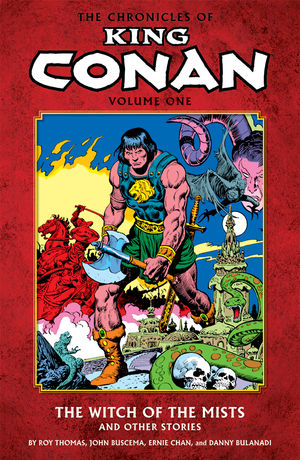
The Chronicles of King Conan Volume 1: The Witch of the Mists and Other Stories: written by Roy Thomas, based on characters created by Robert E. Howard and stories by L. Sprague de Camp, Bjorn Nyberg, and Lin Carter; illustrated by John Buscema, Ernie Chan, and Danny Bulanadi (1980-81; collected 2010): Writer Roy Thomas's decade-long affiliation with Conan at Marvel Comics would end fairly early into this early 1980's spin-off series, which gives us a 50-something Conan ruling the Hyborean Age's greatest kingdom, Aquilonia.

The five double-length adventures reprinted here present King Conan's final, multi-issue battle with the wizard Thoth-Amon, owner of the most unwieldy hat in Marvel history. Conan's son Conn is a chip off the old block, already a decent fighter at the age of 13. Penciller John Buscema's Conan is stolid and solid and grim. Buscema is strong on humans and, as always, somewhat uninspired when depicting the fantastic -- unlike seminal Marvel Conan artist Barry Windsor-Smith, Buscema is too representative in his art to convincingly depict magic and monsters. It all makes for a good time-waster, but not much else. Lightly recommended.

Sunday, April 22, 2012

Conan the Destroyed

Conan the Barbarian: written by Thomas Dean Donnelly, Joshua Oppenheimer, and Sean Hood, based on the character created by Robert E. Howard; directed by Marcus Nispel; starring Jason Momoa (Conan), Stephen Lang (Khalar Zym), Ron Perlman (Conan's father), Rachel Nichols (Tamara) and Rose McGowan (Marique) (2011): Oh, what an awful, awful movie. The sheer ineptitude of this movie caused me to think fondly of Conan the Destroyer, which really wasn't that good of a movie but which, compared to this movie, was Citizen Kane.

Don't ask me what that makes Citizen Kane.

The makers of this movie steadfastly ignore pretty much everything from Robert E. Howard's 1930's pulp creation and the 20-odd stories and one novel he appeared in. What they substitute is an awful, derivative revenge plot lifted instead from the original Conan movie with Arnold Schwarzenegger.

As evil despot Khalar Zym, Stephen Lang looks and acts hopelessly out of his depth, while Rose MacGowan, as his evil sorceress daughter Marique, jarringly plays everything with about as flat and contemporary an accent as one can imagine. We know she's evil, though, because she voluntarily paints a unibrow on herself. Quel horreur!!!

As Conan, Jason Momoa doesn't have much to do other than run around, ride around, and strike muscleman poses in lieu of demonstrating any actual sword-fighting skills. Not that one would be able to notice any such skills, as the editing jumps around a lot, I'd assume to hide the fact that no one involved with this movie knows how to stage a fight scene, much less any other type of scene. The movie substitutes a wearying series of chases and fights for character development, explanation, exposition, and world-building.

In this Conan's world, a person can pretty much get anywhere on horseback in less than a day. Apparently, the entire Hyborian realm is roughly the size of Oxford County. Written and directed by idiots, Conan the Barbarian is a wretched, stupid, embarrassing botch. Nothing makes much sense, and you're not going to care anyway. Not recommended.

Wednesday, January 4, 2012

Solomon Kane's First Homecoming

Solomon Kane by Ramsey Campbell, based on the screenplay by Michael J. Bassett and the character created by Robert E. Howard (2011): Based on a well-regarded movie that I haven't seen yet, Solomon Kane gives Conan creator Robert E. Howard's 17th-century Puritan ghost-and-demon-buster an actual origin story.

Featured in about a dozen stories, poems and fragments from the early 1930's, Solomon Kane predates Conan by a few years. Robert E. Howard created a LOT of heroes during his short, prolific life. Unlike many of those heroes, Kane moves within an actual historical context. His adventures take place in the 16th and 17th centuries, though many of them are in an Africa as fanciful as any of the wholly fictional lands of Conan.

Campbell finished up several Kane fragments for publication in the 1970's, there demonstrating an ability to approximate Howard's prose style without sliding into parody. He does the same here. His Kane is a brooding, haunted hero, and the environment is bloody and filled with the violence of men and supernatural beings. Campbell nicely echoes Howard's occasionally wonky diction (there's a stretch involving the repeated use of the word 'supine' that almost does slide into parody) and seriousness of purpose.

The novel is fun, but it's not funny or light-hearted or campy, though Campbell does seem to get stuck with what seem to be a couple of campy, Bondian missteps from the original screenplay. The worst of these comes when a necromancer says 'How do you like what I've done to the place?' to Kane as Kane regards with horror what the necromancer has done to his ancestral home. Augh! This is what Michael Moorcock and James Cawthorn flagged as "deadly jolite" in their study of fantasy, Wizardry and Wild Romance, a terrible bleedover from the Bond films.

Overall, though, this is one of the ten best non-Howard, Howard novels I've read. Ramsey Campbell deserves praise for sublimating his own peculiar style and thematic concerns to the service of telling a fairly straightforward sword-and-sorcery novel in the Howard tradition. And screenwriter Bassett does, for the most part, lay out a plausible background for this Renaissance Man, whose greatest Howard moment (in my eyes) came when he physically beat the crap out of a ghost. Recommended.

Thursday, September 29, 2011

Conan in the Hands of an Angry Thesaurus

The Chronicles of Conan Volume 2: Rogues in the House and Other Stories, written by Roy Thomas, illustrated by Barry Windsor-Smith, Sal Buscema and Others (1970-71; collected 2003): This second volume of Thomas and Windsor-Smith's pivotal Conan Marvel comic-book work of the early 1970's offers one fairly faithful adaptation of a Robert E. Howard Conan novelette (the eponymous "Rogues"), a lovingly rendered adaptation of short story "The Frost-Giant's Daughter", and several other stories of young Conan as he wanders around thieving, getting arrested, escaping arrest, and fighting wizards, gods and monsters.

Windsor-Smith's art grows more splendid and idiosyncratic throughout this volume as he changes from Kirbyesque super-hero artist to lush, pre-Raphaelite-influenced illustrator at a fairly astonishing rate of progression. He wouldn't stay on Conan much beyond this point, but he'd remain the acknowledged, definitive comic-book Conan artist ever afterwards, though John Buscema would soon surpass him in page count if not in overall effect.

Writer Roy Thomas thuds along as if he were paid by the word (which he wasn't). He'd work on Conan's comic-book adventures at Marvel for a decade and become the "definitive" Conan comic-book writer through sheer weight of output. Occasionally, the artwork creaks and shudders under the weight of all that obscuring prose. Uk wuk. Recommended.

Saturday, September 17, 2011

Albino Gnome


The Chronicles of Conan Volume 3: The Monster of the Monoliths and Other Stories, written by Roy Thomas, Michael Moorcock and James Cawthorn, illustrated by Barry Windsor-Smith, Gil Kane and others (1971-72; collected 2006): It took awhile for Marvel's comic-book Conan the Barbarian to gain sales traction, but once it did it ran for about 30 years in both colour and black-and-white magazines. For fans, the high point of the series came early, when long-time writer Roy Thomas was teamed with up-and-coming artist Barry Windsor-Smith for the first twenty issues or so of the colour comic.

Windsor-Smith's art became increasingly refined, complex and painterly as the series went on, evidenced in part here by the decision to try printing one issue directly from his pencils (it doesn't work that well here reproduced and remastered in a high-quality format, so I shudder to think what it looked like on pulp newsprint).

Thomas was (and is) an almost self-parodically verbose writer, and it becomes quite trying here after awhile, though this was admittedly also Marvel's house writing style at the time. Which is to say, every damn panel has to have dialogue or captions in it. When your book is about a taciturn barbarian, this seems especially annoying.

Included here is the two-part cross-universal team-up between Conan and Michael Moorcock's anti-Conan sword-and-sorcery character, Elric of Melnibone. The Windsor-Smith art achieves some startling effects in this story, especially in a battle between two god-like beings, though it suffers somewhat from Windsor-Smith's misunderstanding of what Elric's headgear was supposed to look like. As is, Elric ends up wearing a hat that seems to have been borrowed from a garden gnome. How does Conan keep from laughing?

Other artistic high points occur throughout this reprint collection, including a two-parter illustrated by Gil Kane. The writing can be a really heavy, purple slog at points, but the art makes this worth picking up. Recommended.

Tuesday, March 15, 2011

No Conan


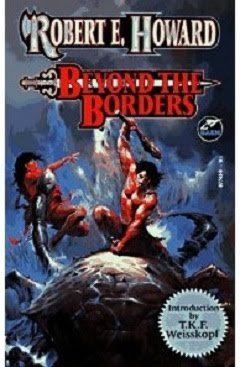
The Robert E. Howard Library Volume 7: Beyond the Borders, edited and with an introduction by T.K.F. Weisskopf (1996):

Stories:

1 · The Voice of El-Lil
34 · The Cairn on the Headland
61 · Casonetto’s Last Song
67 · The Cobra in the Dream
76 · Dig Me No Grave
95 · The Haunter of the Ring
117 · Dermod’s Bane
125 · King of the Forgotten People
152 · The Children of the Night
173 · The Dream Snake
182 · The Hyena
200 · People of the Black Coast
213 · The Fire of Asshurbanipal

Conan creator Robert E. Howard may have more variant editions of his many stories than almost any other 20th-century fantasy writer. This volume comes from Baen Books' 1990's Howard line, and focuses on non-Conan, mostly horror and dark fantasy tales set in the 1920's and 1930's. Lost civilizations, African shenanigans, and supernatural investigators predominate, along with a Howard stand-by, the ancestral memory story (or maybe more accurately the 'reincarnation recalled' story).

Most of the stories here are slight but interesting -- Howard was an inherently interesting writer, which is a lot rarer than you may think; even his prejudices can be fascinating. I really like contemporary dark fantasy tale "The Cairn on the Headland", with its suggestion that the pagan gods were actually demonic, possibly Cthulhoid forces from Outside. Howard also has some fun with an evil phonograph recording ("Casonetto's Last Song") and various evil animals, men, and lost races. Editor Weisskopf completely whiffs on one of Howard's real-world historical references (Weisskopf seems to think Howard made up a religion which is in fact is a real one). Oh, well. Lightly recommended.