Showing posts with label john buscema. Show all posts

Wednesday, December 14, 2016

Apes and Avengers


DC Goes Ape Volume 1 (1959-99/ Collected 2008): edited by Bob Joy; written by Otto Binder, John Broome, and others; illustrated by George Papp, Wayne Boring, and others: The story goes that 1950's DC Comics editors noted a sales uptick whenever primates appeared on a comic-book cover. And so primates readers would be given, mostly gorillas and apes (and one Kryptonian super-monkey!). Well, and Detective Chimp.

This volume collects some of DC's finest, freakiest tales of super-apes and criminal gorilla criminals. The material from the 1950's and 1960's shines the brightest, giving us mainstays such as Titano the giant super-ape, the gorilla crime boss of Gotham, telepathic Flash villain Gorilla Grodd, a super-monkey to annoy a young Superboy (or was it Superbaby?), and several others. Wonder Woman even gets changed into a gorilla by an astronaut gorilla from another world. Hoo ha! Recommended.


Avengers: Assault on Olympus (1987/ Collected 2011): written by Roger Stern and Bob Harras; illustrated by John Buscema, Bob Hall, Tom Palmer, and Kyle Baker: Roger Stern's tenure as writer of the Avengers in the 1980's stands as one of two or three high points for Marvel's superhero group. And the art by John Buscema and finisher Tom Palmer was more than solid as well. 

In the aftermath of the epic siege on Avengers mansion story arc, the Avengers find themselves plunged into the world of the magical and mythic. Avenger Hercules got beaten into an unbreakable coma during the siege. Now, Zeus blames the Avengers for Hercules' condition -- and seeks vengeance. It's fun stuff, with one of the more powerful Avengers line-ups when it comes to brute strength (She-Hulk, Thor, and the Sub-mariner). An off-beat standalone story about Avengers' butler Jarvis rounds out the collection. Recommended.

Tuesday, September 1, 2015

Vico, Vico

The Savage Sword of Conan the Barbarian Archives Volume 1: written by Roy Thomas, Lin Carter, and Robert E. Howard; illustrated by Barry Windsor-Smith, John Buscema, Tony DeZuniga, Pablo Marcos, Tim Conrad, Jim Starlin, and others (1971, 1973-75; collected 2007): This first reprint volume of Marvel's black-and-white Conan comics magazines that started in the 1970's peaks right at the beginning, with quintessential Conan comic-book artist Barry Windsor-Smith illustrating several tales. He's terrific on what's almost a vignette about a teen-aged Conan, "The Frost Giant's Daughter." And he hits an all-time high with an adaptation of the Conan novella "Red Nails." There's a reprint volume devoted entirely to Windsor-Smith's colour and black-and-white Conan work for Marvel, if you're so inclined.

The rest of the volume, almost entirely written by long-time Conan scribe/adapter Roy Thomas, is mostly high quality as well. Thomas' Conan was always more stereotypically heroic than Robert E. Howard's original, but he can still be a bit of a jerk at times. Highlights include the oft-imitated crucifixion of Conan from an adaptation of Howard's "A Witch Shall Be Born" and an original team-up with Howard's female barbarian Red Sonya. John Buscema, who penciled more Conan stories at Marvel than anyone else, gives us his older-looking Conan throughout, with Tony DeZuniga and others ably inking Buscema or drawing him themselves. It's too bad these volumes weren't reprinted at their original magazine-page size, though -- the art and lettering can get a bit cramped at points in the comic-book-page dimensions of the collection. Recommended.


Dr. Spektor Volume 1: written by Mark Waid; illustrated by Neal Edwards and Christian Ward (2014): Enjoyable reboot of a Silver Age Gold Key hero about whom I know absolutely nothing. Veteran scribe Mark Waid gives us a master of the mystic arts who's also a TV personality and a bit of a knob. The art is competent, though never particularly mystical or surreal. It's a book about a magician that could use an injection of the surreal and the non-representational on the artistic side. Lightly recommended.


Superman: Camelot Falls Vol. 1 and 2: written by Kurt Busiek; illustrated by Carlos Pacheco and Jesus Merino (2006-2007; collected 2009): Lengthy Superman story that appeared intermittently in about a year-and-a-half's worth of Superman comics gets collected here, with art primarily by Carlos Pacheco and story by Kurt Busiek. It's among the finest Superman stories of the last 25 years in both art and story. Pacheco is a clean, dynamic penciler with just the right hint of whimsy in his art. Busiek's Superman is forthright and stalwart though occasionally plagued by doubt. 

Busiek riffs on a Superman story from the early 1970's, "Must There Be A Superman?", as Superman discovers that the presence of he and his fellow heroes will ultimately lead to the destruction of all human life on Earth. Or will it? 

Busiek brings back Atlantean super-magician Arion to present a superhero-tinged version of Vico's cyclical view of history. There will always be a Rise, there will always be a Fall, there will always be another Rise, and so on, but the prevention of that Fall by Superman and friends will cause the Fall to build in power until when it comes, there will be no subsequent Rise again. Humanity will perish in the turbo-charged wave of darkness. Arion wants Superman to retire intentionally so this future won't come to pass. But if Superman won't retire, Arion will retire him forcibly and then start the next wave of darkness himself before it builds any further. To Arion, the ends justify the means, no matter how many billions must die to ensure humanity's survival.


It may sound grim, but Busiek keeps things hopeful throughout: Arion may be wrong. And Superman remains heroic and dedicated to preserving life, as he should. Busiek introduces a new villain for Superman, Khyber, who grows on one over the course of the story. He is in many ways an attempt to give Superman his own Ra's Al Ghul, an immortal enemy with designs on global domination and a patience born of immortality. Only the name, which seems to be an attempt to meld the historic and ongoing importance of the Khyber Pass with the sounds-similar 'Cyber,' is a bit vexing. Well, unless Busiek is playing with the Cockney rhyming slang construction of "Khyber Pass" as a stand-in for "Ass" (or "Arse"), which would be hilarious. In all, recommended.

Wednesday, October 8, 2014

But What of Kodos?

The Avengers/Kang: Time and Time Again: written by Stan Lee, Jack Kirby, Roy Thomas, and Roger Stern; illustrated by Jack Kirby, John Buscema, Sal Buscema, Herb Trimpe, Tom Palmer, and others (1968-1986; collected 2005): Time-travelling super-villain Kang is probably the most fun villain Marvel's Avengers have ever had. He pops up all over the place. There are several thousand versions of him at one point. And he's also, probably, maybe, two other super-villains as well at different points in his timeline.

This too-slim volume presents Kang stories from a span of about 20 years, beginning with an encounter with Thor and ending with...well, actually the volume ends with a lengthy prose piece that explains Kang's twisted timeline from his first appearance in the late 1960's to the early 2000's. Along the way, Kang butts heads with the Avengers, and the Hulk and Thor in solo outings.

Among other things, Kang gave Marvel writer Roy Thomas a handy way to indulge his love of obscure characters, Marvel's 1940's superheroes, and homages to the characters of other comic-book companies. The Hulk teams up with the Phantom Eagle, a World War One flying ace in the Marvel universe with only one appearance previous to that team-up, to thwart Kang's plans. The Squadron Sinister, a riff on DC's Justice League, battles the Avengers. The Invaders, Marvel's World War Two superhero group, battles the Avengers. And so on, and so forth. Most importantly, Kang battles himself. Really, Kang's greatest enemy almost always turns out to be another version of Kang, while the Avengers look on in bemused fashion. He's the Man Who Scolded Himself.

The Roger Stern/John Buscema/Tom Palmer 1986 arc that ends the volume shows Stern at the top of his form as a writer, cleaning up continuity while also forging a fascinating story without over-indulging in nostalgia and minutiae in that Roy Thomas manner. The art throughout the volume ranges from competent in the sections pencilled by workhorse Sal Buscema to top-notch in the Jack Kirby-pencilled Thor outing and that concluding Stern arc, with Buscema and Palmer doing a fine job. Kang multiplies. He divides. I'd like an omnibus that contains all of his appearances. Would that be too much to ask? Recommended.

Tuesday, November 20, 2012

It Only Seems Like Eternity

The Chronicles of Conan Volume 16: The Eternity War and Others: written by Roy Thomas and J.M. de Matteis; illustrated by John Buscema, Bob McLeod, and Ernie Chan (1980; collected 2008): Workmanlike Dark Horse reprints of Conan adventures originally published by Marvel Comics in the early 1980's. The only item of historical note is that this collection bridges the transition from writer Roy Thomas to other writers on the Conan colour comic book.

Thomas had written the Marvel Conan pretty much by himself since the comic started publication in 1970. But 1979-1980 saw Thomas out at Marvel and in at DC, where he'd soon be writing his self-created sword-and-sorcery book, Arak, Son of Thunder. While two Conan Annuals present some of Thomas' last Conan work for the next ten years or so, a young J.M. de Matteis does nothing to embarass himself here on the included issues of the monthly book: but Marvel's Conan was, like a a lot of other Marvel comics of the time, pretty bland gruel.

Long-time Conan artist John Buscema was only doing breakdowns by this point, leaving it to other inkers to put perhaps too much of a hard edge on the final art (Buscema was apparently chronically dissatisfied with Ernie Chan's work as an inker/finisher which, given the eternal perversity of Marvel Comics, probably explains why Chan finished so much Buscema work). Chan would be a good inker for Buscema if super-heroes were involved but on Conan a lighter hand (or maybe a moodier one like Alfredo Alcala) would have added some sorcery to the cleanly, blandly depicted swordplay.

I'll tell you, though, Buscema really had problems with drawing horses. And don't get me started on the Manotaur, a creature as badly designed as its name was badly chosen. Only recommended for Conan completists.

Wednesday, June 6, 2012

Conan: Beginnings and Endings

The Chronicles of Conan Volume 1: The Tower of the Elephant and Other Stories: written by Roy Thomas, based on stories and fragments by Robert E. Howard and L. Sprague de Camp; illustrated by Barry Windsor-Smith and others (1970-1971; collected 2003): Marvel's long-running affair with Robert E. Howard's mighty barbarian begins here, with the first few early-1970's issues of the Conan colour comic book (a B&W magazine, The Savage Sword of Conan, would soon follow).

Roy Thomas was always a bit of a wet blanket as an adapter of Howard's stories. He buffed away all the sharp edges of Conan for the Comics Code Authority while indulging in that peculiar sin of 1970's comic books, the endless description of things one can already see in the comics panel.

Nonetheless, the strength of Howard's original stories still shines through, especially in the title adaptation of what I'd say is Howard's finest Conan short story. "The Tower of the Elephant" offers us a thieving young Conan, a seemingly impregnable fortress, a wicked sorcerer, a giant spider, and a surprisingly sympathetic character who allows Conan to showcase his rough-hewn Cimmerian honour. Other stories introduce such Conan staples as giant snakes, wicked Set-worshipping wizard Thoth-Amon, and an endless string of slave girls, prostitutes, and thieves.

Main artist Barry Windsor-Smith, a Kirby knock-off artist before his stint on Conan, grows with astonishing swiftness from issue to issue. He maintains the dynamism he learned from Kirby while coming quickly into an early version of his fluid, evocative style. He's the only comic-book artist I can think of whose two main artistic influences are Jack Kirby and the Pre-Raphaelites. It's neato. Recommended.


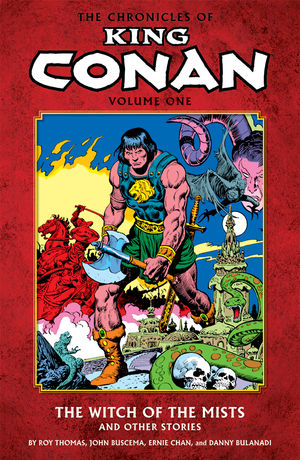
The Chronicles of King Conan Volume 1: The Witch of the Mists and Other Stories: written by Roy Thomas, based on characters created by Robert E. Howard and stories by L. Sprague de Camp, Bjorn Nyberg, and Lin Carter; illustrated by John Buscema, Ernie Chan, and Danny Bulanadi (1980-81; collected 2010): Writer Roy Thomas's decade-long affiliation with Conan at Marvel Comics would end fairly early into this early 1980's spin-off series, which gives us a 50-something Conan ruling the Hyborean Age's greatest kingdom, Aquilonia.

The five double-length adventures reprinted here present King Conan's final, multi-issue battle with the wizard Thoth-Amon, owner of the most unwieldy hat in Marvel history. Conan's son Conn is a chip off the old block, already a decent fighter at the age of 13. Penciller John Buscema's Conan is stolid and solid and grim. Buscema is strong on humans and, as always, somewhat uninspired when depicting the fantastic -- unlike seminal Marvel Conan artist Barry Windsor-Smith, Buscema is too representative in his art to convincingly depict magic and monsters. It all makes for a good time-waster, but not much else. Lightly recommended.