
Showing posts with label robert e. howard. Show all posts
Showing posts with label robert e. howard. Show all posts
Sunday, November 25, 2018


Thursday, September 10, 2015
9 X 13

Enjoyable, brief anthology of stories previously published in the venerable Weird Tales (originally 1923-1954, with several brief revivals since then). Robert Bloch supplies a nice little introduction while anthologist Mike Ashley gives the reader lengthy, informative notes before and sometimes after the nine stories. The two 1973 anomalies in the story appearance dates come from Lin Carter finishing a much older Clark Ashton Smith fragment for the brief 1970's revival of Weird Tales and a rejected 1940's Eric Frank Russell/Leslie Johnson story that also appeared in the 1970's revival.
For such a short anthology, Weird Legacies possesses impressive range. All of the original Weird Tales writers who got high marks in the readers' polls in the magazine appear here with the exception of Seabury Quinn, whom Ashley promises will appear in a later (non-existent, so far as I can tell) anthology.
Kuttner and Bloch's "The Black Kiss" is a revelation, an excellent, unsettling bit of aquatic horror with certain similarities to H.P. Lovecraft's "The Shadow Over Innsmouth" from two correspondents with H.P.L.. August Derleth's literal-minded expansion of a Lovecraft fragment, "The Survivor," is perhaps too similar, and inferior, to the Bloch/Kuttner piece to profitably appear here. Lin Carter's Smith expansion offers an interesting pastiche of Smith's ornate, baroque writing style, but it too offers too much of the same thing as it concludes.
The other stories are more in line with the excellence of "The Black Kiss," with a solid Solomon Kane story from Robert E. Howard and Edmond Hamilton's elegiac tale of a winged mutant leading the way. "The Three Marked Pennies", one of the most popular Weird Tales stories ever, seems like a Twilight Zone bit super-collided with a conte cruel. It is indeed memorable. The Francis Flagg piece is interesting as a Lovecraftian riff with an ending more suited to the Horta episode of Star Trek. A somewhat atypical Ray Bradbury story set on the battlefields of WWII and the truly odd, metaphysical "Eternal Rediffusion" round out the selection. Recommended.
Tuesday, September 1, 2015
Vico, Vico
 The Savage Sword of Conan the Barbarian Archives Volume 1: written by Roy Thomas, Lin Carter, and Robert E. Howard; illustrated by Barry Windsor-Smith, John Buscema, Tony DeZuniga, Pablo Marcos, Tim Conrad, Jim Starlin, and others (1971, 1973-75; collected 2007): This first reprint volume of Marvel's black-and-white Conan comics magazines that started in the 1970's peaks right at the beginning, with quintessential Conan comic-book artist Barry Windsor-Smith illustrating several tales. He's terrific on what's almost a vignette about a teen-aged Conan, "The Frost Giant's Daughter." And he hits an all-time high with an adaptation of the Conan novella "Red Nails." There's a reprint volume devoted entirely to Windsor-Smith's colour and black-and-white Conan work for Marvel, if you're so inclined.
The rest of the volume, almost entirely written by long-time Conan scribe/adapter Roy Thomas, is mostly high quality as well. Thomas' Conan was always more stereotypically heroic than Robert E. Howard's original, but he can still be a bit of a jerk at times. Highlights include the oft-imitated crucifixion of Conan from an adaptation of Howard's "A Witch Shall Be Born" and an original team-up with Howard's female barbarian Red Sonya. John Buscema, who penciled more Conan stories at Marvel than anyone else, gives us his older-looking Conan throughout, with Tony DeZuniga and others ably inking Buscema or drawing him themselves. It's too bad these volumes weren't reprinted at their original magazine-page size, though -- the art and lettering can get a bit cramped at points in the comic-book-page dimensions of the collection. Recommended.


Busiek riffs on a Superman story from the early 1970's, "Must There Be A Superman?", as Superman discovers that the presence of he and his fellow heroes will ultimately lead to the destruction of all human life on Earth. Or will it?
Busiek brings back Atlantean super-magician Arion to present a superhero-tinged version of Vico's cyclical view of history. There will always be a Rise, there will always be a Fall, there will always be another Rise, and so on, but the prevention of that Fall by Superman and friends will cause the Fall to build in power until when it comes, there will be no subsequent Rise again. Humanity will perish in the turbo-charged wave of darkness. Arion wants Superman to retire intentionally so this future won't come to pass. But if Superman won't retire, Arion will retire him forcibly and then start the next wave of darkness himself before it builds any further. To Arion, the ends justify the means, no matter how many billions must die to ensure humanity's survival.
It may sound grim, but Busiek keeps things hopeful throughout: Arion may be wrong. And Superman remains heroic and dedicated to preserving life, as he should. Busiek introduces a new villain for Superman, Khyber, who grows on one over the course of the story. He is in many ways an attempt to give Superman his own Ra's Al Ghul, an immortal enemy with designs on global domination and a patience born of immortality. Only the name, which seems to be an attempt to meld the historic and ongoing importance of the Khyber Pass with the sounds-similar 'Cyber,' is a bit vexing. Well, unless Busiek is playing with the Cockney rhyming slang construction of "Khyber Pass" as a stand-in for "Ass" (or "Arse"), which would be hilarious. In all, recommended.
Thursday, July 9, 2015
Weird Detective Stories

For a fairly low-budget fantasy film, Solomon Kane looks great, is jam-packed with good actors who seem to be invested in their roles, and has a suitably haunted James Purefoy as Kane. In terms of both sword-and-sorcery movies and Robert E. Howard adaptations, I might actually rank this over the original Conan the Barbarian, if only because its lack of pomposity hews much closer to Howard's writing than John Milius's bellicose sturm-und-drang. Highly recommended.


Alas, with about 75 pages to go, it completely craps the bed. Despite the fact that its climax is rushed and sketchy and amazingly satisfaction-light, Night Souls nonetheless finds the space for back-to-back chapters in which major female characters are raped, murdered, and dismembered in graphic detail. Then it throws in the dismemberment of an old homeless guy in a subsequent chapter because the writers seem to have lost all interest in the procedural aspects of their own narrative. As we've already been shown how bad the antagonists can be, these chapters don't tell or show us anything we don't know -- and the later fate of the rapist-murderers comes and goes with so little effect that there's no sense of catharsis or justice or really much of anything.
Oh, and one of the women is raped by a lizard-like monster which we're told on more than one occasion has a foot-long penis with giant barbs on it. Hooray! As the only other horror-novel rape scenes involving monsters with barbed penises that I recall happen in terrible Richard Laymon novels (yes, more than once, barbed-penis-rape-scene fans!), I can only assume this is a grotesque tip of a grotesque hat. There are horror novels that effectively portray rape scenes; Night Souls is not one of them unless you're a rape fetishist or a connoisseur of unusually large barbed penises. Not recommended.
Thursday, April 30, 2015
Horrors Unknown!

Sam Moskowitz assembles a dandy 1971 anthology of stories by major horror and fantasy authors that had not been previously anthologized and puts it together with copious and useful biographical and bibliographical notes.
The genre gem here (at least for me) is "The Challenge from Beyond," a multiple-author story from the 1930's in which each writer wrote a couple of thousand words and then passed it on to the next writer. And what a group of writers -- H. P. Lovecraft, C. L. Moore, A. Merritt, Robert E. Howard, and Frank Belknap Long drive this car all over the road, off the road, and upside-down, in their own distinctive stylistic and thematic voices. It's certainly not a great story, but it is a hoot -- especially when Robert E. Howard (Conan) goes off on an almost stereotypical Robert E. Howard tangent in his section, leaving Long to figure out how to put everything back together again to end the story.
The rest of the collection has its joys too, especially to someone steeped in the genres and writers of fantasy and horror. Ray Bradbury's first published story and the revision of that same story he did with Henry Hasse isn't particularly good, but it's a great window into the author's brain in its earliest stages. The entries from Marshall, Merrit, Norris, and Sabin are all fascinating rarities.
C.L. Moore's solo entry, "Werewoman," is a dream-like, uncharacteristic entry in her pulp-space-hero Northwest Smith's adventures. The weird night-journey of "Unseen - Unfeared' by Francis Stevens has gone on to be anthologized numerous times since 1971 for its strange mix of science and the supernatural. And "Hand to Mouth" by the major and short-lived mid-19th-century fantasist Fitz-James O'Brien ("What Was It?", "The Diamond Lens") seems like a novella written 50 years too early. It, too, is a night-journey of dreams and nightmares, almost surreal or even dadaist in its sensibilities. In all, highly recommended.
Wednesday, June 11, 2014
'Old' Books

Basically, one gets some contemporary horror stories, of which "Pigeons from Hell" is the marvelously titled best, and at worst Howard's second-best pure horror story. Howard's ancient Pict leader Bran Mak Morn shows up a few times, even after he's dead. Some Lovecraftian horrors show up, as do a few ghosts and demons and one malevolent magic snake.
Roaming freebooters of the Middle Ages, Turlogh O'Brien and Athelstane, have a couple of adventures involving lost civilizations and massive bloodshed. And a couple of (then) modern-day Americans suddenly flash back to past lives of adventure, as happens a lot in Howard's stories. Viva reincarnation! Recommended.

Cinder and Ashe: written by Gerry Conway; illustrated by Jose Luis Garcia-Lopez and Joe Orlando (1988): Solidly written thriller from Gerry Conway, Cinder and Ashe follows private detectives Jacob Ashe and Cinder DuBois as an enemy from their shared past in Viet Nam long thought dead suddenly turns up in a case they're working in 1988.
This miniseries, from that long-lost era when DC Comics regularly released non-superhero work under the main DC banner (as opposed to under the Vertigo banner) has never been collected into book form so far as I know, so you'll have to check out the back-issue bins.
Conway's writing does the job -- you can see how he would seamlessly transition from writing for comics to working for the Law and Order franchise in the years to come .
And the art, by longtime DC mainstay Jose Luis Garcia-Lopez, is fantastic -- beautifully detailed and fluid. Because Garcia-Lopez works here on normal people and not super-heroes, his artistic similarity to the great Milton Caniff and other comic-strip giants really shines through. Not only does the art alone make a case for permanent collection, it makes a case for oversized permanent collection so that the often exquisite linework becomes fully visible. Recommended.
Saturday, March 22, 2014
Why a Duck?

This collection prints about a dozen one-page 'gags,' but the meat of the book comes with the longer adventures. And they truly are adventures on land, on sea, and in the air. These are some action-packed ducks.
Barks remains a wonder. The cartooning and the writing are both still fresh and funny. There are moral lessons here, but they're not rammed down the readers' throats. And the story of the hidden city of Tralala is about as pessimistic a tale about human nature as I can imagine in a comic book aimed squarely at children. Capitalism turns out to be toxic, but there's no conceivable escape from it. Whee, fun! That story remains funny nonetheless even as it verges on being a Jonathan Swift satire, with ducks.
Once upon a time in the 1950's, these were the best-selling comic books in North America. It's a tribute to the pop-cult sensibilities of Carl Barks that they're also rewarding, breezy entertainments that make the typical superhero comic book of the time look ham-fisted by comparison. Mmm. Ham. Highly recommended.

Jonah Hex: No Way Back: written by Jimmy Palmiotti and Justin Gray; illustrated by Tony DeZuniga with John Stanisci (2010): Ill-served by an egregiously awful Hollywood movie, Jonah Hex nonetheless remains a terrific comic book character who's had extraordinary luck in terms of writers and artists. Set in the post-Civil War American West, the original graphic novel Jonah Hex: No Way Back brings legendary (and, sadly, soon-to-be deceased) Hex artist Tony DeZuniga back for a look at Hex's dark past.
 Hex may be a homicidal, bounty-hunting anti-hero, but he still possesses a rudimentary moral code. His origins suggest that code was a reaction to the complete amorality of his father and adandonment by his mother. It's certainly a place to start, anyway. Palmiotti and Gray have been writing Hex's regular comic-book adventures for a decade now, and they're worthy successors to such previous Hex scribes as John Albano, Michael Fleischer, and Joe Lansdale.
 Their West is a nightmarish place, part-spaghetti-Western, part-horror-show, just as it as been since Albano first wrote the character in the early 1970's. And while DeZuniga's art is somewhat inconsistent at first, by the time the book gets into ultraviolent second half, DeZuniga is operating with his familiar gritty, weathered artistry intact. Recommended.
Thursday, November 7, 2013
Solomon Kane's First Homecoming

Solomon Kane doesn't have the weird, sweaty, portentous grandeur of the original Conan the Barbarian, but it's certainly better-acted and better-written than that odd classic. This is a dark yet ultimately hopeful movie, devoid of Camp and metafoolery, committed to its peculiar (and very Howardesque) version of English history.
Indeed, the main cast suggests nothing more than a Masterpiece Theatre production gone rogue into the wilds of American pulp. James Purefoy is great as Solomon Kane at the beginning of his demon-fighting career, and the rest of the talented cast and crew seems similarly invested. It's like watching real historical drama acted by real actors, only with awesome sword-fights and monsters! Madness! No wonder it couldn't secure an American distributor!
The story begins in the year 1600. After escaping a demon who tells him that someone has already sold his soul to the Devil, kill-crazy British privateer Solomon Kane retires to an English Abbey to repent of his sins and remake himself into a Man of Peace. He will fight no more forever.
But God's got other plans for him. Before long, Kane's trying to single-handedly stop Northern England from being overrun by Satan's Army. You know, just like it happened in the history books. An invasion of England by Hell really is suitably Howardesque, though, despite the fact that almost nothing in the movie is drawn from Howard's actual work. The big, gloomy Texan loved to scramble history in his blood-soaked sword-and-sorcery melodramas.
Howard's stories, fragments, and poems about Solomon Kane only briefly refer to his 'origins' as the Renaissance World's premiere monster-fighter. And this film doesn't really synchronize with Howard's references: nowhere in Howard's work is the suggestion that Kane had to repent of anything. He was an evil-killing machine from the beginning. He probably beat up ghosts while still in the womb. However, contemporary heroic-origin movies tend to need a character arc of redemptive psychology. At least in this case, the psychological growth trends towards Kane's acceptance of his mission as for the public, and not just the personal, good.
In any event, there's lots of sword-fighting and musket-firing. There's crucifixion, an old Howard standby. There are several nicely visualized supernatural beings, including a creepy looking fire demon and some truly unpleasant things lurking inside some supernatural mirrors. There's a rain-swept, plague-ravaged, burned-out landscape to quest across, a Waste Land to be redeemed.
A little more stillness and time for character development would have been nice. As is, though, this is quite the propulsive action-adventure movie. It's a shame there won't be more installments. I'd have liked to see writer/director Michael J. Bassett's take on Kane's loopy African adventures amongst the vampires, harpies, shambling super-blobs, evil men black and white, and sympathetic gorillas of the 'Dark Continent.' Highly recommended.
Sunday, September 15, 2013
Toads and Snakes and Ghostly Apes

Nice little collection of Robert E. Howard horror stories, some but not all of them additions to H.P. Lovecraft's Cthulhu Mythos. Howard added Nameless Cults, another evil tome of lore that should have been forgotten, to the Mythos, along with a few creatures, characters, books, and quasi-gods.
Among the Mythos tales, "The Black Stone" is by far the strongest. It places the action in Eastern Europe rather than North America, where much of Lovecraft's work was set. Besides introducing some of the poetry of Justin Geoffrey, who would be driven mad by the cosmic horrors he experienced and die screaming in an asylum, the story also gives us an extremely unpleasant toad-thing. It also introduces Muslims as, if not heroes, then not as villains -- their sweep into Hungary results in the destruction of a particularly horrible witch-cult. And in the Cthulhu universe, witch-cults aren't worshipping anything as mundane as Satan.
The other stories include a desert adventure into a lost city reputed to be guarded by something awful ("The Fire of Asshurbanipal") and a couple of heroic fantasies with major horror elements ("The Worms of the Earth" and "The Valley of the Worm"). "The Worms of the Earth" also ties in with "People of the Dark", as both present a subterranean race of reptilian 'men' driven underground by humanity some time in the dim past. These stories echo some of Arthur Machen's prototypical dark fantasies about the 'Little People', but with a typical Howard flavour (snakes and snake-like beings were one of Howard's most-favoured tropes).
"The Thing on the Roof" and "Dig Me No Grave" are fairly standard Mythos stories, although the former doesn't really achieve shock in its final revelation. "The Shadow of the Beast", one of Howard's many posthumously published stories, conjures up some nice atmospherics in a haunted house. The thing doing the haunting turns out to be quite interesting, partially because Howard's hard-bitten narrator shows some pity for its plight.
And then there's "Pigeons from Hell," adjudged by Stephen King to be one of the scariest stories ever written. It is quite a creep-out, and may be made even more creepy by the heavy lifting required to make a story with that somewhat goofy title legitimately scary.
Here, Howard seemed to be riffing on Lovecraft's repeated use of whippoorwills as psychopompic omens of death and the supernatural in the New England states, substituting pigeons for the Southern United States. It's the only thing about this horror story that doesn't quite play -- otherwise, this is a masterpiece of building tension and repeated shocks. It's Howard's finest horror short story, and one that stands up well against anyone else's horror stories, anywhere, anytime. In all, recommended.
Tuesday, November 27, 2012
Armies of Night

Bantam's second (and last) 1970's volume of the adventures of Robert E. Howard's quasi-Puritan monster-fighter takes place mostly in Africa. Not historic Africa, but an Africa almost as fantastic as the world of Conan the Barbarian. Howard aficiando and acclaimed horror writer Ramsey Campbell finishes two Howard fragments here, to solid effect -- the seams don't show.
This time out, Kane battles an army of vampires, an army of carnivorous hawkmen, a couple of lost civilizations, and an unnameable Cthulhuian horror. He gets a lot of help from his African magician pal N'Longa and from the ancient staff N'Longa gives him to fight evil with, a staff the stories tell us may predate the existence of the Earth itself. Solomon Kane fights for an ostenibly Christian God, but he does so within a fantastic framework that resembles H.P. Lovecraft's Cthulhu Mythos, one in which evolution is taken as a given.
Howard's racial sensibilities will offend some, though they seem surprisingly progressive in a "White Man's Burden" sort of way. N'Longa is a great help, and Kane spends a lot of time liberating African slaves or fighting to save villages from terrible supernatural menaces. He's a real gent. Highly recommended.
Tuesday, November 20, 2012
It Only Seems Like Eternity

Thomas had written the Marvel Conan pretty much by himself since the comic started publication in 1970. But 1979-1980 saw Thomas out at Marvel and in at DC, where he'd soon be writing his self-created sword-and-sorcery book, Arak, Son of Thunder. While two Conan Annuals present some of Thomas' last Conan work for the next ten years or so, a young J.M. de Matteis does nothing to embarass himself here on the included issues of the monthly book: but Marvel's Conan was, like a a lot of other Marvel comics of the time, pretty bland gruel.
Long-time Conan artist John Buscema was only doing breakdowns by this point, leaving it to other inkers to put perhaps too much of a hard edge on the final art (Buscema was apparently chronically dissatisfied with Ernie Chan's work as an inker/finisher which, given the eternal perversity of Marvel Comics, probably explains why Chan finished so much Buscema work). Chan would be a good inker for Buscema if super-heroes were involved but on Conan a lighter hand (or maybe a moodier one like Alfredo Alcala) would have added some sorcery to the cleanly, blandly depicted swordplay.
I'll tell you, though, Buscema really had problems with drawing horses. And don't get me started on the Manotaur, a creature as badly designed as its name was badly chosen. Only recommended for Conan completists.
Thursday, November 15, 2012
Skulls and Bones

Unlike Conan, whose battles against evil came mostly came as a by-product of his battles for money and power, Kane intentionally sought out evil. Howard is already more canny at a young age (the Kane stories were all written before the age of 25) than many pulp writers ever are: there are a number of fascinating writerly observations about Kane's personality throughout these tales, most of them about Kane's non-self-aware fanaticism and its pros and cons when it comes to fighting evil.
Kane is obsessive, and his faith is unshakeable -- and it often seems that that unshakeable faith brings powerful forces to his aid when he needs it. He can, however, fight his way out of almost any situation. And unlike Conan, he has the benefits of gunpowder and muskets.
Ramsey Campbell does a nearly seamless job of finishing up one Kane fragment ("The Castle of the Devil") in this late 1970's collection. The rest of the stories (and one poem) were finished by Howard himself, with the remaining Kane stories and fragments in a second volume. The adventures here aren't quite as fantastic as those in the second volume. Kane fights 'normal' brigands in one story, while in another the foes are human and the help from an African magician the only magical part of the narrative.
Howard's racism is noticeable throughout, though later stories set in Africa would make Africans much more sympathetic as Kane battled to save tribespeople from supernatural threats (again with the help of the canny African magician he first meets here). The action is involving, the portrayal of Kane fascinating, and the events sometimes move into the realm of the epic. Highly recommended.
Wednesday, June 6, 2012
Conan: Beginnings and Endings

Roy Thomas was always a bit of a wet blanket as an adapter of Howard's stories. He buffed away all the sharp edges of Conan for the Comics Code Authority while indulging in that peculiar sin of 1970's comic books, the endless description of things one can already see in the comics panel.
Nonetheless, the strength of Howard's original stories still shines through, especially in the title adaptation of what I'd say is Howard's finest Conan short story. "The Tower of the Elephant" offers us a thieving young Conan, a seemingly impregnable fortress, a wicked sorcerer, a giant spider, and a surprisingly sympathetic character who allows Conan to showcase his rough-hewn Cimmerian honour. Other stories introduce such Conan staples as giant snakes, wicked Set-worshipping wizard Thoth-Amon, and an endless string of slave girls, prostitutes, and thieves.
Main artist Barry Windsor-Smith, a Kirby knock-off artist before his stint on Conan, grows with astonishing swiftness from issue to issue. He maintains the dynamism he learned from Kirby while coming quickly into an early version of his fluid, evocative style. He's the only comic-book artist I can think of whose two main artistic influences are Jack Kirby and the Pre-Raphaelites. It's neato. Recommended.
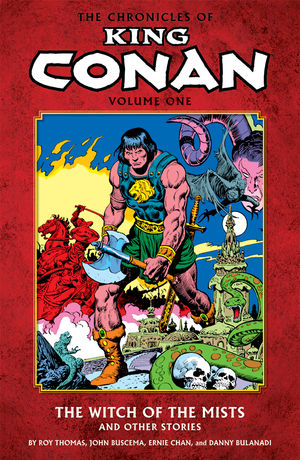
The five double-length adventures reprinted here present King Conan's final, multi-issue battle with the wizard Thoth-Amon, owner of the most unwieldy hat in Marvel history. Conan's son Conn is a chip off the old block, already a decent fighter at the age of 13. Penciller John Buscema's Conan is stolid and solid and grim. Buscema is strong on humans and, as always, somewhat uninspired when depicting the fantastic -- unlike seminal Marvel Conan artist Barry Windsor-Smith, Buscema is too representative in his art to convincingly depict magic and monsters. It all makes for a good time-waster, but not much else. Lightly recommended.
Sunday, April 22, 2012
Conan the Destroyed

Don't ask me what that makes Citizen Kane.
The makers of this movie steadfastly ignore pretty much everything from Robert E. Howard's 1930's pulp creation and the 20-odd stories and one novel he appeared in. What they substitute is an awful, derivative revenge plot lifted instead from the original Conan movie with Arnold Schwarzenegger.
As evil despot Khalar Zym, Stephen Lang looks and acts hopelessly out of his depth, while Rose MacGowan, as his evil sorceress daughter Marique, jarringly plays everything with about as flat and contemporary an accent as one can imagine. We know she's evil, though, because she voluntarily paints a unibrow on herself. Quel horreur!!!
As Conan, Jason Momoa doesn't have much to do other than run around, ride around, and strike muscleman poses in lieu of demonstrating any actual sword-fighting skills. Not that one would be able to notice any such skills, as the editing jumps around a lot, I'd assume to hide the fact that no one involved with this movie knows how to stage a fight scene, much less any other type of scene. The movie substitutes a wearying series of chases and fights for character development, explanation, exposition, and world-building.
In this Conan's world, a person can pretty much get anywhere on horseback in less than a day. Apparently, the entire Hyborian realm is roughly the size of Oxford County. Written and directed by idiots, Conan the Barbarian is a wretched, stupid, embarrassing botch. Nothing makes much sense, and you're not going to care anyway. Not recommended.
Wednesday, January 4, 2012
Solomon Kane's First Homecoming
 Solomon Kane by Ramsey Campbell, based on the screenplay by Michael J. Bassett and the character created by Robert E. Howard (2011): Based on a well-regarded movie that I haven't seen yet, Solomon Kane gives Conan creator Robert E. Howard's 17th-century Puritan ghost-and-demon-buster an actual origin story.
Featured in about a dozen stories, poems and fragments from the early 1930's, Solomon Kane predates Conan by a few years. Robert E. Howard created a LOT of heroes during his short, prolific life. Unlike many of those heroes, Kane moves within an actual historical context. His adventures take place in the 16th and 17th centuries, though many of them are in an Africa as fanciful as any of the wholly fictional lands of Conan.
Campbell finished up several Kane fragments for publication in the 1970's, there demonstrating an ability to approximate Howard's prose style without sliding into parody. He does the same here. His Kane is a brooding, haunted hero, and the environment is bloody and filled with the violence of men and supernatural beings. Campbell nicely echoes Howard's occasionally wonky diction (there's a stretch involving the repeated use of the word 'supine' that almost does slide into parody) and seriousness of purpose.
The novel is fun, but it's not funny or light-hearted or campy, though Campbell does seem to get stuck with what seem to be a couple of campy, Bondian missteps from the original screenplay. The worst of these comes when a necromancer says 'How do you like what I've done to the place?' to Kane as Kane regards with horror what the necromancer has done to his ancestral home. Augh! This is what Michael Moorcock and James Cawthorn flagged as "deadly jolite" in their study of fantasy, Wizardry and Wild Romance, a terrible bleedover from the Bond films.
Overall, though, this is one of the ten best non-Howard, Howard novels I've read. Ramsey Campbell deserves praise for sublimating his own peculiar style and thematic concerns to the service of telling a fairly straightforward sword-and-sorcery novel in the Howard tradition. And screenwriter Bassett does, for the most part, lay out a plausible background for this Renaissance Man, whose greatest Howard moment (in my eyes) came when he physically beat the crap out of a ghost. Recommended.
Thursday, September 29, 2011
Conan in the Hands of an Angry Thesaurus

Windsor-Smith's art grows more splendid and idiosyncratic throughout this volume as he changes from Kirbyesque super-hero artist to lush, pre-Raphaelite-influenced illustrator at a fairly astonishing rate of progression. He wouldn't stay on Conan much beyond this point, but he'd remain the acknowledged, definitive comic-book Conan artist ever afterwards, though John Buscema would soon surpass him in page count if not in overall effect.
Writer Roy Thomas thuds along as if he were paid by the word (which he wasn't). He'd work on Conan's comic-book adventures at Marvel for a decade and become the "definitive" Conan comic-book writer through sheer weight of output. Occasionally, the artwork creaks and shudders under the weight of all that obscuring prose. Uk wuk. Recommended.
Saturday, September 17, 2011
Albino Gnome

The Chronicles of Conan Volume 3: The Monster of the Monoliths and Other Stories, written by Roy Thomas, Michael Moorcock and James Cawthorn, illustrated by Barry Windsor-Smith, Gil Kane and others (1971-72; collected 2006): It took awhile for Marvel's comic-book Conan the Barbarian to gain sales traction, but once it did it ran for about 30 years in both colour and black-and-white magazines. For fans, the high point of the series came early, when long-time writer Roy Thomas was teamed with up-and-coming artist Barry Windsor-Smith for the first twenty issues or so of the colour comic.
Windsor-Smith's art became increasingly refined, complex and painterly as the series went on, evidenced in part here by the decision to try printing one issue directly from his pencils (it doesn't work that well here reproduced and remastered in a high-quality format, so I shudder to think what it looked like on pulp newsprint).
Thomas was (and is) an almost self-parodically verbose writer, and it becomes quite trying here after awhile, though this was admittedly also Marvel's house writing style at the time. Which is to say, every damn panel has to have dialogue or captions in it. When your book is about a taciturn barbarian, this seems especially annoying.
Included here is the two-part cross-universal team-up between Conan and Michael Moorcock's anti-Conan sword-and-sorcery character, Elric of Melnibone. The Windsor-Smith art achieves some startling effects in this story, especially in a battle between two god-like beings, though it suffers somewhat from Windsor-Smith's misunderstanding of what Elric's headgear was supposed to look like. As is, Elric ends up wearing a hat that seems to have been borrowed from a garden gnome. How does Conan keep from laughing?
Other artistic high points occur throughout this reprint collection, including a two-parter illustrated by Gil Kane. The writing can be a really heavy, purple slog at points, but the art makes this worth picking up. Recommended.
Tuesday, March 15, 2011
No Conan
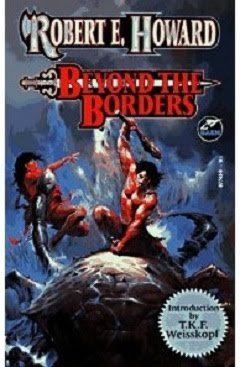
The Robert E. Howard Library Volume 7: Beyond the Borders, edited and with an introduction by T.K.F. Weisskopf (1996):
Stories:
1 · The Voice of El-Lil
34 · The Cairn on the Headland
61 · Casonetto’s Last Song
67 · The Cobra in the Dream
76 · Dig Me No Grave
95 · The Haunter of the Ring
117 · Dermod’s Bane
125 · King of the Forgotten People
152 · The Children of the Night
173 · The Dream Snake
182 · The Hyena
200 · People of the Black Coast
213 · The Fire of Asshurbanipal
Conan creator Robert E. Howard may have more variant editions of his many stories than almost any other 20th-century fantasy writer. This volume comes from Baen Books' 1990's Howard line, and focuses on non-Conan, mostly horror and dark fantasy tales set in the 1920's and 1930's. Lost civilizations, African shenanigans, and supernatural investigators predominate, along with a Howard stand-by, the ancestral memory story (or maybe more accurately the 'reincarnation recalled' story).
Most of the stories here are slight but interesting -- Howard was an inherently interesting writer, which is a lot rarer than you may think; even his prejudices can be fascinating. I really like contemporary dark fantasy tale "The Cairn on the Headland", with its suggestion that the pagan gods were actually demonic, possibly Cthulhoid forces from Outside. Howard also has some fun with an evil phonograph recording ("Casonetto's Last Song") and various evil animals, men, and lost races. Editor Weisskopf completely whiffs on one of Howard's real-world historical references (Weisskopf seems to think Howard made up a religion which is in fact is a real one). Oh, well. Lightly recommended.
Friday, October 29, 2010
Six-Gun Justice

Shadow Kingdoms by Robert E. Howard (1927-29; collected 2005): This collection reprints many of Howard's pre-Conan stories and poems for Weird Tales. Boy, did he publish a lot of poetry! And the poetry isn't bad, all things considered, and it's certainly of a piece with Howard's prose work: lots of lost kingdoms and ghosts and monsters. This is not Emily Dickinson.
On the prose end of things, Howard arrived on the scene surprisingly close to fully formed. He'd become a better prose stylist over the next ten years of his tragically short writing career and life, but his interests are all pretty much here. Ancient kingdoms, solitary heroes, the general depravity of all races other than Caucasians, the primacy of violent action over thought...yep, it's all here. Two of Howard's pre-Conan heroes, Puritan monster-fighter Solomon Kane and Atlantean-born King Kull of time-lost Valusia, make their first appearances here. Several horror stories also appear, one of which features Howard at his worst, trying to write British dialogue. It's bally ridiculous, blighty!
The short novel "Skull-face" dominates the collection in terms of length. The eponymous villain, an odd mix of Fu Manchu and Howardesque/Lovecraftian elder race (he's even called Kathulus!), seeks to unite all the non-white races to destroy the white race. Everyone, regardless of religion or culture, is pretty much immediately on-board with this because non-whites are a treacherous lot. Racially speaking, the story is godawful, so godawful that it becomes funny by the end. Vaguely Oriental women (Howard's definition of the Orient pretty much stretches across the entire non-white globe) are occasionally OK, just so long as they're not black.
Howard's gift for narrative drive overcomes the loathsomeness of his subject matter, but only barely. I really felt like I needed a shower after "Skull-face." It's about as guilty a pleasure as one can get unless you're a member of the Aryan Nation, in which case I guess it would be a documentary. But within this volume, Howard also would give Solomon Kane a super-powerful, super-helpful African medicine man as what would be Kane's only recurring ally in the war against supernatural evil. Howard definitely did contain contradictions. This isn't, for the most part, great Howard, but most of the works reprinted here are compelling. Recommended.
Subscribe to:
Posts (Atom)