Showing posts with label mike royer. Show all posts

Friday, April 20, 2018

Jack Kirby's Black Panther

Black Panther Vs. Abominable Snowman!
Jack Kirby's Black Panther (1976-78; collected in two volumes 2005): written by Jack Kirby with Jim Shooter and Ed Hannigan; illustrated by Jack Kirby and Mike Royer with Denys Cowan: Jack Kirby's Black Panther followed the cancellation of Jungle Action and the premature end to Don McGregor and Billy Graham's run on Black Panther in that Marvel comic book. Readers who followed the character from one book to the next must have suffered from whiplash. 

Kirby's Black Panther is a super-scientific adventurer whose first multi-issue adventure involves a team-up with a diminuitive collector of weird antiquities named Mr. Little on a quest to find the second of two objects known as King Solomon's Frogs. They've discovered one. It periodically pulls someone or something in from another time. Together, the two assume, the two frogs should form a controllable time machine. OK!

This is Jack Kirby in full-on lunacy mode. It's great lunacy, mile-a-second action, wild double-page spreads, and some of the oddest of Kirby's 1970's narratives. I mean, a time machine shaped like a frog (why?) is weird enough. 

But the time machine will eventually pull in a dangerous, hyper-evolved human from millions of years in the future. There will also be a hidden kingdom founded by seven samurai. There will be a half-brother of T'Challa (that is, the Black Panther) who will seize control of the kingdom of Wakanda. There will be a Council of relatives of the Black Panther who will come together from across the world to battle that half-brother while T'Challa is stuck in the samurai kingdom.

Oh, and a lost Black Panther will stumble across a science-fiction movie filming in the North African desert. It isn't Star Wars, but it's clearly a nod to the Tunisia filming location of Star Wars. Kirby's work on a film adaptation of Roger Zelazny's Lord of Light would be used to help some of the American hostages out of Iran. Remember Argo? They actually shot but didn't use a scene with Jack Kirby. It's true!

Whiplash, though, oh boy! This is rollicking science fantasy laced with absurdity. If you like more serious versions of Black Panther that address social and racial concerns, this is probably not your Black Panther. I love it. I love McGregor's version too. I am entertained by multitudes! Highly recommended.

Thursday, September 1, 2016

The Old and the New-Old

Batman (Detective Comics) Archives Volume 2 (1941-42/Collected 1991): written by Bill Finger and Don Cameron; illustrated by Jerry Robinson, George Roussos, Bob Kane, Fred Ray, and others: The Batman Mythos begins to mature with great rapidity in this second archive of stories from Detective Comics (where Batman premiered in 1939). Robin is part of the team, the Joker and the Riddler are recurring villains, and the origin of Two-Face appears here.

As Batman co-creator Bob Kane (with writer Bill Finger, finally being credited by DC in 2016, more than 40 years too late for the long-deceased Finger) doing less and less artwork, Batman's art gets progressively better because frankly, Bob Kane sort of sucked when he wasn't swiping other people's art. Jerry Robinson is on-board for the Joker, a character he co-created, while also supplying a much more pleasingly cartooned, detailed, and often funny Batman and Robin. George Roussos supplies his usually capable inks, complete with his ever-present giant moons.

The stories, most written by Finger, are at their best when they pit Batman against his growing rogue's gallery. Batman vs. mobsters is sort of boring. Batman vs. a mind-reading scientist, the Joker, or the Penguin is pretty great. One of the things to note about the early Batman is how text-heavy and panel-heavy it is. Kids were much faster readers in 1941! One wishes at times that the art was allowed to breath at times with fewer panels per page, but it would be years before this was true in the superhero comic book except in rare exceptions drawn by the Eisner or Simon&Kirby Studios. Recommended.


The Boy Commandos Volume 1 (1941-42/Collected 2010): written and illustrated by Joe Simon and Jack Kirby: Terrible, muddy colour reproduction caused by somebody who doesn't know how to use a colour scanner makes for some tough pages in this collection. Still, it's rewarding to read one of the first 'kid gang' comics. And what a gang! Co-writer-artists Joe Simon and Jack Kirby basically serve up Our Gang with Heavy Weaponry in the Boy Commandos, as a bunch of prepubescent boys run around Europe and Asia machine-gunning the crap out of the Axis powers. 

And they're sanctioned by the Allied military! 

The Boy Commandos are a multi-national group nominally led by adult Captain Rip Carter. Their adventures are wild and woolly, and a lot more fun than those of most adult WWII comic-book characters. One can see how the 'kid gang' comic became a popular one in the 1940's before fading out around the end of WWII. Recommended. Boy, this needs to be colour-adjusted, though.


Essential Fantastic Four Volume 2 (1963-1965/Collected 1995): written and illustrated by Stan Lee and Jack Kirby; inked by Chic Stone, George Roussos, Vince Coletta, and Frank Giacoia: The Stan Lee/Jack Kirby Fantastic Four (the stretchable Mr. Fantastic, Invisible Girl, Human Torch, and super-strong Thing) starts to become a more recognizable, traditional superhero comic in this second collection of the FF's 1960's stories, in glorious B&W because this is an Essential B&W collection. They fight fewer monsters and more traditional super-villains. They also fight the Infant Terrible in a story that whoever wrote the Trelayne episode of  the original Star Trek may have prior to penning "The Squire of Gothos." 

The FF's goofiest, funniest enemies from their first volume of adventures -- the Red Ghost and his Super-Apes (!!!) -- do appear here in all their ridiculous glory. The Watcher, the Blue Area of the Moon, Doctor Doom, Prince Namor, the Super-Skrull, and the Mole Man return; Dragon Man, the Hate Monger, Mr. Gideon, the Frightful Four (including yet-to-be-revealed-as-Inhuman Medusa), and Franklin Storm debut. 

Team-ups with Doctor Strange, the Avengers, the X-Men, and a brief Peter Parker cameo sell the interconnectedness of the growing Marvel Universe to the reader. There are many stand-out stories here. Probably my favourite pits the mighty, wise-cracking Thing against a maddened, more-mighty Hulk for page after page of terrific superhero combat. The Thing's later pummeling of Dr. Doom is also a personal favourite, drawn with succinct power by Jack Kirby.

Stan Lee is typically bombastic and melodramatic throughout, with the slapstick antics of the eternally bickering Thing and Human Torch to add humour. The inking of Kirby's pencils starts off rough with George Roussos, who's a terrible fit with Kirby. It picks up with Chic Stone. Joe Sinnott's masterful inks of Kirby on the FF are still a year or so away by the end of this volume. Highly recommended.


Thor: Godstorm (2001-2002; collected 2011): written by Kurt Busiek; illustrated by Steve Rude and Mike Royer: Fun homage by Busiek, Rude, and late-career Jack Kirby inker Mike Royer to the sort of story normally found in Stan Lee and Jack Kirby's run on The Mighty Thor in the 1960's. Thor's battle with the sentient thunderstorm Godstorm occurs in three different eras as depicted in the story. 

Busiek does that thing he does in which his writing is both homage (to Stan Lee) without being overly imitative of Lee's melodramatic verbiage. Steve Rude gives us his own action-packed, sometimes cartoony pencils, made to look just a bit more Kirbyesque than usual by Rude and inker Royer. My only complaint here would be that I'd like more of Busiek, Rude, and Royer's Thor. It's swell. Highly recommended.

Monday, September 15, 2014

End of Night

Jack Kirby's Fourth World Omnibus Volume 4: written by Jack Kirby; illustrated by Jack Kirby, Mike Royer, Greg Theakston, and others (1974-1986; collected 2010): The last omnibus of Jack Kirby's Fourth World work, or at least of Fourth World work that he both wrote and drew, spans about a decade. Kirby was having major problems with his eyesight by the mid-1980's, and it shows a bit in some of the art, but the conclusion to the saga of Apokolips, New Genesis, and their far-reaching war is a fascinating and essential part of Kirby's body of work.

Of course, it's not really the end: DC Comics would use Kirby's creations again and again after this 'conclusion,' a couple of times with Kirby on-board writing and/or pencilling in the two Super Powers miniseries. The saga was never meant to be wrapped up in less than a hundred pages. So the final graphic novel of Kirby's Fourth World, The Hunger Dogs, is really more of an intermission than anything else, albeit an intermission without any more of the play after it.

The volume collects the last few issues of Mister Miracle from the early 1970's, Kirby's last Fourth World title to remain standing back then. That title concludes with a truly bizarre sequence involving the wedding of Mister Miracle and Big Barda, a wedding the evil god Darkseid decides to crash at the last minute. Groovy!

The concluding material from the 1980's goes places super-hero comics generally don't go -- into the futility of endless war and the possibility that conflict can sometimes simply be walked away from. It was never meant to be an ending, but the last scene between Darkseid and his warrior son/nemesis Orion is both poignant and celebratory. Orion has changed. Darkseid has not. There will be no last battle of prophecy. This time, anyway.

Perhaps thinking of President Nixon's squirmy final days, Kirby invests the previously nigh-omnipotent Darkseid with hitherto unseen characteristics of failure, impotence, and obsolescence. The dark god stands revealed as just another tyrant watching his empire crumble, shaking his fist impotently at the sky.

It's powerful stuff, capped by a terrific final one-page spread that could have stood as the final image of the Fourth World and the New Gods. Kirby was still teaching writers and artists where to go near the end of his colossal and unparalleled career. In all, highly recommended.

Thursday, November 15, 2012

Gods in New York

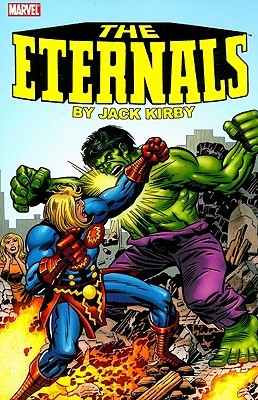
The Eternals Volume 2: written and illustrated by Jack Kirby with Mike Royer (1977; collected 2006): Jack Kirby's loopy, inspired riff on Chariots of the Gods comes to an early end, to be revived approximately every ten years afterwards by other people, including Neil Gaiman and John Romita Jr. on a real dud of a 2006 revival.

While the 2000-foot-tall alien Celestials continue to wander around Earth as part of their 50-year judgment, the Eternals and their foes the Deviants continue to mix it up on a variety of fronts. We follow Eternal Thena and her two Deviant charges, liberated from the Deviant gladiator pits, as they track down a time-travel menace in New York. An unnamed Eternal dubbed The Forgotten One struggles to stop an ill-advised Deviant assault on the Celestial mothership orbiting Earth.

Phew, what else. An ancient mind-controlling menace gets released from its prison below New York, and even the Eternals know fear. A science project designed to look like the Hulk gets animated by cosmic rays and proceeds to destroy New York. Man, New York takes a pounding. Admittedly, as the home of many of Marvel's heroes, it really should be completely depopulated by the late 1970's. How many times can Galactus show up on your streets before you get the message?

Kirby continues to follow different groups on different adventures, often ignoring other protagonists for several issues. It's highly unusual for a Marvel comic book of the time, but it does allow Kirby to develop a large variety of characters. It certainly died too soon. Recommended.

Friday, October 12, 2012

Return of the Space-Gods


A Celestial gives one thumb up...


The Eternals Volume One: written by Jack Kirby; illustrated by Jack Kirby, Mike Royer, and John Verpooten (1975-76; collected 2007): Jack Kirby's return to Marvel brought this tale of space gods and god-like humans to the company. At first, it may have seemed as if Kirby had simply continued his New Gods storyline in another venue, but The Eternals quickly established itself as a different kind of thing about many of the same things that have always occupied Kirby.

The most interesting of these new things are Kirby's Celestials, 2000-foot-tall space aliens whose powers are god-like and motives mysterious. While mucking about with human genetics millennia ago, they created two spin-off races of humanity: the noble, man-like Eternals and the protean Deviants, who produced offspring in a wide assortment of shapes and powers.

In this Chariots of the Gods scenario, the Eternals have provided humanity with the model for many of its gods while the Deviants have provided the model for many of its demons. The Deviants even managed to enslave humanity for a time in some antediluvian past, before the Celestials destroyed their empire in a massive flood.

The Eternals begins with the return of the Celestials, who will stand in judgement over humanity and its off-shoots for fifty years prior to deciding their fate. Politicking and warfare between the Eternals and the Deviants soon breaks out, with humanity finally discovering its siblings. And things get weird very fast.

Most of the Eternals have names that echo those of human gods and figures of myth -- Ikaris, Thena, Zuras, Makkari, Ajak -- though in all cases, they turn out to be models for many different figures from many different cultures. The Eternals get around when they're not hiding out on mountaintops. And they neither age nor die.

One of the oddities for the time of publication was that The Eternals soon establishes that it's a wide-ranging group book without a clear, single protagonist. The stolid Eternal Ikaris initially seems to be the hero, but he vanishes for lengthy sections of the narrative. This sort of storytelling would be much more commonplace ten to fifteen years down the road; in 1975, it's downright peculiar to shift focus from group to group (or sometimes away from all recurring characters entirely) for entire issues at a time.

Art-wise, the Celestials are the stand-out here, one of Kirby's most bizarre and foreboding bits of design, with elements of Aztec and Mayan art mixed in with Kirby's expressionistic take on computer circuitry and high technology. Also, they neither speak nor have thought balloons. Later writers, when using the Celestials, would introduce both speech and thought balloons to these cosmic giants, rapidly removing all mystery from them. For now, though, they're cool and sublime, as is the book itself. Recommended.

Thursday, June 21, 2012

When Animals Evolve


Canada, now proud home to the Insect Revolution!

Jack Kirby's Kamandi Omnibus Volume 1: written and illustrated by Jack Kirby, Mike Royer, and D. Bruce Berry (1972-74; collected 2011): In 1972, DC Comics' then-Editor-in-Chief Carmine Infantino gave up on getting the rights to do a Planet of the Apes comic book and turned to writer-artist Jack Kirby to create something similar. Kirby had never seen Planet of the Apes and wasn't initially supposed to do anything other than create the book. But with the demise of most of Kirby's Fourth World books for DC, Kirby got tagged to write and illustrate his Apes knock-off, which he called Kamandi: The Last Boy on Earth.

 
Kamandi quickly became Kirby's most popular book for DC in the 1970's, one that would only get cancelled six years after its debut because of the infamous line-wide DC Implosion. But by that time, others were writing and drawing it -- Kirby returned to Marvel in 1976 for four years.
 

A double-paged splash in the first issue suggests that Kirby had been told about an iconic scene in the first Planet of the Apes movie -- the splash features the Statue of Liberty half-sunk underwater. And we soon meet talking apes. But Kirby quickly moved into a wilder, woolier universe than anything Charlton Heston ever encountered. This was the future after a nebulous Great Disaster redrew the maps and rewrote genetics. This was the world of Kamandi!
 

Kamandi, a scrappy blond teenager, gets forced out of the bunker he's been living in his entire life, a bunker called Command D (get it?), when the bunker is overrun by raiders and Kamandi's grandfather killed. No other humans survive in the bunker.
 

But the raiders are intelligent, bipedal wolves. In the world after disaster, a wide variety of animals are now intelligent and bipedal, while others (killer whales, snakes) are intelligent but not bipedal. Some will turn out to be Kamandi's allies and friends -- the Lions are civilized environmentalists; a giant grasshopper becomes a valued companion; and Tiger Prince Tuftan becomes one of Kamandi's few animal friends, along with helpful Doctor Canis. Some will be pains in the neck -- the thieving wolves and rats, the pirate leopards...
 

Conversely, much of humanity has reverted to a pre-civilized state and, furthermore, has become something of an endangered species in most parts of the world. Some humans are enslaved, some kept as pets and guards, others put in zoos. A few radically altered humans persist as tiny but courageous Mole People (!) who keep ancient machines running simply because the noise drives off a giant, voracious earthworm (!!).
 

Kirby shuffles and reshuffles the thematic and conceptual deck repeatedly. The book moves rapidly from story to story, from animal kingdom to animal kingdom, and from one devastated but familiar locale to another. Kirby soon indulges his ability to synthesize myth and popular culture into odd and rewarding combinations. I mean, pirate leopards working for a greedy but cultured talking snake who runs a piracy operations called Sacks? A 100-foot-tall talking ape dubbed Tiny who is caged by Hoover Dam? It's weird stuff. Improbable and enjoyable.


My favourite creations here (other than the Eater, that radiation-charged, Moleman-hating, gigantic earthworm) are the Fission people -- genetically altered humans whom Kamandi teams up with on several occasions -- and their floating, super-scientific city Tracking Site. Therein dwells Morticoccus, a giant germ that eats everything and anything biological or metallic, indestructible but caged forever. Or is it? Whee!
 

DC would severely misuse Kamandi's world during its Countdown to Final Crisis/Final Crisis event a few years back. One measure of that failure would be that they made Morticoccus a normal-sized super-germ, which is way less awesome and creepy than a germ that can engulf an entire city and which is apparently highly intelligent AND EVEN APPEARS TO HAVE EYES. But DC has also finally made Kirby's entire run on Kamandi available in the Omnibus format, so kudos for that. It's Kirby's last lengthy run on a title, and one of the most enjoyable from his entire career. Also, it would make an awesome movie. Highly recommended.