First Reformed (2018): written and directed by Paul Schrader; starring Ethan Hawke (Reverend Toller), Amanda Seyfried (Mary), Cedric the Entertainer (Reverend Jeffers), and Philip Ettinger (Michael): Ethan Hawke plays a pastor in upstate New York who's lost most of his faith after the death of his son and his wife's subsequent leave-taking because the son died as a military chaplain because his father urged him to join the service.
Hawke's Reverend Toller presides over a historical church with few parishioners but a groovy souvenir ship, with that church owned and operated by a nearby MegaChurch run by Cedric the Entertainer. Whew!
I'll leave you to look up the stylistic influences on writer-director Paul Schrader. Suffice to say they result in a lot of long shots in distance and duration, very slow camera movement when the camera moves at all, and a lot of symmetrical and near-symmetrical shot compositions. It can all be almost overwhelmingly slow, especially in the first half. Stick with it, though, and the cumulative effect is affecting and somewhat mesmerizing.
First Reformed tackles several big questions in a serious way. The acting is stellar across the board. Ethan Hawke holds the whole thing together with his grim, increasingly haunted priest. Cedric the Entertainer is a revelation as the reverend of the MegaChurch, a man who can deliver a toxic sermon about anxiety while nonetheless being portrayed overall as a decent man. Amanda Seyfried is also solid, especially as she has to work with being a pregnant woman named Mary in a movie about Christianity...
How this wasn't nominated for a Best Picture Oscar and several Acting nominations... well, that's the Oscars! It's a fine, nuanced work that nonetheless manages to intelligently shock the viewer. Bonus points for having a choir sing a 2014 Neil Young song at a funeral. Highly recommended.
Gun Machine (2013) by Warren Ellis: Warren Ellis, a long-time comic-book writer (Transmetropolitan, The Authority, and Planetary, among many others) and acerbic futurist, creates one hell of a smart Pop detective thriller here.
Lonely, burned-out, never-was NYPD detective John Tallow starts Gun Machine with a bad day that quickly gets worse. The violent events of the first few pages open a door into a secret Manhattan world of murder and weird maps. And guns. Lots of guns. Hundreds of guns from flintlocks to modern, near-metal-less handguns. An otherwise empty apartment filled with guns arranged into a mysterious, incomplete pattern. And every gun attached to either an unsolved murder or a murder now known to be incorrectly solved.
Tallow's detective instincts get jump-started by this room of mystery, especially after the case is dumped on him because the NYPD not-so-secretly wants Tallow to fail and the cases to vanish as quickly as possible. A bad detective gets born again, though that rebirth may be short-lived. Conspiracies of power don't want the secret of the guns solved.
Ellis' prose is as pungent and cynical as ever, densely packed with information. The plot rockets along. Tallow and the other characters are sharply drawn. Sharply drawn, too, is our attention to the secret maps of Manhattan which Tallow discovers. A financial map based on the time it takes for financial offices to communicate with Wall Street. A map of gun crimes in Manhattan and the other boroughs. And the map the killer carries in his head, of Manhattan before Europeans came, a map that still surfaces in surprising places in the postmodern landscape.
It's a dark romp that engages with social and technological questions as it zips along, dialogue crackling and sparking, the narrative casting a cold eye on the modes of NYPD evidence collection, the surveillance state, the technical specifications of guns used in famous murders, the difficulty of parking in New York, the meaning of Occupy Wall Street, the malign rise of private policing, the dangers of too much exercise, an assortment of Native American tribes and rituals, and the politics of the police bureaucracy.
Gun Machine is too densely packed to make a great movie, but it would make one hell of an HBO miniseries. Highly recommended.
The Spider: The City That Paid to Die! (The Black Police Trilogy Part One) (1938): written by Norvell Page writing as Grant Stockbridge, in The Spider Vs. The Empire State: The Black Police Trilogy (2009):: Pulp-action-hero The Spider's crime-fighting disguise was so bizarre that it was only depicted on two of the covers of his 1930's and 1940's magazine. Basically, he dressed up to look like a hideous vampire. Most of the time, the cover artists depicted him as a generic masked crime-fighter, similar to The Phantom and a legion of others.
The Spider's adventures were no worse than the second-most apocalyptic pulp-hero sagas in history (Operator 5 may have been moreso, but it was set in a vague near-future America under siege by a host of foreign powers both real and imagined, which is to say both the Japanese military and The Purple Emperor laid waste to North America). The death toll was often in the millions, with New York often being depopulated in every issue by building-destroying death rays, plague-carrying vampire bats, and endless armies of criminals, madmen, and enemy fifth-columnists.
The City That Paid to Die! is the first part of what's now known as the Black Police Trilogy. In this first novel, fascist criminal forces basically trick New York's population into voting for their political proxies. That done, the forces of evil -- led by a mysterious Master -- enact legislation that allows them to terrorize and enslave the population of New York State. Even the federal government is helpless, we're told, because everything is legal and above-board!
Enter Richard Wentworth, The Spider, unmasked and forced to fight with his secret identity in shreds, his property and weapons seized, his friends and allies in perpetual mortal danger. But his ties to the benevolent inhabitants of Chinatown allow him to escape New York City just ahead of the forces of The Black Police (their uniform colours, not a racial bit, by the way).
In the wilderness of upstate New York, the Spider must build an army from those he's rescued from the murderous clutches of the New New York Order. But the Black Police number 100,000 or more dangerous criminals made legal by the machinations of their Master. Can the Spider prevail? Can he even survive? Two more novels tell the story. Recommended.
The Spider: The Spider At Bay (The Black Police Trilogy Part Two) (1938) by Norvell Page writing as Grant Stockbridge, in The Spider Vs. The Empire State: The Black Police Trilogy (2009): Richard Wentworth's battle against American fascism continues in the second part of what became known as The Black Police Trilogy.
While Wentworth normally fought weird crime as the pulo hero The Spider, here he repeatedly 'pretends' to be The Spider in order to rally the Resistance around him. That almost seems meta!
Things are really bad for freedom and justice in what's basically The Empire Strikes Back of the Black Police Trilogy. New York State is even more under the thumb of an evil mastermind known only as The Master.
The Master's puppet government, democratically elected with a spineless figurehead as governor, is free to murder and pillage the resources of the state because, um, State's Rights are really solid and binding in the world of The Spider. Even an unnamed FDR can't help! The Master's minions can even call in the National Guard to fight the Resistance!
As the second book in a trilogy, The Spider At Bay mainly exists to make things worse for The Spider and his ragtag group of helpers. This is very much New Deal pulp heroics, with our heroes battling a government that hates the poor and the working class and thrives on villainy. You know, like Trump! By the end, things look bad. Very bad. Is this the end of The Spider, err, Richard Wentworth? Recommended.
The Spider: Scourge Of the Black Legions (The Black Police Trilogy Part Three) (1938) by Norvell Page writing as Grant Stockbridge, in The Spider Vs. The Empire State: The Black Police Trilogy (2009): With the duly elected forces of villainy in New York State holding all the cards, Richard Wentworth/ The Spider must mount one last mission to save the state from The Master!
The Spider takes more physical punishment than any other pulp hero of the 1930's and 1940's. The Shadow, the Avenger, and Doc Savage were generally very little bloodied in the course of their adventures. That was the job of their subordinates -- to get knocked out and beaten up.
The Spider is basically a cross between Ash from Evil Dead 2 and Leonardo DiCaprio's titular character in The Revenant. He gets shot, shot again, beaten, stabbed... really, he's Wolverine without the mutant healing factor. It's sort of exhilarating to read the adventures of a pulp hero whose main quality is perseverance. Well, and a love of heating up the spider insignia on his ring with a cigarette lighter so he can brand captured criminals on the forehead with the Sign of the Spider!
So many questions...
- Will The Spider stop The Master?
- Will the federal government get off its ass and do something?
- Will we learn the true identity of The Master and perhaps feel a bit underwhelmed at the revelation?
- Will a Bad Twin become a Good Twin because of the love of a good woman?
- Will completely insane death traps like a giant wood-chipper made to chip up humans be put into play?
- Will The Spider save the dam in Pennsylvania from being blown up by the Master as a way to divert federal attention away from New York State?
- Will anyone realize that The Spider and Richard Wentworth really are the same person?
So many questions... answered in The Scourge of the Black Legions! Highly recommended.
The Whites (2015) by Richard Price: Richard Price's newest crime novel is a delight from start to finish, a pungent look at police and criminals and New York City. Our protagonist is Billy Graves, a Manhattan night-shift detective whose past as a member of a group of patrol cops who called themselves the Wild Geese may finally be catching up with him.
Billy is a flawed, wounded, introspective protagonist. He's also a very good detective who finds himself in two parallel situations that may not be so parallel. Someone seems to be stalking Billy and his family in pursuit of vengeance for some unknown wrong. And the lives of perpetrators investigated by Billy and his former Wild Geese are being snuffed out -- these perpetrators were never convicted for their crimes and are thus known to Billy and company by the slang term 'Whites.'
Price deftly draws the characters and their relationships, presents cop life in all it sordid details, and presents page after page of note-perfect dialogue. It's the sort of novel that someone who loved The Wire would love. Highly recommended.
The Redbreast (2000/ Harry Hole#3-Oslo Trilogy#1) by Jo Nesbo, translated into English by Don Bartlett: The Nazi Occupation of Norway supplies the back-story for this, the third of Jo Nesbo's detective-thrillers about Norwegian police officer Harry Hole and the first of the 'Oslo trilogy'-within-a-series. Harry gets caught up in trying to track down an assassin who was one of the Norwegians who fought alongside the Nazis during the Siege of Leningrad during World War Two.
Harry is on pretty good behaviour in this novel as he fights his demons (alcoholic and otherwise). Section dealing with the Norwegian collaborators of World War Two and the war's aftermath fascinated me -- it's not an area of history I knew anything about beyond the name 'Quisling.' The depiction of Harry's detective work is also top-notch. Norway itself fascinates, in the past and present, in Nesbo's depiction of Neo-Nazis and apologists and unctuous civil servants and historians and many others. Recommended.
The Ceremonies by T.E.D. Klein (1984): The Ceremonies isn't the greatest horror novel ever written, but it may be the greatest horror novel ever written in which the stakes are the survival of the world. There were a lot of those apocalyptic and pre-apocalyptic horror novels in the late 1970's and 1980's, during the later nuclear-war-fear years. I'd probably give the edge to The Ceremonies over all of them, 1980's or otherwise, though Ramsey Campbell's The Hungry Moon and Midnight Sun would offer stiff competition.
T.E.D. Klein is a Top-Ten American horror-writing talent despite his meager output: this novel; the four novellas collected in Dark Gods (1985); the novella The Ceremonies is based on, "The Events at Poroth Farm" (1973); and maybe 200 pages of ephemera. Horror readers sit and wait, hoping that second novel announced in 1985 will some day see publication.
The Ceremonies looms large for a number of reasons. It's beautifully written. Its allusions, intertexts, and interpolations of what sometimes seems to be the entire history of horror fiction are fascinating, keenly observed, and essential to the unfolding of the plot. The plot itself is expertly machined, building slowly until the climax explodes in the last thirty pages or so. The characterization of players minor and major is deft and witty and occasionally heart-breaking. The novel follows certain tropes and conventions while exploding others along the way. It's structurally and stylistically complex in an unshowy manner -- its use of three distinct, linked narrative streams in three different voices and tenses, for one, has thematic significance that only dawns on the reader gradually as the novel and its voices accumulate in one's head to increasingly disturbing effect. And it's capable of both cosmic uneasiness and gross-out horror, the latter used sparingly but to great effect, especially in the climactic scenes.
To appreciate The Ceremonies fully, one should read at least some of the texts it interacts with. But if one doesn't do so, one of the main characters labours away on a graduate English thesis on horror fiction throughout the novel. Along the way, we get his thoughts on texts ranging from The Castle of Otranto to The Haunting of Hill House. Some of these texts are important to the novel as a whole. All of the observations are, at the very least, interesting. Some are even hilarious. Because one can certainly agree with the protagonist's view that The Castle of Otranto sucks, or that Dracula stops being interesting once the novel exits Transylvania.
The protagonist of the novel, Jeremy Freirs, takes lodging on a farm near the small New Jersey town of Gilead for the summer in order to finish his M.A. thesis. His landlords are Sarr and Deborah Poroth, members of a small Christian sect that settled in the area more than a hundred years earlier. The sect bears some resemblance to the Pennsylvania Dutch or the Amish, though the Poroths have a truck and indoor plumbing. But it's not the Poroths or their sect or even Jeremy that are the real problem.
The real problem is something that waited in the surrounding woods for 5000 years to be born again, something that spent centuries clinging to a tree branch in the distorted heart of a section of the forest initially called by the adjacent Native Americans "The Place of Burning." No one ever lived there or near there until settlers started to encroach in the 19th century. Then the thing's waiting ended, along with its life, and the Ceremonies began. And even in the 19th century, the forested heart of darkness sat only about 50 miles from New York City.
Something beyond all measure fell into or broke through or seeped up into our universe; the novel leaves the thing's means of entry a "mystery." But the novel also suggests that the thing somehow also broke through into human mythology, folklore, rituals, stories, and even folk dances. Fragments of the rituals needed to resurrect the being hide in all these things, waiting to be reassembled and used so that the thing can be reassembled and reborn. Even a Coney Island Ferris Wheel and a grumpy cat fit into the Ceremonies.
One of the keen pleasures of The Ceremonies is its combination of mystery and precision. We're taken through various rituals and preparations and signs and portents. Strange, tarot-like cards are read. Complex ceremonies that must be followed with an anal-retentive attention to detail are enacted. But the mysteries of what awaits, of what will be done to the world and how it will change, remain to the very end of the text. At no time does Klein feel the need to have the ultimate antagonist of the novel deliver an expositional speech.
And even the acolyte of the antagonist remains vague and refreshingly unglib to the very end. And this henchman, Rosie -- this short, fat, seemingly jolly old man -- is one of the novel's many terrific creations. He's awful. He's also pitiful, but only in terms of what he was before he found himself in the wrong place at the wrong time, nearly 100 years before the main action of the novel takes place. The third-person description of his thoughts doesn't give us the exterior charm of so many antagonists, from Hannibal Lecter all the way back to Milton's Satan. We see Rosie from inside, a manipulative and remorseless engine of death. Well, death for all humanity. If humanity were lucky. Which it probably won't be if Rosie gets his way. There are worse things than death.
The indispensable references for the novel are several late-19th and early-20th-century stories by the Welsh horror-writer/mystic Arthur Machen. The novel's title refers to three sets of ceremonies named but never fully explained in Machen's (mostly) first-person tour de force "The White People"; Machen's novella is also discussed by Jeremy in the novel itself. A short, cryptic Machen piece called "The Ceremony" also adds to one's appreciation of the novel, as do Machen's "The Novel of the Black Powder" and "The Great God Pan." These are all in the public domain, and worth reading regardless of whether or not you read The Ceremonies.
But you should read The Ceremonies. You really should. It's both its own evocative, poetic, ruthless piece of horror and a terrific act of play with what sometimes seems to be every major horror and Gothic work ever written, either explicitly or implicitly. The Ceremonies rewards close and careful reading. It rewards multiple readings. And it has a killer inversion of a horror trope that horror readers will probably associate most with Stephen King's The Shining, as creatures almost never associated with goodness nonetheless ride to the rescue by accident, driven by instinctual fury, even as Nature itself comes under existential assault. Highly recommended.
The Central Park Five: written and directed by Ken Burns, Sarah Burns, and David McMahon; starring Antron McCray, Kevin Richardson, Yusef Salaam, Raymond Santana, and Korey Wise as themselves (2012): Harrowing documentary about how police and bureaucratic incompetence, if not malevolence, put five African-American and Latino teenagers in jail for a rape they didn't commit in 1989, the rape being the headline-grabbing Central Park Jogger case.
This is unlike any documentary Ken Burns has worked on, as it eschews narration for a direct cinema approach of testimonies, period footage, and voiceovers from the people involved. It's a sorrowful and mind-bending thing.
With DNA evidence, a timeline, and a suspect the police never bothered following up on all pointing away from the five teenagers, only confessions by the five -- solicited and coached through fear, intimidation, their own youthful misunderstanding of what was going on, and exhaustion brought on by two days of grilling -- would convince two separate juries to convict them.
This despite the fact that the confessions themselves didn't make any sense in relation to the case, and that a fairly rigorous timeline put them far away from the scene of the crime. Physical evidence was either ignored or spun by the prosecution. Meanwhile, the press coined a term for the alleged gang rape -- "wilding" -- that ultimately referred to nothing that had happened. The teens were reviled as mutants, monsters and wolves in the mainstream press before the trial ever got underway. And the victim remembered nothing of the crime when she finally woke up from her coma.
The Five were eventually freed, in one of those twists that seems like something out of The Shawshank Redemption. Their civil suit against the City of New York drags on, as the City refuses to admit any culpability. Anyone who comprehensively says 'The police are your friend' should be forced to watch this. It's chilling. Highly recommended.
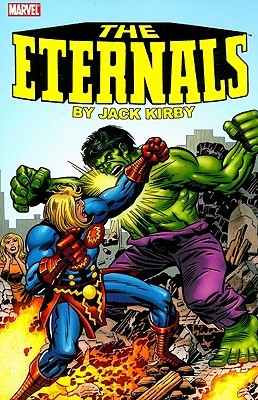
The Eternals Volume 2: written and illustrated by Jack Kirby with Mike Royer (1977; collected 2006): Jack Kirby's loopy, inspired riff on Chariots of the Gods comes to an early end, to be revived approximately every ten years afterwards by other people, including Neil Gaiman and John Romita Jr. on a real dud of a 2006 revival.
While the 2000-foot-tall alien Celestials continue to wander around Earth as part of their 50-year judgment, the Eternals and their foes the Deviants continue to mix it up on a variety of fronts. We follow Eternal Thena and her two Deviant charges, liberated from the Deviant gladiator pits, as they track down a time-travel menace in New York. An unnamed Eternal dubbed The Forgotten One struggles to stop an ill-advised Deviant assault on the Celestial mothership orbiting Earth.
Phew, what else. An ancient mind-controlling menace gets released from its prison below New York, and even the Eternals know fear. A science project designed to look like the Hulk gets animated by cosmic rays and proceeds to destroy New York. Man, New York takes a pounding. Admittedly, as the home of many of Marvel's heroes, it really should be completely depopulated by the late 1970's. How many times can Galactus show up on your streets before you get the message?
Kirby continues to follow different groups on different adventures, often ignoring other protagonists for several issues. It's highly unusual for a Marvel comic book of the time, but it does allow Kirby to develop a large variety of characters. It certainly died too soon. Recommended.