Showing posts with label chariots of the gods. Show all posts

Thursday, November 15, 2012

Gods in New York

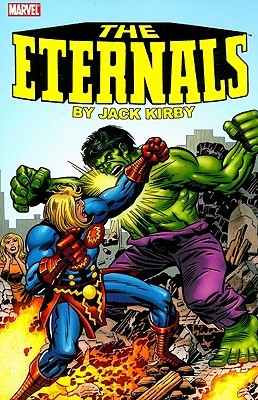
The Eternals Volume 2: written and illustrated by Jack Kirby with Mike Royer (1977; collected 2006): Jack Kirby's loopy, inspired riff on Chariots of the Gods comes to an early end, to be revived approximately every ten years afterwards by other people, including Neil Gaiman and John Romita Jr. on a real dud of a 2006 revival.

While the 2000-foot-tall alien Celestials continue to wander around Earth as part of their 50-year judgment, the Eternals and their foes the Deviants continue to mix it up on a variety of fronts. We follow Eternal Thena and her two Deviant charges, liberated from the Deviant gladiator pits, as they track down a time-travel menace in New York. An unnamed Eternal dubbed The Forgotten One struggles to stop an ill-advised Deviant assault on the Celestial mothership orbiting Earth.

Phew, what else. An ancient mind-controlling menace gets released from its prison below New York, and even the Eternals know fear. A science project designed to look like the Hulk gets animated by cosmic rays and proceeds to destroy New York. Man, New York takes a pounding. Admittedly, as the home of many of Marvel's heroes, it really should be completely depopulated by the late 1970's. How many times can Galactus show up on your streets before you get the message?

Kirby continues to follow different groups on different adventures, often ignoring other protagonists for several issues. It's highly unusual for a Marvel comic book of the time, but it does allow Kirby to develop a large variety of characters. It certainly died too soon. Recommended.

Friday, October 12, 2012

Return of the Space-Gods


A Celestial gives one thumb up...


The Eternals Volume One: written by Jack Kirby; illustrated by Jack Kirby, Mike Royer, and John Verpooten (1975-76; collected 2007): Jack Kirby's return to Marvel brought this tale of space gods and god-like humans to the company. At first, it may have seemed as if Kirby had simply continued his New Gods storyline in another venue, but The Eternals quickly established itself as a different kind of thing about many of the same things that have always occupied Kirby.

The most interesting of these new things are Kirby's Celestials, 2000-foot-tall space aliens whose powers are god-like and motives mysterious. While mucking about with human genetics millennia ago, they created two spin-off races of humanity: the noble, man-like Eternals and the protean Deviants, who produced offspring in a wide assortment of shapes and powers.

In this Chariots of the Gods scenario, the Eternals have provided humanity with the model for many of its gods while the Deviants have provided the model for many of its demons. The Deviants even managed to enslave humanity for a time in some antediluvian past, before the Celestials destroyed their empire in a massive flood.

The Eternals begins with the return of the Celestials, who will stand in judgement over humanity and its off-shoots for fifty years prior to deciding their fate. Politicking and warfare between the Eternals and the Deviants soon breaks out, with humanity finally discovering its siblings. And things get weird very fast.

Most of the Eternals have names that echo those of human gods and figures of myth -- Ikaris, Thena, Zuras, Makkari, Ajak -- though in all cases, they turn out to be models for many different figures from many different cultures. The Eternals get around when they're not hiding out on mountaintops. And they neither age nor die.

One of the oddities for the time of publication was that The Eternals soon establishes that it's a wide-ranging group book without a clear, single protagonist. The stolid Eternal Ikaris initially seems to be the hero, but he vanishes for lengthy sections of the narrative. This sort of storytelling would be much more commonplace ten to fifteen years down the road; in 1975, it's downright peculiar to shift focus from group to group (or sometimes away from all recurring characters entirely) for entire issues at a time.

Art-wise, the Celestials are the stand-out here, one of Kirby's most bizarre and foreboding bits of design, with elements of Aztec and Mayan art mixed in with Kirby's expressionistic take on computer circuitry and high technology. Also, they neither speak nor have thought balloons. Later writers, when using the Celestials, would introduce both speech and thought balloons to these cosmic giants, rapidly removing all mystery from them. For now, though, they're cool and sublime, as is the book itself. Recommended.

Wednesday, July 4, 2012

Prometheus Unbound by Basic Logic

Prometheus: written by John Spaihts and Damon Lindelof, based on characters and concepts created by Dan O'Bannon, Ronald Shusett, Walter Hill, and Ridley Scott; directed by Ridley Scott; starring Noomi Rapace (Liz Shaw), Michael Fassbender (David), Charlize Theron (Meredith Vickers), Idris Elba (Janek), Guy Pearce (Weyland), and Logan Marshall-Green (Charlie Holloway) (2012): The prequel to Alien (but only Alien and not the sequels or attendant Predator prequels), Prometheus looks fantastic and moves beautifully. I wasn't bored, and I didn't look at my watch for the whole two hours. Admittedly, that had something to do with the extremely comfortable theatre seats, but still...

On the other hand, Prometheus is a hilarious mess when it comes to science, character motivation, and basic plot logic. Somehow, this enriches the experience. You'll have a lot to talk about when you're done. Boy, howdy.

Billions of years ago, aliens start life on Earth. Well, maybe they start animal life on Earth because there's definitely vegetable life on Earth in the scenes we see. In truth, what they do makes no evolutionary sense, so I'm instead going to say that billions of years ago, an alien visiting Earth got drunk, passed out, and fell into Niagara Falls. Billions of years later and thousands of years ago, giant aliens left star maps all over the world pointing to a particular solar system.

And in the year 2091, a nefarious trillionaire named Peter Weyland (yes, the Weyland corporation, as of 2091 not yet joined with Yutani) sends a mission on the starship Prometheus to that star system for his own sinister purposes. The archaeologist who figured out the whole star map thing, Liz Shaw (Noomi Rapace), goes along, as does her partner/life-partner, a bunch of cannon fodder, an annoying business woman (Charlize Theron), a curious robot (Michael Fassbender), and an accordion-playing captain (The Wire's Idris Elba).

And in case you're wondering, the planet (well, technically a moon) they land on is not the planet from Alien. This is LV-223; that was LV-426. I note this to save you a lot of time trying to figure out how things ended up like they did for the beginning of Alien on this planet. It's not the same planet. Though if you want to believe they are the same planets to simulate our confused discussion at the end of the film, you'll have a good time coming up with scenarios that put the fossilized, gut-busted Pilot back in that funky space chair surrounded by giant eggs.

In any case, the Prometheus arrives at LV-223. Rather than survey the entire planet, it lands at the first visible structure. Against the Captain's warnings that sundown is coming (a warning that really only makes a huge amount of sense if the Captain's last mission was to the Planet of the Vampires), the scientists proceed to rush into the structure. Needless to say, shenanigans ensue, many of them caused by the simple fact that this is the dumbest crew of any Alien movie, dumber even than the crew in the godawful Alien Resurrection.

The pacing and visual design really carry this movie. It looks great. It moves like a rollercoaster. And Rapace (Lisbeth Salander in the original Swedish Girl with the Dragon Tattoo), Fassbender as curious robot David, and Elba as the Captain put in strong performances. Fassbender especially stands out, his character ultimately sympathetic despite the crappy things he does, or is ordered to do. There are clever character bits throughout related to David's fascination with Lawrence of Arabia and the Captain's interest in Crosby, Stills, Nash, and Young. Theron is suitably icy playing, well, Paul Reiser in Aliens.

References and allusions are shovelled into the movie willynilly, and perhaps even higgily-piggily. Scott's own directorial efforts Alien (natch) and Blade Runner, Aliens, The Thing, several Doctor Who serials, the nightmarish Space: 1999 episode with the crazy-ass tentacle monster, David Cronenberg's The Fly, H.P. Lovecraft's At the Mountains of Madness, Quatermass and the Pit...it goes on.

Does anyone connected with the writing of this movie show the faintest understanding of how evolution works and how DNA develops? Hell, no. But to paraphrase a line from another Ridley Scott movie, I was entertained. Recommended.