Showing posts with label the white people. Show all posts

Tuesday, March 15, 2016

The White People and Other Weird Stories by Arthur Machen; edited by S.T. Joshi (2011)


Pan Sold Separately


The White People and Other Weird Stories by Arthur Machen; edited by S.T. Joshi (2011), containing the following pieces:

Foreword: The Ecstasy of St. Arthur  by Guillermo Del Toro: Nice, brief appreciation of Arthur Machen by the film-maker, whose works often refer directly or indirectly to Machen's work and concepts.

Introduction by S. T. Joshi: A usual excellent historical overview from Joshi.

The Inmost Light  (1894): Pseudo-science based horror with ties to the longer, creepier "The Great God Pan.".

Novel of the Black Seal  (1895): 'Novel' meaning 'Nouvelle' here and below, and not a matter of length. One of several Machen stories dealing with a survived, malign race of 'Little People.'

Novel of the White Powder  (1895): Another piece of pseudo-science based horror. As with the above 'novel,' this was also published as part of the actual 'novel'/short-story cycle The Three Impostors. The 'science' moves into the realm of the occult at the conclusion.

The Red Hand  (1895): A fine piece of horror which uses the style and structure of the mystery story.

The White People  (1904): A towering achievement in first-person narrative in the horror genre, framed by a somewhat wonky but necessary philosophical discussion of the nature of good and evil. One of the most unnerving stories ever told.

A Fragment of Life  (1904) : A slightly weird tale of a young couple chafing at life in a London suburb really grows on one as it builds to a climax reaffirming Machen's love/hate relationship with cities.

The Bowmen  (1914): That famous piece of accidental 'journalism' (it's a short story mistaken at the time for being real) that spawned the World War One legend of ghostly bowmen coming to the rescue of British soldiers.

The Soldiers' Rest  (1914): Another of Machen's brief newspaper short stories meant to buoy spirits during the early days of the Great War.

The Great Return  (1915): A weird tale without horror -- instead, it's a faux-journalistic piece on the Holy Grail in the Welsh countryside.

Out of the Earth  (1915): Very minor piece concerns Machen's underground, malign, and apparently foul-mouthed little people. 

The Terror  (1916): Written in a straightforward journalistic style that's unlike Machen's earlier works of weird fiction that include "The White People" and "The Great God Pan," The Terror is instead the great-grandfather of Max Brooks' World War Z. The Terror depicts its events as real, investigated by the unnamed narrator.  

Those events aren't zombie attacks -- they're mysterious deaths breaking out in various locations throughout Great Britain during World War One. Have the Germans landed some sort of hidden force on the British Isles? Is someone using a mysterious 'Z-Ray' to smother people or send them running off cliffs to their deaths? Or is there something wrong with the animal kingdom?

 Machen was writing furiously at this time in his life, forced into newspaper work in order to pay the bills. The Terror isn't the imaginative and literary triumph that the aforementioned stories were, but it's still an enjoyable and often weird book. It's also an important permutation in horror's long love affair with the pseudo-documentarian style. Where 'letters' and 'journal entries' once told us that what we were reading was 'real,' now the journalistic voice does. 

It's also a mutation of something going back to at least Daniel DeFoe's A Journal of the Plague Year. In that early 18th-century work, DeFoe told a fictional 'you-are-there' story about a real event. Machen embeds The Terror in the real, early events of the Great War and then, like DeFoe, tells everything as a piece of actual reportage. It's a major stylistic leap. 

There are many fine moments of horror and pity throughout The Terror, along with some marvelously weird images. Machen captures the way fear can travel through gossip when the official channels are trying to hide the problem. A late-novel tableaux of horror at an isolated farm is especially well-managed through the description of the aftermath and through a dead man's journal describing the mysterious and terrible events that led to that aftermath. 

There are a couple of flaws to note. One isn't so much a flaw as a relative lack of closure. Things just sort of stop. This first flaw is exacerbated by the second, which is the narrator's jaw-dropping, climactic theory about why what happened, happened. It's an explanation totally in keeping with Arthur Machen's beliefs about society. But it's a moment of political and social commentary that will leave a sour aftertaste with anyone who doesn't long to live in a medieval fiefdom. I kid you not. 

Overall: A selection that includes non-horror pieces makes for an interesting overview of Machen's career. Those interested only in Machen's horror output would be better served by seeking out a collection that includes "The Great God Pan" and "The Shining Pyramid." The end-notes to the stories are extremely useful. The cover is the only oddity, as it seems to have been commissioned for a collection that did include "The Great God Pan." Highly recommended.

Monday, October 19, 2015

Dragon's Domain

The Ceremonies by T.E.D. Klein (1984): The Ceremonies isn't the greatest horror novel ever written, but it may be the greatest horror novel ever written in which the stakes are the survival of the world. There were a lot of those apocalyptic and pre-apocalyptic horror novels in the late 1970's and 1980's, during the later nuclear-war-fear years. I'd probably give the edge to The Ceremonies over all of them, 1980's or otherwise, though Ramsey Campbell's The Hungry Moon and Midnight Sun would offer stiff competition.

T.E.D. Klein is a Top-Ten American horror-writing talent despite his meager output: this novel; the four novellas collected in Dark Gods (1985); the novella The Ceremonies is based on, "The Events at Poroth Farm" (1973); and maybe 200 pages of ephemera. Horror readers sit and wait, hoping that second novel announced in 1985 will some day see publication.

The Ceremonies looms large for a number of reasons. It's beautifully written. Its allusions, intertexts, and interpolations of what sometimes seems to be the entire history of horror fiction are fascinating, keenly observed, and essential to the unfolding of the plot. The plot itself is expertly machined, building slowly until the climax explodes in the last thirty pages or so. The characterization of players minor and major is deft and witty and occasionally heart-breaking. The novel follows certain tropes and conventions while exploding others along the way. It's structurally and stylistically complex in an unshowy manner -- its use of three distinct, linked narrative streams in three different voices and tenses, for one, has thematic significance that only dawns on the reader gradually as the novel and its voices accumulate in one's head to increasingly disturbing effect. And it's capable of both cosmic uneasiness and gross-out horror, the latter used sparingly but to great effect, especially in the climactic scenes.

To appreciate The Ceremonies fully, one should read at least some of the texts it interacts with. But if one doesn't do so, one of the main characters labours away on a graduate English thesis on horror fiction throughout the novel. Along the way, we get his thoughts on texts ranging from The Castle of Otranto to The Haunting of Hill House. Some of these texts are important to the novel as a whole. All of the observations are, at the very least, interesting. Some are even hilarious. Because one can certainly agree with the protagonist's view that The Castle of Otranto sucks, or that Dracula stops being interesting once the novel exits Transylvania.

The protagonist of the novel, Jeremy Freirs, takes lodging on a farm near the small New Jersey town of Gilead for the summer in order to finish his M.A. thesis. His landlords are Sarr and Deborah Poroth, members of a small Christian sect that settled in the area more than a hundred years earlier. The sect bears some resemblance to the Pennsylvania Dutch or the Amish, though the Poroths have a truck and indoor plumbing. But it's not the Poroths or their sect or even Jeremy that are the real problem. 

The real problem is something that waited in the surrounding woods for 5000 years to be born again, something that spent centuries clinging to a tree branch in the distorted heart of a section of the forest initially called by the adjacent Native Americans "The Place of Burning." No one ever lived there or near there until settlers started to encroach in the 19th century. Then the thing's waiting ended, along with its life, and the Ceremonies began. And even in the 19th century, the forested heart of darkness sat only about 50 miles from New York City. 

Something beyond all measure fell into or broke through or seeped up into our universe; the novel leaves the thing's means of entry a "mystery." But the novel also suggests that the thing somehow also broke through into human mythology, folklore, rituals, stories, and even folk dances. Fragments of the rituals needed to resurrect the being hide in all these things, waiting to be reassembled and used so that the thing can be reassembled and reborn. Even a Coney Island Ferris Wheel and a grumpy cat fit into the Ceremonies.

One of the keen pleasures of The Ceremonies is its combination of mystery and precision. We're taken through various rituals and preparations and signs and portents. Strange, tarot-like cards are read. Complex ceremonies that must be followed with an anal-retentive attention to detail are enacted. But the mysteries of what awaits, of what will be done to the world and how it will change, remain to the very end of the text. At no time does Klein feel the need to have the ultimate antagonist of the novel deliver an expositional speech. 

And even the acolyte of the antagonist remains vague and refreshingly unglib to the very end. And this henchman, Rosie -- this short, fat, seemingly jolly old man -- is one of the novel's many terrific creations. He's awful. He's also pitiful, but only in terms of what he was before he found himself in the wrong place at the wrong time, nearly 100 years before the main action of the novel takes place. The third-person description of his thoughts doesn't give us the exterior charm of so many antagonists, from Hannibal Lecter all the way back to Milton's Satan. We see Rosie from inside, a manipulative and remorseless engine of death. Well, death for all humanity. If humanity were lucky. Which it probably won't be if Rosie gets his way. There are worse things than death.

The indispensable references for the novel are several late-19th and early-20th-century stories by the Welsh horror-writer/mystic Arthur Machen. The novel's title refers to three sets of ceremonies named but never fully explained in Machen's (mostly) first-person tour de force "The White People"; Machen's novella is also discussed by Jeremy in the novel itself. A short, cryptic Machen piece called "The Ceremony" also adds to one's appreciation of the novel, as do Machen's "The Novel of the Black Powder" and "The Great God Pan." These are all in the public domain, and worth reading regardless of whether or not you read The Ceremonies

But you should read The Ceremonies. You really should. It's both its own evocative, poetic, ruthless piece of horror and a terrific act of play with what sometimes seems to be every major horror and Gothic work ever written, either explicitly or implicitly. The Ceremonies rewards close and careful reading. It rewards multiple readings. And it has a killer inversion of a horror trope that horror readers will probably associate most with Stephen King's The Shining, as creatures almost never associated with goodness nonetheless ride to the rescue by accident, driven by instinctual fury, even as Nature itself comes under existential assault. Highly recommended.

Tuesday, July 15, 2014

"A Wicked Voorish Dome in Deep Dendo"

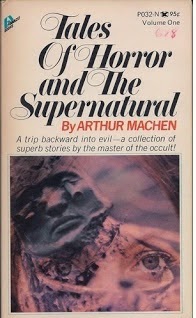
Tales of Horror and the Supernatural Volume 1 by Arthur Machen, containing the following stories: "The Great God Pan", "The Inmost Light", "The Shining Pyramid", "The White People", and "The Great Return" (This edition 1948): Arthur Machen remains one of the ten or so greatest and most influential horror writers who ever lived, more than 100 years since his greatest works were published. Both scientifically inclined and mystical in nature, Machen combined these two traits in stories that expanded upon the philosophical and scientific speculations of Mary Shelley's Frankenstein.

This collection, long out of print, has been supplanted by more complete assemblies of Machen's greatest work. Nonetheless, four of the stories are among the prolific Machen's finest horror stories, while the fifth, the later "The Great Return", shows Machen's later-career move into non-horrifying Catholic mysticism.

"The Great God Pan" and "The White People" are the two titanic stories here. The first concerns a scientific experiment meant to bridge the gap between the material and immaterial world. To do so, the scientist performs a brain operation on a woman. All kinds of Hell result, though it takes decades for the full horror of the experiment to be revealed.

Collapsing the spiritual realm into the physical realm creates a being of sinister potency, and the novella explores not only the nature of evil, but what might be called the evil of nature in certain circumstances: the amoral physical universe is not something to be contemplated without some form of philosophical or ideological buffer between humanity and The Massive. Madness and self-destruction await those who confront the creature born of the experiment: traditionally, those who see the Great God Pan, die.

"The White People", framed by the drawing-room conversation of two men on the nature of true evil, is a stylistic tour-de-force. The main narrative takes the form of a teen-aged girl's journal. Educated from the age of three by a nanny who appears to practice some fairly disturbing witchcraft, the girl moves further and further into the realms of Faery -- the eponymous White People.

The journal works its horrors in a number of subtle ways. The girl's impressions of the disturbing things going on around her are those of a naive innocent, thus leaving certain surmises about what's actually happening to the reader's imagination and deductive abilities. It's brilliantly and sensitively written -- the girl is one of the most heart-breaking narrators in horror fiction by the end of the story -- and the frame narrative, with her story recollected in tranquility, adds an extra layer of verisimilitude and philosophical depth.

Added to these things is a trope that writers such as H.P. Lovecraft would explore more fully -- the story repeatedly refers to rituals and concepts without ever explaining what they truly are. Terms such as 'Aklo' and 'voorish' and 'dhols' would show up in the work of other writers, as would the overall concept of fictional rituals and terms. The great T.E.D. Klein would go so far as to posit "The White People" as a dangerous supernatural text in its own right in his sublime 1984 novel The Ceremonies. There are the White Ceremonies, the Green Ceremonies, and the Scarlet Ceremonies...

Besides the joyful "The Great Return," in which the Holy Grail brings hope to the Welsh during World War One, we also get "The Shining Pyramid," with sinister doings in the countryside and sinister hidden races, and "The Inmost Light," which works as a companion piece to "The Great God Pan." Machen's potent combination of cosmic musings, philosophical enquiry, and mythologies both real and fictional would show the way for many writers to follow. H.P. Lovecraft and his 'disciples' would owe a lot to Machen, and Lovecraft himself praised Machen's work extravagantly in his essay "Supernatural Horror in Literature." He's an indispensable part of the history of horror literature. Because sometimes you really don't want to know what a "wicked voorish dome in Deep Dendo" is, yet you sort of do. Highly recommended.

Friday, May 10, 2013

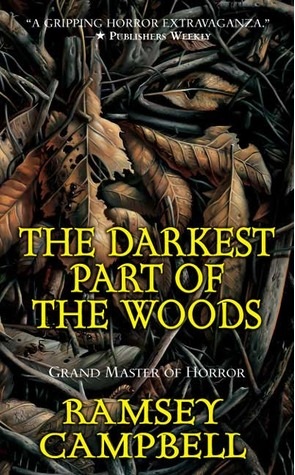
The Darkest Part of the Woods by Ramsey Campbell (2002)

The Darkest Part of the Woods by Ramsey Campbell (2002): This novel, deliberately paced and filled to the bursting with unnerving, telling detail, is Campbell's most (Arthur) Machenesque long work, firmly in the tradition of that seminal horror writer's "The Great God Pan" and "The White People." There are cosmic, Lovecraftian elements as well -- Machen was one of the great influences on H.P. Lovecraft's conception of horror, after all.

30 years prior to the main events of the novel, biologist Lennox Price attempted to discover and contain whatever psychoactive agent had been mentally crippling generations of people unfortunate enough to encounter it in the small, ancient grove of Goodmanswood in the Severn Valley near Campbell's fictional city of Brichester.

Lennox apparently succeeded, but at the cost of his own sanity. Now, he and other similarly compromised men and women live in a mental hospital in Goodmanswood. His eldest daughter, wife, and grandson live nearby.

But a widening of the highway around the wood -- and the destruction of several of the trees therein -- seems to have awakened something. Or maybe it was never asleep. And while his younger daughter, wife, and grandson all seem to have been mentally influenced by the wood, it's eldest daughter Heather who will ultimately have to piece together what's been going on in the woods since before the Romans came. Birds fly over the wood, but they refuse to land anywhere in it, and wildlife has always been strangely absent.

This is Campbell's most densely descriptive novel, one with a fairly straightforward plot but an immensity of destabilizing descriptions and things almost but not quite seen. The wood itself was planted by the Romans to obscure or erase something that was there before, something the people we call the Druids either worshipped or feared. Or both.

Campbell's cheeky sense of humour occasionally shines through -- there's a particularly funny bit about religious book-burning -- but for the most part this is serious stuff. As Heather discovers early on, the Devil was often placated by being referred to as 'The Good Man.'

Readers who require subtext will certainly find some here (some of the effects of the thing or things in Goodmanswood closely resemble global warming, while others evoke the impact of non-indigenous plant and animal species on new environments). But the horror here is ultimately the Thing itself, and the price required to acknowledge it, much less stop it. Highly recommended.

Wednesday, January 23, 2013

Into the Woods

The Ritual by Adam Nevill (2011): Four British friends (Luke, Dom, Phil, and Hutch) who first met in university 15 years earlier decide to go camping in Sweden for their 15th anniversary reunion. Tensions start to run a bit high, as Luke begins to chafe at what he feels is the derogatory attitude of two of the others to his low-income, high-freedom lifestyle. But when the group finds an animal so mutilated as to be unrecognizable hanging fifteen feet up in a tree, social frictions gradually start to seem less important. Something is out there, and they are lost because the most competent of them decided to try a short-cut. Oops.

In the small but sturdy sub-genre of 'camping trips gone wrong', The Ritual is a humdinger. Nevill has a sure hand with characterization, giving all the characters reasons for their behaviour, and eliciting sympathy in the face of whatever it is that's out there just beyond the firelight.

One of the things that elevates The Ritual above the run-of-the-mill is Nevill's careful attention to describing the problems of navigating a forest that hasn't been navigated by people for hundreds of years, if ever. His characters are pursued through a forest that has reduced their speed to a near-crawl. Whatever it is that pursues them is never seen clearly. And the forest seems only to want them to go on one specific path -- to a moldering house, an ancient graveyard complete with an ancient dolmen and a passage graveyard, and beyond.

There are glimpses of something in the trees improbably big, and sounds of trees crashing down in the distance. Food and water run scarce. Two of the four are injured and unable to make good time. Night keeps arrving too soon.

Nevill acknowledges the influences of both fiction and non-fiction work -- this may be one of the first novels to owe a debt to both Into the Wild and Arthur Machen's "The White People." But this is a striking work on its own, perhaps in need of a bit of trimming in its second half, but overall a riveting horror novel. Highly recommended.