Showing posts with label the shining pyramid. Show all posts

Friday, October 2, 2015

Even Monsters Need Health Care

Deep in the Darkness by Michael Laimo (2004): Solid and enjoyable horror-thriller walks in the footsteps of Arthur Machen and some H.P. Lovecraft (specifically "The Lurking Fear" in the latter case). A Manhattan doctor gets an offer he can't refuse: take over the rural New England practice of a recently deceased M.D. and get out of the city with his wife and 5-year-old daughter. What a deal!

Ha! The only place more dangerous than the city in a horror novel is the country (and paradoxically, vice versa). It might be more accurate to say that wherever you go, you should have stayed away. 

Laimo chose to tell this story within a frame narrative that establishes that something really terrible has happened from the beginning of the novel. I"m not sure it's a great choice -- it primarily explains 'where' the first-person narration comes from without adding much in the way of suspense. 

The antagonists of the novel straddle a line between 'natural' cryptid and supernatural boogeyman until very late in Deep in the Darkness. All is (sort of) revealed in a mostly satisfying manner. And Laimo has his sometimes muddle-headed protagonist of an M.D. realize that muddle-headedness, and ponder the source, as the novel progresses. People do some oddly stupid things in the course of the narrative, but there's actually an explanation for that, one that makes sense. And one that the narrator realizes, perhaps too late.

Laimo describes both the antagonists and their woodland haunts viscerally and grotesquely. The novel seems especially oriented to the smells of horror. It also gradually orients itself towards sexualized body horror as it progresses, leading to a couple of extremely graphic and disturbing scenes as the novel moves to a climax. And is a child in danger throughout the novel? Well, yeah. That never gets old.

Deep in the Darkness would probably work better if it were shorter. There's a dragginess to the middle section, a need to get on with it already given what we've seen so far.  And while the first-person narration allows for both unreliability and a refreshing dose of unlikeability in the narrator, it also makes the late-novel objectification of the female body more problematic than third-person would. Characters other than the narrator never really achieve any depth, making what happens to them, especially the wife, verge on gruesome exploitation rather than carefully constructed body horror. 

That there's a sequel to the novel makes a certain amount of sense -- Deep in the Darkness throws a twist in towards the end that allows for further expansion of the narrative while also recontextualizing everything we've read to that point. Though given that this is a first-person narrative recorded 'after' the fact, the revelation may unsuspend the disbelief of a certain portion of readers. Would a narrator lead with the revelation and explain things in terms of it? It certainly could be argued that this would be more believable, especially as the narrative is also framed as a warning to whoever finds it.  Lightly recommended.

Tuesday, July 15, 2014

"A Wicked Voorish Dome in Deep Dendo"

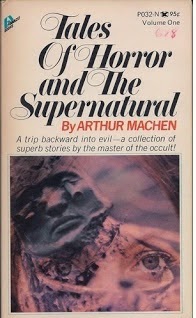
Tales of Horror and the Supernatural Volume 1 by Arthur Machen, containing the following stories: "The Great God Pan", "The Inmost Light", "The Shining Pyramid", "The White People", and "The Great Return" (This edition 1948): Arthur Machen remains one of the ten or so greatest and most influential horror writers who ever lived, more than 100 years since his greatest works were published. Both scientifically inclined and mystical in nature, Machen combined these two traits in stories that expanded upon the philosophical and scientific speculations of Mary Shelley's Frankenstein.

This collection, long out of print, has been supplanted by more complete assemblies of Machen's greatest work. Nonetheless, four of the stories are among the prolific Machen's finest horror stories, while the fifth, the later "The Great Return", shows Machen's later-career move into non-horrifying Catholic mysticism.

"The Great God Pan" and "The White People" are the two titanic stories here. The first concerns a scientific experiment meant to bridge the gap between the material and immaterial world. To do so, the scientist performs a brain operation on a woman. All kinds of Hell result, though it takes decades for the full horror of the experiment to be revealed.

Collapsing the spiritual realm into the physical realm creates a being of sinister potency, and the novella explores not only the nature of evil, but what might be called the evil of nature in certain circumstances: the amoral physical universe is not something to be contemplated without some form of philosophical or ideological buffer between humanity and The Massive. Madness and self-destruction await those who confront the creature born of the experiment: traditionally, those who see the Great God Pan, die.

"The White People", framed by the drawing-room conversation of two men on the nature of true evil, is a stylistic tour-de-force. The main narrative takes the form of a teen-aged girl's journal. Educated from the age of three by a nanny who appears to practice some fairly disturbing witchcraft, the girl moves further and further into the realms of Faery -- the eponymous White People.

The journal works its horrors in a number of subtle ways. The girl's impressions of the disturbing things going on around her are those of a naive innocent, thus leaving certain surmises about what's actually happening to the reader's imagination and deductive abilities. It's brilliantly and sensitively written -- the girl is one of the most heart-breaking narrators in horror fiction by the end of the story -- and the frame narrative, with her story recollected in tranquility, adds an extra layer of verisimilitude and philosophical depth.

Added to these things is a trope that writers such as H.P. Lovecraft would explore more fully -- the story repeatedly refers to rituals and concepts without ever explaining what they truly are. Terms such as 'Aklo' and 'voorish' and 'dhols' would show up in the work of other writers, as would the overall concept of fictional rituals and terms. The great T.E.D. Klein would go so far as to posit "The White People" as a dangerous supernatural text in its own right in his sublime 1984 novel The Ceremonies. There are the White Ceremonies, the Green Ceremonies, and the Scarlet Ceremonies...

Besides the joyful "The Great Return," in which the Holy Grail brings hope to the Welsh during World War One, we also get "The Shining Pyramid," with sinister doings in the countryside and sinister hidden races, and "The Inmost Light," which works as a companion piece to "The Great God Pan." Machen's potent combination of cosmic musings, philosophical enquiry, and mythologies both real and fictional would show the way for many writers to follow. H.P. Lovecraft and his 'disciples' would owe a lot to Machen, and Lovecraft himself praised Machen's work extravagantly in his essay "Supernatural Horror in Literature." He's an indispensable part of the history of horror literature. Because sometimes you really don't want to know what a "wicked voorish dome in Deep Dendo" is, yet you sort of do. Highly recommended.