Showing posts with label the great god pan. Show all posts

Monday, January 19, 2015

Revival by Stephen King (2014)

Revival by Stephen King (2014): Cruising in under the radar after the big splash that was 2013's award-winning Doctor Sleep, Revival is what Doctor Sleep purported to be: a return to full-blown supernatural horror by Stephen King. Like King's It, Revival is a horror novel that salutes a lot of other fictional horrors. It mainly concentrated on the horrors of the big screen in its overt references; Revival mainly goes after written horrors right from its Dedication page onwards, as King lists several horror writers and one horror novella (Arthur Machen's spectacular, more-than-a-century-old "The Great God Pan") to whom he's dedicated Revival.

We've seen King grapple with Machen's novella recently, in the mostly successful 2008 novella "N.", collected in Just After Sunset. And you don't have to have read "The Great God Pan" to enjoy Revival. Though you really should read it in any case. It's swell!

To use a baseball metaphor that seems appropriate to the baseball-loving King, Revival first appears to be a solid double hit by a slow-footed power hitter who's lost some bat speed in recent years. But the double falls into a gap between outfielders. Things start to happen. When the play is over, Revival's delivered a lurchy, gasping, but successful (and terrifically exciting) inside-the-park home run. It's not the sort of towering, out-of-the-park slam that was a novel such as The Shining. But it's impressive nonetheless, maybe more impressive for its relatively greater rarity.

Revival begins in very-small-town Maine. We're somewhere near other King towns such as Castle Rock, but Castle Rock or Derry would be a metropolis by comparison. King gives us something new with the Morton family, from which his narrator Jamie Morton springs: a family with more than one child, and the family dynamics this entails. It's rare ground for King, who's generally depicted one-child families (though sometimes, as in It and "The Body," families whittled down to one surviving child by tragedy). King is out of his comfort zone, which is good. The family stuff works. So, too, does having Jamie Morton grow up to be a recording engineer and occasional session musician rather than the standard writer-protagonist of so many King novels and short stories.

Told by Morton in the present day, Revival shows Jamie Morton's long, intermittent relationship with his town's preacher, from Jamie's boyhood in the 1950's and early 1960's to 2014. Three years into Preacher Charlie Jacobs' small-town tenure, a terrible tragedy ends his priesthood, and his belief in God.

The aftermath of this first tragedy (there will be many more, for many people) sees King write one of his finest scenes of non-supernatural horror. Jacobs gives a nihilistic, God-denying sermon at his church. That's not the horror. The horror comes with the townspeople's reaction to his sermon, a reaction that rings utterly true and horrible in its smug, nasty religiosity buttressed with the most awful, judgmentally toxic gossip. It's a great scene of horrific mourning, one to stand with the funeral scene in Salem's Lot.

Then... we're off. I'll leave the specifics of the plot for you to discover yourself. Jamie Morton's post-teen-aged problems parallel those of many other King protagonists; the solution to these problems is different from what we've seen before in King. Jamie and Jacobs form a twinned narrative, two addicts whose addictions ultimately merge into one.

Along the way, King nods both explicitly and implicitly to 200 years of written horror in English. Jacobs' obsession with electricity and what it can accomplish in the realms of life and death gestures towards that early megalith, Mary Shelley's Frankenstein. Obsessions with death, the dying, and what lies beyond death nod to Poe (perhaps most notably in one scene to Poe's short story "The Facts in the Case of M. Valdemar"). 

And there are many, many others, including Machen, including H.P. Lovecraft and Robert Bloch and Ray Bradbury. King also nods to himself nodding to H.P. Lovecraft in one of the horrific images offered at the climax of the story, an image which echoes something in King's explicit Lovecraft homage, "Crouch End." 

There are other King-on-King moments dotted throughout Revival, mostly to good effect, from the tiny, sinister "Billygoats Gruff" door in It to the terrible, hidden invaders of "The Ten O'Clock People." And for those of you who've read King's non-fiction horror survey Danse Macabre, there's a notable riff on something King discusses therein -- the Ray Milland-starring horror movie X: The Man with the X-Ray Eyes. Seriously. And it works. And HE CAN STILL SEE!

Certainly, the horror takes awhile to build in Revival. And you may at points think you know where the text is going. Does it go somewhere unusual for King? Good question. It goes where it goes. I think the climax is terrific and utterly earned by what's gone before. Implications for everything that happens earlier in the text allow for a re-evaluation of the events we've read about... and, possibly, a re-evaluation of the narrator. Possibly. In any case, really a terrific and enjoyable horror novel from young Mr. King. I hope we'll be seeing more from him! Highly recommended.

Tuesday, July 15, 2014

"A Wicked Voorish Dome in Deep Dendo"

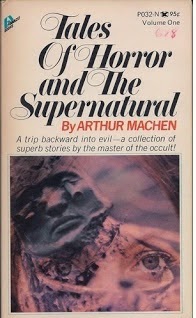
Tales of Horror and the Supernatural Volume 1 by Arthur Machen, containing the following stories: "The Great God Pan", "The Inmost Light", "The Shining Pyramid", "The White People", and "The Great Return" (This edition 1948): Arthur Machen remains one of the ten or so greatest and most influential horror writers who ever lived, more than 100 years since his greatest works were published. Both scientifically inclined and mystical in nature, Machen combined these two traits in stories that expanded upon the philosophical and scientific speculations of Mary Shelley's Frankenstein.

This collection, long out of print, has been supplanted by more complete assemblies of Machen's greatest work. Nonetheless, four of the stories are among the prolific Machen's finest horror stories, while the fifth, the later "The Great Return", shows Machen's later-career move into non-horrifying Catholic mysticism.

"The Great God Pan" and "The White People" are the two titanic stories here. The first concerns a scientific experiment meant to bridge the gap between the material and immaterial world. To do so, the scientist performs a brain operation on a woman. All kinds of Hell result, though it takes decades for the full horror of the experiment to be revealed.

Collapsing the spiritual realm into the physical realm creates a being of sinister potency, and the novella explores not only the nature of evil, but what might be called the evil of nature in certain circumstances: the amoral physical universe is not something to be contemplated without some form of philosophical or ideological buffer between humanity and The Massive. Madness and self-destruction await those who confront the creature born of the experiment: traditionally, those who see the Great God Pan, die.

"The White People", framed by the drawing-room conversation of two men on the nature of true evil, is a stylistic tour-de-force. The main narrative takes the form of a teen-aged girl's journal. Educated from the age of three by a nanny who appears to practice some fairly disturbing witchcraft, the girl moves further and further into the realms of Faery -- the eponymous White People.

The journal works its horrors in a number of subtle ways. The girl's impressions of the disturbing things going on around her are those of a naive innocent, thus leaving certain surmises about what's actually happening to the reader's imagination and deductive abilities. It's brilliantly and sensitively written -- the girl is one of the most heart-breaking narrators in horror fiction by the end of the story -- and the frame narrative, with her story recollected in tranquility, adds an extra layer of verisimilitude and philosophical depth.

Added to these things is a trope that writers such as H.P. Lovecraft would explore more fully -- the story repeatedly refers to rituals and concepts without ever explaining what they truly are. Terms such as 'Aklo' and 'voorish' and 'dhols' would show up in the work of other writers, as would the overall concept of fictional rituals and terms. The great T.E.D. Klein would go so far as to posit "The White People" as a dangerous supernatural text in its own right in his sublime 1984 novel The Ceremonies. There are the White Ceremonies, the Green Ceremonies, and the Scarlet Ceremonies...

Besides the joyful "The Great Return," in which the Holy Grail brings hope to the Welsh during World War One, we also get "The Shining Pyramid," with sinister doings in the countryside and sinister hidden races, and "The Inmost Light," which works as a companion piece to "The Great God Pan." Machen's potent combination of cosmic musings, philosophical enquiry, and mythologies both real and fictional would show the way for many writers to follow. H.P. Lovecraft and his 'disciples' would owe a lot to Machen, and Lovecraft himself praised Machen's work extravagantly in his essay "Supernatural Horror in Literature." He's an indispensable part of the history of horror literature. Because sometimes you really don't want to know what a "wicked voorish dome in Deep Dendo" is, yet you sort of do. Highly recommended.

Tuesday, June 17, 2014

Le Massif Attack

The Course of the Heart by M. John Harrison (1992): If you've read Harrison's novella "The Great God Pan" in the 1988 horror anthology Prime Evil, then you've read a chunk of this novel, though the characters' names differ. The novel also makes the title of the novel, an homage to the classic Arthur Machen story of the same name, abundantly clear in a way that the novella itself did not.

Machen's novella, first published in 1890, essentially involves a series of encounters with either Satan himself or with an amoral avatar of the natural world. Opinions differ. I tend to side more with the latter than the former, as Machen's story seems to me to foreground the possible metaphysical implications of the seemingly Godless natural universe being revealed to scientists in the 19th century. More than any other Machen work, "The Great God Pan" gestures forward towards H.P. Lovecraft's mathematically malign cosmos.

Harrison's novel deals with similar cosmic issues, though Harrison has always been one of the most mysterious and difficult to quantify of all writers of horror and dark fantasy. If that's even what he's writing. The movement to come up with a new way of categorizing certain stories that led to the concept of the 'New Weird' in the early 21st century oriented itself around Harrison and his body of work, at least initially. He is really a one-off: no one writes like him.

In The Course of the Heart, three British university students and a self-styled Gnostic magician conduct some sort of ritual back in the early 1970's. 20 years later, they're still dealing with the consequences of that ritual. Strange, seemingly supernatural events plague the three students. The magician himself has plunged further and further into the world of magic, though whether or not magic works remains a question throughout the novel.

Harrison can frustrate people in his short stories with the lack of answers to the questions his stories seem to pose. At the length of a short novel, that mystery grows accordingly. The Course of the Heart isn't exactly a horror novel -- it is, instead, a novel of Something Sublime interacting with the human world, and the multitudinous consequences of that interaction.

I can think of two recent novels -- Peter Straub's A Dark Matter and Joe Hill's Horns -- that seem to me to be much less successful attempts at what Harrison has succeeded in creating here: an existential mystery, a Sublime whodunnit, a Mysterium Tremendum. It might actually be a great novel. It might be an ultimately pompous and non-committal mess (though beautifully written in either case). I'm still digesting it. Or being digested by it. Highly recommended.

Friday, May 10, 2013

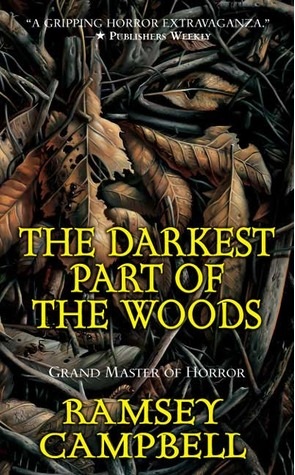
The Darkest Part of the Woods by Ramsey Campbell (2002)

The Darkest Part of the Woods by Ramsey Campbell (2002): This novel, deliberately paced and filled to the bursting with unnerving, telling detail, is Campbell's most (Arthur) Machenesque long work, firmly in the tradition of that seminal horror writer's "The Great God Pan" and "The White People." There are cosmic, Lovecraftian elements as well -- Machen was one of the great influences on H.P. Lovecraft's conception of horror, after all.

30 years prior to the main events of the novel, biologist Lennox Price attempted to discover and contain whatever psychoactive agent had been mentally crippling generations of people unfortunate enough to encounter it in the small, ancient grove of Goodmanswood in the Severn Valley near Campbell's fictional city of Brichester.

Lennox apparently succeeded, but at the cost of his own sanity. Now, he and other similarly compromised men and women live in a mental hospital in Goodmanswood. His eldest daughter, wife, and grandson live nearby.

But a widening of the highway around the wood -- and the destruction of several of the trees therein -- seems to have awakened something. Or maybe it was never asleep. And while his younger daughter, wife, and grandson all seem to have been mentally influenced by the wood, it's eldest daughter Heather who will ultimately have to piece together what's been going on in the woods since before the Romans came. Birds fly over the wood, but they refuse to land anywhere in it, and wildlife has always been strangely absent.

This is Campbell's most densely descriptive novel, one with a fairly straightforward plot but an immensity of destabilizing descriptions and things almost but not quite seen. The wood itself was planted by the Romans to obscure or erase something that was there before, something the people we call the Druids either worshipped or feared. Or both.

Campbell's cheeky sense of humour occasionally shines through -- there's a particularly funny bit about religious book-burning -- but for the most part this is serious stuff. As Heather discovers early on, the Devil was often placated by being referred to as 'The Good Man.'

Readers who require subtext will certainly find some here (some of the effects of the thing or things in Goodmanswood closely resemble global warming, while others evoke the impact of non-indigenous plant and animal species on new environments). But the horror here is ultimately the Thing itself, and the price required to acknowledge it, much less stop it. Highly recommended.