Showing posts with label steve gerber. Show all posts

Monday, April 9, 2018

Nevada

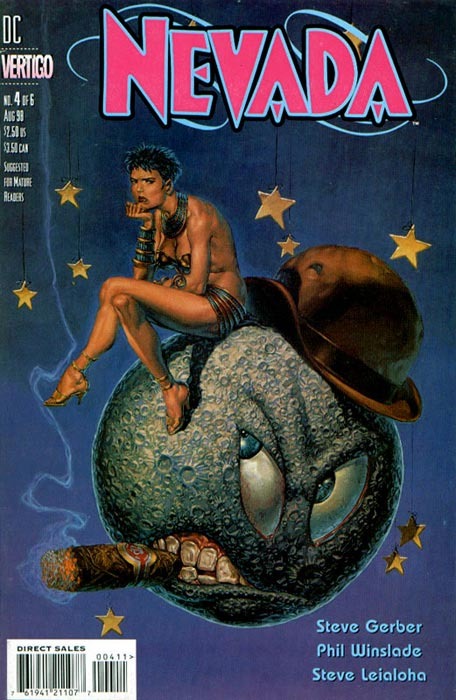
Nevada (1998/ Collected 1999)): written by Steve Gerber; illustrated by Phil Winslade, Steve Leialoha, Dick Giordano, and others: Steve Gerber was one of the great Marvel writers of the 1970's, a quirky member of a new wave of comics writers who'd grown up on Marvel's blend of superheroism and pop psychology and wanted to make superhero comics more literate and 'adult.' 

His greatest popular success was his own creation (along with artist Val Mayerik) -- Howard the Duck, terribly botched by the movie and terrifically compelling when written by Gerber. But Gerber created Howard for Marvel, which meant that when he left Marvel, Howard stayed.

Gerber did a lot of compelling comic-book work over the subsequent decades, from a terrific in-continuity Superman miniseries (The Phantom Zone, 1981) to an abortive scifi epic originally pitched as a reboot of DC's Hawkman (Void Indigo) to a host of other often short-lived titles. 

Nevada supposedly sprung from a brief incident in a 1977 Howard the Duck story in which a chorus girl who works onstage with an ostrich fights a "killer lampshade." Some time in the 1990's, Neil Gaiman supposedly asked Gerber when he would go into this story in more depth. The six-issue DC/ Vertigo miniseries Nevada was the result.

It's a typically atypical Gerber story, mostly self-contained but clearly designed to allow for a sequel or a regular series that never happened. It's set in Las Vegas. There's a chorus girl and her dancing ostrich, a mysterious homeless man, a guy with what looks like a Lava Lamp for a head, a laser beaming a message from outer space into the security system of a casino, a series of strange locked-room murders, and some extremely cosmic vistas and philosophies. Gods and angels fight in the skies over Las Vegas. Well, gods and angels from the human POV.

It's a solid piece of off-kilter Gerber genre-bending, ably illustrated by Phil Winslade in a manner that keeps the stranger concepts grounded in representational verisimilitude. The ostrich is a bit of a hoot. Recommended.

Saturday, December 21, 2013

Super-heroes in Limbo

Superman: The Phantom Zone: written by Steve Gerber; illustrated by Gene Colan, Tony DeZuniga, Dick Giordano, Rick Veitch, and Bob Smith (1982, 1986; Collected 2013): Steve Gerber was both the oddest mainstream comic-book writer of the 1970's and, with the benefit of hindsight, far and away the best and most interesting superhero writer of that decade. His work on Man-Thing and Howard the Duck for Marvel Comics remains legendary, and unlike a lot of decades-ago legends of the superhero-writing game, compulsively readable and rewarding to this day.

This volume collects a 1982 Superman miniseries and a 1986 follow-up story. It also marks, I think, Gerber's first work for DC Comics. In a perfect world, the miniseries might have led to Gerber getting a full-time gig writing the Man of Steel's adventures. In this world, this volume is pretty much Gerber's entire Superman output. It's still a gem.

The Phantom Zone, introduced during the 1950's as the planet Krypton's extra-dimensional jail for criminals, was originally a handy source of enemies for Superman because within it were held Kryptonian criminals who would have the same powers as Superman should they be released on Earth. Oh oh! Over time, though, the ramifications of the Phantom Zone became stranger and more disturbing.

For one, Krypton (and Superman's father, Jor-El, specifically, for he had invented the Phantom Zone projector) had allowed dozens of dangerous criminals to survive the death of Krypton. For another, the non-physical, telepathic state the Zone put prisoners into did not seem to encourage anything resembling rehabilitation. Actually, the criminals just seemed to get angrier and crazier over the years. For a third, the Zone actually allowed the criminals to telepathically influence people in the normal universe to, I don't know, let them out? What a prison system!

Gerber explores these problems and others in his Phantom Zone work, while coming up with an explanation for what the Phantom Zone really was that's completely bonkers and genuinely disturbing. And as he runs Superman through a gauntlet that becomes increasingly surreal and nightmarish, Gerber gives the Man of Steel some of his greatest comic-book moments.

The artists chosen for the miniseries and the follow-up augment the oddness of the proceedings. Gene Colan and Tony DeZuniga supply art that one would have found much more normal on Batman or Dr. Strange or Dracula, three characters whom Colan is best known for drawing, along with Daredevil. DeZuniga, who spent years on various Conan properties at Marvel and on Western anti-hero Jonah Hex at DC, inks the miniseries with satisfying heft and murkiness. The follow-up issue brings Rick Veitch, best known in the mainstream for his art and writing on Swamp Thing, into the fold. It may not be his best work, but it's still pretty swell. In both cases, Superman remains heroic despite being faced with horrors and weirdness more suited to a Master of the Mystic Arts.

Could Gerber have kept going at this level of weirdness and excitement on a regular Superman series? Well, we'll never know. But a man can dream. Highly recommended.


Harbinger: Perfect Day: written by Joshua Dysart; illustrated by Barry Kitson, Clayton Henry, Riley Rossmo, and others (2013): The new Valiant Comics universe is a dangerous place. So when super-psychic Peter Stanchek and his friends get a chance to rest and relax after their disastrous Las Vegas confrontation with the super-powered forces of both older super-psychic Harada's Harbinger Foundation and the anti-psychic soldiers of Project Rising Spirit , they take it.

And then stuff happens.

Writer Joshua Dysart and artists Barry Kitson and Clayton Henry continue to create great stories in what was, back in the early 1990's with the original Valiant, a universe that basically copied the X-Men. They've grounded the super-heroics by trying to establish a sense of verisimilitude. These psychics (called 'psiots' in the Valiant universe) possess basic human weaknesses. They can be killed. They can be distracted. But they can also cut loose in horrific ways.

Besides the sharp characterization of Stanchek and his friends, the book also makes its main antagonist, the world-conquering/world-saving Harada, an unusual comic-book villain insofar as he not only sees himself as hero and saviour, he may very well be humanity's best hope: his desire to save the world from itself is never written as anything other than genuine and heartfelt. But the means to his ends aren't so good for everyone involved, and the ends may ultimately not be either. He's a saviour who's likely to turn into Sauron by the end.

By any standard, this is a great and affecting superhero comic book, already one of the best quasi-realistic superhero books ever published. It manages scenes of spectacle that aren't empty of concern and horror, and it's remarkably generous to even its most minor and fleeting of characters. Highly recommended.

Saturday, October 20, 2012

Planetary Bodies


The Guardians of the Galaxy: The Power of Starhawk: written by Steve Gerber, Roger Stern, and Stan Lee; illustrated by Al Milgrom, John Buscema, and others (1975-77; collected 2011): Marvel's original Guardians of the Galaxy hailed from the 31st century, something I'm pretty sure the movie is going to avoid in favour of the more contemporary version of the team. Oh, well. This volume collects some of the grooviest science fantasy comics of my youth, most of them written by the inimitable Steve Gerber and pencilled by Al Milgrom.

Chronologically, this is the second collection of the team, picking up the story after they've liberated the solar system from Marvel's most underwhelming interstellar empire, the Brotherhood of the Badoon, with the help of the 20th century's Defenders. After quickly winning the peace by striking a bargain with the Sisterhood of the Badoon (the lizard-like Badoon having split into two competing cosmic empires along gender lines; the women are a lot nicer), the Guardians find themselves out of place on Earth.

This anomie makes sense as the team comprises a genetically engineered pair of men who are the last survivors of the Jupiter and Pluto colonies; the mysterious space-faring Starhawk; Major Vance Astro, a thousand-year-old American astronaut condemned to life inside a metal shell so that he doesn't disintegrate; the last survivor of the dominant species of the Alpha Centauri system; and, almost immediately, the last surviving genetically engineered woman from the Mercury colony.

Under the direction of Starhawk, they take to space in the starship Captain America to travel to the centre of the galaxy and confront a nihilistic super-planet shaped like a person and dubbed The Topographical Man. It's several light years across and has suns about to go supernova at each wrist. Along the way, they fight one of the Topographical Man's energy-gathering animalcules, a planet-sized, energy-eating space frog. And then things really get weird. Steve Gerber was fucking bananas in the best possible way.

Steve Gerber's ability to write really, really weird stories seems even more remarkable given the context -- this was the mid-1970's, after all. A story arc that involves the giant astral projection of a woman having sex with the possessed body of the Topographical Man...well, it's not something that would happen with any other writer. Roger Stern takes over for the last couple of issues collected here and does a pretty good job of following Gerber's lead. All in all, this really is a weird and enjoyable comic book. Though I'm still not sure how people settled on Jupiter, genetic engineering or not. Gerber didn't come up with that implausibility; he just has to deal with it. Recommended.

Saturday, March 19, 2011

Four!

America's Best Comics, written by Alan Moore, Peter Hogan, Steve Moore and Rick Veitch; illustrated by Art Adams, Sergio Aragones, Jim Baikie, Kyle Baker, Hilary Barta, J. Scott Campbell, Zander Cannon, John Cassaday, Claudio Castellini, Frank Cho, Dame Darcy, Jose Luis Garcia Lopez, Melinda Gebbie, Michael Golden, Adam Hughes, Phil Noto, Kevin Nowlan, Kevin O'Neill, Jason Trent Pearson, Humberto Ramos, Alex Ross, Eric Shanower, Rick Veitch, Al Gordon, Chris Sprouse, Karl Story and John Totleben (2001-2003; collected 2004): This collection is essentially a portmanteau of stuff that doesn't fit into any of the other collections of Alan Moore's America's Best Comics universe, anchored by a lengthy dimension-hopping adventure of Tom Strong's daughter Tesla. The shorter stories are all pretty solid; of greatest interest, probably, is the bizarre but appropriate League of Extraordinary Gentlemen board game. Sketches and early design work fill out the volume. It's all good, mostly clean fun. Recommended.


The Helmet of Fate, written by Steve Gerber, Steve Niles, Gail Simone, Tad Williams and Bill Willingham; illustrated by Scott Hampton, Shawn McManus, Duncan Rouleau, Peter Snejberg, Phil Winslade and others (2007): One of those odd non-miniseries miniseries that DC occasionally plays around with -- as originally published, this was five one-shots with different writer/artist teams, and really worked best as an adjunct to the Day of Vengeance miniseries and the subsequent ongoing supernatural team series Shadowpact.

Having been pummelled by the Spectre in a suicidal (and successful) gambit to get that loony, near-omnipotent supernatural avenger back under control, longtime DC mystical hero Doctor Fate has been reduced to its essence -- a magical helmet without a human partner/host -- and flung into space by Captain Marvel to let fate find it a new, um, Fate. It meets up with a handful of DC's supernatural heroes, some of them newly rebooted 'legacy' heroes (Ibis the Invincible and Sargon the Sorcerer), some of them just new (Black Alice), some their old loveable selves (Detective Chimp and angel-on-assignment Zauriel).

And that's about it. The helmet and the heroes have an adventure; the helmet moves on. Nothing is really resolved, as Steve Gerber's subsequent Fate stories in the Countdown to Mystery miniseries would reveal who the new Doctor Fate would be. Still, the writing and art are for the most part top-notch; it's a shame that none of these spun off into at least a miniseries (so far as I know). Recommended.


Fantastic Four Visionaries: Walt Simonson Volume 2, written by Walt Simonson and Danny Fingeroth; illustrated by Walt Simonson and Rex Valve (1990-91; collected 2008): Marvel pushes the acceptable lower page limits of comic-book collections here with a volume that collects just five of writer/artist Walt Simonson's early 1990's run on the Fantastic Four. And one of those is a fill-in issue that basically reiterates the point of an earlier John Byrne FF, complete with a reference to that earlier, better story.

We do, however, get the FF's loopy adventures in an alternate reality in which Stalin is still running the Soviet Union in 1990 (shades of Command and Conquer!). Simonson does shine here doing the fast-paced science-fantasy stuff that's been his strongest suit as a writer/artist ever since he did Thor in the mid-1980's. The reconstituted FF takes a bit of getting used to (at this point in their history, Ben Grimm isn't the Thing, but his girlfriend Ms. Marvel is the (a) Thing. But she's not the original Ms. Marvel. And female Things look pretty much identical to male Things, though she wears a top for modesty's sake so we don't really know how anatomically correct she is). Short but fun. Recommended.


Fantastic Four Visionaries: Walt Simonson Volume 3, written by Walt Simonson; illustrated by Walt Simonson, Art Adams and others (1991; collected 2009): Walt Simonson's FF run continues, or possibly ends...Marvel really isn't big on supplying context in its reprint volumes. Marvel's first family of superheroing battles Doctor Doom and a time-controlling adjustment bureau angered by the FF's meddling in history.

Cosmic shenanigans proliferate, Reed Richards shows once again why he's the most dangerous member of the Fantastic Four, and Ben Grimm goes through yet more mutations and permutations of his rocky, orange self. Hopefully there's a timeline out there somewhere in which Simonson wrote and drew a Superman comic for several years -- the combination of lightheartedness and the cosmic is pretty refreshing, much like a Junior Mint. Recommended.