Wednesday, February 22, 2012

Live Twee or Die Hard

Poe's Children: The New Horror: An Anthology: edited by Peter Straub, containing the following stories:

The Bees by Dan Chaon
Cleopatra Brimstone by Elizabeth Hand
The Man on the Ceiling by Steve Rasnic Tem and Melanie Tem
The Great God Pan by M. John Harrison
The Voice of the Beach by Ramsey Campbell
The Body by Brian Evenson
Louise's Ghost by Kelly Link
The Sadness of Detail by Jonathan Carroll
Leda by M. Rickert
In Praise of Folly by Thomas Tessier
Plot Twist by David J. Schow
The Two Sams by Glen Hirshberg
Notes on the Writing of Horror: A Story by Thomas Ligotti
Unearthed by Benjamin Percy
Gardener of Heart by Bradford Morrow
Little Red's Tango by Peter Straub
The Ballad of the Flexible Bullet by Stephen King
20th Century Ghost by Joe Hill
The Green Glass Sea by Ellen Klages
The Kiss by Tia V. Travis
Black Dust by Graham Joyce
October in the Chair by Neil Gaiman
Missolonghi 1824 by John Crowley
Insect Dreams by Rosalind Palermo Stevenson

I'd like this anthology a lot better with 'horror' removed from the title, though what one would replace that word with could lead to some debate: several stories don't feature the supernatural, so that's out; ghosts don't appear in all the stories, so there goes 'ghost story.' Even The New Fabulists fails, despite the broad net of that term.

"The New Horror" seems to have started around 1980 for Straub, though several writers (Stephen King, Ramsey Campbell, and Straub himself, among others) have published careers that stretch back up to 15 years before that. Again, odd: there are at least two generations of writers here, maybe even three. 130 years after Poe, the title seems a bit odd as well, and unintentionally dismissive of those 130 years of horror between Poe's death and the appearance of the first story here.

And horror, no -- about half the stories here fail to horrify, terrify, gross out or (per S.T. Joshi) unnerve. And not just because I've read too much horror. Some of the choices -- maybe none moreso than Straub's choice for his own story -- simply aren't horror, though all the stories in this anthology are well written.

One of the strangely dominant modes here is the sort of dark, fantastical whimsy that John Collier and Roald Dahl, among others, were masters of -- perhaps the most acceptable literary form of the fantastic through much of the 20th century if one bases one's analysis on the slick magazines and what they tended to publish for decades on end. Neil Gaiman, Straub, Jonathan Carroll and a few others offer this sort of project, in which the whimsy can sometimes be smothered in twee, never moreso than in Kelly Link's "Louise's Ghost", a treacly, twinkly botch of a story.

King's uncharacteristic entry here -- I can't recall ever seeing it anthologized since its first appearance in 1984 -- is much better than I remember it, but still undercut by the sheer, well, whimsy of the basic premise. The fantastic element simply can't bear the weight of the story's exploration of madness and addiction. The story would be better without any nod to the fantastic.

I did enjoy many of the stories I'd never encountered before, even many of those that aren't really horror at all. But it's a darn peculiar anthology: peculiarly skimpy on contextual material, and peculiarly spotty in terms of satisfying the 'horror' portion of its title. Lightly recommended.

Sunday, February 19, 2012

Absolute Before Watchmen!

WATCHMEN creators Alan Moore (L) and Dave Gibbons c. 1986
I've returned from the farflung future of 2014, in which remaindered copies of the trade paperbacks of the various Before Watchmen series are currently being used to build flood levees in Louisiana. Without Before Watchmen, New Orleans would have been destroyed again. Thanks, DC!
But what a tremendous prequel to writer Alan Moore and artist Dave Gibbons's 1986-87 12-issue Watchmen limited series humanity got, despite the non-involvement of writer Alan Moore and artist Dave Gibbons. While Before Watchmen will neither be listed as one of Time magazine's 100 books of the century (as Watchmen was) nor become the best-selling graphic novel in history (as Watchmen was), it does offer many delightful surprises. Excelsior!

So here's a spoiler-heavy rundown of the awesome delights that await you at your local comic-book shop in the summer of 2012.

Minutemen (6 issues), written and illustrated by Darwyn Cooke: The Minutemen engage in a number of exciting and life-affirming adventures that make absolutely no sense given what we saw of them in Watchmen.* In one of them, a 50-year-old Comedian defeats Cassius Clay in a boxing match.** Hoo ha, that's attention to historical detail!

Rorschach (4 issues), written by Brian Azzarello, illustrated by Lee Bermejo: Rorschach shows how tough he is in various tough corners of New York over the years. Also, his 'The End is Nigh' sign finally gets a proper origin story. Guess what: it's the secret hero of Watchmen! As with most recent Azzarello-penned projects, all four issues combined will take less than 5 minutes to read.

The Comedian (6 issues), written by Brian Azzarello, illustrated by J.G. Jones: The Comedian demonstrates how tough he is in various tough locales over the years, as he turns out to be behind the assassinations of Robert Kennedy, Malcolm X, Martin Luther King Jr., and the Phillie Phanatic. As with most recent Azzarello-penned projects, all six issues combined will take less than 5 minutes to read.

Dr. Manhattan (4 issues), written by J. Michael Straczynski, illustrated by Adam Hughes: In order to reconnect with humanity, Dr. Manhattan starts walking across the United States***. However, he quits halfway through and gets someone else to finish the walk.****

Nite Owl (4 issues), written by J. Michael Straczynski, illustrated by Andy and Adam Kubert: Nite Owl discovers that his non-existent superpowers derive from The Owl Totem*****. Much brooding ensues. He loses an eye, but it grows back.****** At some point, he yells, "Not on my watch!"*******

Ozymandias (6 issues), written by Len Wein, illustrated by Jae Lee: 6 issues of hardcore, photorealistically rendered gay sex. The big surprise of the Before Watchmen event.

Silk Spectre (4 issues), written by Darwyn Cooke, illustrated by Amanda Conner: Silk Spectre's giant boobs******** take part in a variety of exciting adventures with life-affirming conclusions.

Curse of the Crimson Corsair (backup), written by Len Wein, illustrated by John Higgins: This is the story that's the comic-book equivalent of having a Beatles reunion with only Ringo Starr and George Martin involved, as original Watchmen editor Len Wein and original Watchmen colourist John Higgins give Watchmen fanatics the pirate story they've been waiting 25 years for, though what they were hoping for involved some combination of Alan Moore, Dave Gibbons, and the late Joe Orlando.

Before Watchmen: Epilogue (1 issue), various writers and artists: Surprise! The Epilogue to Before Watchmen is a lavishly recoloured Watchmen that slathers the art you loved in layers and layers of quasirealistic full-process colour! Written by Alan Moore, illustrated by Dave Gibbons, and coloured by the Computronic Colouring Robot 3000.


* Darwyn Cooke just did an interview in which he said Watchmen wasn't great because it wasn't hopeful and optimistic enough.

** As a decrepit Golden-Age hero Wildcat does in Cooke's Justice League: The New Frontier.

*** As Straczynski had Superman do in the recent Grounded storyline.

**** Straczynski quit the Grounded storyline less than halfway through, leaving writer Chris Roberson to try to clean up the mess.

***** As Straczynski had Spider-man discover the same about The Spider Totem.

****** Something Straczynski did to Spider-man during his run on the title.

******* A favourite saying of characters on Straczynski's Babylon 5.

******** Amanda Conner just got done a stint drawing DC's Power Girl, aka the DC superheroine with the world's largest breasts.

Saturday, February 18, 2012

Grimjack

Grimjack Omnibus Volume 1: written by John Ostrander; illustrated by Tim Truman with John K. Snyder III and Len Elmore (1983-85; collected 2010): Science fiction -- or at least science fantasy -- maintained quite a presence in non-super-hero comic books of the 1980's, especially at publishers other than DC and Marvel striving to find an audience of their own, preferably a more adult one. First Comics, original publisher of Grimjack, probably released more well-regarded science-fiction titles than anyone.
Created by John Ostrander and Tim Truman, Grimjack follows the adventures of hardboiled mercenary John "Grimjack" Gaunt in the "pandimensional" city of Cynosure, a nexus where all the dimensions meet and mingle. Cynosure is pretty much the most wretched hive of scum and villainy in the galaxy, allowing Grimjack plenty of opportunities to make money or die trying.

Grimjack's most obvious comic-book antecedent is DC's Jonah Hex, another scar-faced bounty hunter with an occasional heart of gold when it comes to certain clients. John Gaunt's a lot more introspective than Hex, however, as his narration allows us to see -- indeed, the narration places Gaunt more in the tradition of hardboiled detectives than hardboiled mercenaries.

Cynosure itself allows Ostrander and Truman to play with a variety of genres, thanks to the overlapping dimensions, putting Gaunt into everything from a tribute to Sergio Leone Westerns to a world of funny animals threatened by an invasion of killer rabbits. It's a lot of fun, despite the fact that Truman -- already a solid draftsman and detailed renderer of the human form -- has always seemed to have an aversion to drawing human beings capable of smiling. So it goes.

The time when non-tie-in science-fiction comic books had a major presence at the comic-book store seems to have ended long ago; this is an enjoyable reminder of the decade when it seemed like the successful expansion of comic books into every mainstream genre was only a matter of time. Recommended.

Fever Dream

A Scanner Darkly: adapted by Richard Linklater from the Philip K. Dick novel of the same name; directed by Richard Linklater; starring Keanu Reeves (Bob Arctor); Robert Downey Jr. (James Barris); Rory Cochrane (Charles Freck); Winona Ryder (Donna Hawthorne) and Woody Harrelson (Ernie Luckman) (2006): Adapter/director Richard Linklater achieved at least three remarkable things with A Scanner Darkly: he created the most faithful movie adaptation of a Philip K. Dick novel or short story ever; he created an outstanding science-fiction film; and he maximized the limited acting ability of Keanu Reeves by casting Reeves as a burnt-out case in the midst of a drug-fueled mental breakdown.
Reeves plays Bob Arctor, a near-future California undercover government narc charged by his superiors with helping win the war against Substance D, a highly addictive illegal substance that rapidly causes irreversible brain damage in those addicted to it, partially by severing the connection between an addict's left and right brain hemispheres.

Arctor is deep undercover, sharing a house with two other addicts and buying Substance D from a third in increasingly difficult-to-supply mass quantities in the hopes of moving up the supply chain. The government knows what the main ingredient of Substance D derives from -- a small, blue-flowered plant -- but it doesn't know who is growing it, refining it, and putting it on the street.

Dick based much of A Scanner Darkly on his own drug experiences of the 1960's and 1970's, experiences which saw him committed to a mental asylum for a time, and experiences which caused him to interact with a large number of doomed and mostly doomed addicts. Indeed, the movie appends a portion of the novel's afterword to the end of the movie -- a roll call of the dead and damaged.

The hyper-colourful, rotoscoped animation Linklater uses here (he first used it in Waking Life) suits the material and the tone of that material -- the movie looks like a fever dream, a pulsating nightmare in which nothing is stable. All the principals deliver outstanding performances, including Reeves, and perhaps most notably Robert Downey Jr., who presents us with a jittery speed freak (Substance D appears to be at least partially an amphetamine) over-bursting with his own paranoid delusions and fantasies.

The title is a play on the Biblical phrase 'Through a glass, darkly': there are scanners in this movie, but they aren't the Cronenberg variety. Highly recommended.

Before Watchmen!

I've returned from the farflung future of 2014, in which remaindered copies of the trade paperbacks of the various Before Watchmen series are currently being used to build flood levees in Louisiana. Without Before Watchmen, New Orleans would have been destroyed again. Thanks, DC!

But what a tremendous prequel to writer Alan Moore and artist Dave Gibbons's 1986-87 12-issue Watchmen limited series humanity got, despite the non-involvement of writer Alan Moore and artist Dave Gibbons. While Before Watchmen will neither be listed as one of Time magazine's 100 books of the century (as Watchmen was) nor become the best-selling American graphic novel in history (as Watchmen was), it does offer many delightful surprises. Excelsior!

So here's a spoiler-heavy rundown of the awesome delights that await you at your local comic-book shop in the summer of 2012.

Minutemen (6 issues), written and illustrated by Darwyn Cooke: The Minutemen engage in a number of exciting and life-affirming adventures that make absolutely no sense given what we saw of them in Watchmen. In one of them, a 50-year-old Comedian defeats Cassius Clay in a boxing match. Hoo ha, that's attention to historical detail! Their world is almost just like ours!

Rorschach (4 issues), written by Brian Azzarello, illustrated by Lee Bermejo: Rorschach shows how tough he is in various tough corners of New York over the years. Also, his 'The End is Nigh' sign finally gets a proper origin story. Guess what: it's the secret hero of Watchmen! As with most recent Azzarello-penned projects, all four issues combined will take less than 5 minutes to read.

The Comedian (6 issues), written by Brian Azzarello, illustrated by J.G. Jones: The Comedian demonstrates how tough he is in various tough locales over the years, as he turns out to be behind the assassinations of Robert Kennedy, Malcolm X, Martin Luther King Jr., and the Phillie Phanatic. As with most recent Azzarello-penned projects, all six issues combined will take less than 5 minutes to read.

Dr. Manhattan (4 issues), written by J. Michael Straczynski, illustrated by Adam Hughes: In order to reconnect with humanity, Dr. Manhattan starts walking across the United States. However, he quits halfway through and gets someone else to finish the walk.

Nite Owl (4 issues), written by J. Michael Straczynski, illustrated by Andy and Adam Kubert: Nite Owl discovers that his non-existent superpowers derive from The Owl Totem. Much brooding ensues. He loses an eye, but it grows back. At some point, he yells, "Not on my watch!"

Ozymandias (6 issues), written by Len Wein, illustrated by Jae Lee: 6 issues of hardcore, photorealistically rendered gay sex. The big surprise of the Before Watchmen event.

Silk Spectre (4 issues), written by Darwyn Cooke, illustrated by Amanda Conner: Silk Spectre's giant boobs take part in a variety of exciting adventures with life-affirming conclusions.

Curse of the Crimson Corsair (backup), written by Len Wein, illustrated by John Higgins: This is the story that's the comic-book equivalent of having a Beatles reunion with only Ringo Starr and George Martin involved, as original Watchmen editor Len Wein and original Watchmen colourist John Higgins give Watchmen fanatics the pirate story they've been waiting 25 years for, though what they were hoping for involved some combination of Alan Moore, Dave Gibbons, and the late Joe Orlando.

Before Watchmen: Epilogue (1 issue), various writers and artists: Surprise! The Epilogue to Before Watchmen is a lavishly recoloured Watchmen that slathers the art you loved in layers and layers of quasirealistic full-process colour! Written by Alan Moore, illustrated by Dave Gibbons, and coloured by the Computronic Colouring Robot 3000.

Wednesday, February 15, 2012

Adam Raised a Cain

The Seven Days of Cain by Ramsey Campbell (2010): Young Liverpool couple Andy Bentley and Claire are struggling to conceive a child. Andy works at his father and mother's photography studio; Claire works for a government-sponsored charitable organization that tries to provide homes and job training for the homeless. Things seem to be going OK, despite the fact that doctors can't figure out why Claire can't conceive.
Elsewhere, someone has murdered a playwright with the somewhat goofy name of Penny Scrivener in New York. One of Barcelona's "living statues" has been murdered in Barcelona; her name was Serena Paz. Soon thereafter, Andy begins getting emails about something he did in the past, apparently something awful, from an unknown sender with a flair for puzzles and word games. An old schoolmate of Claire's shows up outside her workplace, homeless, and very odd. A self-important writer shows up at Andy's studio, looking to get memorable photographs of himself, eventually offering Andy a chance for mainstream publication of his photos.

After 150 pages, one may think one knows where this novel is heading, but one really doesn't.

On the beach near Claire and Andy's house, the (real), and really odd Liverpudlian metal statues of the same figure repeated dozens of times, staring out to sea, sometimes seem to have one less member, or perhaps one more. On the horizon, giant windmills tilt at the sky, always intruding into Claire and Andy's perceptions of that environment.

Campbell's novels have often tugged and pulled at the nature of reality, perhaps most notably and successfully in Incarnate and The Grin of the Dark. Well, he's back at reality again, in a novel that functions as a sequel of sorts -- or perhaps more accurately a shared-universe tale -- as related to a previous but recent novel and a 40-year-old short story that turned out to have a concept within it that adapted well to the Age of Internet. Naming that novel and that short story would reveal too much, too soon of the novel's clever shift midway through, and knowledge of the two isn't necessary to enjoying The Seven Days of Cain, though that knowledge does add to the enjoyment -- and the level of existential disturbance.

The Seven Days of Cain supplies a lot of Campbell's trademarked description, both vivid and intensely allusive, that can sometimes make a story seem disturbingly dream-like, as background and midground and foreground collapse into one (the story does feature a photographer as a protagonist, after all). No one will be punished for anything resembling a "real" crime here, but punishment -- or judgement -- is coming nonetheless. Why and for whom? Read the emails carefully. Don't stand too long on the beach. Don't check your spam box too often. Highly recommended.

Tuesday, February 14, 2012

Giant-size Swamp Thing

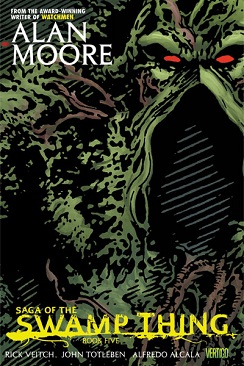
The Saga of the Swamp Thing Volume 5: written by Alan Moore, Steve Bissette, Rick Veitch, and John Totleben; illustrated by Rick Veitch, Steve Bissette, John Totleben, and Alfredo Alcala (1986; collected 2011): The penultimate collection of Alan Moore's career-making run on DC's Saga of the Swamp Thing sees Rick Veitch take over as primary penciller. As previous Swamp Thing penciller (and then-continuing cover artist) Steve Bissette notes in the informative introduction, Veitch's interest in science fiction over horror helped shift the book to a more science-fiction-oriented direction. But first Swamp Thing would travel to Gotham City for a fateful encounter with Batman. Then it was off into space for several issues for an odyssey that would conclude in the next volume.

The double-sized issue featuring Swamp Thing's battle with Batman is a doozy, showcasing as it does longtime Swamp Thing inker John Totleben's second full-art stint on the comic book. It's gorgeous: Totleben's art often looked like he was cutting his fine lines into wood or perhaps copper. It's elegant and old-school without being stiff or anachronistic. This was the time of Frank Miller's Dark Knight Returns, so Batman gets a really, really big Batmobile. However, Moore's Batman is much more sympathetic and fallible than Miller's -- and reasonable, in the end, as he and Swamp Thing ultimately resolve their differences without killing each other.

Subsequent issues further develop the character of Swamp Thing's beloved Abigail Cable, reintroduce two horribly transformed characters from Martin Pasko's early 1980's run on Saga, and bring us Swamp Thing's first foray into space travel. One can see Moore straining at the chains of the endless status quo of the mainstream superhero universe here. Things may return to the baseline at the end of each seemingly world-changing event, but logically they shouldn't.

Even if DC wouldn't soon anger Moore and cause him to leave the mainstream forever, one can't really believe, reading these stories, that he would have been much longer satisfied with 'The More Things Change, The More They Stay The Same.' Highly recommended.


The Saga of the Swamp Thing Volume 6: written by Alan Moore, Steve Bissette, and Rick Veitch; illustrated by Rick Veitch, Steve Bissette, John Totleben, Alfredo Alcala, and Tom Yeates (1986-87; collected 2011): And so Alan Moore's time as writer of DC's Saga of the Swamp Thing comes to an end after four years and nearly 50 issues'-worth of adventures. When he took over with issue 20, Moore was a British comic-book writer making his American debut. When he finished, he was the most praised writer of mainstream comic books in North America.
Swamp Thing's space odyssey continues, as the muck-encrusted Plant Elemental desperately seeks a way back to Earth and the arms of his beloved Abby. Meanwhile, on Earth, Abby believes Swamp Thing to be dead and starts to gradually move on with her life. Yes, they are literally star-crossed lovers.

The move into space brings Swamp Thing into contact (and occasionally conflict) with some of DC's Silver Age space characters, most notably Earth hero Adam Strange and a couple of really jerky Hawkpeople from Hawkman's planet of Thanagar. Swamp Thing also encounters a creepy machine entity in an artistic tour-de-force for Totleben, who illustrates an entire issue in the sort of heavy-duty collage that really does have to be seen to be appreciated, an issue that also allows Moore to cut loose with a long burst of prose-poetry meant to show the alien-ness of the issue's narrator, a world-sized machine intelligence pining for love in the lonely abyss of space.

Swamp Thing also encounters some of Jack Kirby's New Gods in an issue written by Veitch, one that showcases the more satiric, blackly comic and irreverent Swamp Thing that Veitch would be writing a lot more of when he took over from Moore as Saga writer with issue 65. Bissette's first full script sees Abby back on Earth encountering a character from the very beginnings of Swamp Thing back in the early 1970's, when it was written by Len Wein and illustrated by Bernie Wrightson. And there's a Green Lantern to be met before our hero returns home and Moore's stint as writer concludes with the lovely, elegaic "Return of the Good Gumbo." It was one hell of a ride. Highly recommended.