Showing posts with label neil gaiman. Show all posts

Monday, April 9, 2018

Nevada

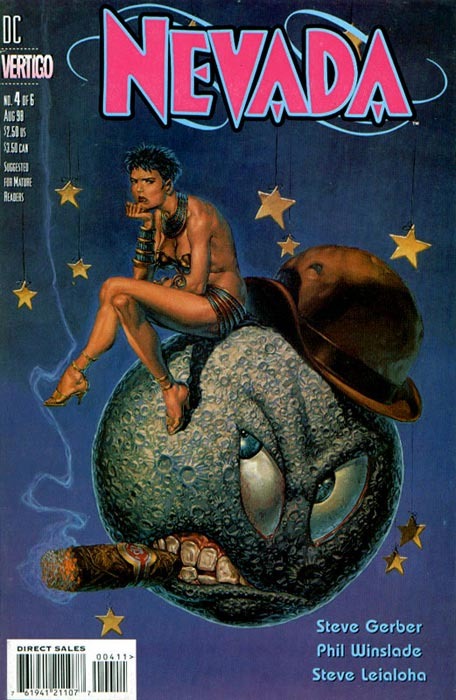
Nevada (1998/ Collected 1999)): written by Steve Gerber; illustrated by Phil Winslade, Steve Leialoha, Dick Giordano, and others: Steve Gerber was one of the great Marvel writers of the 1970's, a quirky member of a new wave of comics writers who'd grown up on Marvel's blend of superheroism and pop psychology and wanted to make superhero comics more literate and 'adult.' 

His greatest popular success was his own creation (along with artist Val Mayerik) -- Howard the Duck, terribly botched by the movie and terrifically compelling when written by Gerber. But Gerber created Howard for Marvel, which meant that when he left Marvel, Howard stayed.

Gerber did a lot of compelling comic-book work over the subsequent decades, from a terrific in-continuity Superman miniseries (The Phantom Zone, 1981) to an abortive scifi epic originally pitched as a reboot of DC's Hawkman (Void Indigo) to a host of other often short-lived titles. 

Nevada supposedly sprung from a brief incident in a 1977 Howard the Duck story in which a chorus girl who works onstage with an ostrich fights a "killer lampshade." Some time in the 1990's, Neil Gaiman supposedly asked Gerber when he would go into this story in more depth. The six-issue DC/ Vertigo miniseries Nevada was the result.

It's a typically atypical Gerber story, mostly self-contained but clearly designed to allow for a sequel or a regular series that never happened. It's set in Las Vegas. There's a chorus girl and her dancing ostrich, a mysterious homeless man, a guy with what looks like a Lava Lamp for a head, a laser beaming a message from outer space into the security system of a casino, a series of strange locked-room murders, and some extremely cosmic vistas and philosophies. Gods and angels fight in the skies over Las Vegas. Well, gods and angels from the human POV.

It's a solid piece of off-kilter Gerber genre-bending, ably illustrated by Phil Winslade in a manner that keeps the stranger concepts grounded in representational verisimilitude. The ostrich is a bit of a hoot. Recommended.

Saturday, December 9, 2017

The League Of Regrettable Heroes (2015) by Jon Morris

The League Of Regrettable Superheroes (2015) by Jon Morris: Jon Morris of the Gone&Forgotten blog does a terrific balancing act here, mocking and celebrating in equal measure some of the goofiest super-heroes in the history of American comic books. 

While the Golden Age (1938-1954) supplies such non-luminaries as the Red Bee, The Black Dwarf, and Doctor Hormone, the book also presents some of the most ridiculous heroes from other eras. 

AKA X-Poochie
The mullet-ridden, EXTREME 1990's provides such unfortunate decisions as Marvel's Adam X-the-Extreme (probably not coming to a Marvel movie any time soon, though there's always Agents of S.H.I.E.L.D.!) and Ravage 2099 (don't ask). 

Earlier decades gave us Marvel truck-driving hero U.S. 1 and DC's dadaistically ridiculous 'New Look' Blackhawks and the Metamorpho-wannabe Ultra the Multi-Alien.

CTE forced an early retirement
Those were the days.

Most of these heroes had fairly short runs, demonstrating that the marketplace sometimes knows what it's doing. Some are absurdly offensive (Mr. Muscles conquers polio by working out a lot). Some are awesome and recognized as such (Joe Simon's Prez got a terrific return appearance in Neil Gaiman's Sandman in the early 1990's). 

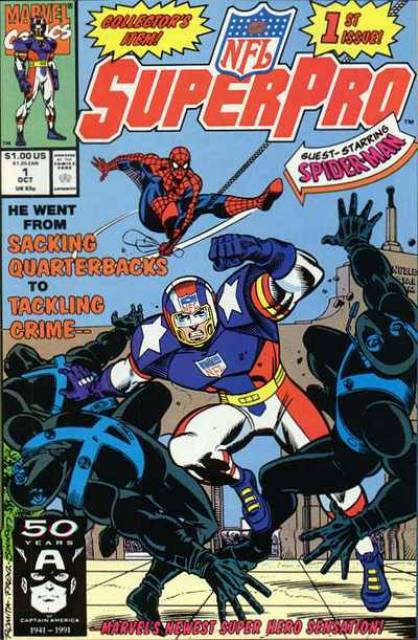
Some have even moved into the mainstream (Steve Ditko's hilarious Squirrel Girl). Some are truly screwed-up product advertisements (Marvel's NFL Superpro, who really deserved a crossover with Marvel's Kickers, Inc., a team of crime-fighting professional football players). 

There's now a second volume of this focusing on goofy super-villains. I'll have to pick that up. In any case, hours of fun and education make this Highly Recommended.

Monday, August 14, 2017

Ten Graphic Novels for People Who Don't Read Comics

There are dozens of others that could fit this list. Note that I avoid super-heroes and their fellow travelers science fiction, fantasy, and horror in this list because all these things put some people off.

---


Louis Riel by Chester Brown
---


Stuck Rubber Baby by Howard Cruse

---


Kings in Disguise by James Vance and Dan Burr

---


Maus by art spiegelman

---


American Splendor by Harvey Pekar and many artists

---


The Book of Genesis by God and Robert Crumb

---


Palomar by Gilbert Hernandez

---


Can't Get No by Rick Veitch

---


From Hell by Alan Moore and Eddie Campbell

---


Signal to Noise by Neil Gaiman and Dave McKean


-30-

Friday, May 27, 2016

And Rex Hamilton as Moby Dick

The Unwritten: Apocalypse (2014-2015): written by Mike Carey; illustrated by Peter Gross, Dean Ormiston, Yuko Shimuzo, and others: And so Mike Carey and Peter Gross' grand, meta fantasy comic-book series comes to its 12-issue conclusion. It's magnificent and funny and clever, and if you haven't read the rest of The Unwritten, you should start there before coming to the end.

Writer Wilson Taylor spent decades trying to create a human being who straddled the worlds of Story and Reality. That was Tom(my) Taylor, his son whose namesake is the young magician-hero in a series of insanely popular children's books written by Wilson Taylor. Why? 

Well, that's what a lot of The Unwritten was about. But in Apocalypse, Tom must finally use his strange powers to save the world from collapsing into an endless series of pocket-realities, or perhaps even complete oblivion. Why? 

Because the great beast Leviathan, living repository of all of humanity's stories, is dying. As it dies, it bleeds stories into reality. The world is disintegrating into a battlefield of narratives. And all this, ostensibly, because the man known best as Pullman wants to die. Pullman is the first villain of humanity's stories. And because he's become an archetype, he cannot die. This really pisses him off. For Pullman to die, humanity has to die. So what?

Our stalwart heroes Tom, Liz Hexam, vampire-journalist Richie Savoy, and a few others must figure out how to stop Pullman's plans and buy Leviathan time to heal. To do so, they'll quest through the shifting landscapes of Story now erupting into London, England. 

Main artist Peter Gross gets tested to the limit by the various artistic styles required to depict everything from Medieval Romance to 21st-century children's books to the events of Moby Dick. And he's great, though his fine, clean cartooning for the 'baseline' world of Tom and friends remains my preferred mode. He's been terrific for the entire run of The Unwritten. So too cover artist Yuko Shimuzo.

To save both Reality and Story will require unlikely allies (Mr. Bun? Madame Rausch?). It will take the stories to the den of the Inklings, and to the haunts of anthropomorphic animals, and to the carnage of London under siege by a seemingly infinite array of fictional beings. 

It's all thoughtful, sometimes sad, often funny. Comparisons to that other long-form fantasy comic series about Story, Neil Gaiman's Sandman, are apt. Carey is a lighter, funnier writer than Gaiman, however -- they may have similar bone structures, but the two series nonetheless look a lot different on the surface. The conclusion of this story is utterly apt, clever, and possessed of that white whale from "the only book where the whale wins." Read the rest of The Unwritten and then read this, and you'll understand why it's Highly Recommended.

Wednesday, March 9, 2016

Fortissimo


J.H. Williams III channels Peter Max

The Sandman: Overture: written by Neil Gaiman; illustrated by J.H. Williams III and Dave Stewart (2015): I started reading Neil Gaiman's career-making Sandman series when it first started appearing in monthly comic-book form back in the late 1980's. And I don't recall ever wondering much about what this prequel details: what happened just before the events of the first Sandman to result in the Sandman returning home weakened from a trip across the universe?

The Sandman, mostly known in the series as either Morpheus or Dream, is one of seven Endless in Gaiman's conception -- god-like siblings who supervise seven conditions of existence (Dream, Death, Destiny, Delirium/Delight, Desire, Despair, and Destruction). The original series followed Morpheus over about 2000 pages of comics prior to ending in 1995. Subsequently, Gaiman has written 'side' pieces (among them Endless Nights, seven stories about the seven Endless; The Dream Hunters, an illustrated text novel in which Morpheus is a supporting character) but no continuations or major additions to the main Sandman story. 

But to mark the 20th anniversary of the end of the original Sandman, Gaiman and artist J.H. Wiliiams III created this six-issue miniseries, subsequently collected. It is a prequel, though the time-bending nature of the narrative means that it's also a sequel of sorts.

The book tells us what Morpheus was doing just prior to his fateful return to Earth that kicked off the events in Sandman #1. We meet hundreds of new characters. We visit, mostly briefly, with many characters we've seen before. And we encounter two characters I never thought existed prior to Overture: the mother and father of the Endless. 

All of this is rendered by the meticulous, cosmic J.H. Williams III, whose high point in wild, dense, expansive comic-book art comes on Alan Moore's Promethea. Williams throws an explosion of carefully chosen styles and some extremely complicated panel lay-outs at us throughout the pages of Overture. At points, the art really overwhelms the narrative. 

I'm not sure that's entirely a good thing. Gaiman had many fine artists on his original Sandman run, but they tended to support the narrative with relatively standard panel progressions and page-to-page continuity. In Overture, the reader deals with a wide variety of unconventional lay-outs, many of them confusing at first. Does it work? Does it serve the story? Not always. The 'tooth' lay-out associated with the Corinthian (I'm not explaining this!) in the first chapter is probably the lay-out that most pushes the boundaries of ridiculousness for the sake of being startling, though there are others.

But boy, the art is gorgeous and complicated and multi-vocal. There's an 'artist's edition' that renders all the text of Overture translucent so as to foreground the art even more, if you want that sort of thing. 

Overture is relatively essential to anyone who loves The Sandman or who enjoys the boundary-pushing art of J.H. Williams III. It's lovely stuff, though the art overwhelms the smaller charms of the narrative throughout. This foregrounds the fact that the original Sandman thrived on its smaller charms of characterization and description -- especially once Overture becomes the most apocalyptic story ever told by Gaiman about Morpheus. 

The resolution of that apocalypse depends on one character from the original run revealing major new depths, a minor character gaining a new plot function, and lessons to be learned from a couple of the old Sandman stories. I'm not sure how well these things work for one who hasn't read the original stories (or who has forgotten them). But I'm not sure why someone would read Overture without having read everything else Sandman-related first. This is a prequel that needs to be read after everything else, not before. 

Overture's art is splendid. The narrative connects a few too many dots that might better have been left unconnected -- there's a 2010 feeling to certain scenes and revelations. Still, far from being some sort of failure. Recommended.

Thursday, January 28, 2016

One Bad Rabbit, Furnished in Relatively Early Gaiman

Free Country: A Tale of the Children's Crusade: written by Neil Gaiman, Toby Litt, Jamie Delano, Alisa Kwitney, and Rachel Pollack; illustrated by Chris Bachalo, Peter Snejberg, Peter Gross, Mike Barreiro, Al Davison, and others (1993-94/2015/Collected 2015): DC's adult-oriented fantasy comics line Vertigo tried its first line-wide crossover in the early 1990's. As Neil Gaiman notes in his introduction to this volume, no one really knew how to do such a thing. The result was a special event with a beginning and an end but a confusing and disjointed middle.

In this volume, Gaiman and company work to give Free Country: A Tale of the Children's Crusade a workable middle and a partially rewritten end so that everything holds together. I think they succeed, thus giving a 'lost' Gaiman comics story a new life in a collected edition.

The original structure of Free Country: A Tale of the Children's Crusade saw beginning and ending chapters published in two extra-length Free Country comic books, while the middle of the story appeared in several of Vertigo's ongoing comics that included Animal Man, Swamp Thing, and Black Orchid. Gaiman's Dead Boy Detectives (boy ghosts who elected not to go to the afterlife), who first appeared in Gaiman's A Season of Mists story arc in The Sandman, drive the plot as they accept a job to find a young girl's missing brother. He went missing along with everyone else in his English village. Why? Well, therein lies the story.

And really, what an enjoyably dense and epic story it is. Writers Neil Gaiman, Toby Litt, Jamie Delano, Alisa Kwitney, and Rachel Pollack mesh together quite wonderfully -- their individual voices remain distinctive without being jarringly discordant. 

The art duties are primarily handled by pencillers Chris Bachalo, Peter Snejberg, and Peter Gross. They work well together, as all are able cartoonists who can lightly depict the realistic while also doing fine work with the more fantastical artistic elements. And all of them do one sinister talking rabbit!

The story weaves together the history of the real Children's Crusade with mythology, folklore, and the particular fictional mythologies of the various comics involved in the crossover. The Dead Boy Detectives, on what I believe is their first real case, are a humourous, sympathetic pair. The looming menace to all the Earth's children gives a horrific tone to some of the comic, as does the truly disturbing section devoted to that real Children's Crusade. It's a fine thing that Free Country: A Tale of the Children's Crusade has been restored and refurbished for contemporary consumption. Highly recommended.

Friday, October 9, 2015

Lovecraft Ascending

The Dream Cycle of H.P. Lovecraft: Dreams of Terror and Death (1995) by H.P. Lovecraft, containing the following stories (Publication dates in brackets):

Introduction: Concerning Dreams and Nightmares by Neil Gaiman: Enjoyable but light on context and somewhat glib. The volume could really use a historical overview of its contents to establish a context for the stories, along with both composition and publication dates for all the stories.


  • Azathoth (1922): Short prose poem/fragment.
  • The Descendant (1926) : Fragment.
  • The Thing in the Moonlight (1934): Fragment.
  • Polaris (1920): It's an oddity all right, one that could be sub-titled 'Angry Man Yells at North Star.'
  • Beyond the Wall of Sleep (1919): A scientific romance of multiple personalities got turned into a mostly unfaithful movie.
  • The Doom That Came to Sarnath (1920): Maybe the best of Lovecraft's short, moody Dunsanian horror stories. Introduces a precursor to the Deep Ones.
  • The Statement of Randolph Carter (1920): The first appearance of the closest thing to a recurring protagonist Lovecraft ever created. Has one of HPL's two most familiar, quoted and/or mocked concluding lines.
  • The Cats of Ulthar (1920): HPL loved cats and he let it show. And they would show up again to play a major role in the events of The Dream-Quest of Unknown Kadath.
  • Celephais (1922): Prose poem.
  • From Beyond (1934): Short horror story of perception. Turned into a sort-of faithful movie.
  • Nyarlathotep (1920): Short prose poem/fragment about the Herald of the Great Old Ones from ancient Egypt to a briefly imagined dystopic future.
  • The Nameless City (1921): That would be the lost desert city of Irem, which also figures in the Cthulhu Mythos.
  • The Other Gods (1933): Whimsical bit of Dunsanian fabulism and cosmic relativism.
  • Ex Oblivione (1921): Prose poem.
  • The Quest of Iranon (1935): Dunsanian fable.
  • The Hound (1924): Fairly straightforward horror story features two decadents and an unusual-for-HPL setting of Amsterdam.
  • Hypnos (1922): As much a nod to Poe's "The Facts in the Case of M. Valdemar" as it is a Dream-Cycle work.
  • What the Moon Brings (1922): Prose poem.
  • Pickman's Model  (1927): A straightforward horror story with elements that would be re-used in the Dream-Cycle short novel The Dream-Quest of Unknown Kadath, written the same year but published 16 years later. Has one of HPL's two most familiar, quoted and/or mocked concluding lines.
  • The Dream-Quest of Unknown Kadath (1943): HPL's oddest long work combines the soporific with the startling. Randolph Carter stars.
  • The Silver Key (1929): Randolph Carter again, exploring the Dream-lands.
  • The Strange High House in the Mist (1931): Demon-haunted Kingsport makes an appearance, though it's positively normal compared to its representation in "the Festival."
  • The Case of Charles Dexter Ward (1943): Unpublished for years after its composition, this short novel gave us "essential salts" and Lovecraft's most fully realized antagonist, Joseph Curwen. Certain sections approach a parody of overused tropes.
  • The Dreams in the Witch-House (1933): Horror story has ties to both the Dream Cycle and to the Cthulhu Mythos. Somehow turned into soft-core-porn horror on TV anthology Masters of Horror.
  • Through the Gates of the Silver Key (1934) by H. P. Lovecraft and E. Hoffmann Price: Price and Lovecraft collaborate on a continuation of the story of Randolph Carter, for whom friends and relatives now search. A lengthy section on four-dimensional, non-linear space-time is nearly essential to understanding where Alan Moore is coming from in similar sections in his Lovecraft-inspired Neonomicon.


Overall: Certainly not as strong a collection as one of HPL's later-period work would be, but still extremely strong at points, and necessary for understanding him as a writer. Highly recommended.

Tuesday, July 21, 2015

Horror Comix Anthologies: The Big Book of Taboo

Taboo Issue 4 (1990): edited by Stephen Bissette and Nancy O'Connor, containing the following comics: Text pieces, interviews, and bios by Steve Bissette with Jean-Marc Lofficier; Front cover by Moebius; Back cover by Brian Sendelbach; Frontispiece by Nancy O'Connor; "Dreaming And The Law" written and illustrated by Phillip Hester; "1963" illustrated by Dave Sim; Untitled written and illustrated by Charles Burns; "Babycakes" written by Neil Gaiman and illustrated by Michael Zulli; "Cholesterol" written and illustrated by D’Israeli"; "Davey’s Dream" written by Mark Askwith and illustrated by Rick Taylor; "Eyes Of The Cat aka Les Yeux Du Chat" written by Alejandro Jodorowsky and illustrated by Moebius (originally printed in France in 1978); "El Topo" written by Alejandro Jodorowsky and illustrated by Spain Rodriguez (originally printed in Europe in 1979);  "Retinal Worm" written and illustrated by S. Clay Wilson; "La Fugue {The Escape}" written and illustrated by P. Foerster;  "Blue Angel" written by Tim Lucas and illustrated by Steve White; "Morrigan Tales" written by Elaine Lee and illustrated by Charles Vess; "These Things Happen" written and illustrated by  Rick Grimes; "Neither Seen Nor Heard" written by L. Roy Aiken and illustrated by Mike Hoffman; From Hell, Chapter Three: Blackmail or Mrs. Barrett written by Alan Moore and illustrated by Eddie Campbell; From Hell Pin-Up illustrated by Alan Moore.

The fourth oversized paperback issue of the late, much-lamented Taboo contains a wealth of great horror and weird comics material. The high point is a reprint of Alejandro Jodorowsky and Moebius's 1978 collaboration "The Eyes of the Cat," a lengthy weird horror tale made up entirely of gorgeous and occasionally disturbing full-page panels by Moebius. Combined with interviews with the two, it makes for quite a treat. Spain Rodriquez's odd 'tie-in' to the Jodorowsky film El Topo completes this part of the package.

The rest of the anthology is excellent as well, from the third serialized chapter of Alan Moore and Eddie Campbell's epic graphic novel about Jack the Ripper, From Hell, to a horrifying bit of insect craziness from underground comix mainstay S. Clay Wilson. Elaine Lee writes a fascinating new-wave fairy tale illustrated by Charles Vess in his old-school, Hal Foster by way of N.C. Wyeth style. Most of the short pieces are genuinely horrific, and it's interesting to see relatively early, non-Sandman Neil Gaiman as illustrated by the fine, overlooked Michael Zulli, and very early Phil Hester writing and drawing. Taboo was very much cutting-edge horror for its time, and rewards reading now if one can find issues of it. Highly recommended.


The Big Book of the Unexplained: written by Doug Moench; illustrated by Russ Heath, Sergio Aragones, Brent Anderson, Joe Sacco, Steve Leialoha, and many others (1997): Another enjoyable entry in Paradox Press' 'Big Book of' series of single-author, multiple-artist comics anthologies from the 1990's. This foray into the world of UFO's, cryptids, and general all-around Fortean madness (indeed, a cartoon version of Charles Fort is our narrator) is fun stuff with a wide variety of artists working in a wide variety of styles to alternately creep the reader out and make the reader laugh while, perhaps, thinking a little, at least about the credulity of the human animal. Recommended.

Sunday, January 18, 2015

Bury the Lead

Last Vegas: written by Dan Fogelman; directed by Jon Turteltaub; starring Michael Douglas (Billy), Robert De Niro (Paddy), Morgan Freeman (Archie), Kevin Kline (Sam), and Mary Steenburgen (Diana) (2013): Relatively enjoyable, fairly tame senior-citizens' version of The Hangover gets aided by its top-notch cast. A number of scenes play like ads for Las Vegas, LMFAO, and Red Bull (to name three of the most blatant). Coming off cancer surgery, Michael Douglas looks haggard and about a decade older than everyone else in the cast. Lightly recommended.


Stardust: adapted by Matthew Vaughn and Jane Goldman from the novel by Neil Gaiman and Charles Vess; directed by Matthew Vaughn; starring Charlie Cox (Tristan), Claire Danes (Yvaine), Mark Strong (Septimus), Michelle Pfeiffer (Lamia), Robert De Niro (Captain Shakespeare), and Kate Magowan (Una) (2007): Somewhat loose adaptation of the Neil Gaiman novel originally and heavily illustrated by the great Charles Vess is a real charmer for those people looking for something to watch after watching The Princess Bride for the fiftieth time.

The cast is strong, and given enough decent lines and character bits to keep everything percolating in what may be a slightly too-long film. Michelle Pfeiffer is terrific as the arch-witch Lamia. Several transition scenes involving walking and riding are photographed pretty much exactly as these things are done in Peter Jackson's Tolkien movies, possibly in the hopes of tricking some people into thinking they're at a Lord of the Rings movie. The score also comes pretty close to Horner's LOTR score at points. I do wonder whether these things were done at studio insistence -- certainly the majority of the movie is lighter and cleverer than Jackson's Middle Earth. Recommended.


The Fisher King: written by Richard LaGravenese; directed by Terry Gilliam; starring Jeff Bridges (Jack), Mercedes Ruehl (Anne), Robin Williams (Parry), Amanda Plummer (Lydia), Michael Jeter (Unnamed), Tom Waits (Uncredited) (1991): Gilliam and LaGravenese's urban fantasy offers a sometimes sarcastic love letter to New York. Bridges, Ruehl, Williams, and Plummer all do terrific work, though only Ruehl (deservedly) won an Oscar.

Seen now, The Fisher King is a document of a much dirtier New York, one that hadn't yet had Times Square turned into a food court at Disneyland. Williams manages to modulate manic and melancholy as he did in few other movies, and Bridges is his usual Jeff Bridges self, making the acting appear too effortless and invisible for him to be recognized for how good it always is. He's probably the perfect fit for the role of a vain, self-centred, but potentially decent talk-radio shock-jock: he may be handsome, but he's not afraid to look awful in a variety of ways.

This is probably Gilliam's biggest commercial success (along with 12 Monkeys). He tones down his weirdness without ever losing it -- his vision of New York suggests the medieval at the right points, and not the shiny medieval, but the crap-covered ground-level world we laughed at in Monty Python and the Holy Grail. It isn't Gilliam's best film, but it's certainly his sunniest. Highly recommended.

Wednesday, December 17, 2014

Bringing Light

Lucifer Volume 9: Crux: written by Mike Carey; illustrated by Peter Gross, Marc Hempel, Ryan Kelly, and others (2005/Collected 2007): So we enter what amounts to the stretch run of Mike Carey and Peter Gross's Lucifer comic series. This version of Lucifer first appeared in Neil Gaiman's Sandman back in 1990. Carey would pretty much make him his own once the Lucifer series began in the late 1990's, to run 75 issues and assorted other miniseries and one-shots.

War now percolates across a number of dimensions, realms, and at least two universes. Who will be fighting whom, and why, is not quite determined in this volume. Things do look dire for Lucifer's home universe, where the prolonged absence of Yahweh has started to cause the universe to fall apart. 

In the universe Lucifer created earlier in the series, various natural and supernatural beings have begun to choose sides. In Hell, decisions must be made about who rules Hell, and how Hell should be ruled. Heaven is falling apart. Earth isn't in much better shape. And Lucifer's endgame remains unclear, though the events of the previous eight volumes seem to have given the Lightbringer a slightly less caustic sense of humour.

It's all surprisingly and fantastically written by Carey, with Peter Gross and Marc Hempel making the most fantastic things seem plausible and, at appropriate moments, surrealistically sinister. Highly recommended.


Lucifer Volume 10: Morningstar: written by Mike Carey; illustrated by Peter Gross, Michael Kaluta, Colleen Doran, Ryan Kelly, and others (2005-2006/ Collected 2007): War erupts. Creation continues to dissolve in the continued absence of Yahweh. The plan of the malevolent Deck of Cards, the Basanos (yeah, you read that right), comes to fruition. Hell gets re-organized on a non-judgmental model. All of Lucifer's plans come to a head. Fenris, the Big Bad Wolf of all creation, looks to destroy everything. And the role of half-angel Elaine Belloc, the daughter of the Archangel Michael, will finally be fully revealed. Lucifer, first known as Samael Lightbringer, isn't a good guy, but he's pretty much the universe's last line of defense against ultimate destruction. Go Team Lucifer! Highly recommended.


Lucifer Volume 11: Evensong: : written by Mike Carey; illustrated by Peter Gross, Michael Kaluta, Dean Ormiston, Jon J. Muth, Ryan Kelly, and others (2005-2006/ Collected 2007): War is over. Loose ends must be tied up. There's a new God on the Throne of Heaven, re-establishing Creation and preventing the dissolution of everything into primordial nothingness. And that God isn't Lucifer. He will tie up the loose ends he feels responsible for, before flying off into the Vasty Deep that is the Ancient Chaos that lies outside his particular universe. 

As a somewhat confusing bonus, this last volume include the standalone graphic novel Lucifer: Nirvana, which is not the grunge crossover you may be expecting. It came out in 2002, four years before the rest of the volume, but is somewhat confusingly placed last in the volume. It features some nice painted artwork from Jon J. Muth (Moonshadow), though I prefer the more traditional cartooning of regular Lucifer artist Peter Gross when it comes down to it. 

In all, a wonderful series from writer Mike Carey, Gross, and all the others who worked on it. We come full circle towards the end, with Lucifer's conversation with Dream from Neil Gaiman's Sandman retold from a slightly different POV, and with the knowledge of everything that happened after Lucifer emptied Hell and gave the keys to Dream. Also, the always entertaining Gaudium does some cleaning up in what amounts to the sub-basement of all religions. Highly recommended, though you'll now be fortunate enough to buy it new in five volumes, not 11.

Monday, August 18, 2014

Stephen Leacock, Sherlock Holmes, Boobies

The Improbable Adventures of Sherlock Holmes: edited by John Joseph Adams (2009), containing the following stories:

The Doctor's Case (1987) by Stephen King;
The Horror of the Many Faces (2003) by Tim Lebbon;
The Case of the Bloodless Sock  (2001) by Anne Perry;
The Adventure of the Other Detective  (2001) by Bradley H. Sinor;
A Scandal in Montreal (2008) by Edward D. Hoch;
The Adventure of the Field Theorems (1995) by Vonda N. McIntyre;
The Adventure of the Death-Fetch (1994) by Darrell Schweitzer;
The Shocking Affair of the Dutch Steamship Friesland (2005) by Mary Robinette Kowal;
The Adventure of the Mummy's Curse (2006) by H. Paul Jeffers;
The Things That Shall Come Upon Them (2008) by Barbara Roden;
Murder to Music (1989)   by Anthony Burgess;
The Adventure of the Inertial Adjustor  (1997) by Stephen Baxter;
Mrs Hudson's Case (1997) by Laurie R. King;
The Singular Habits of Wasps (1994) by Geoffrey A. Landis;
The Affair of the 46th Birthday (2008) by Amy Myers;
The Specter of Tullyfane Abbey (2001) by Peter Tremayne;
The Vale of the White Horse (2003) by Sharyn McCrumb;
The Adventure of the Dorset Street Lodger (1995) by Michael Moorcock;
The Adventure of the Lost World (2004) by Dominic Green;
The Adventure of the Antiquarian's Niece (2003) by Barbara Hambly;
Dynamics of a Hanging (2005) by Tony Pi;
Merridew of Abominable Memory (2008)  by Chris Roberson;
Commonplaces (2008) by Naomi Novik;
The Adventure of the Pirates of Devil's Cape (2008) by Rob Rogers;
The Adventure of the Green Skull (2008) by Mark Valentine;
The Human Mystery (1999) by Tanith Lee;
A Study in Emerald (2003) by Neil Gaiman;
You See But You Do Not Observe (1995) by Robert J. Sawyer.

Hugely entertaining and lengthy anthology, mostly consisting of reprints, of Sherlock Holmes stories from the two decades previous to the anthology's publication. Many of the stories involve either science fiction or the supernatural, hence the 'improbable' part of the title. That itself riffs on Holmes' famous quotation, "When you have eliminated the impossible, whatever remains, no matter how improbable, is the truth."

Some stories expand upon brief mentions of unchronicled cases in the original Holmes stories by Arthur Conan Doyle ("Merridew of Abominable Memory" by Chris Roberson and "The Shocking Affair of the Dutch Steamship Friesland" by Mary Robinette Kowal both reference the original mention in their titles). Others pit Holmes against the supernatural ("The Horror of the Many Faces" by Tim Lebbon, "The Adventure of the Antiquarian's Niece" by Barbara Hambly, and "A Study in Emerald" (2003) by Neil Gaiman memorably riff on H.P. Lovecraft's brand of cosmic horror).

Writers also bounce Holmes off the works and characters of other writers ("The Things That Shall Come Upon Them" by Barbara Roden puts Holmes into a sequel of sorts to the classic M.R. James ghost story "Casting the Runes") or Doyle's own non-Holmesian works ("The Adventure of the Lost World" (2004) by Dominic Green). Mrs. Hudson and Doctor Watson get chances to solve crimes before Holmes does. Alternate worlds and science-fictional devices appear. Conan Doyle himself appears as a character. Holmes' childhood and college years are speculated upon, as is his family history. He even teams up with Stephen Leacock! In Canada!

There are a few duds here, but very few. One doesn't need to be a Holmes expert to enjoy the stories, and a concise history of Holmes included in the volume will aid those with too little knowledge of the World's First Consulting Detective. Highly recommended.


The Witchcraft Reader: edited by Peter Haining (1969) containing the following stories: Timothy (1966) by Keith Roberts; The Witch (1943) by A. E. van Vogt; The Warlock (1960) by Fritz Leiber; All the Devils in Hell  (1960) by John Brunner; From Shadowed Places (1960) by Richard Matheson; One Foot and the Grave (1949) by Theodore Sturgeon; Broomstick Ride (1957) by Robert Bloch; The Mad Wizards of Mars (1949) by Ray Bradbury.

Another of the voluminous Haining's fascinating anthologies. At his peak, he seemed to be releasing one of these a week. OK, he wasn't THAT prolific. Still, his selections are often immensely valuable because they're often way, way off the beaten path for this sort of thing.

The best character study here is John Brunner's  "All the Devils in Hell ." It's a marvelous exploration of a man in conflict with occult powers that ultimately can be opposed. Fritz Leiber's story puts a modern spin on witchcraft, while Robert Bloch's story deals with ancient witchcraft during a future era of interstellar travel. It's a solid little anthology. Also, there are naked boobies on the cover of the paperback. Huzzah! Recommended.
Saturday, September 7, 2013

A Game of Hellboy

Hellboy: Masks and Monsters: written by Mike Mignola and James Robinson; illustrated by Mike Mignola, Scott Benefiel, and Jasen Rodriguez (Collected 2009): Short volume collects two Hellboy miniseries team-ups with three other characters -- DC's Batman and Starman in one adventure and Dark Horse's own Ghost in the other.

A good time is pretty much had by all. Though I'm not familiar with Ghost -- a two-gunned female ghost fighting crime -- Hellboy's adventure with her makes a certain amount of sense given their supernatural backgrounds. Mignola's script presents an interesting mix of mythology and the mundane as organized crime gets mixed up with ancient gods who want Hellboy's giant hand for something nefarious. The art by Scott Benefiel, from Mignola's layouts, is fairly smooth, though perhaps a bit too representational for Mignola's blocky, occasionally impressionistic Hellboy.

The Starman/Batman team-up, plotted by Mignola and scripted by Starman's James Robinson, is really serious fun, with Mignola handling the art. Batman and Hellboy team up to fight magical Aryan Nation types in Gotham. With Batman temporaily sidelined by a re-appearance of the Joker, it's then up to Hellboy and second-generation Starman Jack Knight to rescue the Golden-Age Starman (who's also Jack's father Ted Knight) from a Nazi base in South America. There, the Nazis have supernaturally coerced Ted into helping them bring a very large, evil God back to Earth.

Oh, Nazis! Mignola's Batman is shadowy and bulky, while his Starman is quite a change from the more representational art generally seen in Jack Knight's own title. The whole volume goes down nicely, and is also an enjoyable break from the increasingly labyrinthine continuity of Hellboy's own adventures. Recommended.


The Sandman Volume 5: A Game of You: written by Neil Gaiman; illustrated by Shawn McManus, Colleen Doran, George Pratt, Stan Woch, Dick Giordano, and Bryan Talbot (1991-92): The fifth volume of Gaiman's now twenty-year-old+ Sandman adventures presents a mostly self-contained tale concerned with gender, identity, race, and childhood dreams. Minor characters from previous story arcs do reappear here, along with the Lord of Dreams and his attendant (wise)-talking raven Matthew.

The six issues focus on one minor character from an earlier story arc, Barbie, whose previous encounter with the world of the Dreaming destabilized her marriage to Ken (!), along with her own carefully constructed self-image, and sent her to New York to figure out who she is. That previous interaction with the world of Dreams also had an unintended consequence. She's stopped dreaming.

However, somewhere in dreams, a ragtag group of talking and sometimes imaginary animals continue to search for the vanished Princess Barbara, who is the only person who can defeat the all-devouring Cuckoo and its conquering hordes. But she's going to need the help of her neighbours -- the lesbian couple Hazel and Foxglove, the transvestite Wanda, and the mysterious Thessaly -- to negotiate an increasingly unstable fantasy world.

The real world and the dream world are, of course, connected, in both obvious and less-than-obvious ways. Things do not necessarily go well for everyone involved in this adventure, with its echoes of Narnia and Tolkien and The Wizard of Oz's game-changing tornado. We also learn an awful lot about the life-cycle of the cuckoo bird. Why did someone put these awful things in clocks to begin with? Recommended.

Monday, March 4, 2013

Fox Hunt

Sandman: The Dream Hunters: written by Neil Gaiman; illustrated by Yoshitaka Amano (1999): For the tenth anniversary of the first issue of his critically and commercially gigantic Sandman comic-book series (which ended its run in 1995), writer Neil Gaiman wrote a novella set in the Sandman universe and illustrated by acclaimed Japanese artist Yoshitaka Amano. It's not a comic book, but rather an illustrated story, as Amano wasn't comfortable trying to draw a comic book.

We see several familiar characters again, chief among them Morpheus, also known as Dream, one of the seven Endless in Gaiman's comic book (the others being, circa 1989, Destiny, Death, Desire, Despair, Destruction, and Delirium, the last once having been Delight before something changed).

Set in medieval Japan, The Dream Hunters ostensibly retells a Japanese folk tale. Gaiman's afterword in which he somewhat puckishly and straight-facedly describes this (imaginary) folk tale led a lot of people to believe there really was a folk tale to begin with. There wasn't. That thinly veiled versions of DC Comics' Cain and Abel make an appearance, along with the Dream King's raven, possibly should have tipped people off.

The story begins with a bet between a fox and a badger about who can force a young Monk to abandon his lonely mountain-side shrine so that either the fox or the badger can live there. As foxes and badgers have considerable abilities in the realms of shape-changing and illusion, this is a bet it seems one or the other must win. But things don't go the way either plans.

It's a very enjoyable story, and Amano's illustrations offer a new look at Gaiman's Lord of Dreams and his kingdom. I do think that Gaiman is a better comic-book writer than a writer of prose, however, and P. Craig Russell's comic-book adaptation of this novella, from 2009, is superior to this work. In either case, one doesn't have to know the backstory of Sandman to enjoy the book. Recommended.

Wednesday, September 26, 2012

Land of Dreams

Sandman: The Dream Hunters: adapted by P. Craig Russell from a novella by Neil Gaiman and Yoshiaka Amano (2009): Writer-artist Russell adapted Neil Gaiman's illustrated 1999 Sandman novella into comic-book form to help celebrate the 20th anniversary of the first issue of Gaiman's hyper-popular Sandman series. The novella itself was released to celebrate the 10th anniversary of Sandman. What will the 30th anniversary bring?

Told as if it were an old Japanese folk story (it isn't, though Gaiman's afterword to the 1999 novella convinced a lot of people, including Russell, that it was), The Dream Hunters chronicles the adventures of a female fox, a young monk, and a magician searching for a cure for his chronic fear. It's set in a legendary Japan of animal spirits, demons, and witches. The Sandman himself -- Dream, or Morpheus -- plays a supporting role, as he periodically did in his own comic-book series. The narrative focus is squarely upon the fox and the monk.

Russell's art is pleasingly legendary in its own way, as sometimes cartoony and sometimes nightmarish demons rub shoulders with realistically rendered humans, a slightly anthropomorphic fox, and some truly horrible witches. Or are they oracles? Russell's faces are always expressive, that expressiveness the product of just a few lines properly placed.

The colouring by Lovern Kindzierski apparently tries to replicate the palette available to Japanese print-makers of a certain era. It's a lovely, muted wash of pastels and faded primary colours. Much of the wording remains Gaiman's, but Russell has done a fine job of selecting what to keep in language and what to render as art. All in all, this is a marvelous addition to the Sandman library, and worth owning whether or not one already has the novella. Highly recommended.

Wednesday, July 18, 2012

Best Spoken Underwater

New Cthulhu: The Recent Weird: edited by Paula Guran (2012) containing the following stories:

"The Crevasse", Dale Bailey & Nathan Ballingrud; "Old Virginia", Laird Barron; "Shoggoths in Bloom", Elizabeth Bear; "Mongoose", Elizabeth Bear & Sarah Monette; "The Oram County Whoosit", Steve Duffy; "A Study in Emerald", Neil Gaiman; "Grinding Rock", Cody Goodfellow; "Pickman’s Other Model (1929)", Caitlin Kiernan; "The Disciple", David Barr Kirtley; "The Vicar of R'lyeh", Marc Laidlaw; "Mr. Gaunt", John Langan; "Take Me to the River", Paul McAuley; "The Dude Who Collected Lovecraft", Nick Mamatas & Tim Pratt; "Details", China Mieville; "Bringing Helena Back", Sarah Monette; "Another Fish Story", Kim Newman; "Lesser Demons", Norm Partridge; "Cold Water Survival", Holly Phillips; "Head Music", Lon Prater; "Bad Sushi", Cherie Priest; "The Fungal Stain", W.H. Pugmire; "Tsathoggua", Michael Shea; "Buried in the Sky", John Shirley; "Fair Exchange", Michael Marshall Smith; "The Essayist in the Wilderness", William Browning Spencer; "A Colder War", Charles Stross; "The Great White Bed", Don Webb.

Editor Paula Guran's mandate here is focused -- the best Lovecraftian stories of the first 11 years or so of the new millennium. If there's a disappointment here, it lies in something that's only going to be immediately apparent to a reader who buys a lot of Lovecraft-influenced anthologies and collections.

However, as I imagine a high percentage of people who read this sort of thing do just that, I'll note the disappointment: too many stories taken from the same original anthologies (eight of the stories herein appear in just three other original anthologies) and a fairly significant overlap (four stories) with the 2011 anthology The Book of Cthulhu, the mandate of which was to collect Lovecraft-influenced stories from the last thirty years or so.

In a pinch, I'd suggest going with The Book of Cthulhu. Its overall quality is higher, though that's obviously a factor of a longer span of time to choose from. Furthermore, choosing a lot of stories from other anthologies strikes me as somewhat problematic -- I've got several of these stories in three anthologies already, a pretty heavy load for a story published in, say, 2008 to be carrying. This may indicate taste rather than laziness, but it feels like laziness. And a couple of the multiple stories from other anthologies really sort of stink. Others are a stretch for the anthology, especially for one with a big picture of Cthulhu on the cover.

Nonetheless, there are some corkers here, both too often repeated ("The Oram County Whoosit" is a terrific tale -- so terrific I've now seen it in three different anthologies) and relatively new to this anthology (the offerings from old pros Michael Shea and John Shirley are especially gratifying). Shirley's almost reads like a Cthulhu Mythos story semi-sarcastically supercollided with a Young Adult novel. Shea's story about Clark Ashton Smith's blobby toad-god addition to the Lovecraft pantheon (subsequently described by HPL in At the Mountains of Madness) is squishy and, thankfully, not the over-anthologized, excellent "Fat Face".

Neil Gaiman impresses with a Sherlock Holmes/Cthulhu Mythos crossover, but not only was it in a fairly high print-run anthology, the story also appeared on Gaiman's website free of charge for several years. China Mieville's terrific "Details" also appeared in an anthology that, ten years later, remains in print.

There's a problem of overfishing the same ponds over and over again. Ponds filled with the Deep Ones. What is it with all the stories about people who identify with Lovecraft's Deep Ones? Yeuch. Alan Moore was on to something with Neonomicon. Lightly recommended.

Tuesday, June 19, 2012

My Long Zombie Nightmare

Zombies: Encounters with the Hungry Dead, edited by John Skipp (2010) containing the following stories:

* ? Lazarus (1906) by Leonid Andreyev,
* ". . . Dead Men Working in the Cane Fields"(1929) by William B. Seabrook,
* The Return of Timmy Baterman (1983) by Stephen King,
* ? The Emissary (1947) by Ray Bradbury,
? A Case of the Stubborns (1976) by Robert Bloch,
* ? It (1940) by Theodore Sturgeon,
* Lie Still, Sleep Becalmed (2007) by Steve Duffy,
Bitter Grounds (2003) by Neil Gaiman,
* ? Sea Oak (1998) by George Saunders,
* The Late Shift (1980) by Dennis Etchison,
A Zombie's Lament (2010) by S. G. Browne,
Best Served Cold (2010) by Justine Musk,
The Dead Gather on the Bridge to Seattle (2010) by Adam Golaski
The Quarantine Act (2010) by Mehitobel Wilson
The Good Parts (1989) by Les Daniels,
Bodies and Heads (1989) by Steve Rasnic Tem,
* On the Far Side of the Cadillac Desert with Dead Folks (1989) by Joe R. Lansdale,
* Like Pavlov's Dogs (1989) by Steven R. Boyett,
* Jerry's Kids Meet Wormboy (1989) by David J. Schow,
The Visitor (1998) by Jack Ketchum,
The Prince of Nox (1992) by Kathe Koja,
Call Me Doctor by Eric Shapiro,
* The Great Wall: A Story from the Zombie War (2007) by Max Brooks,
Calcutta, Lord of Nerves (1992) by Poppy Z. Brite,
God Save the Queen (2006) by John Skipp and Marc Levinthal,
Eat Me (1989) by Robert R. McCammon,
We Will Rebuild (2010) by Cody Goodfellow,
Sparks Fly Upward (2005) by Lisa Morton,
Lemon Knives 'N' Cockroaches (2010) by Carlton Mellick III,
* Zaambi (2006) by Terry Morgan and Christopher Morgan,
The Zombies of Madison County (1997) by Douglas E. Winter,
Dead Like Me (2000) by Adam-Troy Castro.

Six months later and I'm finally finished this anthology. Now I know how the survivors of a zombie apocalypse feel. There are a number of good and/or historically relevant stories here. I starred them. There are a number of stories that I wouldn't classify as zonbie stories because while they feature dead people walking, I wouldn't classify 'dead people walking' as the sole determinant of zombieism. I question-marked those.

The rest run the gamut from perfectly OK to dreadful, but being a nice fellow, I didn't indicate which ones are which. I must say, I'm exhausted by boundary-pushing hyperviolence, especially when it's linked to sex. I just don't care and I'm not scared. There's a surprisingly low 'fun' level here. Zombies are serious business. So serious that I don't remember what half these stories were about. They've all vanished into the eternal slurry of the walking dead, of what the walking dead leave behind.

But you know what? Zombies aren't a horror trope that can support all that much seriousness or social commentary. I think George Romero's Dawn of the Dead beautifully shows how much heavy lifting the zombie can do, and how much that heavy lifting must be leavened with humour and pathos. Not recommended except for the zombie obsessive.

Sunday, April 15, 2012

Debts

Lucifer Volume 5: Inferno: written by Mike Carey; illustrated by Peter Gross, Dean Ormiston and others (2002): After his fight with the malign, supernatural card deck (!) known as the Basanos, Lucifer is weakened, many of his powers separated from him and stored in two lost feathers from his wings (double !). Challengers with vengeance on their minds are after him. He really needs to get back to the administration of the universe he created.

Oh, and Lucifer owes a debt to part-angel Elaine Belloc, a debt that he must repay by rescuing her stolen soul from the great areas of uncreated space known as the Mansions of the Silence. And there are, of course, other loose ends that involve the archangel Michael, the fallen cherub Gaudium, and the fate of the demon who killed Elaine.

Add in supernatural avenger Solomon (son of David), Loki, Yahweh, Mazikeen of the Lilim, and a standalone tale featuring a cancer-stricken convenience store owner and the surprisingly decent demon who frequents his store and you've got a collection. Recommended if one has read the books before this volume.

Thursday, March 8, 2012

Tarot of Terror

Lucifer Volume 4: The Divine Comedy: written by Mike Carey; illustrated by Peter Gross and Dean Ormiston (2002; collected 2003): Lucifer, based on the version of Lucifer in Neil Gaiman's earlier Sandman series, has succeeded in creating his own universe. Humans and supernatural beings have flocked there from God's universe through any one of thousands of portals, there to live by only two commandments: Thou shalt not worship any gods, and thou shalt not attempt to be worshipped as gods.

And things seem to proceed swimmingly.

But Lucifer has enemies and rivals. He also has allies, though he doesn't have any friends -- he's a self-involved jerk, which means readerly sympathy has to be built upon the supporting characters and, negatively, by showing that Lucifer's enemies are much, much worse than he is.

Carey, Gross, and Ormiston succeed in this task -- Carey's writing zips along, combining inventiveness with a quirky oddness of original creation; Gross and Ormiston are deft cartoonists, cleanly rendering a world of wonders and terrors both supernatural and natural. And the fallen Cherubim Gaudium really is cute in a gargoyley way as he complains his way across two creations.

Lucifer's chief opponent here is the Basanos, a sentient Tarot Card deck created as a malign twin of the Book of Destiny. The Basanos can see all possible realities and force the outcome they desire; Lucifer is powerful enough to shrug off almost any and all attacks imaginable. But we're dealing with a deck of cards here -- They/It have something up Their/Its sleeve(s). Highly recommended.

Wednesday, February 22, 2012

Live Twee or Die Hard

Poe's Children: The New Horror: An Anthology: edited by Peter Straub, containing the following stories:

The Bees by Dan Chaon
Cleopatra Brimstone by Elizabeth Hand
The Man on the Ceiling by Steve Rasnic Tem and Melanie Tem
The Great God Pan by M. John Harrison
The Voice of the Beach by Ramsey Campbell
The Body by Brian Evenson
Louise's Ghost by Kelly Link
The Sadness of Detail by Jonathan Carroll
Leda by M. Rickert
In Praise of Folly by Thomas Tessier
Plot Twist by David J. Schow
The Two Sams by Glen Hirshberg
Notes on the Writing of Horror: A Story by Thomas Ligotti
Unearthed by Benjamin Percy
Gardener of Heart by Bradford Morrow
Little Red's Tango by Peter Straub
The Ballad of the Flexible Bullet by Stephen King
20th Century Ghost by Joe Hill
The Green Glass Sea by Ellen Klages
The Kiss by Tia V. Travis
Black Dust by Graham Joyce
October in the Chair by Neil Gaiman
Missolonghi 1824 by John Crowley
Insect Dreams by Rosalind Palermo Stevenson

I'd like this anthology a lot better with 'horror' removed from the title, though what one would replace that word with could lead to some debate: several stories don't feature the supernatural, so that's out; ghosts don't appear in all the stories, so there goes 'ghost story.' Even The New Fabulists fails, despite the broad net of that term.

"The New Horror" seems to have started around 1980 for Straub, though several writers (Stephen King, Ramsey Campbell, and Straub himself, among others) have published careers that stretch back up to 15 years before that. Again, odd: there are at least two generations of writers here, maybe even three. 130 years after Poe, the title seems a bit odd as well, and unintentionally dismissive of those 130 years of horror between Poe's death and the appearance of the first story here.

And horror, no -- about half the stories here fail to horrify, terrify, gross out or (per S.T. Joshi) unnerve. And not just because I've read too much horror. Some of the choices -- maybe none moreso than Straub's choice for his own story -- simply aren't horror, though all the stories in this anthology are well written.

One of the strangely dominant modes here is the sort of dark, fantastical whimsy that John Collier and Roald Dahl, among others, were masters of -- perhaps the most acceptable literary form of the fantastic through much of the 20th century if one bases one's analysis on the slick magazines and what they tended to publish for decades on end. Neil Gaiman, Straub, Jonathan Carroll and a few others offer this sort of project, in which the whimsy can sometimes be smothered in twee, never moreso than in Kelly Link's "Louise's Ghost", a treacly, twinkly botch of a story.

King's uncharacteristic entry here -- I can't recall ever seeing it anthologized since its first appearance in 1984 -- is much better than I remember it, but still undercut by the sheer, well, whimsy of the basic premise. The fantastic element simply can't bear the weight of the story's exploration of madness and addiction. The story would be better without any nod to the fantastic.

I did enjoy many of the stories I'd never encountered before, even many of those that aren't really horror at all. But it's a darn peculiar anthology: peculiarly skimpy on contextual material, and peculiarly spotty in terms of satisfying the 'horror' portion of its title. Lightly recommended.

Thursday, November 17, 2011

The Verdict on Satan: Quite a Guy!!!

Lucifer Volume 6: Mansions of the Silence, written by Mike Carey, illustrated by Peter Gross, Ryan Kelly, Dean Ormston and David Hahn (2003; collected 2004); Lucifer Volume 7: Exodus, written by Mike Carey, illustrated by Peter Gross and Ryan Kelly (2003-2004; collected 2005): Mike Carey's version of Lucifer, created by Neil Gaiman in his Sandman series, almost seems like a conscious upping of the ante with Gaiman's award-winning title about Dream of the Endless. Dream wasn't all that likeable. Indeed, he was something of a jerk. Indeed, the whole series was in part about Dream coming to terms with the fact that he was a jerk in the self-pitying Byronic mode.

And here we have Lucifer, who is even more of an anti-hero, though a fascinating and shaded one, and definitely not one to be burdened by guilt or self-pity. In such a situation, one's sympathies will be engaged not by the titular protagonist but by the supporting characters, though Lucifer occasionally comes across pretty well simply because so many of his opponents are such monsters and assholes by comparison.

Lucifer gave up his kingship of Hell fairly early in the Sandman series, wandering the Earth for awhile before opening a night-club (aptly named Lux) in Los Angeles. But his out-sized ambitions returned, and by the time of these volumes he's created his own universe, apparently hoping to learn from the mistakes of his Father -- that is, God, or the Presence as he is generally called herein.

Mansions of the Silence depicts Lucifer's repayment of a debt to the human/angel hybrid named Elaine Belloc, who saved Lucifer's life in a previous installment but whose soul was subsequently kidnapped and dragged off into the eponymous Mansions, a vast expanse inhabited by various supernatural beings who have no interest in living in any of the codified afterlifes of the spiritual universe.

Belloc's soul has been used to bait a trap for Lucifer; he despatches a ragtag group of allies into the Mansions both to reveal the extent of the threat and to preserve the integrity of this spiritual space, at least until he retrieves Elaine. Lucifer's power is too great for the Mansions to support his presence -- if he enters them, the entire realm will quickly disintegrate.

The quest is weird and wooly, with lots of mythical overtones, undertones, and shout-outs to a wide assortment of world religions. Exodus then follows Lucifer's subsequent moves, and the fall-out from God's big announcement at the beginning of Mansions. Lucifer plays the hero, to an extent, in both volumes, though always for his own reasons -- reasons which are not entirely revealed at the time. He's a right bastard, but less so than any of the gods (or God) we meet, and Lucifer's creation seems remarkably benign and pleasant under the circumstances.

Carey deftly combines humour and pathos and the epic throughout both these volumes -- a 'mini-arc' about an odd and very sympathetic demon who spins webs out of emotions he steals from human souls is the stand-out in Exodus, a weird little heart-warmer about families and friendship. The art by Peter Gross and others is crisp throughout, expressively managing to convey menace, the Sublime and a pleasing level of cartoony humour at the appropriate moments with equal skill. Recommended.