
Showing posts with label cosmic horror. Show all posts
Showing posts with label cosmic horror. Show all posts
Wednesday, November 28, 2018


Sunday, November 25, 2018

Sunday, January 15, 2017

Monday, November 2, 2015
Nihilism For Marionettes

The Frolic • (1982)
Les Fleurs • (1981)
Alice's Last Adventure • (1985)
Dream of a Manikin • (1982)
The Nyctalops Trilogy, consisting of The Chymist • (1981), Drink to Me Only with Labyrinthine Eyes • (1982), and Eye of the Lynx • (1983)
Notes on the Writing of Horror: A Story • (1985)
The Christmas Eves of Aunt Elise: A Tale of Possession in Old Grosse Pointe • (1983)
The Lost Art of Twilight • (1986)
The Troubles of Dr. Thoss • (1985)
Masquerade of a Dead Sword: A Tragedie • (1986
Dr. Voke and Mr. Veech • (1983)
Professor Nobody's Little Lectures on Supernatural Horror • (1985)
Dr. Locrian's Asylum • (1987)
The Sect of the Idiot • (1988)
The Greater Festival of Masks • (1985)
The Music of the Moon • (1987)
The Journal of J.P. Drapeau • (1987)
Vastarien • (1987)
Songs of a Dead Dreamer first appeared in 1985 as Thomas Ligotti's first short-story collection. Its contents changed in different editions over the years. In this Penguin 'Double,' paired with Grimscribe, his second collection, Songs of a Dead Dreamer uses the same contents as the 2010 Subterranean Press edition.
Ligotti is a relatively unknown quantity outside horror fiction -- his biggest career exposure came as people on-line debated whether or not he'd been plagiarized in the first season of True Detective to supply Matthew McConaughey's Rust Cohle with all his best lines.
Prior to that, Ligotti was a mysterious figure. After that, he was also a mysterious figure. His reclusiveness isn't at the level of Pynchon or Salinger, but it's still remarkable in today's media-saturated age. His stories and essays tell the story. He doesn't write novels, though he has written one fairly long novella (My Work is Not Yet Done). He's certainly not for everybody, but then again, what writer is?
Ligotti's literary universe, already distinctly Ligottian early in his career, resembles something assembled in a laboratory from pieces of H.P. Lovecraft, Edgar Allan Poe, Franz Kafka, and Jorge Luis Borges. Then someone threw in an obsession with puppets, mannequins, and marionettes. Then someone set Phasers to Nihilism and roasted everything for about an hour. And that doesn't really describe his corpus all that well. He's got a more noticeable sense of humour than the four named authors, for one. Poe occasionally had a similar sense of humour in his blackly comic stories, but he didn't tend to exhibit that sense of humour in his horror stories. Ligotti often does.
But while there will always be attempts to classify Ligotti as Weird (including one by Weird spokesman Jeff VanderMeer in his clumsy, vague introduction to this Penguin volume), he's horror all the way down. His narrative structure and voice sometimes seem more Absurdist than horrific, but next to Ligotti, Kafka and other absurdists look like Pollyannas.
There are no happy endings in these stories. There aren't even any points where one can imagine that anyone, anywhere is happy, or fulfilled, or anything other than Totally Damned except when that person is fulfilled by doing terrible things to other people. The biggest positive moral triumph in any of these stories comes when a mind-blasted person manages to kill himself, leaving a "victorious corpse" as a rebuke to his nemesis, a nemesis which is in actuality the personification of the Universe as a malign chaos at eternal play with everything that composes its body. That's a happy ending.
For all that nihilism, the stories are exhilarating, witty, unique, intellectually challenging, aesthetically pleasing, and often bleakly hilarious. Ligotti riffs on predecessors such as H.P. Lovecraft and genre tropes such as vampirism at certain points ("The Cult of the Idiot" posits a cult devoted to Lovecraft's burbling, bubbling, atomic chaos of an idiot god Azathoth; "Alice's Last Adventure" bounces Lewis Carroll and Roald Dahl and several other writers off some very hard and unforgiving walls; "The Lost Art of Twilight" makes vampires both horrible and absurd).
Throughout, Ligotti offers short stories with enough Big Ideas to support entire novels. Ligotti may not write novels, but he certainly doesn't write miniatures. Stories such as "Vastarien" and "Les Fleurs" supply massive mythologies in Fun-Size form. And "The Frolic" presents one of the most annoying and tired of modern horror tropes, the antic and seemingly omniscient serial killer, in such a fresh and sinister way that in other hands it would have supported a trilogy.
"The Frolic" is the first story in the collection and it's a killer -- a serial killer who makes Hannibal Lecter and his ilk look like the tired pop contrivances that they are and a horror mostly implied that clutches the heart. "The Frolic" also showcases a relative rarity for Ligotti as 'normal' suburban characters are set off against the horror of the world. It could almost be a Charles Beaumont or T.E.D. Klein story except for the bleak, nihilistic cosmic vistas described by the serial killer.
Songs of a Dead Dreamer is an extraordinary collection, one that does indeed make one nervous about the realities of, well, reality. If your perfect model of horror runs to Stephen King (or John Saul, gods help you), then one should probably avoid this collection -- or buy it and shake yourself up. To lift Buzz Aldrin's phrase about the Moon, this is Magnificent Desolation. But Jesus, does Ligotti love puppets. Highly recommended.
Monday, October 19, 2015
Dragon's Domain

T.E.D. Klein is a Top-Ten American horror-writing talent despite his meager output: this novel; the four novellas collected in Dark Gods (1985); the novella The Ceremonies is based on, "The Events at Poroth Farm" (1973); and maybe 200 pages of ephemera. Horror readers sit and wait, hoping that second novel announced in 1985 will some day see publication.
The Ceremonies looms large for a number of reasons. It's beautifully written. Its allusions, intertexts, and interpolations of what sometimes seems to be the entire history of horror fiction are fascinating, keenly observed, and essential to the unfolding of the plot. The plot itself is expertly machined, building slowly until the climax explodes in the last thirty pages or so. The characterization of players minor and major is deft and witty and occasionally heart-breaking. The novel follows certain tropes and conventions while exploding others along the way. It's structurally and stylistically complex in an unshowy manner -- its use of three distinct, linked narrative streams in three different voices and tenses, for one, has thematic significance that only dawns on the reader gradually as the novel and its voices accumulate in one's head to increasingly disturbing effect. And it's capable of both cosmic uneasiness and gross-out horror, the latter used sparingly but to great effect, especially in the climactic scenes.
To appreciate The Ceremonies fully, one should read at least some of the texts it interacts with. But if one doesn't do so, one of the main characters labours away on a graduate English thesis on horror fiction throughout the novel. Along the way, we get his thoughts on texts ranging from The Castle of Otranto to The Haunting of Hill House. Some of these texts are important to the novel as a whole. All of the observations are, at the very least, interesting. Some are even hilarious. Because one can certainly agree with the protagonist's view that The Castle of Otranto sucks, or that Dracula stops being interesting once the novel exits Transylvania.
The protagonist of the novel, Jeremy Freirs, takes lodging on a farm near the small New Jersey town of Gilead for the summer in order to finish his M.A. thesis. His landlords are Sarr and Deborah Poroth, members of a small Christian sect that settled in the area more than a hundred years earlier. The sect bears some resemblance to the Pennsylvania Dutch or the Amish, though the Poroths have a truck and indoor plumbing. But it's not the Poroths or their sect or even Jeremy that are the real problem.
The real problem is something that waited in the surrounding woods for 5000 years to be born again, something that spent centuries clinging to a tree branch in the distorted heart of a section of the forest initially called by the adjacent Native Americans "The Place of Burning." No one ever lived there or near there until settlers started to encroach in the 19th century. Then the thing's waiting ended, along with its life, and the Ceremonies began. And even in the 19th century, the forested heart of darkness sat only about 50 miles from New York City.
Something beyond all measure fell into or broke through or seeped up into our universe; the novel leaves the thing's means of entry a "mystery." But the novel also suggests that the thing somehow also broke through into human mythology, folklore, rituals, stories, and even folk dances. Fragments of the rituals needed to resurrect the being hide in all these things, waiting to be reassembled and used so that the thing can be reassembled and reborn. Even a Coney Island Ferris Wheel and a grumpy cat fit into the Ceremonies.
One of the keen pleasures of The Ceremonies is its combination of mystery and precision. We're taken through various rituals and preparations and signs and portents. Strange, tarot-like cards are read. Complex ceremonies that must be followed with an anal-retentive attention to detail are enacted. But the mysteries of what awaits, of what will be done to the world and how it will change, remain to the very end of the text. At no time does Klein feel the need to have the ultimate antagonist of the novel deliver an expositional speech.
And even the acolyte of the antagonist remains vague and refreshingly unglib to the very end. And this henchman, Rosie -- this short, fat, seemingly jolly old man -- is one of the novel's many terrific creations. He's awful. He's also pitiful, but only in terms of what he was before he found himself in the wrong place at the wrong time, nearly 100 years before the main action of the novel takes place. The third-person description of his thoughts doesn't give us the exterior charm of so many antagonists, from Hannibal Lecter all the way back to Milton's Satan. We see Rosie from inside, a manipulative and remorseless engine of death. Well, death for all humanity. If humanity were lucky. Which it probably won't be if Rosie gets his way. There are worse things than death.
The indispensable references for the novel are several late-19th and early-20th-century stories by the Welsh horror-writer/mystic Arthur Machen. The novel's title refers to three sets of ceremonies named but never fully explained in Machen's (mostly) first-person tour de force "The White People"; Machen's novella is also discussed by Jeremy in the novel itself. A short, cryptic Machen piece called "The Ceremony" also adds to one's appreciation of the novel, as do Machen's "The Novel of the Black Powder" and "The Great God Pan." These are all in the public domain, and worth reading regardless of whether or not you read The Ceremonies.
But you should read The Ceremonies. You really should. It's both its own evocative, poetic, ruthless piece of horror and a terrific act of play with what sometimes seems to be every major horror and Gothic work ever written, either explicitly or implicitly. The Ceremonies rewards close and careful reading. It rewards multiple readings. And it has a killer inversion of a horror trope that horror readers will probably associate most with Stephen King's The Shining, as creatures almost never associated with goodness nonetheless ride to the rescue by accident, driven by instinctual fury, even as Nature itself comes under existential assault. Highly recommended.
Friday, October 9, 2015
Lovecraft Ascending

Introduction: Concerning Dreams and Nightmares by Neil Gaiman: Enjoyable but light on context and somewhat glib. The volume could really use a historical overview of its contents to establish a context for the stories, along with both composition and publication dates for all the stories.
- Azathoth (1922): Short prose poem/fragment.
- The Descendant (1926) : Fragment.
- The Thing in the Moonlight (1934): Fragment.
- Polaris (1920): It's an oddity all right, one that could be sub-titled 'Angry Man Yells at North Star.'
- Beyond the Wall of Sleep (1919): A scientific romance of multiple personalities got turned into a mostly unfaithful movie.
- The Doom That Came to Sarnath (1920): Maybe the best of Lovecraft's short, moody Dunsanian horror stories. Introduces a precursor to the Deep Ones.
- The Statement of Randolph Carter (1920): The first appearance of the closest thing to a recurring protagonist Lovecraft ever created. Has one of HPL's two most familiar, quoted and/or mocked concluding lines.
- The Cats of Ulthar (1920): HPL loved cats and he let it show. And they would show up again to play a major role in the events of The Dream-Quest of Unknown Kadath.
- Celephais (1922): Prose poem.
- From Beyond (1934): Short horror story of perception. Turned into a sort-of faithful movie.
- Nyarlathotep (1920): Short prose poem/fragment about the Herald of the Great Old Ones from ancient Egypt to a briefly imagined dystopic future.
- The Nameless City (1921): That would be the lost desert city of Irem, which also figures in the Cthulhu Mythos.
- The Other Gods (1933): Whimsical bit of Dunsanian fabulism and cosmic relativism.
- Ex Oblivione (1921): Prose poem.
- The Quest of Iranon (1935): Dunsanian fable.
- The Hound (1924): Fairly straightforward horror story features two decadents and an unusual-for-HPL setting of Amsterdam.
- Hypnos (1922): As much a nod to Poe's "The Facts in the Case of M. Valdemar" as it is a Dream-Cycle work.
- What the Moon Brings (1922): Prose poem.
- Pickman's Model (1927): A straightforward horror story with elements that would be re-used in the Dream-Cycle short novel The Dream-Quest of Unknown Kadath, written the same year but published 16 years later. Has one of HPL's two most familiar, quoted and/or mocked concluding lines.
- The Dream-Quest of Unknown Kadath (1943): HPL's oddest long work combines the soporific with the startling. Randolph Carter stars.
- The Silver Key (1929): Randolph Carter again, exploring the Dream-lands.
- The Strange High House in the Mist (1931): Demon-haunted Kingsport makes an appearance, though it's positively normal compared to its representation in "the Festival."
- The Case of Charles Dexter Ward (1943): Unpublished for years after its composition, this short novel gave us "essential salts" and Lovecraft's most fully realized antagonist, Joseph Curwen. Certain sections approach a parody of overused tropes.
- The Dreams in the Witch-House (1933): Horror story has ties to both the Dream Cycle and to the Cthulhu Mythos. Somehow turned into soft-core-porn horror on TV anthology Masters of Horror.
- Through the Gates of the Silver Key (1934) by H. P. Lovecraft and E. Hoffmann Price: Price and Lovecraft collaborate on a continuation of the story of Randolph Carter, for whom friends and relatives now search. A lengthy section on four-dimensional, non-linear space-time is nearly essential to understanding where Alan Moore is coming from in similar sections in his Lovecraft-inspired Neonomicon.
Overall: Certainly not as strong a collection as one of HPL's later-period work would be, but still extremely strong at points, and necessary for understanding him as a writer. Highly recommended.
Friday, May 10, 2013
The Darkest Part of the Woods by Ramsey Campbell (2002)
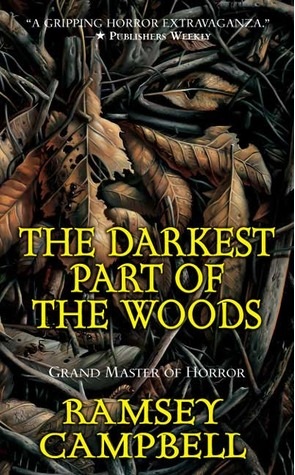
30 years prior to the main events of the novel, biologist Lennox Price attempted to discover and contain whatever psychoactive agent had been mentally crippling generations of people unfortunate enough to encounter it in the small, ancient grove of Goodmanswood in the Severn Valley near Campbell's fictional city of Brichester.
Lennox apparently succeeded, but at the cost of his own sanity. Now, he and other similarly compromised men and women live in a mental hospital in Goodmanswood. His eldest daughter, wife, and grandson live nearby.
But a widening of the highway around the wood -- and the destruction of several of the trees therein -- seems to have awakened something. Or maybe it was never asleep. And while his younger daughter, wife, and grandson all seem to have been mentally influenced by the wood, it's eldest daughter Heather who will ultimately have to piece together what's been going on in the woods since before the Romans came. Birds fly over the wood, but they refuse to land anywhere in it, and wildlife has always been strangely absent.
This is Campbell's most densely descriptive novel, one with a fairly straightforward plot but an immensity of destabilizing descriptions and things almost but not quite seen. The wood itself was planted by the Romans to obscure or erase something that was there before, something the people we call the Druids either worshipped or feared. Or both.
Campbell's cheeky sense of humour occasionally shines through -- there's a particularly funny bit about religious book-burning -- but for the most part this is serious stuff. As Heather discovers early on, the Devil was often placated by being referred to as 'The Good Man.'
Readers who require subtext will certainly find some here (some of the effects of the thing or things in Goodmanswood closely resemble global warming, while others evoke the impact of non-indigenous plant and animal species on new environments). But the horror here is ultimately the Thing itself, and the price required to acknowledge it, much less stop it. Highly recommended.
Thursday, August 23, 2012
Abyss Gazes Also

Barron works in the tradition of H.P. Lovecraft and Arthur Machen, but he brings to the cosmic tradition of horror his own muscular, cloachal, sadomasochistic vision of evil. Many of his stories take place on an Earth much like ours, only behind the walls lurk the horrifying emissaries and representatives of the Children of Old Leech.
There's much that's Cthulhian about Old Leech, a world-ravaging god-monster whose followers have a pronounced fondness for torturing and eating children. But many of Barron's stories center around the horror of metamorphosis -- the Children want some humans to become them and share in their terrible ecstasies. There aren't many heroes in Barron's stories, but there are a lot of victims, and a lot of normal people doing the best they can when faced with evil of sublime and abyssal gravity.
Barron also makes some truly bizarre forays into more traditional supernatural tropes here, but they're as distinctive as the tales set in the world of Old Leech. He's got the fearlessness and the distinctiveness of a truly great writer, and his horrors aren't quite like anything I've read before. And trust me, I've read a lot of horror. Highly recommended.
Tuesday, July 24, 2012
The Worms Crawl In

Many of Barron's stories share the same mythology, in which a race of cosmic horrors collectively known as the Children of Old Leech lurk in the lost places of the Earth, spiritually and physically feasting on humans while occasionally offering a small handful of people the "honour" of joining them. Technically speaking, the Leech are both endo- and exocolonists: they conquer from without and within, all in preparation for the day Old Leech itself wakes up hungry and devours the populations of whole planets. Which is what happened to the dinosaurs, among other lost Earth populations.
Yes, he's the feel-good writer of 2012!
The Croning is Barron's first novel, and it's a doozy. For the most part, the narrative follows hapless geologist Don Miller who, in the present day, is in his 80's and plagued by gaps in his memory that, when encountered, his mind scrambles to either explain or forget that such a discovery ever happened (he's even forgotten that he ever knew Spanish well enough to translate Spanish documents).
Don's uncannily young-looking wife of more than 50 years, Michelle Mock, has always pursued the anthropology and archaeology of "lost" tribes, periodically leaving Don for weeks or even months at a time. And as the narrative swings back and forth in time and space, we begin to see why Don's mind is so screwed up -- and why, despite his great love for Michelle, he also occasionally fears her.
The horrors here are indeed horrible, the worst coming from the failures of human morality when confronted by terrible tests. Barron weaves history and mythology and legend (including a crackerjack origin for the story of Rumplestiltskin) into this backwards-and-forwards-looking opus, presents the horrors of the flesh and the soul, and gives us scant light in the face of world-annihilating darkness. It's a brilliant debut, but not for the physically or philosophically squeamish. Highly recommended.
Subscribe to:
Posts (Atom)