
Showing posts with label las vegas. Show all posts
Showing posts with label las vegas. Show all posts
Monday, February 11, 2019


Monday, April 9, 2018
Nevada
His greatest popular success was his own creation (along with artist Val Mayerik) -- Howard the Duck, terribly botched by the movie and terrifically compelling when written by Gerber. But Gerber created Howard for Marvel, which meant that when he left Marvel, Howard stayed.
Gerber did a lot of compelling comic-book work over the subsequent decades, from a terrific in-continuity Superman miniseries (The Phantom Zone, 1981) to an abortive scifi epic originally pitched as a reboot of DC's Hawkman (Void Indigo) to a host of other often short-lived titles.
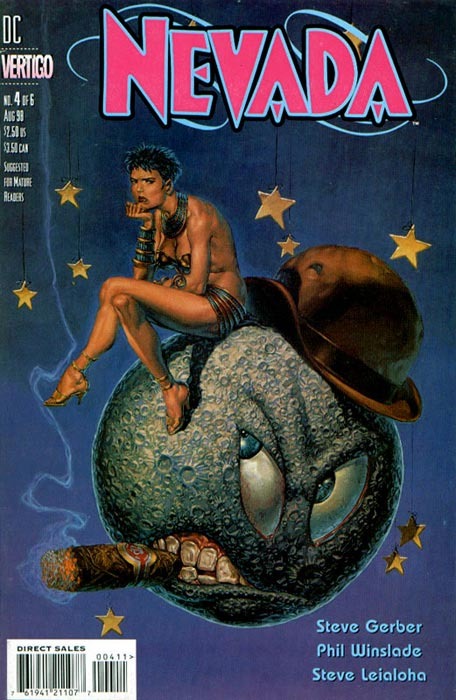
Nevada supposedly sprung from a brief incident in a 1977 Howard the Duck story in which a chorus girl who works onstage with an ostrich fights a "killer lampshade." Some time in the 1990's, Neil Gaiman supposedly asked Gerber when he would go into this story in more depth. The six-issue DC/ Vertigo miniseries Nevada was the result.
It's a typically atypical Gerber story, mostly self-contained but clearly designed to allow for a sequel or a regular series that never happened. It's set in Las Vegas. There's a chorus girl and her dancing ostrich, a mysterious homeless man, a guy with what looks like a Lava Lamp for a head, a laser beaming a message from outer space into the security system of a casino, a series of strange locked-room murders, and some extremely cosmic vistas and philosophies. Gods and angels fight in the skies over Las Vegas. Well, gods and angels from the human POV.
It's a solid piece of off-kilter Gerber genre-bending, ably illustrated by Phil Winslade in a manner that keeps the stranger concepts grounded in representational verisimilitude. The ostrich is a bit of a hoot. Recommended.
Tuesday, May 29, 2012
Adaptations and Mutations

Frankly, the Vincent role would be funnier (and truer to the original) if we had someone like Steve Coogan playing Vincent as an aging, occult-obsessed rock star suddenly faced with the real thing. Oh, well. Tennant does have a terrific smoking scene. But I'd still like to see an old rock star with a fetish for Aleister Crowley and The Lord of the Rings taking on the hounds of Hell. Wouldn't everybody?
The bare bones of the story remain the same as in the original: geeky Charlie Brewster comes to believe a vampire has moved in next door to him. Almost no one believes him, but he's right. Vampiric shenanigans ensue.
The movie cleverly moves the action to Las Vegas, where despite the anti-vampiric sun, there's lots of good eating in a town with a lot of itinerants and a large population of people who are already nocturnal due to their night jobs at the casinos and hotels. There's real wit in our first look at Charlie's subdivision, which seems to sit in the middle of an empty desert.
Yelchin and the other actors do nice work here, though the character of 'Evil' Ed gets shoved off-stage rapidly so as to focus more on Charlie's ass-kicking girlfriend Amy, played by hellacute Brit Imogen Poots (!). The always reliable Toni Collette, who now seems to be the go-to actress for American single moms, also gets to be a bit more pro-active on the vampire-fighting front.
Colin Farrell plays the vampire (incongruously named Jerry) as an Alpha Male thug, and it works nicely as a counterpoint to all those more refined vampires out there. Director David Gillespie stages some nifty setpieces, most notably a funny/scary car chase in which a realtor's sign makes a surprisingly welcome appearance. All in all, an enjoyable romp. Recommended.

I'd go with the first choice, as the tone, the atmosphere and even the performances would support such a view even if one didn't know that Guillermo del Toro had something to do with this.
Based on a 1973 TV movie that got del Toro interested in horror in the first place. Don't Be Afraid of the Dark features plucky, misunderstood 10-year-old Sally, a girl suffering through the divorce of her parents and, soon, persecution by tiny monsters living beneath the basement of the old New England house her father is renovating for profit.
Oh, it's Rhode Island -- that an H.P. Lovecraft allusion whether one wants it or not. Explicitly referenced in the film is Welsh fantasist Arthur Machen, whose stories often featured the monstrous real creatures behind the myths and legends (Machen's "The White People" and "The Shining Pyramid" are the two stories most relevant to this one). A doomed 19th-century painter and naturalist gets named (Ralph Waldo?) Emerson (Algernon?) Blackwood. Hoo ha.
The father is distant and somewhat thick (remember the fairy tale elements here or you'll obsess over stupid parents a bit too much), his new girlfriend sympathetic to Sally and, ultimately, an ally. The little, talkative monsters are a bit of a letdown -- they're basically Gollum crossed with a rat -- but occasionally scary, though if someone had the sense to buy a tennis racket, they'd be a lot less dangerous. Troy Nixey summons a lot of atmosphere and a real sense of place; the opening titles (directed, I assume, by someone other than Nixey) are stunning. Recommended.
Subscribe to:
Posts (Atom)