Showing posts with label marvel. Show all posts

Tuesday, February 4, 2020

Thanos: Titan Consumed (2018) by Barry Lyga


Thanos: Titan Consumed (2018) by Barry Lyga: Very enjoyable back-story for Thanos in the Marvel Cinematic Universe does a nice job of gradually making the Mad Titan unsympathetic after depicting his childhood and early adulthood as a time of isolation and sorrow. All this and we find out where and when Thanos gets the Mind Stone! Though Thanos' ultimate plan of killing half of the population of the universe to save it still doesn't make much sense, Lyga at least specifies that we're talking about the sentient population of the universe and not every virus, bacterium, and tree. Recommended.

Wednesday, July 31, 2019

Spider-Man: Far from Home (2019)

Spider-Man: Far from Home (2019): CAST AND CREDITS: The first post-Avengers: Endgame Marvel movie quickly skates over the ramifications of that movie's ending, which I think will soon be one of those 'Now let us never speak of those five years again!' things in upcoming Marvel joints. 

Tom Holland makes a good Peter Parker. Marvel has wisely emphasized Peter's mechanical and problem-solving genius, a welcome nod to Peter's status as a very clever fellow in the classic Steve Ditko/Stan Lee comics of the 1960's. Hey, that guy beat the Sandman with a goddam vacuum cleaner!!! 

Pretty much all the actors are charming, and Jake Gyllenhaal's Mysterio is a hoot. Even the tweaking of Mysterio's origin is funny yet convincing, though I sort of miss the idea of a character who was a visual and special effects movie guy. Maybe because he could have teamed up with Joe Simon and Jack Kirby's Stuntman. 

The whole thing plays like one of those Roger Moore James Bond movies where everything stays pretty light and jokey while Bond travels from country to country destroying priceless artifacts and occasionally landmarks. Recommended.

Tuesday, June 18, 2019

X-men: Dark Phoenix (2019)

X-Men: Dark Phoenix (2019): written and directed by Simon Kinberg; based on characters and situations created by Jack Kirby, Stan Lee, Len Wein, Dave Cockrum, Chris Claremont, John Byrne, and otrhers; starring James McAvoy (Professor X), Michael Fassbender (Magneto), Jennifer Lawrence (Raven), Nicholas Hoult (Beast), Sophie Turner (Jean Grey/ Phoenix), Tye Sheridan (Cyclops), Alexandra Shipp (Storm), Evan Peters (Quicksilver), Kodi Smit-McPhee (Nightcrawler), and Jesicca Chastain (Vuk):

X-Men: Dark Phoenix wasn't terrible. Certainly not enough for all the now-cliched Internet agita about it. Spoilers ahoy!

I wonder if it suffered at the box office in part because it uses Hollywood's ubiquitous Daddy-Daughter trope in a negative sense. Young Jean "Phoenix" Grey is abandoned by her father after Jean accidentally kills her mother because she hates the music Mom is playing on the car radio. Professor X chooses not to tell Jean that her father is still alive after the accident. This seems to me to be a good idea as Jean is only 8 and is traumatized. He slips up by never telling her as a teen or adult that her father is alive, but in his defense, Professor X is a busy man!

The main problem is that once Disney's acquisition of Fox was imminent, Disney clearly told Fox to change the ending of Dark Phoenix because it was similar to the ending of Captain Marvel -- Jean Grey was supposed to destroy a giant alien spaceship that had come to try to acquire the Phoenix Force for itself, saving the Earth and (seemingly) sacrificing herself in the process. This led to reshooting the climax a year after filming had originally ended.

The film-makers changed this woman vs. spaceship battle to a battle between the aliens on one side and the X-Men and human soldiers on the other side, all on a prison train. 

Because nothing says epic sci-fi confrontation more than a battle in and around the apex of 19th-century travel technology.

Of course, this led to an interesting plot hole. Is the spaceship still in orbit? Because the answer would seem to be 'Yes,' given that we saw the aliens come to Earth in the now obligatory meteorite-like landing pods.

So it goes.

Perhaps needless to note at this point, there's no Daddy-Daughter issues in the original comic book Dark Phoenix Saga. Jean's parents are loving and accepting of her mutant powers, and when she gains the Phoenix powers, the saga plays out as a cautionary tale about absolute power corrupting absolutely, along with self-sacrifice. Realizing that the Phoenix Force could never be controlled, Jean commits suicide. Or does she? That was a story for another day!

Lightly recommended.


Tuesday, May 7, 2019

Venom (2018)

Venom (2018): Venom created by David Michelinie and Todd MacFarlane; written by Jeff Pinkner, Scott Rosenberg, and Kelly Marcel; directed by Ruben Fleischer; starring Tom Hardy (Eddie Brock/Venom), Michelle Williams (Anne), and Riz Ahmed (Carlton Drake/Riot):

I guess it's good that the current superhero glut can result in even marginally offbeat projects based on Marvel and DC characters. Venom isn't a good movie, but it's intermittently fun, and the goopy creature effects are a far cry from most normal Marvel and DC movie fare.

In the comics, Venom was what happened when Spider-man's black-and-white alien symbiote costume he acquired in the Secret Wars event in the mid-1980's acquired a new host because it was driving Spidey crazy and he got rid of it. You may remember events like this from Spider-man 3. Yes, Venom has appeared in a movie before, its host Eddie Brock played then by Topher Grace.

Now Eddie Brock is a formerly heroic, now down-on-his-luck journalist in San Francisco who acquires the symbiote (or is acquired by the symbiote) while trying to resurrect his career by blowing the whistle on Riz Ahmed's mad billionaire scientist. Ahmed barely registers as an evil version of Elon Musk. Well, more evil. He torpedoed Brock's career because Brock discovered he was doing some crazy experiments on people who subsequently died.

The symbiote gives Eddie a wide, ill-defined range of superpowers along with a blobby covering that looks a lot like Spider-man because, well, Venom was a Spider-man suit in the comics. The suit likes eating human heads and Tater Tots. What larks, Pip!

Our lumpy, lumpen anti-hero eventually learns the value of human life and saves the world from some stuff. It seems like about 20 minutes of story has been cut that showed Venom's progress from head-eater to Earth-lover. Oh, well.

Tom Hardy is hilarious doing some insanely bad accent that's supposed to be... Brooklynese? I have no idea. Venom sounds like Tom Hardy doing a Keith David impersonation. Michelle Williams looks absolutely lost in a CGI-laden action movie. And Riz Ahmed, as noted, is barely there. 

This is not a good movie, but it's oddly charming and enjoyable enough to waste time with. And as it's technically part of the Spider-verse Sony still has rights to despite their NuX2 Spider-man movies now being part of the Marvel Cinematic Universe.... well, that astronaut is the son of J. Jonah Jameson, who in the comics became the werewolf Man-Wolf after visiting the Moon. I hope that happens in a subsequent Venom movie!!! Lightly recommended.

Saturday, March 30, 2019

Captain Marvel (2019)

Captain Marvel (2019): based on characters created by Stan Lee, Arnold Drake, Jack Kirby, Gene Colan, and many others; written by Nicole Perlman, Meg LeFauve, Anna Boden, Ryan Fleck, and Geneva Robertson-Dworet; directed by Ryan Fleck and Anna Boden; starring Brie Larson as Carol Danvers /Captain Marvel, Samuel L. Jackson as Nick Fury, Ben Mendelsohn as Talos, Jude Law as Yon-Rogg, Annette Bening as Supreme Intelligence/Mar-Vell, Gemma Chan as Minn-Erva, Lee Pace as Ronan, Mckenna Grace as Young Carol Danvers, Djimon Hounsou as Korath, and Clark Gregg as Agent Phil Coulson:

What's weird about Captain Marvel is that it's more like a Joss Whedon project than Whedon's two Avengers movies. Relentlessly light in tone, Captain Marvel is basically a buddy comedy featuring Carol 'Captain Marvel' Danvers and a young, mid-1990's Nick Fury, played by a CGI-youthanized Samuel L. Jackson. 

Disney seems to have spent all the de-aging CGI money on Jackson, as a de-aged Agent Phil Coulson (Clark Gregg) often looks like a nightmare from the Uncanny Valley.

This is the first Captain Marvel in the Marvel Cinematic Universe, though the Carol Danvers Captain Marvel is the third or fourth so-named hero in Marvel history (and not the original Captain Marvel -- that is the 'Shazam'-uttering Fawcett Comics hero soon to appear in a movie called Shazam; after DC acquired the rights to that Captain from Fawcett, they forgot to trademark the name, thus leading to Marvel debuting their then-male Captain Marvel in the late 1960's).

It's a mostly fun, light snack. It's overly long in the climax department, as pretty much every blockbuster now is these days, relentlessly ticking off items on a Checklist of Closure. Brie Larson is fine as the good Captain, though she's not given much to work with beyond a surface jokiness. Jackson seems to be delighted to be doing comedy work, as do Jude Law as Marvel alien Kree mentor Yon-Rogg and Ben Mendelsohn as the alien Skrull leader Talos. Recommended.

Saturday, January 12, 2019

Marvel 2016 Again!

Captain America: Civil War (2016): based on characters and situations created by Joe Simon, Jack Kirby, Mark Millar, Stan Lee, and others; written by Christopher Markus and Stephen McFeely; directed by Anthony and Joe Russo; starring Chris Evans (Captain America), Robert Downey Jr. (Iron Man), Anthony Mackie (The Falcon), Sebastian Stan (The Winter Soldier), Elizabeth Olsen (Scarlet Witch), Paul Bettany (The Vision), and Scarlet Johansson (Black Widow): 

Fast-moving, crowded film pits lots of Marvel super-heroes against lots of other Marvel super-heroes. The movie stays moderately zippy as it leaps from location to location. It also manages to bring Spider-man into the Marvel Cinematic Universe in fairly rousing fashion. Well, rousing if you enjoy seeing the increasingly dickish Iron Man practice child endangerment! It's really not a Captain America movie but rather a third (at the time) Avengers movie.

Black Panther gets introduced too, and ends up being one of the few voices of reason. All hail Wakanda!


Things go on about one super-hero battle too long, in part because the best part of the whole movie occurs during that second-to-last battle as the movie goes all-out comic book. Boy, though, the Vision's costume is terrible. If nothing else, the film suggests that Marvel's Damage Control comic, in which super-powered cleaners clean up the aftermaths of super-battles, should be turned into a movie franchise. Stat. Recommended.


Doctor Strange (2016): based on the character created by Steve Ditko; written by Jon Spaihts, Scott Derrickson, and C. Robert Cargill; directed by Scott Derrickson; starring Benedict Cumberbatch (Dr. Stephen Strange), Rachel McAdams (Rachel Palmer), Chiwetel Ejiofor (Mordo), Benedict Wong (Wong), Tilda Swinton (The Ancient One), and Mads Mikkelsen (Kaecilius): 

A bit of a boiler-plate Marvel Movie (think Iron Man with magic instead of technology and you've pretty much got it) enlivened by some ambitiously loopy visuals, albeit some of them riffing on Inception and not anything in the Dr. Strange comic books themselves.

The changes to Dr. Strange's character make him a twin for Robert Downey Jr.'s snarky Tony Stark. That's faithful to the original comics version of pre-magic Dr. Strange, not so much for post-magical-training Dr. Strange, possibly early Marvel's least quippy hero -- even Reed Richards (or Sue Storm, for that matter) got off more zingers than Dr. Strange in the 1960's. 

Created by writer-artist Steve 'Spider-man' Ditko, Dr. Strange's non-quippy gravitas probably makes him the Marvel character who would most benefit from a trade to DC Comics for, say, the Legion of Super-heroes.

Benedict Cumberbatch is fine as Dr. Strange, though his American accent is all kinds of weird. Chiwetel Ejiofor does nice work as a seriously reworked Mordo. Mads Mikkelsen plays the least interesting Marvel Movie villain since Mickey Rourke and Sam Rockwell in Iron Man 2. Rachel McAdams is stuck playing Natalie Portman in the Thor movies, only moreso.

The movie's visuals fail spectacularly at the end even as they also succeed admirably in translating Ditko's surreal comic-book visuals of the Dark Dimension into the movie world. To say that the visual redesign of Dr. Strange's greatest foe is regrettable is about the most praise I can offer. The poor bugger has been biggie-sized into a giant floating head that looks an awful lot like what would happen if you painted the Tron visuals for the Master Control Program onto an accordion.

As to the white-washing in regards to Asians... yep, one of Marvel's first prominent, 'good' Asian characters is no more. Doc's mentor, the ancient Asian known only as the Ancient One, is now the surprisingly spry Tilda Swinton, a.k.a. The Whitest Actress Ever. And the other tweaks made to the Ancient One's character don't help much either. 

In other areas, the magic training Strange endures now has all the length and rigor of selecting icons off a computer screen. Really, it makes the Harry Potterverse seem like a world teeming with educational rigor by comparison. Doctor Strange just has to make funky Kung Fu moves -- no pronouncement of spells required. 

And the mystical doodad Strange and friends need to travel through space-time? It's there to be dropped at a crucial moment, as these things always are. And it's called a 'Sling Ring,' thus recalling one of the lowest of low points in adaptations of Marvel comics to other media -- the laughable Thing animated show of the 1980's and the cry "Thing ring, do your thing!" On the bright side, the Wand of Watoomb makes a cameo and the Cloak of Levitation gains the personality of  loyal dog. Lightly recommended.

Saturday, January 5, 2019

Spider-man: Into the Spider-verse (2018)

Spider-man: Into the Spider-verse (2018): written by Phil Lord and Rodney Rothman; directed by Bob Persichetti, Peter Ramsey, and Rodney Rothman; starring the voices of Shemeik Moore (Miles Morales), Jake Johnson (Peter B. Parker), Hailee Steinfeld (Gwen), Mahershala Ali (Uncle Aaron), Brian Tyree Henry (Jefferson Davis - Miles' Dad), Lily Tomlin (Aunt May), Luna Velez (Rio Morales), Zoe Kravitz (Mary Jane), John Mulaney (Spider-Ham), Kimiko Glenn (Peni Parker), Nicolas Cage (Spider-man Noir), Kathryn Hahn (Doctor Octopus), Liev Schreiber (Kingpin), and Chris Pine (Spider-man): Whew!

Spider-man: Into the Spider-verse is an animated delight in both senses of the word. Its protagonist is Miles Morales, known to Marvel fans as the second Spider-man of the Ultimate comics universe and not known to pretty much anyone else. He gets a lot of help learning how to use his powers from a bunch of Spider-heroes sucked into his universe from other universes by a cosmic doohickey that nonetheless has a USB port because EVERYTHING HAS A USB PORT.

The Spider-characters are all drawn from different comic-book takes on Spider-man, from the original (Peter B. Parker here) to funny-animal Spider-Ham. Even with two major character deaths, things remain fairly light -- credit Lego Movie's Phil Lord for that. The whole thing is terrific fun and terrifically meta-fictional. 

The CGI character animation is clean and somewhat life-like without ever entering the Uncanny Valley, and the movie takes full advantage of the limitless possibilities of animation at many points. It's pretty trippy! And Kingpin's cartoonishly grotesque physique owes more than a little to the 1980's work of artist Bill Sienkiewicz.

All that and a worthwhile post-credits sequence. May Miles Morales get more movies! Highly recommended.

Saturday, June 16, 2018

The Ultimates Volume 1: Superhuman

The Ultimates Volume 1: Superhuman (2001-2002/ Collected 2002): written by Mark Millar; illustrated by Bryan Hitch and Andrew Currie: Long ago when the millennium was new, Marvel's Ultimates line rejuvenated Marvel's place in the comics marketplace after bankruptcy and creative stagnation. The Ultimate universe was a grittier, darker place than the 'normal' Marvel universe. And it was made with one eye towards movies.

The Ultimates was the new line's version of the Avengers. It was really, really pointed towards movies, with Samuel L. Jackson being paid so that Marvel could use his likeness as Nick Fury. Yep. Seven years before Jackson's first onscreen appearance as Nick Fury, he'd already been pen-and-ink Nick Fury for seven years!

One can see a lot of the Marvel Cinematic Universe in The Ultimates, obviously in Nick Fury and the idea that the Avengers were assembled by the government. Iron Man/Tony Stark is closer in personality to his movie version than the regular Marvel universe version. Hulk and Thor, not so much.

Oh, right. This is rapey, cannibalistic Hulk! Creepy stalker Bruce Banner! Wife-beating Ant Man! Mutant Wasp! Captain America is pretty much Captain America, though steroids now played a part in his creation. Indeed, the Hulk is also the accidental result of Bruce Banner's pursuit of a super-soldier formula.

Bryan Hitch's art is, well, widescreen, though there's also a lot of standing and talking. Writer Mark Millar, fresh off a popular, ultraviolent run writing DC-Wildstorm's The Authority, pretty much does the same thing here -- ultraviolence, snarkiness, and somewhat unlikable heroes. The comics readers of the time loved it! It all seems a bit dark and dreary now, especially all the stuff involving creepy Banner and cannibal rapist Hulk. What fun! Lightly recommended.

Saturday, May 5, 2018

Avengers: Infinity War (2018)

This scene may not be in movie.


Avengers: Infinity War (2018): written by everybody; directed by Joe and Anthony Russo; starring everybody: Mostly diverting, overlong superhero slug-fest struggles to balance bombast and quippiness and mostly succeeds. 

Visually and writing-wise, it's a huge step down from preceding Marvel movies that include Black Panther, Thor: Ragnarok, Ant-man, Spider-man: Homecoming, and Dr. Strange. It's a bit like eating mush made from cotton candy.

The plot thread starring Iron Man, Spider-man, and Dr. Strange is terrific. The Wakanda battle scenes make little strategic or tactical sense, and suggest that, among other things, none of the Avengers or Wakandans have ever seen Zulu

Or read about military battles after the invention of projectile weapons. Wait, didn't Captain America FIGHT in World War Two?

Thanos has been much-changed from his tirelessly malevolent comic-book self into a mournful giant who desperately needs a hug that he never receives. Maybe in Part Two! Lightly recommended.

Friday, April 20, 2018

Black Panther: Panther's Rage

One of many dynamic pages from Graham and McGregor

Black Panther: Panther's Rage (Marvel Epic Collection Volume 1) (1966, 1973-1976; collected 2015): written by Don McGregor; illustrated by Billy Graham, Rich Buckler, Gil Kane, Klaus Janson, and others: Jack Kirby and Stan Lee gave Black Panther life. Don McGregor and artists Rich Buckler and especially Billy Graham gave the character a soul. And note that the character predates the 1960's political movement of the same name by several months.

The recent Marvel movie used a number of elements from the McGregor-penned run included in this collection. Much is different, however. After reprinting the Black Panther's first two-issue appearance in Fantastic Four in 1966, this volume reprints McGregor's entire run on Black Panther from Marvel's Jungle Action comic book. What a ride it is!

The Lee/Kirby two-parter is fascinating insofar as it gives us an African superhero who rules over a seemingly backwater African nation that's actually a hive of super-technological sophistication. Beyond that, Black Panther is fairly boilerplate -- a noble fellow with a desire for revenge against white villain Ulysses Klaw. Still, the storyline is notable not only because the Black Panther is the first modern black superhero from a major comic-book company, but because Wyatt Wingfoot, a smart non-superhero Native American, saves the day in the first of the two Lee/Kirby issues. It's sort of a racial milestone for American superheroes.

McGregor's stuff is a whole different story. The mix of super-science and tradition remains in the Black Panther's country of Wakanda. McGregor's interests are such that Black Panther becomes a self-sacrificing, self-doubting character very early in the arc, with subsequent issues building on these attributes. 

This Black Panther had moved to America and joined the Avengers after his intro in FF; McGregor's work brings him back to a Wakanda that's grown turbulent in his absence. And Erik Killmonger (the villain of the movie as well) intends to wrest control of Wakanda from the Black Panther.

What follows is one of the longest sustained narratives in American superhero comic books to that point in the mid-1970's, one of the first true serialized graphic novels. Initial artist Rich Buckler does solid work. Once Billy Graham comes on board, the art really soars. And it's notable that Graham is one of the first African-American artists to work on a major publisher's superhero book.

Graham and McGregor are ambitious in their storytelling ambitions -- a variety of intriguing single and double-page compositions are just one way the art stands out. Graham is especially good at character work, faces and poses that make each character an individual. An issue inked by P. Craig Russell is especially fine as a horror story filled with grotesques.

The Black Panther's physical sufferings throughout McGregor's run, depicted and described in detail, cast him repeatedly in the role of a suffering Christ figure -- albeit a two-fisted Christ. I don't know that any mainstream superhero has had his suffering depicted in such detail. It ties into McGregor's ethos insofar as McGregor tempers the thrills of superheroics with repeated examinations of the physical and mental ramifications of Men in Tights walloping one another.

Erik Killmonger's plans ultimately occupy 13 (!) issues of Jungle Action. As Jungle Action was bimonthly, this first arc (titled Panther's Rage) went on for more than two years. Subsequently, McGregor and Graham send the Black Panther back to America to battle the KKK. Never let it be said that McGregor shied away from political and social issues. Alas, Marvel cancelled Jungle Action before the Klan storyline was over. It's still a bracing bit of storytelling. In all, highly recommended.

Saturday, December 9, 2017

The League Of Regrettable Heroes (2015) by Jon Morris

The League Of Regrettable Superheroes (2015) by Jon Morris: Jon Morris of the Gone&Forgotten blog does a terrific balancing act here, mocking and celebrating in equal measure some of the goofiest super-heroes in the history of American comic books. 

While the Golden Age (1938-1954) supplies such non-luminaries as the Red Bee, The Black Dwarf, and Doctor Hormone, the book also presents some of the most ridiculous heroes from other eras. 

AKA X-Poochie
The mullet-ridden, EXTREME 1990's provides such unfortunate decisions as Marvel's Adam X-the-Extreme (probably not coming to a Marvel movie any time soon, though there's always Agents of S.H.I.E.L.D.!) and Ravage 2099 (don't ask). 

Earlier decades gave us Marvel truck-driving hero U.S. 1 and DC's dadaistically ridiculous 'New Look' Blackhawks and the Metamorpho-wannabe Ultra the Multi-Alien.

CTE forced an early retirement
Those were the days.

Most of these heroes had fairly short runs, demonstrating that the marketplace sometimes knows what it's doing. Some are absurdly offensive (Mr. Muscles conquers polio by working out a lot). Some are awesome and recognized as such (Joe Simon's Prez got a terrific return appearance in Neil Gaiman's Sandman in the early 1990's). 

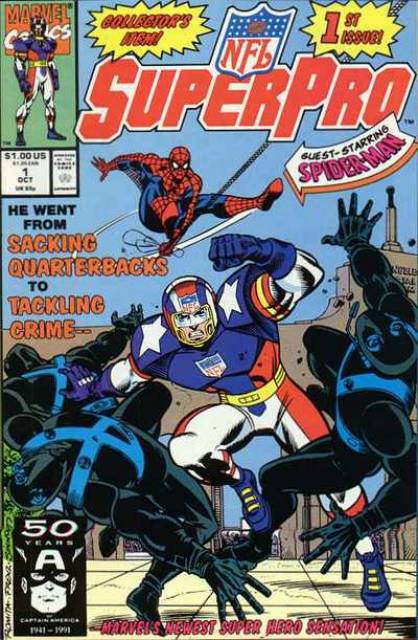
Some have even moved into the mainstream (Steve Ditko's hilarious Squirrel Girl). Some are truly screwed-up product advertisements (Marvel's NFL Superpro, who really deserved a crossover with Marvel's Kickers, Inc., a team of crime-fighting professional football players). 

There's now a second volume of this focusing on goofy super-villains. I'll have to pick that up. In any case, hours of fun and education make this Highly Recommended.

Tuesday, November 14, 2017

Thor: Ragnarok (2017)

Thor: Ragnarok (2017): based on characters and stories by Jack Kirby, Walt Simonson, Sal Buscema, Larry Lieber, Stan Lee, and others; written by Eric Pearson, Craig Kyle, and Christopher Yost; directed by Taika Waititi; starring Chris Hemsworth (Thor), Tom Hiddleston (Loki), Cate Blanchett (Hela), Idris Elba (Heimdall), Mark Ruffalo (Banner/Hulk), Tessa Thompson (Valkyrie), Jeff Goldblum (Grandmaster), and Karl Urban (Skurge the Executioner): Almost too jolly and jaunty an entry in the Marvel Movie Sweepstakes, given the death toll in the movie. Reducing Gotterdammerung to a punchline seems both too much and not enough.

Oh, well. Thor: Ragnarok is also the Marvel movie that looks most like the comic books it's based on, particularly Jack Kirby's 1960's work on Thor and Walt Simonson's writer-artist duties on his great Thor run of the 1980's. 

The tone is really more Simonson than Kirby -- there was a jocularity and a sense of the absurd to his run, though he was better than the film-makers at balancing the epic and the absurd. Full credit to director Taika Waititi, whose What We Do In the Shadows was an absurdly hilarious faux-documentary. 

The movie goes on about 15 minutes' worth of CGI battles too long. All the actors are as fresh and lively as in any Marvel production to date, and Cate Blanchett camps it up as super-villain Hela, whose crazy head-piece comes right off the Jack Kirby pages (so, too, the designs of many of the aliens in campy Jeff Goldblum's space-court, extras from Kirby's 1970's space-god saga The Eternals). Even Bruce Banner and the Hulk are funny. Recommended.

Friday, October 13, 2017

Avengers: Age of Ennui (2015)

Avengers: Age of Ennui (2015): based on characters created by Stan Lee, Jack Kirby, Joe Simon, Jim Starlin, Roy Thomas, John Buscema, and others; written and directed by Joss Whedon; starring Robert Downey Jr. (Iron Man/ Tony Stark), Chris Hemsworth (Thor), Mark Ruffalo (Bruce Banner/ Hulk), Chris Evans (Captain America/ Steve Rogers), Scarlett Johansson (Natasha Romanoff/ Black Widow), Jeremy Renner (Clint Barton/ Hawkeye), James Spader (Ultron), and a bunch of other people: 

Marvel Studios interfered with the production of the second Avengers movie so many times that Joss Whedon is now doing emergency surgery on DC's Justice League movie and developing a DC Batgirl movie. Yay! 

Avengers: Age of Ultron is a busy, crowded mess with plot holes one could fly the SHIELD helicarrier through. It's a good time-waster on TV because one can pause it every 45 minutes or so and because, as with the majority of Marvel Studios movies, it looks like the world's most expensive movie to have ever been shot on the same videotape used for 1970's Doctor Who episodes. Jesus, I hate the colour palette of most Marvel Studios movies. Lightly recommended

Saturday, April 1, 2017

The Sorrows of Young Warlock

Jim Starlin's Warlock: The Complete Collection (1975-77/ Collected here 2014): written by Jim Starlin; illustrated by Jim Starlin, Steve Leialoha, Josef Rubinstein, Alan Weiss, and Al Milgrom: The 1970's were a quirky age of growth for mainstream American comic books, with much of that growth occurring at the margins in a way we just don't see any more. Some of the greatest writers and artists mainstream comics have ever produced worked away on series that were mostly far from the big hitters like Spider-man and Superman

Names to conjure with included Bernie Wrightson, Howard Chaykin, Walt Simonson, Don McGregor, Steve Gerber and many others. And the great series of mainstream comics at DC and Marvel were either limited-run back-up strips (Archie Goodwin and Walt Simonson's brilliant, beautiful Manhunter at DC) or strange, genre-bending series located safely away from the normal mainstream universe (Don McGregor, P. Craig Russell and company's sprawling, poetic Killraven). 

And then there's Jim Starlin, a writer-artist who staked out his own peculiar corner of cosmic adventure. The only thing all that similar to Starlin's early 1970's Marvel work on Captain Marvel and Warlock was writer-artist Jack Kirby's gigantic, unfinished Fourth World saga over at DC. But where Kirby was ultimately obsessed with life (really, LIFE), Starlin was obsessed with death (DEATH). 

Having cut his cosmic teeth on Marvel's Captain Marvel in the early 1970's, Starlin would return to fringe heroes and outer-space sturm-und-drang in 1975 when he revived the Adam Warlock character. Warlock made his debut as a naive, genetically engineered superman known only as 'Him' in the pages of Jack Kirby and Stan Lee's Fantastic Four in 1967. Over the next few years, he'd gain the name Adam Warlock, have adventures on Counter-Earth, and fulfill his superheroic Jesus Christ arc by getting himself crucified and resurrected.

HIM! In his cocoon.
Returned to Marvel publication after a few years off (hey, everyone has to take time to recover from a crucifixion!), Warlock was now being written and penciled by Starlin, who never met a case of cosmic angst he didn't like. And Warlock would soon be the angstiest cosmic hero of all, easily surpassing the Silver Surfer for the number and rate of existential crises suffered during barrages of energy bolts and exploding stars. 

But it's fun. And very heavy metal (though not really Heavy Metal) in its adolescent mixture of self-loathing and super-powered punching. Starlin would bring the cosmically villainous Thanos over from his run on Captain Marvel, first as an unlikely ally for Warlock and then as a more likely antagonist. Nay, nemesis! For while Captain Marvel was a problem for Thanos, Warlock is his full-blown opposite: the Life Equation to Thanos' Anti-Life Equation, in terms of Jack Kirby's Fourth World comics for DC.

People talk a lot in Warlock. Boy, do they talk a lot. Starlin has learned to lighten things up a bit by giving Warlock a comic sidekick -- Pip the Troll -- and a female sounding board -- Gamora, played by Zoe Saldana in the Marvel Cinematic Universe.  Starlin's fascination with the Church (and specifically the Roman Catholic Church) as an institutional Evil shows up here, to later be expanded upon in his Dreadstar series. And he gives Warlock one of the most fascinatingly twisted enemies to ever appear in an ostensibly mainstream superhero comic: The Magus, about which no more said.

But it's the battle against Thanos that dominates much of this volume, as it should. It's probably good that Warlock got cancelled when it did, thus forcing Starlin to end the Thanos saga in post-cancellation Avengers and Marvel Two-in-One annuals. Otherwise, Warlock's suffering might have gone on forever. Instead, Warlock rallies the Avengers, Spider-man, and the Thing to his crusade against Thanos. It's a smaller scale version of what would happen 15 years later in Marvel's Infinity Gauntlet miniseries: everyone versus Thanos. And Starlin throws in some lovely twists along the way. It's good, clean, angsty cosmic fun in the Mighty Starlin Manner. Highly recommended.

Against Infinity

Jim Starlin's Captain Marvel: The Complete Collection (1968-82/ Collected here 2016): written by Jim Starlin, Gary Friedrich, Steve Engelhart, and Steve Gerber; illustrated by Jim Starlin, Al Milgrom, Dan Green, and others: The 1970's were a quirky age of growth for mainstream American comic books, with much of that growth occurring at the margins in a way we just don't see any more. Some of the greatest writers and artists mainstream comics have ever produced worked away on series that were mostly far from the big hitters like Spider-man and Superman

Names to conjure with included Bernie Wrightson, Howard Chaykin, Walt Simonson, Don McGregor, Steve Gerber and many others. And the great series of mainstream comics at DC and Marvel were either limited-run back-up strips (Archie Goodwin and Walt Simonson's brilliant, beautiful Manhunter at DC) or strange, genre-bending series located safely away from the normal mainstream universe (Don McGregor, P. Craig Russell and company's sprawling, poetic Killraven). 

And then there's Jim Starlin, a writer-artist who staked out his own peculiar corner of cosmic adventure. The only thing all that similar to Starlin's early 1970's Marvel work on Captain Marvel and Warlock was writer-artist Jack Kirby's gigantic, unfinished Fourth World saga over at DC. But where Kirby was ultimately obsessed with life (really, LIFE), Starlin was obsessed with death (DEATH). 

Starlin would cut his cosmic, thanatophiliac teeth on Marvel's version of Captain Marvel, a not-particularly-popular superhero from the alien race of the Kree. Starlin would give Cap cosmic awareness (whatever that was) and, most importantly, a new villain: Thanos, the "mad Titan," which is to say, a crazy member of the race of demi-god-like Titans living on, well, Titan, Saturn's largest moon.

Starlin initially intended Thanos to be an evil riff on Kirby's Fourth World demi-god Metron, which explains why Thanos spends so much of his early life sitting in a chair just like Metron in his Mobius Chair, a tendency that seems to have persisted into Thanos' early appearances in the Marvel Cinematic Universe. But Thanos soon grew into the Marvel Universe's biggest threat. Well, a big enough threat that Captain Marvel would have to enlist Iron Man, the Avengers and others of Marvel's mainstream heroes to thwart Thanos' plans.

In the Captain Marvel volume reviewed here, Captain Marvel and friends battle a number of Thanos' stooges before taking on the big man himself. The original Drax the Destroyer appears for the first time -- he'll be much mutated by the time the world sees him played by Dave Bautista in Guardians of the Galaxy. The object of Thanos' quest this time around is a Cosmic Cube, a doohickey from Stan Lee and Jack Kirby's 1960's Captain America comics that confers nigh-infinite power on its user. It's no Infinity Gauntlet, but it's helladangerous.

Besides the assorted comic space adventures and battles inside the mind that Starlin deploys to generally enjoyable effect, Captain Marvel also allows for a lot of superhero philosophizing. Starlin doesn't script a lot of these stories, so that philosophizing hasn't reached its apex yet. But Warlock is coming, and it will. Boy, will it ever. 

An omnibus of the Starlin Warlock and Captain Marvel stories would make a certain amount of chronological sense. The last piece in this volume is a reprint of Marvel's first 'graphic novel,' 1982's The Death of Captain Marvel. It's really a coda to Starlin's Captain Marvel and Warlock. Captain Marvel, retired to Titan for years, discovers that he has incurable super-cancer. Fun stuff!

The graphic novel does illustrate, literally, that with Starlin, less is more. Given more time to render the art in a more painterly style, Starlin's work ossifies into curious, stilted poses at certain points. One of his tics -- posing characters knees partially bent in an anatomically puzzling partial stoop -- becomes distracting whenever it shows up. Given more time to work on the faces, Starlin elongates everything below the eyes, another distracting oddity.

Still, The Death of Captain Marvel is a fascinating piece, especially in its early 1980's context. It's not about fist-fights, which for Marvel remains a rarity. If one has purchased both of these Starlin volumes, leave it to the last -- otherwise, you're going to have the fate of Thanos spoiled. Well, the temporary fate of Thanos. In superhero comics, death is always conditional. Highly recommended.

Saturday, December 10, 2016

Unstranger Things

Dr. Strange (2016): based on the character created by Steve Ditko; written by Jon Spaihts, Scott Derrickson, and C. Robert Cargill; directed by Scott Derrickson; starring Benedict Cumberbatch (Dr. Stephen Strange), Rachel McAdams (Rachel Palmer), Chiwetel Ejiofor (Mordo), Benedict Wong (Wong), Tilda Swinton (The Ancient One), and Mads Mikkelsen (Kaecilius): A bit of a boiler-plate Marvel Movie (think Iron Man with magic instead of technology and you've pretty much got it) enlivened by some ambitiously loopy visuals, albeit some of them riffing on Inception and not anything in the Dr. Strange comic books themselves.

The changes to Dr. Strange's character make him a twin for Robert Downey Jr.'s snarky Tony Stark. That's faithful for pre-magic Dr. Strange, not so much for post-magical-training Dr. Strange, possibly early Marvel's least quippy hero -- even Reed Richards (or Sue Storm, for that matter) got off more zingers than Dr. Strange in the 1960's. Created by writer-artist Steve 'Spider-man' Ditko, Dr. Strange's non-quippy gravitas probably makes him the Marvel character who would most benefit from a trade to DC Comics for, say, the Legion of Super-heroes.

Benedict Cumberbatch is fine as Dr. Strange, and Chiwetel Ejiofor does nice work as a seriously reworked Mordo. Mads Mikkelsen plays the least interesting Marvel Movie villain since Mickey Rourke and Sam Rockwell in Iron Man 2. Rachel McAdams is stuck playing Natalie Portman in the Thor movies, only moreso.

The movie's visuals fail spectacularly at the end even as they also succeed admirably in translating Ditko's surreal comic-book visuals of the Dark Dimension into the movie world. To say that the visual redesign of Dr. Strange's greatest foe is regrettable is about the most praise I can offer. The poor bugger has been biggie-sized into a giant floating head that looks an awful lot like what would happen if you painted the Tron visuals for the Master Control Program onto an accordion.

As to the white-washing in regards to Asians... yep, one of Marvel's first prominent, 'good' Asian characters is no more. Doc's mentor, the ancient Asian known only as the Ancient One, is now the surprisingly spry Tilda Swinton, a.k.a. The Whitest Actress Ever. And the other tweaks made to the Ancient One's character don't help much either. 

In other areas, the magic training Strange endures now has all the length and rigor of selecting icons off a computer screen. Really, it makes the Harry Potterverse seem like a world teeming with educational rigor by comparison. Doctor Strange just has to make funky Kung Fu moves -- no pronouncement of spells required. And the mystical doodad Strange and friends need to travel through space-time? It's there to be dropped at a crucial moment, as these things always are. Lightly recommended.

Friday, January 15, 2016

Dragons in Underpants


Nextwave: Agents of H.A.T.E. (2007-2008): written by Warren Ellis; illustrated by Stuart Immonen and Wade Von Grawbadger: Fast-paced, hilarious, and nasty. Warren Ellis takes a handful of minor Marvel heroes and uses them to parody pretty much everything about superhero comics past and present while also delivering plenty of high-speed, densely plotted thrills and chills and a certain number of spills. 

Nextwave only survived for 12 issues, which is a shame, though it ends at pretty much the right place. Along the way, Ellis and his brilliant cartooning collaborator Stuart Immonen take the piss out of S.H.I.E.L.D., Fin Fan Foom, Captain America, the United States of America, and boring comic books. This is one of the funniest, funnest things Ellis has ever written. Stuart Immonen's deft, uncluttered cartooning constantly pleases and thrills and elicits laughs at the appropriate places. Highly recommended.


JLA: A League of One (2000): written and illustrated by Christopher Moeller: Moeller was mainly known for his fantasy painting when this graphic novel came out. And it is a fantasy adventure of a sort. A typically oblique warning from the Oracle at Delphi causes Wonder Woman to figure out how to get the rest of the Justice League out of the picture so that she can go it alone against the newly reawakened last dragon. Yes, dragon. 

The Oracle claims that the Justice League will die if it confronts the dragon. The Justice League being the Justice League, Wonder Woman realizes that she'll have to trick them out of the fight -- there's no way otherwise they will let her fight alone against a 200-foot-long dragon. Moeller's painting is fine and often quite interesting -- the dragon looks great, and he gives the members of the Justice League recognizably human-type proportions. He also uses Wonder Woman's connection to Greek myth in effective ways, though having a dragon out of Northern European mythology as an antagonist really isn't Greek at all, is it? 

Like a lot of 'event' graphic novels of its time at the turn of the century, A League of One is embedded a bit too firmly in existing continuity, making it seem at times like a really long Annual rather than a special, standalone volume. Still, more fun than a lot of superhero stuff, and with some appeal to fans of fantasy and sword-and-sorcery. Recommended.


Jew Gangster (2005): written and illustrated by Joe Kubert: The art is typically great Joe Kubert, pared down after seven decades of cartooning (!!!) to an evocative, spare combination of lines and shadows. Kubert's writing isn't as good as his cartooning. The plot is a fairly rote fall-from-grace story of a young man's transformation into a gangster. It also seems to end about halfway through a narrative. But while the characters and situations are often only slightly reworked clichés, the art is finely observed and completely human-sized. Recommended.

Saturday, August 29, 2015

Animal Men

Point Blank: adapted from the Donald Westlake novel The Hunter by Alexander Jacobs, David Newhouse, and Kate Newhouse; directed by John Boorman; starring Lee Marvin (Walker), Angie Dickinson (Chris), Keenan Wynn (Yost), Carroll O'Connor (Brewster), Lloyd Bochner (Carter) and John Vernon (Mal) (1967): God knows John Boorman has his flaws as a director, but lack of ambition isn't one of them. Here, he takes a straightforward novel of revenge by Donald Westlake and makes it burningly trippy and subjective without losing the narrative momentum or bleakness of the original work. Lee Marvin is great as the lead, a master thief and burglar betrayed and left for dead by his partners. The rest of the cast is strong. Many read the movie as being borderline supernatural -- is Marvin's character really alive or is he a vengeful spirit? -- and the film supports both the supernatural and natural interpretations of events. Remade as Mel Gibson's Payback. An essential 1960's thriller. Highly recommended.


The Fly: written by George Langelaan and adapted by James Clavell; directed by Kurt Neumann; starring David Hedison (Andre Delambre), Patricia Owens (Helene Delambre), Vincent Price (Francois Delambre), and Herbert Marshall (Inspector Charas) (1958): I'll be damned if I know why this is set in Montreal. I guess the original short story was. Only one of the leads attempts a French-Canadian accent, and the maid's attempt at a French-Canadian accent occasionally slips into a Hollywood Irish brogue. One of the big-budget horror hits of the 1950's, The Fly now seems unthrilling and painfully slow. The spider-web sequence is great, though, and the Fly prosthetics still possess the ability to startle. Lightly recommended for historical reasons.


Ant-Man: based on the character created by Stan Lee, Larry Lieber, and Jack Kirby; written by Edgar Wright, Joe Cornish, Adam McKay, and Paul Rudd; directed by Peyton Reed; starring Paul Rudd (Scott Lang), Michael Douglas (Hank Pym), Evangeline Lilly (Hope van Dyne), Corey Stoll (Darren Cross), Bobby Cannavale (Paxton), Anthony Mackie (The Falcon), and Michael Pena (Luis) (2015): Jolly heist film masquerading as a superhero origin story. This would make a terrific pilot for a TV show -- indeed, it's a much more suitable TV project than Marvel's Agents of SHIELD. The large cast is affable, some of the writing is cleverly non-stereotypical, and the 'shrunken' sequences are nicely imagined. A brief scene showing the 'original' Ant-Man and Wasp in action against a nuclear missile is actually the most spectacular and interesting effects sequence in the movie. More of that! Recommended.


The Day of the Jackal: adapted by Kenneth Ross from the book by Frederick Forsyth; directed by Fred Zinnemann; starring Edward Fox (The Jackal) and Michael Lonsdale (Lebel) (1973): Tense, documentary structure and tone make this fictional account of a 1963 assassination attempt on then-French President Charles De Gaulle seem like a docudrama, to the extent that its events have often been confused with reality. This is one of the great thrillers of the 1960's, on par with The Manchurian Candidate. Edward Fox makes a suave cipher as the paid assassin who goes by the moniker 'The Jackal,' and French actor Michael Lonsdale is excellent as the police detective who leads the efforts to stop him. Old-school Hollywood director Fred Zinnemann (High Noon, From Here To Eternity, Oklahoma!) was never better. Highly recommended.


The In-Laws: written by Andrew Bergman; directed by Arthur Hiller; starring Peter Falk (Vince Ricardo), Alan Arkin (Sheldon Kornpett), Richard Libertini (General Garcia), and Ed Begley, Jr. (Barry Lutz) (1979): Hilarious comedy from a co-writer of Blazing Saddles sends Alan Arkin and Peter Falk on a spy odyssey around New York and New Jersey and ultimately to a (fictional) Central American banana republic whose dictator collects Black Velvet paintings and practices ventriloquism with his 'talking' hand. Falk's character is a CIA agent who is also the soon-to-be father-in-law of Arkin's daughter. Arkin plays a high-strung dentist who gradually comes unstrung as the plot unfolds. The film juggles verbal comedy and slapstick with great elan, and the actors all succeed marvelously. A young David Paymer shows up as a helpful NY cabdriver, while Ed Begley, Jr. plays a CIA wonk. Dreadfully remade in 2003 with Michael Douglas and Albert Brooks in the Falk and Arkin roles. Highly recommended.

Saturday, June 27, 2015

Strange Heroes

Spy: written and directed by Paul Feig; starring Melissa McCarthy (Susan Cooper), Jessica Chaffin (Sharon), Jude Law (Bradley Fine), Miranda Hart (Nancy), Jason Statham (Rick Ford), Bobby Cannavale (Sergio De Luca), Rose Byrne (Rayna Boyanov), Alison Janney (Elaine Crocker), and 50 Cent (Himself) (2015): Hilarious spy spoof takes full advantage of Melissa McCarthy's out-sized comic talents by making her hyper-competent, if occasionally a bit over-matched. The supporting cast is pretty much uniformly well-served as well, whether it's Jason Statham spoofing Jason Statham or 50 Cent supplying a winning cameo. Paul Feig, who did similar writing/directing duties on previous McCarthy movies The Heat and Bridesmaids, has become a gifted comic voice with a particularly appealing manner with women. Highly recommended.


Defending Your Life: written and directed by Albert Brooks; starring Albert Brooks (Daniel Miller), Rip Torn (Bob Diamond), Meryl Streep (Julia), and Lee Grant (Lena Foster) (1991): Albert Brooks writes, headlines, and directs this delightful bit of afterlife satire. I think it's one of the great all-time satiric-romantic film fantasies. The efficient, vaguely sinister bureaucracy of the Afterlife is really a star itself. Brooks is great riffing on that neurotic Albert Brooks archetype. Meryl Streep is unprecedentedly funny and charming. Rip Torn and Lee Grant supply sharp supporting work as dueling attorneys at Brooks' post-death 'trial' that decides whether or not he moves on or gets sent back to be reincarnated again. Highly recommended.


Big Hero 6: adapted by Jordan Roberts, Robert L. Baird, David Gerson, Joseph Mateo, and Paul Briggs from the comic book written by Steven T. Seagle and illustrated by Duncan Rouleau; directed by Don Hall and Chris Williams; starring the voices of Scott Adsit (Baymax), Ryan Potter (Hiro), T.J. Miller (Fred), James Cromwell (Callaghan), and Maya Rudolph (Cass) (2014): Charming Disney adaptation of a little-known comic book is better (and more moral) than most of Disney-Marvel's live-action superhero movies. The writing is sharp enough for adults but soft on hands for children. 'Personal health-care' robot Baymax, voiced by 30 Rock's Scott Adsit, steals every scene. Wait until the end of the credits. This is a Marvel movie, after all, even though it pretends otherwise... except in that post-credits scene. Recommended.


The Boxtrolls: adapted by Irena Brignull, Adam Pava, Anthony Stacchi, Phil Dale, and Vera Brosgol from the novel Here Be Monsters! by Alan Snow; directed by Graham Annable and Anthony Stacchi; starring the voices of Ben Kingsley (Archibald Snatcher), Jared Harris (Lord Portley-Rind), Nick Frost (Mr. Trout), Richard Ayoade (Mr. Pickles), Isaac Hampstead Wright (Eggs), Simon Pegg (Herbert Trubshaw), Dee Bradley Baker (Fish/ Wheels / Bucket), and Elle Fanning (Winnie Portley-Rind) (2014): Very, very English stop-motion animation film from the studio that brought you the weird and excellent Corpse Bride and Coraline. The first 20 minutes are a bit off-putting, but give the film a chance and the design, writing, and voice work ultimately make it well worth watching. A post-modern bit in the end credits is just icing on the cake. Or wheel of cheese. Indeed, The Boxtrolls is almost as obsessed with cheese as Wallace and Gromit. Recommended.


Thursday, November 15, 2012

Gods in New York

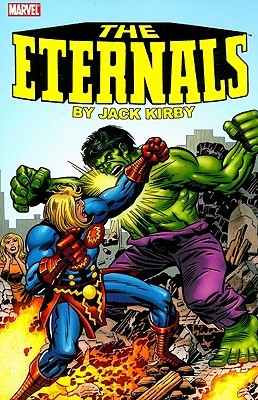
The Eternals Volume 2: written and illustrated by Jack Kirby with Mike Royer (1977; collected 2006): Jack Kirby's loopy, inspired riff on Chariots of the Gods comes to an early end, to be revived approximately every ten years afterwards by other people, including Neil Gaiman and John Romita Jr. on a real dud of a 2006 revival.

While the 2000-foot-tall alien Celestials continue to wander around Earth as part of their 50-year judgment, the Eternals and their foes the Deviants continue to mix it up on a variety of fronts. We follow Eternal Thena and her two Deviant charges, liberated from the Deviant gladiator pits, as they track down a time-travel menace in New York. An unnamed Eternal dubbed The Forgotten One struggles to stop an ill-advised Deviant assault on the Celestial mothership orbiting Earth.

Phew, what else. An ancient mind-controlling menace gets released from its prison below New York, and even the Eternals know fear. A science project designed to look like the Hulk gets animated by cosmic rays and proceeds to destroy New York. Man, New York takes a pounding. Admittedly, as the home of many of Marvel's heroes, it really should be completely depopulated by the late 1970's. How many times can Galactus show up on your streets before you get the message?

Kirby continues to follow different groups on different adventures, often ignoring other protagonists for several issues. It's highly unusual for a Marvel comic book of the time, but it does allow Kirby to develop a large variety of characters. It certainly died too soon. Recommended.