Showing posts with label Thor. Show all posts

Sunday, June 6, 2021

Thor and the Eternals

Thor and the Eternals: The Celestials Saga (1979-1980/This collection 2020): written by Roy Thomas, Mark Gruenwald, and Ralph Macchio; illustrated by Keith Pollard, Chic Stone, John Buscema, and Gene Day; adapting portions of Richard Wagner's RING CYCLE (seriously): 

Say what you will about longtime comic-book writer Roy Thomas, but he really likes Norse mythology and Wagner's RING CYCLE. So much so that he shoehorns a really wonky take on the former and an even wonkier shoehorning of the latter into this lengthy attempt to fit Jack Kirby's Eternals into mainstream Marvel continuity.

As it wasn't enough to just figure out how the Eternals could possibly fit into Marvel's already overstuffed pantheons of Norse, Greek, and pretty much every other god on record with the exception of the Christian ones, Roy said, no, I'm also going to offer a new expanded origin for the Norse gods seen in THOR. And I'm going to adapt the RING CYCLE. And the RING CYCLE will explain mysteries of Thor's origins that no one realized were mysteries before. 

And I'll have a sizeable portion of this story narrated by the sentient, giant floating eyeball that Odin sacrificed for knowledge back when the eye was neither sentient nor floating nor giant. The eyeball will tell this story to the titular hero of this saga, Thor, who will be almost as baffled as the readers will be. 

And then Roy left Marvel before the story was over, leaving Mark Gruenwald and Ralph Macchio to figure out how to end the whole thing, though I assume Roy may have left notes or something,

It's far and away the craziest cosmic saga of Marvel's Bronze Age, ably illustrated by John Buscema and the always under-rated Keith Pollard. Roy would go on to retell the Norse Ragnarok with DC's Justice Society of America chipping in to help the Norse gods. Then he and artist Gil Kane would adapt the RING CYCLE in the early 1990's, this time without added superheroes. Because it don't mean a thing if it ain't got that Ring... of the Nibelung! Recommended.


Saturday, March 31, 2018

Thor: Ragnarok (2017)

Thor: Ragnarok (2017): based on characters and stories by Jack Kirby, Walt Simonson, Sal Buscema, Larry Lieber, Stan Lee, and others; written by Eric Pearson, Craig Kyle, and Christopher Yost; directed by Taika Waititi; starring Chris Hemsworth (Thor), Tom Hiddleston (Loki), Cate Blanchett (Hela), Idris Elba (Heimdall), Mark Ruffalo (Banner/Hulk), Tessa Thompson (Valkyrie), Jeff Goldblum (Grandmaster), Anthony Hopkins (Odin), Taika Waititi (Korg), Benedict Cumberbatch (Dr. Strange), Clancy Brown (Surtur), and Karl Urban (Skurge the Executioner): 

See also

The off-beat jolliness and humour of this Marvel entry only grows on a small screen. One wishes Joss Whedon had the leeway to make as jolly a superhero movie. Chris Hemsworth is a comic revelation, closely followed by Mark Ruffalo himself as Bruce Banner and in motion-capture CGI as Banner's Hulkish alter ego. All that and so much design work based on Jack Kirby's art, right down to Hela's head-dress and all those weird circuit diagrams painted on every wall. Highly recommended.

Tuesday, November 14, 2017

Thor: Ragnarok (2017)

Thor: Ragnarok (2017): based on characters and stories by Jack Kirby, Walt Simonson, Sal Buscema, Larry Lieber, Stan Lee, and others; written by Eric Pearson, Craig Kyle, and Christopher Yost; directed by Taika Waititi; starring Chris Hemsworth (Thor), Tom Hiddleston (Loki), Cate Blanchett (Hela), Idris Elba (Heimdall), Mark Ruffalo (Banner/Hulk), Tessa Thompson (Valkyrie), Jeff Goldblum (Grandmaster), and Karl Urban (Skurge the Executioner): Almost too jolly and jaunty an entry in the Marvel Movie Sweepstakes, given the death toll in the movie. Reducing Gotterdammerung to a punchline seems both too much and not enough.

Oh, well. Thor: Ragnarok is also the Marvel movie that looks most like the comic books it's based on, particularly Jack Kirby's 1960's work on Thor and Walt Simonson's writer-artist duties on his great Thor run of the 1980's. 

The tone is really more Simonson than Kirby -- there was a jocularity and a sense of the absurd to his run, though he was better than the film-makers at balancing the epic and the absurd. Full credit to director Taika Waititi, whose What We Do In the Shadows was an absurdly hilarious faux-documentary. 

The movie goes on about 15 minutes' worth of CGI battles too long. All the actors are as fresh and lively as in any Marvel production to date, and Cate Blanchett camps it up as super-villain Hela, whose crazy head-piece comes right off the Jack Kirby pages (so, too, the designs of many of the aliens in campy Jeff Goldblum's space-court, extras from Kirby's 1970's space-god saga The Eternals). Even Bruce Banner and the Hulk are funny. Recommended.

Thursday, September 1, 2016

The Old and the New-Old

Batman (Detective Comics) Archives Volume 2 (1941-42/Collected 1991): written by Bill Finger and Don Cameron; illustrated by Jerry Robinson, George Roussos, Bob Kane, Fred Ray, and others: The Batman Mythos begins to mature with great rapidity in this second archive of stories from Detective Comics (where Batman premiered in 1939). Robin is part of the team, the Joker and the Riddler are recurring villains, and the origin of Two-Face appears here.

As Batman co-creator Bob Kane (with writer Bill Finger, finally being credited by DC in 2016, more than 40 years too late for the long-deceased Finger) doing less and less artwork, Batman's art gets progressively better because frankly, Bob Kane sort of sucked when he wasn't swiping other people's art. Jerry Robinson is on-board for the Joker, a character he co-created, while also supplying a much more pleasingly cartooned, detailed, and often funny Batman and Robin. George Roussos supplies his usually capable inks, complete with his ever-present giant moons.

The stories, most written by Finger, are at their best when they pit Batman against his growing rogue's gallery. Batman vs. mobsters is sort of boring. Batman vs. a mind-reading scientist, the Joker, or the Penguin is pretty great. One of the things to note about the early Batman is how text-heavy and panel-heavy it is. Kids were much faster readers in 1941! One wishes at times that the art was allowed to breath at times with fewer panels per page, but it would be years before this was true in the superhero comic book except in rare exceptions drawn by the Eisner or Simon&Kirby Studios. Recommended.


The Boy Commandos Volume 1 (1941-42/Collected 2010): written and illustrated by Joe Simon and Jack Kirby: Terrible, muddy colour reproduction caused by somebody who doesn't know how to use a colour scanner makes for some tough pages in this collection. Still, it's rewarding to read one of the first 'kid gang' comics. And what a gang! Co-writer-artists Joe Simon and Jack Kirby basically serve up Our Gang with Heavy Weaponry in the Boy Commandos, as a bunch of prepubescent boys run around Europe and Asia machine-gunning the crap out of the Axis powers. 

And they're sanctioned by the Allied military! 

The Boy Commandos are a multi-national group nominally led by adult Captain Rip Carter. Their adventures are wild and woolly, and a lot more fun than those of most adult WWII comic-book characters. One can see how the 'kid gang' comic became a popular one in the 1940's before fading out around the end of WWII. Recommended. Boy, this needs to be colour-adjusted, though.


Essential Fantastic Four Volume 2 (1963-1965/Collected 1995): written and illustrated by Stan Lee and Jack Kirby; inked by Chic Stone, George Roussos, Vince Coletta, and Frank Giacoia: The Stan Lee/Jack Kirby Fantastic Four (the stretchable Mr. Fantastic, Invisible Girl, Human Torch, and super-strong Thing) starts to become a more recognizable, traditional superhero comic in this second collection of the FF's 1960's stories, in glorious B&W because this is an Essential B&W collection. They fight fewer monsters and more traditional super-villains. They also fight the Infant Terrible in a story that whoever wrote the Trelayne episode of  the original Star Trek may have prior to penning "The Squire of Gothos." 

The FF's goofiest, funniest enemies from their first volume of adventures -- the Red Ghost and his Super-Apes (!!!) -- do appear here in all their ridiculous glory. The Watcher, the Blue Area of the Moon, Doctor Doom, Prince Namor, the Super-Skrull, and the Mole Man return; Dragon Man, the Hate Monger, Mr. Gideon, the Frightful Four (including yet-to-be-revealed-as-Inhuman Medusa), and Franklin Storm debut. 

Team-ups with Doctor Strange, the Avengers, the X-Men, and a brief Peter Parker cameo sell the interconnectedness of the growing Marvel Universe to the reader. There are many stand-out stories here. Probably my favourite pits the mighty, wise-cracking Thing against a maddened, more-mighty Hulk for page after page of terrific superhero combat. The Thing's later pummeling of Dr. Doom is also a personal favourite, drawn with succinct power by Jack Kirby.

Stan Lee is typically bombastic and melodramatic throughout, with the slapstick antics of the eternally bickering Thing and Human Torch to add humour. The inking of Kirby's pencils starts off rough with George Roussos, who's a terrible fit with Kirby. It picks up with Chic Stone. Joe Sinnott's masterful inks of Kirby on the FF are still a year or so away by the end of this volume. Highly recommended.


Thor: Godstorm (2001-2002; collected 2011): written by Kurt Busiek; illustrated by Steve Rude and Mike Royer: Fun homage by Busiek, Rude, and late-career Jack Kirby inker Mike Royer to the sort of story normally found in Stan Lee and Jack Kirby's run on The Mighty Thor in the 1960's. Thor's battle with the sentient thunderstorm Godstorm occurs in three different eras as depicted in the story. 

Busiek does that thing he does in which his writing is both homage (to Stan Lee) without being overly imitative of Lee's melodramatic verbiage. Steve Rude gives us his own action-packed, sometimes cartoony pencils, made to look just a bit more Kirbyesque than usual by Rude and inker Royer. My only complaint here would be that I'd like more of Busiek, Rude, and Royer's Thor. It's swell. Highly recommended.

Wednesday, October 8, 2014

But What of Kodos?

The Avengers/Kang: Time and Time Again: written by Stan Lee, Jack Kirby, Roy Thomas, and Roger Stern; illustrated by Jack Kirby, John Buscema, Sal Buscema, Herb Trimpe, Tom Palmer, and others (1968-1986; collected 2005): Time-travelling super-villain Kang is probably the most fun villain Marvel's Avengers have ever had. He pops up all over the place. There are several thousand versions of him at one point. And he's also, probably, maybe, two other super-villains as well at different points in his timeline.

This too-slim volume presents Kang stories from a span of about 20 years, beginning with an encounter with Thor and ending with...well, actually the volume ends with a lengthy prose piece that explains Kang's twisted timeline from his first appearance in the late 1960's to the early 2000's. Along the way, Kang butts heads with the Avengers, and the Hulk and Thor in solo outings.

Among other things, Kang gave Marvel writer Roy Thomas a handy way to indulge his love of obscure characters, Marvel's 1940's superheroes, and homages to the characters of other comic-book companies. The Hulk teams up with the Phantom Eagle, a World War One flying ace in the Marvel universe with only one appearance previous to that team-up, to thwart Kang's plans. The Squadron Sinister, a riff on DC's Justice League, battles the Avengers. The Invaders, Marvel's World War Two superhero group, battles the Avengers. And so on, and so forth. Most importantly, Kang battles himself. Really, Kang's greatest enemy almost always turns out to be another version of Kang, while the Avengers look on in bemused fashion. He's the Man Who Scolded Himself.

The Roger Stern/John Buscema/Tom Palmer 1986 arc that ends the volume shows Stern at the top of his form as a writer, cleaning up continuity while also forging a fascinating story without over-indulging in nostalgia and minutiae in that Roy Thomas manner. The art throughout the volume ranges from competent in the sections pencilled by workhorse Sal Buscema to top-notch in the Jack Kirby-pencilled Thor outing and that concluding Stern arc, with Buscema and Palmer doing a fine job. Kang multiplies. He divides. I'd like an omnibus that contains all of his appearances. Would that be too much to ask? Recommended.

Saturday, June 14, 2014

The Enemy of My Enemy

Riddick: written and directed by David Twohy, based on characters created by Jim and Ken Wheat; starring Vin Diesel (Riddick), Katee Sackhoff (Dahl), Jordi Molla (Santana) and Matt Nable (Johns) (2013): Vin Diesel loves his anti-social space fugitive very, very much. Thus this film, which he and writer-director Twohy basically financed themselves before finding a distributor.

After the bizarre bollocks that was 2004's Chronicles of Riddick, Riddick returns its titular anti-hero to the more familiar, monster-fighting ground of the first Riddick movie, Pitch Black. Diesel and Twohy also give Riddick lots of people to fight, with bounty hunters lining up on the planet upon which Riddick is stranded to collect the price on his head, and double the price if Riddick is dead.

It's all competent stuff, and the assorted CGI landscapes and monsters are entertaining enough. As in Pitch Black, we appear to have an ecosystem that produces an endless number of predators without there being any naturally occurring prey in the vicinity. Stupid planet! One's enjoyment of Riddick, which runs a bit long, mostly depends on how much one likes Vin Diesel. I like him fine, but I really wish he'd get better dialogue. Lightly recommended.

Thor: The Dark World: based on characters and concepts created by Stan Lee, Larry Lieber, Jack Kirby, and Walt Simonson; written by Robert Rodat, Don Payne, Stephen McFeely, Christopher Markus, and Christopher Yost; directed by Alan Taylor; starring Chris Hemsworth (Thor), Natalie Portman (Jane Foster), Tom Hiddleston (Loki), Anthony Hopkins (Odin), Christopher Eccleston (Malekith) and Kat Dennings (Darcy) (2013): Five credited writers and Odin knows how many more uncredited script doctors (including Joss Whedon, I'm pretty sure) manage to turn writer-artist Walt Simonson's terrific Thor comic-book Surtur Saga of the early 1980's into an ungodly mess.

The whole thing remains enjoyable because of the performances of its leads -- Hemsworth and Hiddleston in particular, squabbling as reluctant brothers-in-arms Thor and Loki. Unfortunately, the writers have dumped a giant crap-load of ridiculous exposition on top of the movie. Where originally one had a comic-book epic derived from Norse mythology's end-times and Thor's desperate attempts to prevent the last battle, now we have pseudo-scientific babble derived from too many viewings of The Lord of the Rings.

Yes, Tolkien. Because once upon a time, a bad dark lord made a thing which he could use to conquer the universe. But Thor's mighty ancestors defeated the Dark Lord. They didn't destroy the weapon, though -- they just buried it. Will someone find the weapon, thus drawing the dark lord into the light so he can grab the weapon for himself? Will we get a fiery, boat-riding Viking funeral for somebody? Will everybody speak in vaguely British accents? Why the hell do the dark elves all speak in a language that has to be sub-titled?

I hope Christopher Eccleston got paid a lot for the role of the dark elf Malekith, because between the whole not-speaking-English thing and the heavy slathering of make-up and prosthetics, he's completely unrecognizable. So, too, the actor who played Adubisi on Oz and Mr. Eko on Lost -- as Malekith's right-hand man, he was so unrecognizable that I only realized it was him while I was reading the credits.

But, you know, superhero fun! Whee! I actually think the ponderous, often nonsensical fake mythology expounded upon in Thor: The Dark World may be worse than the similar gunk we had dumped upon us in Man of Steel. Hemsworth is noble as Thor, anyway, and Tom Hiddleston actually invests Loki with something resembling human motivation. Someone get these guys a better movie. Lightly recommended.


The Family: based on the book by Tonino Benacquista, written by Luc Besson and Michael Caleo; starring Robert DeNiro (Giovanni), Michelle Pfeiffer (Maggie), Dianna Agron (Belle), John D'Leo (Warren) and Tommy Lee Jones (Robert Stansfield) (2013): Vicious black comedy from French action-auteur Luc Besson plays with audience expectations and sympathies. As a New York mobster in Witness Protection in Normandy, France (!) with his family because he ratted out his comrades, DeNiro is surprisingly loose and funny. He's also playing a near-psychopath, as are all the other actors playing his family.

What is for much of its length a seemingly jolly (albeit violent) comedy takes a surprising turn with about half-an-hour to go. I don't think it's entirely effective, but the violence does serve a thematic and cultural point. Recommended.

Wednesday, February 26, 2014

Sports and Spectacle

42: Written and directed by Brian Helgeland; starring Chadwick Boseman (Jackie Robinson), Harrison Ford (Branch Rickey), Nicole Beharie (Rachel Robinson), Lucas Black (Pee Wee Reese), Alan Tudyk (Ben Chapman) and Hamish Linklater (Ralph Branca) (2013): Enjoyable biopic of Jackie Robinson -- the player who broke major league baseball's colour barrier in 1947 -- stays mostly faithful to the facts. Other than a bit of swearing, 42 could have been made in the early 1960's by Stanley Kramer.

Chadwick Boseman is fine as Robinson, selected by Brooklyn Dodgers general manager Branch Rickey to become the first African-American major leaguer of the modern era in part because his character suggested that he could take the stress that would result without beating the crap out of somebody or breaking down himself. And Harrison Ford probably deserved an Oscar Best Supporting Actor nomination for his work as Rickey -- he's very good in a movie for the first time in a long time. Alan Tudyk also shines as the virulently racist manager of the Philadelphia Phillies, and Nicole Beharie is also solid as Jackie's wife. Recommended.


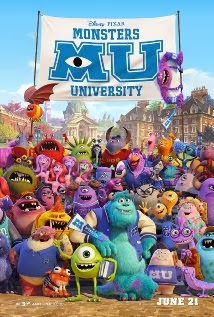
Monsters University: written by Dan Scanlon, Daniel Gerson, and Robert L. Baird; directed by Dan Scanlon; starring the voices of Billy Crystal (Mike). John Goodman (Sullivan), and Helen Mirren (Dean Hardscrabble) (2013):

What's apparently the first prequel from Pixar (to Monsters, Inc.) is a fairly breezy, light-hearted affair that isn't the equal of Up or Wall.E in terms of emotion of inventiveness, but is nonetheless a much more enjoyable and smoothly engineered movie than Brave or any of the Cars movies. A relative lack of engagement in what happens to anyone led me to a number of moments in which I spent more time scrutinizing the animation than engaged with the characters, but the animation is terrific, so as an aesthetic experience, Monsters University doesn't disappoint. Why Disney doesn't have Pixar do a Marvel movie is beyond me. Recommended.


Thor: based on characters and situations created by Jack Kirby, Stan Lee, Larry Lieber, and Walt Simonson; written by J. Michael Straczynski, Mark Protosevich, Ashley Miller, Zack Stentz, and Don Payne; directed by Kenneth Branagh; starring Chris Hemsworth (Thor), Natalie Portman (Jane Foster), Tom Hiddleston (Loki), Anthony Hopkins (Odin), Stellan Skarsgard (Erik Selvig) and Colm Feore (Laufey) (2011):

One thing we inadvertantly discover during the first Marvel Thor movie is that the movie's Asgardian gods/super-aliens/whatever have apparently never read any of Earth's mythology about them. If they had, the plot of this film would be about 20 minutes long. Oh, well. On TV, Thor plays like a handsomely mounted made-for-TV movie, the movie style of Marvel Studios movies being that there's almost no style at all. The actors are all quite likeable, Odin is as dopey here as he is in the comic books (and as prone to going into regenerative comas at the worst possible moments), and the whole thing goes down smoothly. Lightly recommended.


White House Down: written by James Vanderbilt; directed by Roland Emmerich; starring Channing Tatum (John Cale), Jamie Foxx (President Sawyer), Maggie Gyllenhaal (Agent Finnerty), Richard Jenkins (Speaker Raphelson), James Woods (Walker) and Lance Reddick (General Caulfield) (2013):

Holy Moley, is this movie 40 minutes too much of an action movie. There are more false climaxes than a dozen porn movies. The dominant structure is Die Hard; scenes and shots are synthesized from more films than I can think of. I bet you never thought you'd see an homage to Nick Cage's emergency flag-waving in Michael Bay's The Rock. Well, you will. Channing Tatum and Jamie Foxx do a lot of work to sell this, and it's certainly interesting, if only as a look at some of our current action-movie obsessions and their larger real-world implications. Also, tucked in amongst the 2+ hours of sturm-und-drang is a really bizarre use of an intercontinental ballistic missile. Lightly recommended.

Tuesday, May 15, 2012

Spawn of Thor

Marvel Visionaries: Thor: Mike Deodato: written by Warren Ellis and William Messner-Loebs; illustrated by Mike Deodato and others (1996-97; collected 2004): Thor's insane new costume on the cover of this volume would tell some people that this collection comes from the post-Image era of the mid-1990's, when DC and Marvel sought to emulate the success of that upstart company.

In part, this came with the redesign of certain costumes to make them look more like the flowing, chain-heavy costume of Spawn, Image's most popular hero. Except Spawn didn't have a bare midriff. It's like Spawn on Casual Fridays!

However, that costume's only appearance in this volume -- which omits several issues of Deodato's run on Thor -- comes on that cover. Thor is pretty much either shirtless or in another ugly non-traditional costume for the volume. That costume bares a lot of previously unbared Asgardian skin as well and is surpassingly ugly. Apparently, Thor was seeing the Submariner's tailor at this point in Marvel history.

The art is nice in that fetishistic, overstuffed 90's way. Deodato's Thor is so broad in the torso as to appear grotesque at times, while longtime Thor foe (and here lover) the Enchantress now sports a wasp waist and boobs bigger than her head. Warren Ellis writing Thor is, frankly, a pretty weird thing. His storyline, involving somebody somewhere corrupting the World Tree as a means of destroying both Asgard and Earth and ushering in a post-Ragnarok utopia, is at once interesting and weirdly off-key, with a rushed anti-climax of an ending.

Messner-Loebs cleans some of that up in the issues collected here, which led into the cancellation of Thor as part of the Onslaught event and the subsequent brief disaster called Heroes Reborn. Thor would be back in the normal Marvel universe eventually. As with a lot of Marvel collections, the selection seems a bit thin -- why not collect all of Deodato's run? Oh, well. Not recommended unless you're a Deodato completist.

Friday, May 11, 2012

Dead Sert

Thor: Death of Odin: written by Dan Jurgens; illustrated by Stuart Immonen, Jim Starlin, and others (2001; collected 2008): Dan Jurgens and Stuart Immonen were longtime members of the Superman family of comics creators over at DC in the 1990's. Their take on Thor is definitely Supermanesque, with the God of Thunder having secret identity problems galore.

Oh, and he also gets a self-styled 'cousin' who wears a distaff version of his costume and hammer and calls herself Thor Girl. She's actually a shape-changing energy being, though that, too, has its antecedent in 1980's Superman mythology and its bizarrely rebooted Supergirl/Matrix.

It all makes for light, mostly enjoyable superhero stuff. Odin is his usual pontificating, dopey self (a tradition continued from the Lee/Kirby Thor of the 1960's). Ragnarok/Gotterdammerung looms. The Muspelheimian fire giant Surtur again threatens the Earth. Thor is once again mortal for awhile as a punishment from Odin (a punishment which crops up metronomically every four years or so in the Thor comic book).

Much thee-ing and thou-ing occurs. A heavily inked Jim Starlin draws one issue. The Enchantress once again tries to get into Thor's pants. Hercules shows up for comic relief. Volstagg is still really fat. Dire future events are foretold should Thor become the ruler of Asgard. Balder and Sif have almost nothing to do. A new enemy from space threatens to kill off all the gods in the universe -- given that we're shown a bunch of awful, vindictive pantheons, I can't say this strikes me as a totally bad idea. But the climax of that storyline will come after this collection. Hidey ho. Lightly recommended.

Northern Song

Thor Visionaries: Walt Simonson Volume 5: written by Walt Simonson; illustrated by Sal Buscema, Walt Simonson, and Joe Sinnott (1986-87; collected 2007): Simonson's five-year run ends in typically epic fashion, as a crippled Thor -- cursed by the death-god Hela with brittle bones and an inability to die -- faces enemies that include the Frost Giants, his eternally evil step-brother Loki, Grendel (mostly recovered from the whole lost arm thing), the Destroyer, Fin Fang Foom, and the Midgard Serpent.

The last enemy is possibly the most dangerous. Norse mythology has it that the Serpent and Thor battle to mutual destruction at the end of the universe. However, emboldened by the news that Thor can no longer die but is also gradually being reduced to a bowl of jello by also being unable to heal, the Serpent decides to start Gotterdammerung early.

Once the reduced Thor is stuck eternally in his belly, the Serpent believes that it will have free rein to do whatever it wants. The exciting battle between the two comes in an issue illustrated entirely in one- and two-page spreads, supplemented with running commentary from Norse mythology.

Simonson's swan song is a fun one -- yes, his run goes on for two more issues after Thor's devastating battle with the serpent, and there are more epic battles before the end. Simonson actually figures out how to make the robotic, previously mindless Destroyer interesting, something no one had really ever been able to do. Recommended.

Monday, April 23, 2012

Falstaff in Comicbookland

Thor Visionaries Walt Simonson Volume 4: written by Walt Simonson; illustrated by Walt Simonson and Sal Buscema (1986; collected 2004): The fourth collection of Walt Simonson's 1980's run on Marvel's The Mighty Thor marks sort of a slight pause before the last major arc gets fully underway. Norse death-god Hela's curse on Thor would supply the impetus for the final ten-issue arc, and she does curse the Thunder God herein, but most of the collection is concerned with other things.

One of those things is the Simonson/Sal Buscema four-issue Balder the Brave miniseries, part of which takes place during events chronicled in the previous Visionaries volume. It's a pretty entertaining adventure for the Norse sun-god, while also setting up events and situations that lead back into the regular series.

Meanwhile, in the other four issues collected here, Thor teams up with Simonson's homage to Judge Dredd, Judge Peace (who would later appear during Simonson's run on Fantastic Four), to battle two old Thor enemies to save an even older supporting cast member. Most of two other issues tie directly into the line-spanning Mutant Massacre X-Men storyline.

One of Simonson's more endearing side-projects -- his fleshing out of the fleshy, comic-relief Norse god Volstagg -- also proceeds here. Sal Buscema's pencils continue to impress here. He's no Simonson, but the art remains solid and professional throughout, with some unexpected flourishes at points. Recommended.

Thunderfrog

Thor Visionaries Walt Simonson Volume 3: written by Walt Simonson; illustrated by Walt Simonson and Sal Buscema (1986; collected 2004): Walt Simonson's great 1980's run on The Mighty Thor continues here, with Simonson relinquishing the artistic reins to Marvel veteran Sal Buscema towards the end of this collection. Asgard's succession crisis (Odin remains lost in battle with the Fire-Giant Surtur) supplies the overall arc here, as Loki schemes to become ruler of Asgard.

Simonson's gift for light fantasy comes to the forefront in three issues about Thor's transformation into, um, a frog. Loki's magic, supercharged by Surtur's abandoned sword, changes Thor into a frog to keep the Thunder God away from Asgard. But what a frog! The Thunderfrog has charming adventures with talking frogs, rats, and alligators in Central Park before we return to the crisis in Asgard.

Sal Buscema does a nice job of adapting his art to resemble Simonson's without sacrificing his own strengths -- he really was a solid pro. Thor mopes around a bit -- this was the 1980's, after all -- but Simonson keeps moving the book away from angst into something much more Kirbyesque in its sometimes bizarre mix of myth and science fiction and superheroics.

At times, the dialogue seems like a prototype for how Joss Whedon would approach fantasy ten years later on Buffy the Vampire Slayer, an oddball mix of portent, contemporary idiom, bombast, and bombast-deflating insight. Recommended.

Sunday, April 15, 2012

Surtur Ascendant


Thor Visionaries: Walter Simonson Volume 2: written by Walter Simonson; illustrated by Walter Simonson, Sal Buscema, and Bret Blevins (1984-85; collected 2002): Writer-artist Walt Simonson's 4-year run on Thor was one of the highlights of superhero comics in the 1980's, an eclectic blend of sci-fi and mythology that took the title back to its heights, late in the Jack Kirby/Stan Lee years of the 1960's. Simonson's detailed, flowing, majestic but also nimble art made Asgard and the super-gods who lived there fun again without skimping on the melodramatically epic tone of the best Thor comics of the past.

In this second volume, Simonson's lengthy opening arc comes to its conclusion. Surtur, the fire giant tasked by Norse mythology with setting fire to the universe at the end of time, is about to break out of his imprisonment in Muspelheim thanks to the nefarious shenanigans of the Dark Elves, who've managed to unleash all the winters of the world upon the Earth by shattering the Casket of Ancient Winters, until now safely in the keeping of a long line of human protectors. Got all that?

When fire and ice finally conspire to break the walls between worlds, Surtur will storm Asgard, the home of the gods, to light his newly forged sword at the eternal flame Odin stole from him long ago and bring an end to everything. But the road from Muspelheim to Asgard goes straight through Midgard. Or Earth as it's more commonly known.

Gods, superheroes, and even self-interested supervillains and evil gods will have to unite to try to stop the end of the world. But Thor, one of Marvel's heaviest hitters, isn't powerful enough to stop Surtur on his own. Or, perhaps, even with a lot of help.

There's a lot to love in this jaunty second volume. One of my favourite bits lies in Simonson's visualization of Surtur, who had previously been drawn as pretty much a standard 500-foot-tall devil. Simonson goes with something a bit more impressionistic, and I think it works beautifully -- Simonson's a big Lord of the Rings fan, and his Surtur makes me wonder how he'd draw a Balrog. In any case, highly recommended if you've read the first volume.

Monday, June 20, 2011

Kirby!


Kirby! King of Comics, written by Mark Evanier, introduced by Neil Gaiman (2008): This loving, lovingly illustrated biography of comic-book writer/artist Jack Kirby -- creator or co-creator of Captain America, the Fantastic Four, the Silver Surfer, Doctor Doom, Galactus, Magneto, the original X-Men, Darkseid, the Mighty Thor, the Incredible Hulk, the Boy Commandos, the entire sub-genre of romance comic books, the Red Skull, Nick Fury, the Challengers of the Unknown, Professor X, Cyclops, the Beast, the Thing, Ice-man. Mr. Fantastic, the Mole-man, Machine Man, the Avengers, the Newsboy Legion, the Guardian, OMAC, Etrigan the Demon, Mister Miracle, Big Barda, the Cosmic Cube, the Negative Zone, the Boom Tube, the Forever People, the Source, the Omega Force, the Astro Force, and literally thousands of other heroes, villains, concepts and supporting characters -- is a joy to read. And it's a teaser for a much longer Evanier biography promised sometime in the next few years.


A limited business sense and the cut-throat nature of the comic-book business in the 1930's and onwards meant that Kirby never got adequately compensated for all the work he did, and that attention-grabbers like longtime writing collaborator Stan Lee got far more credit for their work with Kirby's than they merited. Kirby was there nearly at the beginnings of the American comic-book industry, and he was still occasionally drawing work when he died at the age of 77 in 1994.


Kirby's characters continue to form the backbone of the Marvel Comics Universe; his visual language is there in pretty much every superhero artist who ever lived, as early on Kirby pioneered techniques such as 'breaking' the panel, tilting the 'camera', one- and two-page spreads, and always action delivered by operatically enhanced heroes and villains. No one threw or took a punch like a Kirby character.


Evanier, who knew Kirby for more than 20 years, supplies both a broad historical context and a rich supply of anecdotes both by and about Kirby (born Jacob Kurtzberg in New York in 1917 -- he changed his name to Jack Kirby because he thought the name sounded more powerful and successful, and not because it was a Jewish name). The book is copiously illustrated with both the expected (comic book covers, panels, and character designs) and the unexpected (a sketch Kirby presented to Paul and Linda McCartney at a 1975 Wings concert in L.A., Kirby's sketch of what should have gone on the Pioneer and Voyager space probe plaques).


Kirby and wife Roz become vital characters; Kirby's treatment by the comic-book companies, and especially Marvel, could form the basis for a tragedy if it weren't for the fact that Kirby essentially refuted tragedy with his outlook, embodied by many of his heroic characters. Those writers, artists, editors, publishers and animation-studio executives who'd come to love him, sometimes only through his work, were able to supply something of a happy financial late Golden Age beginning in the late 1970's and continuing until Kirby's death.


As the American superhero-based comics industry sputters into oblivion, one notes how much it could use someone like Jack Kirby now -- and how little the beancounters and coat-tail-riders deserved him when they had him. Hail to the King, baby! Highly recommended.

Monday, June 6, 2011

Dumb Show


Thor: The World Eaters, written by Matt Fraction with Dan Abnett and Andy Lanning, illustrated by Pascual Ferry, Salvador Larocca and Mark Brooks (2010-2011, collected 2011): I've really enjoyed the 30 or so issues I've read of Fraction's run on Iron Man over the last three or four years. Unfortunately, Fraction's skills don't port over to the adventures of Marvel's Norse Thunder God.

The characters continue to deal with the early part of J. Michael Straczynski's run on the title, over a year since JMS left the title -- Asgard looms about three feet above a small town in Oklahoma, still reminding me of nothing so much as that Deputy Dawg cartoon in which a character ends up orbiting the Earth at a height of six feet. Balder continues to be a lousy ruler, but he's topped here by Thor, who decides to bring back his treacherous step-brother Loki from the dead. Loki only died one issue earlier, making this one of the quickest resurrections in Marvel history. Thor does this because he misses the 'old' Loki, which is to say Loki as a child, a child Thor resurrects using his incredible Asgardian Resurrection Power (TM), a hitherto unseen power introduced by JMS.

Now, in decades of Thor backstory from his first appearance as a Marvel superhero in the early 1960's, Loki has not to my knowledge appeared as a quasi-innocent, fun-loving kid. He has appeared as a treacherous, homicidal, cowardly kid on many occasions, most recently during flashbacks to JMS's run. Either Fraction has forced a completely unsupported version of Thor's childhood upon us, or Thor himself has suffered grievious brain damage. Whatever.

The bulk of the storyline involves shadowy gods from a collapsing universe trying to take over the 'Nine Worlds' of Norse legend (Asgard and Midgard [Earth] are but two of them). In yet another amazing Asgardian Resurrection Power (TM) scene, Thor brings Odin back, and then they do some crazy Asgardian magic involving giants made out of dead bodies that would make a good bit in Hellboy (actually, I think it WAS a good bit in Hellboy, with Mignola properly attributing the idea to Clark Ashton Smith's "The Colossus of Ylourgne") but which makes absolutely no sense in relation to 40 years of Thor comics. Stuff happens. I don't care. And Pascual Ferry's art seems chronically underfinished. He could really use a good inker, as opposed to a hyperactive colourist. Iron Man appears and does nothing for no reason I can really see. Not recommended.

Friday, January 28, 2011

Thor


Thor Omnibus, written by J. Michael Straczynski, illustrated by Mike Deodato, Olivier Coipel and Marko Djurdjevic (2007-2010, collected 2010): This omnibus collects all of J. Michael Straczynski's (JMS) run on Marvel's Thor, including the initial 'return of Thor's hammer Mjolnir' storyline from JMS's run on Fantastic Four. Three years prior to the JMS Thor reboot, Ragnarok/Gotterdammerung had arrived (yet again) for Marvel's version of the Norse gods, and all of them seemingly perished. But as Algis Budrys once said about science fiction ("In science fiction, death is always conditional"), I can say about super-hero comics: no one ever stays dead forever.

JMS's two-year stint on Thor ended fairly abruptly when he moved completely over to DC. This is not necessarily a bad thing. His lengthy stint on Spider-man got progressively more and more loopy the longer he stayed on the book. Here, while he leaves before any 'complete' dramatic resolution, he also leaves the book rebooted in an extremely successful and (hopefully) durable way. All the toys are put back on the table for someone else to play with, and a lot of excess continuity baggage gets thrown out. It's actually almost a model other writers could follow to rejuvenate other superheroes who've worn out their welcome, a model writers used to follow back in the 1960's, 70's and 80's before continuity came to trump all. JMS even managed to give the always-dubious Volstagg a couple of heroic moments, which is not all that easy a thing to do.

The art by Olivier Coipel and Marko Djurdjevic is pleasing throughout, though the depiction of Norse fire-demon Surtur here literalizes him as a fairly traditional Western demon/devil, and thus fails compared to Walt Simonson's more stylized Surtur of, oh, about 25 years ago now. Otherwise, though, the art does the job, with a lot of one- and two-page spreads for all the momentous, earth-shattering stuff that's been a hallmark of Marvel's Thor since Stan Lee stopped having the God of Thunder fight Communists and bank robbers back in the mid-1960's. Recommended.