Young Romance 2: The Early Simon & Kirby Romance Comics (1947-49/ Collected 2014): edited and restored by Michel Gagne; written and illustrated by Joe Simon and Jack Kirby: A second beautiful job of restoration here by Michel Gagne and friends, rescuing Joe Simon and Jack Kirby's tremendous, tremendously popular romance comics of the 1940's and early 1950's from obscurity.
It's a whole different side of Simon and Kirby (co-creators of Captain America, among many other things), one filled with domestic melodrama and solid depictions of the mostly normal. Entertaining as all Hell -- one can see how these comics rapidly became best-sellers. If it weren't for the Comics Code Authority's implementation in the 1950's, comics like these would have helped the American comics industry mature faster by about four decades. Highly recommended.
Crooked Little Vein (2007) by Warren Ellis: Or, Michael McGill and Trix Search for the Secret Constitution. Seriously. Burned-out PI McGill gets himself hired by the President's heroin-addicted Chief of Staff to find the missing Secret Constitution. It's not just a document. Read aloud, it causes people to obey it -- but only when heard in person, not reproduced electronically. And the Chief of Staff wants to make America great again by hypnotizing people back into a 1950's mindset.
OK! The Chief selects McGill because McGill is a self-described "shit magnet." Weird things happen to him, constantly, a fact the Chief believes will lead him inevitably to the Secret Constitution. So off McGill goes, soon to be accompanied by avant-garde grad student Trix, whom McGill meets at a Godzilla Bukkake Night he's stumbled into.
Yes, Godzilla Bukkake: people who are sexually aroused by giant, filmed Japanese monsters to the point of simultaneous release. Hoo ha! And that's not the weirdest thing in the novel.
Warren Ellis, crackerjack comic-book writer and futurist, has a lot of fun in this novel with strange incidents and people and a book-length parody of the standard hard-boiled-detective novel. His narrator is hapless and generally more acted-upon than acting, with sidekick Trix getting him going at various points in the text.
It's all provided within a narrative that satirizes Bush 2-era America and the Republican obsession with "family values." The Secret Constitution could conceivably cause gay people to 'turn straight,' all part of 'making America great again.' There's even a reclusive, insane billionaire who made a failed presidential run -- think Ross Perot by way of an X-rated Monty Python skit.
Sure, the novel's not deep. But it's fun and diverting and pointedly satiric. The events recall Hunter S. Thompson; the prose style recalls the hard-boiled school of Chandler and Hammett. It's 21st-century picaresque. Recommended.
I Must Say: My Life as a Humble Comedy Legend (2014) by Martin Short and David Kamp: Martin Short's memoir is breezy and funny despite all the tragic bits. And there are tragic bits. Short, a native of Hamilton, Ontario (his father was an executive for Stelco), lost his oldest brother, his mother, and his father in separate incidents, all before Short was 20.
But Short's memoir focuses on the good times and, failing that, the funny ones throughout his life while explaining how early tragedy shaped his character -- and in some cases his characters. Periodically, the narrative gives way to two or three pages about the creation and evolution of Short's most famous sketch characters. There's Ed Grimley, of course, along with Jackie Rogers, Jr. and Irving Cohen and Jiminy Glick and several others. Fans of Short will be delighted by revelations about the backgrounds of these characters.
The memoir also reveals the astonishing creative hotbed that was Toronto in the late 1960's and early 1970's -- Short, Victor Garber, Gilda Radner, Andrea Martin, and Eugene Levy (to name five) all worked on the same production of Godspell in the early 1970's. Many others would soon be at the Toronto Second City -- John Candy, Dave Thomas, Catherine O'Hara -- when Short joined that ensemble later in the decade.
Short's decades-long love affair with his wife, Nancy, forms a constant thread throughout. So, too, his friendships with various actors and comedians, most notably Steve Martin, Tom Hanks, Nora Ephron, and Paul Schafer. There are a lot of laughs here, along with the occasional odd revelation (Goldie Hawn and Kurt Russell bought a home in Ontario's Cottage Country because they so liked Short's cottage). There aren't any dark revelations or secrets exposed here -- it is, like Ed Grimley, sweet and a bit odd. Recommended.
Dark Night: A True Batman Story (2016): written by Paul Dini; illustrated by Eduardo Risso: Writer Paul Dini remains best-known for being one of a handful of creators who made Batman: The Animated Series such a joy in the early 1990's. Set in the early 1990's, Dark Night: A True Batman Story is Dini's memoir of the injuries he suffered in a vicious attack, his subsequent withdrawal from work and friends, and his road to recovery.
Of course, it's not just about physical problems. Dini painfully details the depressed head-space he occupied in the early 1990's, infatuated with a starlet who didn't love him and obsessively concerned with his own 'coolness' even at the fringes of Hollywood -- Warner Brothers animation, to be exact. Dini traces some of his childhood experiences in order to explain how he got where he got, and how he then got out of there.
It's an excellent memoir with elements that many outsiders and geeks and nerds will find often harrowingly familiar and poignant. It would be fitting if DC Animation made an animated movie out of this.
Eduardo Risso's art is the best work I've seen from him. Best-known for NuNoir art on Brian Azzarello's hard-boiled 100 Bullets series, Risso here delineates the normative and the fantastic here with an equal conviction. It's marvelous -- I don't know that I thought Risso was capable of this sort of art. This is the sort of Batman story that people with no real interest in Batman might nonetheless find absolutely compelling. Highly recommended.
Invisible Ink: My Mother’s Secret Love Affair with a Famous Cartoonist (2015) by Bill Griffith: Winner of the 2016 Eisner Award for Best Writer/Artist for his work on this graphic novel, Bill Griffith is best-known for his decades of work on the loopy world of Zippy the Pinhead ("Are We Having Fun Yet?"). But in this 200-page memoir, Griffith goes places as a writer and artist that are often astounding to behold.
Invisible Ink sees Griffith investigate his own past, and the central place of his mother's affair with a famous cartoonist/writer during the 1950's and 1960's. Griffith's mother answered an ad placed by that cartoonist, Lawrence Lariar, perhaps best known for his editing work on the Best Cartoons of the Year series that ran from 1942 to 1971. The job develops into an affair that Griffith's mother tells her children about on the day of their father's funeral.
Griffith's cartooning is brilliant throughout, fine-lined and detailed and firmly grounded in the 'real.' He also redraws some of Lariar's cartoons. The history of the affair drives the narrative, but the memoir also deals with Griffith's family history and with Lariar's career. The frame story sees Griffith visiting his uncle (his father's brother) in the present day to talk about his mother and to share the story of the affair with him. It all works beautifully, with a light touch that never uses the various narrative threads for laughs.
Invisible Ink also works as a narrative about 'making it' as a cartoonist -- Lariar pursuit of the Holy Grail of a successful, nationally syndicated strip is one of the historical sub-plots, with Griffith recreating a selection of his attempts, often to intentionally absurd effect as Lariar and his syndicate rework a strip into versions farther and farther away from its original setting and cast of characters.
Griffith's mother nonetheless dominates the text, trapped between a distant husband (sometimes literally -- Griffith's father was a career military man who was often abroad) and an illicit love affair that fulfills her emotionally but which will never be formalized. She's a tragic, stalwart character. And Invisible Ink is a moving, funny, major work of graphic story-telling. Highly recommended.
Doom Patrol Book One (Collects issues 19-34 of Doom Patrol Volume 2 1989-1990, 1992, 2004/ Collected 2016): written by Grant Morrison; illustrated by Richard Case, Doug Braithwaite, Scott Hanna, John Nyberg, Carlos Garzon, Simon Bisley, and Brian Bolland: DC's Doom Patrol was weird even when it was supposed to be a straightforward superhero team book in the 1960's. Revived in the 1980's, it really did become straightforward until, facing low sales, DC elected to hand the keys to the car to Scottish writer Grant Morrison in 1989. Morrison had already invaded the U.S. with Animal Man and Arkham Asylum. But Doom Patrol would soon become his weirdest 'mainstream' superhero work.
This new reprint volume collects the first third of Morrison's writing stint. It starts with a bang. A Borgesian bang, to be exact, as Morrison riffs on Jorge Luis Borges' strange story "Tlon, Uqbar, Orbis Tertius." An imaginary world is in the process of invading the Earth, and the Doom Patrol gets together to face it, reluctantly.
While the wheelchair-bound genius The Chief, a.k.a Niles Caulder, and Cliff Steele, a human brain in the body of Robotman, remain from the first iteration of the Doom Patrol, Morrison adds new member Crazy Jane -- a survivor of childhood sexual abuse who now has at least 64 multiple personalities, all of them with superpowers -- and a modified old one, Negative Man, now renamed Rebis and consisting of an amalgam of a man, a woman, and a 'negative energy being.' Josh, a.k.a. Tempest, comes along from the second iteration of the Doom Patrol, but only if he gets to be the team's medical officer and isn't expected to play superhero on a regular basis. Dorothy Spinner, a holdover from the issues just before Morrison takes over, also functions as an occasional member of the team, with her occasionally erratic, reality-shaping powers.
Having survived the threat of the Scissormen and the invading, fictional world, the Doom Patrol moves into the Justice League's original, abandoned HQ on Rhode Island. But their work is never done. A creature calling itself Red Jack (a Star Trek: TOS reference) kidnaps a comatose former member of the Doom Patrol and takes her to his strange pocket universe. Dorothy's powers go haywire.
There's more! The former Brotherhood of Evil reunites under the new leadership of Mr. Nobody and sucks all of Paris into a magical, reality-bending painting. Crazy Jane retreats inside her own mind, forcing Cliff to take a telepathic voyage into the wonders and horrors of her fractured psyche. The Cult of the Unwritten Book threatens all of reality with erasure.
And The Brain and Monsieur Mallah, charter members of the Brotherhood of Evil, invade Doom Patrol HQ in order to secure Cliff's new and improved robot body for The Brain. The Brain is an evil, disembodied brain living in a jar. Monsieur Mallah is the super-intelligent, beret-and-bandolier-wearing gorilla he trained from birth to be his evil sidekick. And those last two are holdovers from the original, 'normal' rogue's gallery of the 1960's Doom Patrol! Somewhat fittingly, the last issue reprinted here has a title taken from a Smiths song.
Hoo boy. Fractured, self-mocking, postmodern, often poignant fun for the discerning superhero fan. And this volume is as normal as Morrison's run on the title gets! Handling most of the pencilling duties, Richard Case offers a seemingly straightforward, crisp art style that makes even the weirdest moments seem (mostly) plausible. And Morrison and Case keep things straightforward when it comes to page lay-out: there's no need to push the boundaries of lay-out. The weirdness is all inside the panels, so it's best one doesn't get too lost. And remember: 'dada' is French slang for 'hobbyhorse.' Highly recommended.

Batman: Gothic (Deluxe Edition) (1990/ Collected 2015): written by Grant Morrison; illustrated by Klaus Janson: Writer Grant Morrison's second major foray into the world of Batman (after 1989's Arkham Asylum) take the Dark Knight into a literary hellscape of nods to Faustus, Don Giovanni, Lord Byron's Manfred, Fritz Lang's M., Lewis's The Monk, Melmoth the Wanderer, and a host of other horrific antecedents. There's even an exquisitely detailed, Rube Goldbergesque death trap for Batman to escape.
Batman faces an enemy from his past -- his past as a schoolboy at a private school, that is, in the days before Bruce Wayne's parents were murdered and Bruce's journey towards Batman began. But the enemy threatens Gotham's major mobsters as well, whom this old enemy hunts for revenge. Klaus Janson supplies lots of moodiness and doom as artist. It's one of Batman's most nightmarish adventures, even with the typical splash of Morrisonian postmodernism. This would make a terrific Batman movie, live-action or animated. Come on, DC! Highly recommended.
Essential Captain America Volume 2 (1968-1970/ Collected 2004): written by Stan Lee, Jack Kirby, and Jim Steranko; illustrated by Jack Kirby, Jim Steranko, Gene Colan, John Romita, Joe Sinnott, Syd Shores, and others: The great transition period of Captain America begins here, as co-writer/penciller Jack Kirby gives way to Jim Steranko gives way to John Romita gives way, finally, to Gene Colan, who would stay on the book for a few years as penciller.
Early red-giant-phase Stan Lee writes Steve Rogers, Captain America, as such an angsty bastard that the book occasionally shudders to a halt, bloated and inert and over-stuffed with bathetic self-pity. Redemptively, the art is good throughout, and Steranko's innovative lay-outs are such a show-stopper that they've been collected and re-collected on numerous occasions. I don't know that the Gene Colan/Joe Sinnott art team ever entirely works for me -- Sinnott's inks normalize Colan's pencils a bit too much, make them a bit too smooth.
It's 1968 when the collection begins, and Kirby and Stan Lee are clearly producing too much material at the time -- Lee's writing is well into its state of decay. Kirby is still great, but he's decreased the number of panels per page already, as he did on all of his Marvel books in the late 1960's. It makes for more interesting visual storytelling but also a real and notable decrease in content. Cap's African-American pal The Falcon makes his debut here. Once Kirby and Steranko leave, the new villains become ridiculous, as Lee flounders to create interesting villains and mostly fails. Recommended.

Doc Savage: The Spider's Web (2016/ Collected 2016): written by Chris Roberson; illustrated by Cezar Razek: Writer Chris Roberson nails venerable pulp hero Doc Savage much more effectively in his second go-round on the Man of Bronze's adventures for Dynamite Comics. Cezar Razek is a pleasant, straightforward cartoonist. I wish Dynamite would put an artist more, well, dynamic, on the new adventures of Doc Savage. So it goes. Any time Doc has to deal with an Earthquake Machine is all right with me. Recommended.
Flow My Tears, the Policeman Said (1974) by Philip K. Dick: Winner of the John W. Campbell, Jr. Memorial Award for Best Science Fiction Novel of 1974, beating out Ursula Le Guin's revered The Dispossessed. Set in a Dystopian America of 1988, Flow My Tears, the Policeman Said presents a world in which America is a terrible, terrible place to live.
The powers that be have isolated the universities, where college dissidents have been literally forced underground by the government as a result of the Second Civil War between Nixon's presidency and all forms of civil disobedience. America is now a police state with a Police Marshal at the top and five regional Police Generals below that position. A person can't function for long in society without a host of official IDs, and as the students and protesters don't have such ID's, they're easily discovered by the seemingly endless series of official checkpoints throughout America.
But the masses -- especially those living away from the depressed inner cities -- still need entertainment. And Jason Taverner, popular talk-show host and singer, is one of America's most popular and well-paid entertainers.
However, one morning, Jason Taverner wakes up in a fleabag hotel room with no ID. He at least has 5000 dollars in his pocket. But as he soon discovers, he no longer exists either on record or in anyone's memories. What has happened? Well, it's a Philip K. Dick novel, so the answer turns out to be typically reality-bending.
Taverner's odyssey to find out what has happened takes him through various levels of the new American society, from ID forgers to police bureaucrats to middle-class potters. The novel soon provides him with a co-protagonist, Police General Felix Buckman. Buckman isn't actually a bad guy -- he's spent his career at the top trying to save the lives of the enemies of the State, though he's still a dystopian bureaucrat with more than one skeleton in his closet.
This is one of Dick's sharpest, most focused later novels. Nonetheless, it still abounds and swirls with those brilliant, disturbing flashes of Dickian imagination. Most prominently in terms of the novel's critique of certain beliefs both real-world and science-fictional, in this world, there are highly intelligent people genetically engineered to be supermen (indeed, Taverner is one). They're called 'Sixes,' after their batch number (a nod to Dick's own Nexus-6 androids in Do Androids Dream of Electric Sheep?, the basis for Blade Runner?). But the sixes couldn't conquer the world because they can't stand being around one another: the superman abhors the superman, and thus fails to conquer.
There is a bizarre form of phone sex that can cause permanent brain damage and ultimately death. There are flying cars and pin-sized nukes and... conventional 33 1/3 LPs and 45s in juke boxes? Cigarettes are heavily regulated by the State, while pot and mescaline are readily and legally available to all. African-Americans are now seen as a rare, exotic group that's close to extinction thanks to decades of genocidal eugenics. And behind it all, there's a dystopia based on fear and paperwork.
There's also hope, though, especially as the novel ends. The dystopian police state will not endure as long as people are capable of small acts of empathy and compassion, and of creating beauty. And entropy affects everything, good and evil, the same: the dystopia will succumb to entropy just like everything else. It's a fine novel that sends back echoes of the world we live in, refracted by Dick's prismatic and unique imagination. The title is derived from a song (an ayre, actually) by 16th-century composer John Dowland ("Flow, my tears, fall from your springs"). You'll have to read the novel to discover the significance. Highly recommended.
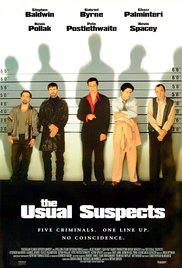
The Usual Suspects (1995): written by Christopher McQuarrie; directed by Bryan Singer; starring Stephen Baldwin (McManus), Gabriel Byrne (Keaton), Benicio Del Toro (Fenster), Kevin Pollak (Hockney), Kevin Spacey (Verbal), Chazz Palmintieri (Dave Kujan), Pete Postlethwaite (Kobayashi), and Giancarlo Esposito (Jack Baer): Still the best thing writer Christopher McQuarrie and director Bryan Singer have ever done, 21 years later.
And that's OK because among the peaks and troughs of the Tarantino Wave of the early-to-mid-1990's, The Usual Suspects is a very high peak indeed. A delightful, violent romp that also serves as a meditation on the telling and receiving of stories, The Usual Suspects never lags and gets the best out of both able actors (Gabriel Byrne, Kevin Spacey) and otherwise undistinguished actors whose best work appears here (Stephen Baldwin, Kevin Pollak). Benicio del Toro is nearly unrecognizable physically and, thanks to some extremely odd speech patterns, aurally. Highly recommended.

Don't Breathe (2016): written by Fede Alvarez and Rodo Sayagues; directed by Fede Alvarez; starring Stephen Lang (The Blind Man), Jane Levy (Rocky), Dylan Minnette (Alex), and Daniel Zovatto (Money): Admirably tense, terse thriller set in the post-apocalyptic wasteland of present-day Detroit. The creative minds behind the solid remake of Evil Dead go with a bit less gore and grue here, though more than one scene is Not For The Squeamish.
The young actors are good as three sympathetic burglars who pick the wrong house, while Stephen Lang (Avatar's nutty Colonel) is extraordinarily menacing as the blind, buff homeowner whose house our unfortunate trio break into in search of a hidden cache of Get Out of Detroit cash. The movie may invert the central premise of classic 1960's thriller Wait Until Dark, but it's also a horrifying reimagining of The Treasure of the Sierra Madre. Brutal but never exploitative. Highly recommended.
Black Sabbath (I tre volti della paura) (1963): adapted from works by Ivan Chekhov, F.G. Snyder, and Aleksei Tolstoy by Mario Bava, Alberto Bevilacqua, and Marcello Fondato; starring Boris Karloff (Gorca/Narrator) and others: Something of a stinker of an Italian anthology horror film from the early 1960's, redubbed for English-speaking audiences. Boris Karloff is fine as both frame narrator and Vourdalak in the third segment.
The first segment actually goes pretty well until the film-makers unwisely over-use their initially effective Dead Witch Dummy (TM). The second sequence sucks. The third sequence, in which a vampire-like Vourdalak terrorizes a travelling nobleman and a family of peasants, is utterly ridiculous in its plot. It's like a training film on what not to do when menaced by the Undead. Or a cautionary tale about the plague of narcolepsy that ravaged Eastern Europe in the early 19th century. Not recommended.

Spectre (2015): written by John Logan, Neal Purvis, Robert Wade, and Jez Butterworth; directed by Sam Mendes; starring Daniel Craig (James Bond), Christoph Waltz (Blofeld), Lea Seydoux (Madeleine), Ralph Fiennes (M), Ben Whishaw (Q), Naomie Harris (Moneypenny), and Andrew Scott (C): Spectre is a lot like the Roger Moore Bond movies, except for the fact that it's grim rather than light-hearted. And perhaps even more improbable than even the last couple of lousy Moore Bonds. Daniel Craig looks ready to quit the role, and the film-makers don't seem to have written a movie so much as hastily assembled a series of flawed action sequences.
This lumpy, careless James Bond moves through a world which is either intensely over-crowded or populated by no one but himself, his unlikely love interest, and whoever's trying to kill him. Christoph Waltz does his best to menace in a non-menacing role as an unconvincingly retconned Blofeld, while Andrew Scott, so great as Moriarty to Benedict Cumberbatch's Sherlock Holmes, is mostly wasted as a nefarious British bureaucrat/technocrat. If I never see another climax to an action movie that involves doing something with a computer, it will probably be too soon. Though I did like an earlier action sequence that terminates with the fiery revelation that the bad guys have built their secret HQ out of gas pipelines and exploding wood. Not recommended.

Hitchcock/ Truffaut (2015): written by Kent Jones and Serge Toubiana; directed by Kent Jones; narrated by Bob Balaban: It's too short and it doesn't name the directors who discuss Hitchcock throughout the documentary until the end credits. But it's still great to revisit the monumental Hitchcock/Truffaut book, initially compiled and published in 1966 from a series of interviews Francois Truffaut conducted via translator with Alfred Hitchcock in 1962. Young (Wes Anderson) and old (Martin Scorsese) alike hold both the book and Hitch himself in monumental regard.
The movie introduces the viewer to several key moments in the text, with special attention paid to Notorious, The Birds, Psycho, and Vertigo. It might help to read the book either immediately before or after seeing the documentary. It's impossible to imagine any contemporary, commercial film-maker being as visually and thematically complex as Hitchcock turned out to be over his 50-year film-making career. He's the Great White Whale of movies, the immensely popular and complex artist. Highly recommended.