Showing posts with label hellboy. Show all posts

Monday, January 23, 2017

Pulp Heroes, Pulp Horrors

BPRD: Hell on Earth Volume 2: Gods and Monsters (2011-2012/ Collected 2012): written by Mike Mignola and John Arcudi; illustrated by Guy Davis and Tyler Crook: Another day in the battle between the Bureau for Paranormal Research and Defense and the unleashed forces of Hell. Good times! Some stuff happens. We see the effects of the ongoing invasion of Earth. A new character is introduced. An old character meets a shocking, though perhaps not final, fate. Some cool-looking monsters rampage around. It's all part of a larger story, and would work best read in sequence with that story. Lightly recommended.


Lobster Johnson 1: The Iron Prometheus (2007-2008/ Collected 2008): written by Mike Mignola; illustrated by Jason Armstrong: Set in the 1930's of writer-artist Mike Mignola's sprawling Hellboy Universe (Earth-Hellboy?), the Lobster Johnson series is an homage to the American pulp magazine heroes of the 1930's. It's part of Hellboy continuity, which means the reader knows Johnson's fate. So it goes. Johnson possesses traits of pulp heroes The Spider, The Shadow, and Doc Savage, while wearing a costume that's part standard superhero, part-Green Hornet.

The Iron Prometheus was the first of the Lobster Johnson miniseries. It's pulpy fun, with the mysterious, masked Lobster Johnson battling Nazis and monsters and an ancient evil to secure a super-weapon with magical properties. Mignola's tendency to underwrite was well underway here -- for a five-issue story, The Iron Prometheus is awfully thin at times. As written, it's 40 pages of story spread out over more than a hundred. We get characterization for a supporting character, but none really for Johnson's associates, much less Johnson himself. And one of the late sequences is almost completely opaque when it comes to clearly portraying what happened. It's fun, but almost too minimalist to be successfully pulpy. Lightly recommended.


Doc Savage: The Silver Pyramid (1987-88/ Collected 2009): written by Dennis O'Neil; illustrated by Andy and Adam Kubert: DC Comics' late 1980's revival of the Doc Savage pulp hero series as a comic book was intermittently successful -- indeed, successful enough that, while short-lived, it's probably no worse than the second-best comic-book Doc Savage, just after Marvel's 8-issue B&W Doc Savage comics magazine of the 1970's.

Writer Denny O'Neil scripted DC's beloved Shadow comics revival of the 1970's. He's tapped here as well, to uneven but mostly successful effect. There's a lot of stuff to get in -- the story spans 40 years -- and O'Neil keeps things moving along while also supplying a fairly dense plot, as the Savage novels often did. There's super-science, lost civilizations, Nazis, and new members of Doc's rollicking band of associates. It was successful enough to launch an ongoing series that lasted 20 issues -- not bad for a Doc Savage revival series. Actually, that's the longest lived Doc Savage comic series since the 1940's!

The Kubert Brothers -- artistic sons of legendary DC artist and mentor Joe Kubert -- are very young here. It shows sometimes as they have trouble maintaining consistent faces for some characters. And they're still too similar to their great father. But overall, the art works. They've already got fair command of action and of opening up the pages to one- and two-page compositions. Their interpretations of Doc's two most popular aides, Monk and Ham, are dreadful, but I don't think they designed them on their own. But they are terrible. Oh, well. Recommended.

Saturday, September 5, 2015

Lobster Johnson, Coneheads, and Northern Ireland

Lobster Johnson 2: The Burning Hand: characters created and designed by Mike Mignola; written by John Arcudi; illustrated by Tonci Zonjic and Dave Stewart (2011-2012; collected 2013): Introduced years ago in Mike Mignola's Hellboy, Depression-era pulp hero Lobster Johnson gets his second miniseries adventure here. Illustrator Tonci Zonjic's style fits the material as his art works in the clean-lined, retro tradition of period-appropriate cartoonists that include Roy Crane, Noel Sickles, and Milton Caniff. John Arcudi's script presents New York-based Lobster Johnson, still a crime-fighter on a learning curve, with both a challenge from the Mob and a challenge from beyond. 

As this is the universe of Hellboy and the BPRD, supernatural menaces abound. And while fighting a gangster, Johnson and his associates find themselves fighting a seemingly unkillable supernatural being with the ability to destroy people and things with an unquenchable black flame. It's pulpy fun in the tradition of the Shadow and Doc Savage, with a little H.P. Lovecraft thrown into the mix. Recommended.


The Boxer: written by Jim Sheridan and Terry George; directed by Jim Sheridan; starring Daniel Day-Lewis (Danny Flynn), Emily Watson (Maggie), Brian Cox (Joe Hamill), Ciaran Fitzgerald (Liam), Ken Stott (Ike Weir), and Gerald McSorley (Harry) (1997): Daniel Day-Lewis and writer-director Jim Sheridan team up for the third time (previous collaborations were Best Actor Oscar-winning My Left Foot and docudrama In the Name of the Father). 

Set in a Northern Ireland on the cusp of a peace agreement between Great Britain and the IRA/Sinn Fein, The Boxer follows Day-Lewis' Danny Flynn, a once-promising young boxer who's been released from prison after 14 years. His prison sentence came in part for covering for IRA accomplices, but the IRA has no time for him -- disgusted with his own complicity, he refused to socialize with them while in jail. He's back now, trying to avoid sectarian politics while he re-opens the boxing gym he himself trained at. Of course, things are going to go awry. As he's still in love with the daughter of the local IRA chief, she herself married to a jailed IRA man, his personal life may go a bit wonky. 

The acting is strong throughout. Day-Lewis seems pitch perfect as always, making Flynn a man who's learned to control his anger without ever eradicating it. Emily Watson is almost literally luminous as his now-married former lover. We get just enough background on the politics to see the problems with both sides, and the frustration of those who would like to have no part of either. Belfast plays Belfast in the second-unit photography, while Dublin stands in for parts of Belfast when the actors are in the frame. The whole presents a city run down and defaced in a way that almost makes it look like Day-Lewis and Watson are appearing in another adaptation of 1984. Recommended.


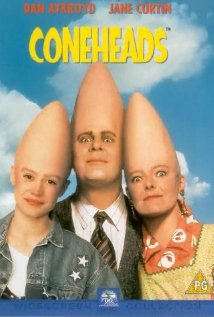
Coneheads: written by Tom Davis, Dan Aykroyd, Bonnie Turner, and Terry Turner; directed by Steve Barron; starring Dan Aykroyd (Beldar Conehead), Jane Curtin (Prymatt Conehead), Phil Hartman (Marlax), David Spade (Eli Turnbull), Michael McKean (Gorman Seedling), Michelle Burke (Connie Conehead), and Chris Farley (Ronnie) (1993): I really like Coneheads. Many do not. But I think it's one of the five best movies based on characters who first appeared on Saturday Night Live. The script and performances are funny, the cameos are almost ridiculously abundant, and even the product placements (there are a lot of them) are weirdly funny at times. I mean, I'm not sure anyone would go to Subway based on the way its sandwiches are eaten here. Even the science-fiction elements are intermittently more well-thought-out than those one would find in a dramatic science-fiction film. the film even uses David Spade perfectly. Recommended.

Saturday, September 7, 2013

A Game of Hellboy

Hellboy: Masks and Monsters: written by Mike Mignola and James Robinson; illustrated by Mike Mignola, Scott Benefiel, and Jasen Rodriguez (Collected 2009): Short volume collects two Hellboy miniseries team-ups with three other characters -- DC's Batman and Starman in one adventure and Dark Horse's own Ghost in the other.

A good time is pretty much had by all. Though I'm not familiar with Ghost -- a two-gunned female ghost fighting crime -- Hellboy's adventure with her makes a certain amount of sense given their supernatural backgrounds. Mignola's script presents an interesting mix of mythology and the mundane as organized crime gets mixed up with ancient gods who want Hellboy's giant hand for something nefarious. The art by Scott Benefiel, from Mignola's layouts, is fairly smooth, though perhaps a bit too representational for Mignola's blocky, occasionally impressionistic Hellboy.

The Starman/Batman team-up, plotted by Mignola and scripted by Starman's James Robinson, is really serious fun, with Mignola handling the art. Batman and Hellboy team up to fight magical Aryan Nation types in Gotham. With Batman temporaily sidelined by a re-appearance of the Joker, it's then up to Hellboy and second-generation Starman Jack Knight to rescue the Golden-Age Starman (who's also Jack's father Ted Knight) from a Nazi base in South America. There, the Nazis have supernaturally coerced Ted into helping them bring a very large, evil God back to Earth.

Oh, Nazis! Mignola's Batman is shadowy and bulky, while his Starman is quite a change from the more representational art generally seen in Jack Knight's own title. The whole volume goes down nicely, and is also an enjoyable break from the increasingly labyrinthine continuity of Hellboy's own adventures. Recommended.


The Sandman Volume 5: A Game of You: written by Neil Gaiman; illustrated by Shawn McManus, Colleen Doran, George Pratt, Stan Woch, Dick Giordano, and Bryan Talbot (1991-92): The fifth volume of Gaiman's now twenty-year-old+ Sandman adventures presents a mostly self-contained tale concerned with gender, identity, race, and childhood dreams. Minor characters from previous story arcs do reappear here, along with the Lord of Dreams and his attendant (wise)-talking raven Matthew.

The six issues focus on one minor character from an earlier story arc, Barbie, whose previous encounter with the world of the Dreaming destabilized her marriage to Ken (!), along with her own carefully constructed self-image, and sent her to New York to figure out who she is. That previous interaction with the world of Dreams also had an unintended consequence. She's stopped dreaming.

However, somewhere in dreams, a ragtag group of talking and sometimes imaginary animals continue to search for the vanished Princess Barbara, who is the only person who can defeat the all-devouring Cuckoo and its conquering hordes. But she's going to need the help of her neighbours -- the lesbian couple Hazel and Foxglove, the transvestite Wanda, and the mysterious Thessaly -- to negotiate an increasingly unstable fantasy world.

The real world and the dream world are, of course, connected, in both obvious and less-than-obvious ways. Things do not necessarily go well for everyone involved in this adventure, with its echoes of Narnia and Tolkien and The Wizard of Oz's game-changing tornado. We also learn an awful lot about the life-cycle of the cuckoo bird. Why did someone put these awful things in clocks to begin with? Recommended.

Wednesday, July 24, 2013

Dragon Nipples


Savage Dragon Archives Volume 2
, written and illustrated by Erik Larsen (Collected 2007): Fun collection of superhero cop Dragon's mid-1990's adventures trying to keep Chicago and the world safe from a wide variety of supervillains and superfreaks. Creator/writer/artist Larsen had really become adept at drawing interesting superhero battles by this time in his career, and often opens up the action into one- and two-page spreads to good effect.

That, and there are a lot of pictures of women with enormous breasts tipped with enormous erect nipples.

The series also more confidently moves into realms of homage and parody this time around, as Larsen riffs on Jack Kirby's New Gods, superhero weddings, and the Mighty Thor. There are also crossovers galore, as Savage Dragon teams up with the Teenage Mutant Ninja Turtles and Hellboy, and fights off the Martians of Mars Attacks! Recommended.

Thursday, October 18, 2012

The Drums of Heaven

Hellboy: The Storm and the Fury: written by Mike Mignola; illustrated by Duncan Fegredo and Dave Stewart (2011-2012): The Duncan Fegredo-drawn 'middle section' of the main Hellboy saga (as opposed to the time-and-space-ranging standalones and miniseries, drawn by many) apparently comes to an end here. The last part of the saga begins in December with the first issue of Hellboy in Hell as Mike Mignola returns to the drawing board.

Fegredo really did a marvelous job over the last five years or so on the main sequence, his style similar to Mignola's without slavishly mimicking it. Fegredo really became a master of grotesqueries as he went along, though his Hellboy and others always seemed a bit skinnier to me than some of Mignola's blockier creations.

But it's been a heck of a ride, and probably not an easy one to illustrate: the second act of Hellboy left the more familiar plots of the first act behind, moving Hellboy from being a paranormal investigator with the Bureau of Paranormal Research and Defence to a wandering hero whose quest never seemed entirely clear because Hellboy himself wasn't clear about it -- or sober for long sections of it.

Mignola and Fegredo supply a handy bit of summary towards the beginning here, voiced by Hellboy himself, before moving to the main action. And what action it is, as Hellboy and his giant hand of doom must stop the end of everything or die trying.

Unlikely allies arise, including Queen Mab and Baba Yaga and a mysterious little girl. Loose ends, signs, and portents set up in the previous 11 volumes suddenly start to make sense, often in startling fashion. There is Ragna Rok and King Arthur and the last weird battle in the West. There is an evil badger and a repentant pig. There's a dragon that bleeds molten gold.

And there's Hellboy, perhaps overmatched but always game for a fight. He doesn't know when to stop punching, and while he was born a demon, he's ultimately humanity's best friend. Or fiend. And boy, can that guy take a punch!

Everything comes to a crashing conclusion which is really only an intermission between one important battle and what will ultimately be the war for humanity. And I'm excited to see what's next. Highly recommended.

Sunday, January 1, 2012

Catching Up Is Hard To Do

Shock Rock (1992), edited by Jeff Gelb; containing

Stephen King - You Know They've Got a Hell Of A Band
F. Paul Wilson - Bob Dylan, Troy Jonson, and The Speed Queen
David J. Schow - Odeed
Nancy A. Collins - Vargr Rule
Ronald Kelly - Blood Suede Shoes
Don D'Ammassa - The Dead Beat Society
Graham Masterton - Voodoo Child
Paul Dale Anderson - Rites Of Spring
Michael E. Garrett - Dedicated To The One I Loathe
Brian J. Hodge - Requiem
R. Patrick Gates - Heavy Metal
Rex Miller - Bunky
Bill Mumy & Peter David - The Black '59
Richard Christian Matheson - Groupies
Michael Newton - Reunion
Mark Verheiden - Bootleg
Ray Garton - Weird Gig
John L. Byrne - Hide In Plain Sight
Thomas Tessier - Addicted To Love
John Shirley - Flaming Telepaths
 
Very uneven original anthology of rock-and-roll horror stories from the early 1990's. I've always liked King's contribution, an ultimately nihilistic story from the 'We stumbled across a weird town' sub-genre of horror. John Shirley's story cleverly inverts the stereotypes that too many of the other stories play straight with (specifically, 'Rock-and-roll is the Devil's music!'), as does Ray Garton's "Weird Gig." The Wilson, Tessier, Verheiden, Masterson, and Schow stories are also solid work. The graphic sex and violence in a couple of the stories manages to be unpleasant without really being horrifying (or terrifying, for that matter). Lightly recommended.


Shatner Rules by William Shatner and Chris Regan (2012): What seems like Shatner's umpteenth non-fiction book goes down as smoothly as a Romulan Ale Smoothie. More anecdotes, more self-promotion, more pointed comments about George Takei's Shatner obsession, and so on, and so forth. Recommended.


Hellboy: House of the Living Dead, written by Mike Mignola; illustrated by Richard Corben (2011): Fun original graphic novel set during Hellboy's "lost months" while on a bender in Mexico during the 1950's, during which time he professionally wrestled and fought various supernatural menaces, generally while either drunk or severely hung over. Forced to kill a young wrestling, monster-fighting ally after vampires turned the young man into a bat-headed monstrosity, Hellboy went on a blackout-inducing bender, the end of which we see here.

Richard Corben's art combines the grotesque and the voluptuous in a variety of fun, pleasing ways, while Mignola's script strikes the right balance between humour and heartbreak. Hellboy has to face his guilt before he can get out of Mexico, but the whole voyage of self-discovery avoids the usual rote, Afterschool Special platitudes and lessons we often see in such a story. Recommended.


Fright Night, written and directed by Todd Holland, starring William Ragsdale (Charlie Brewster), Chris Sarandon (Jerry Dandridge), Amanda Bearse (Amy Peterson), Roddy McDowall (Peter Vincent) and Stephen Geoffreys (Evil Ed) (1985): About as good as I remembered it, which is to say spotty but with a great performance by Roddy McDowall as a horror-movie actor turned late-night horror-movie television host.


A vampire moves in next door to high-school student Charlie. With remarkably little set-up, Charlie is soon battling for his life and the lives of friends, family, and everyone else with a neck and a pulse against 1980's fashion-victim vampire Chris Sarandon. For a vampire, Sarandon eats an awful lot of fruit. The movie picks up once McDowall comes on the scene as a vain, failed actor who is nonetheless the only vampire hunter Charlie has access to.


80's-style cheese gets smeared across the lens by the soundtrack (mostly awful) and some awful 'sexy' scenes between Chris Sarandon and Charlie's girlfriend Amy. There's also full-frontal nudity and lots of swearing, two things that are probably missing from the 2011 remake, along with Roddy McDowall. Writer-director Todd Holland seems to have lifted all his vampire lore directly from Stephen King's Salem's Lot. Retro fun. Recommended.


Twilight Zone: The Movie, written by John Landis, George Clayton Johnson, Richard Matheson, Melissa Mathison, Jerome Bixby, and Robert Garland, based on the TV series created by Rod Serling; directed by John Landis, Steven Spielberg, Joe Dante, and George Miller; starring Vic Morrow, Dan Aykroyd, Albert Brooks, Scatman Crothers, John Lithgow, Kathleen Quinlan, Kevin McCarthy, Nancy Cartwright, Donna Dixon, Abbe Lane, Dick Miller, and Bill Mumy (1983): Veteran TV actor Vic Morrow and two children died while filming the John Landis segment of this movie when a helicopter blade decapitated them thanks to a special-effects explosion that should never have been green-lighted but was because John Landis is a big fucking idiot. That the segment, a ham-fisted bit about prejudice, is awful only adds a last insult to the injury.


This Hollywood tribute to that mostly unHollywoodish writer-producer Rod Serling and his 1960's TV series is pretty uneven. Well, the Landis segment and the Spielberg segment stink on ice. The Joe Dante sequence and the George Miller sequence are good, owing a lot of that goodness to veteran TZ screenwriter Richard Matheson's screenplays.


Dante remakes the famous "It's a Good Life" episode of TZ with a lot less menace and realism but a lot more visual effects zing, while Miller directs a remake of "Nightmare at 20,000 Feet", a great TZ episode starring William Shatner as an airplane passenger who sees something walking on the wing of the plane...at 20,000 feet.

Lithgow's screaming, sweating performance makes Shatner's original turn look restrained by comparison -- the 1980's version now seems much more campy than the original, though it remains fun. Recommended if you skip the first two segments. The Albert Brooks/Dan Aykroyd frame story is pointless, probably because it, too, was written and directed by John Landis, who as I mentioned before is a big fucking idiot.


Mission: Impossible -- Ghost Protocol, written by Josh Applebaum and Andre Nemec, based on the series created by Bruce Geller; directed by Brad Bird; starring Tom Cruise (Ethan Hunt), Jeremy Renner (Brandt), Simon Pegg (Benji), Paula Patton (Jane), and Michael Nyqvist (Hendricks) (2012): Pretty much every Mission: Impossible movie involves the Impossible Mission Force being disgraced, framed, discarded, and/or hunted by its own employers while nonetheless tracking down the real miscreants.

 
And that's the plot of this movie.

 
The globe-trotting seems more James Bondian than ever, and animation director Brad Bird (The Incredibles, The Iron Giant) makes a nice transition to live-action directing, especially in several snazzy, convoluted action sequences. The movie does invoke Hudson Hawk in its utopian vision of the life-saving power of airbags. And no, that's not how ballistic missiles work during the descent stage. Extra marks for blowing up a landmark I haven't seen blown up in a spy-thriller before. Recommended.

Thursday, December 15, 2011

Hell Cows

Hellboy Volume 11: The Bride of Hell and Others, written by Mike Mignola, illustrated by Mignola, Richard Corben, Kevin Nowlan and Scott Hampton (Collected 2011): Mignola continues to alternate between advancing Hellboy's contemporary adventures (which now pretty much occur entirely in terms of the series' overall arc about Hellboy's destiny) and filling in Hellboy's exploits in the past.

 
Hellboy's past on Earth gives Mignola a pretty wide and deep canvas to paint on, as Hellboy operated across the globe for about 50 years as an investigator for the Bureau of Paranormal Research and Defence.

 
Here, we get a big helping of the past, including a now rare (and always appreciated) appearance by artist Kevin Nowlan in a change-up story involving cattle mutilations and aliens. Richard Corben does visceral work on stories that involve Mexican wrestlers, Egyptian mummies, and an extinct rival for the Templars (in a story Mignola notes was partially inspired by Seabury Quinn's stories of occult detective Jules de Grandin, who battled ghostly Templars in one story and, in his only novel-length adventure, took on the case of The Devil's Bride).

 
Elsewhere, Scott Hampton illustrates a fascinating story about why vampires on Earth-Hellboy aren't more prevalent, and Mignola himself takes up the pen for a story that first appeared on-line at the USA Today site (!).

 
Mignola's interest in myth, popular culture, and genre antecedents that include H.P. Lovecraft and the aforementioned Seabury Quinn again shine through, as does his ability to mix the absurd with the deadly serious. Highly recommended.

Tuesday, November 1, 2011

Let the Wild Wild Remain

Hellboy Volume 9: The Wild Hunt, written by Mike Mignola, illustrated by Duncan Fegredo (2008-2009): Cleverly (and for new readers welcomingly), Mignola's Hellboy output now splits almost evenly into two categories -- standalone stories of one to three issues about Hellboy's past, and the 'mythology' stories about Hellboy's role in the coming apocalypse.

The Wild Hunt is one of the latter. I'd imagine it's almost impenetrable to a newbie (hence the standalone stories to bring new readers in without requiring them to buy a whole trade if they don't want to). It's pretty essential for those who've followed The Story Thus Far, though.

Having left the Bureau for Paranormal Research and Defence several years earlier, Hellboy begins the volume chilling at the home of some dead friends. Well, the ghosts of dead friends. Some Upper-Class British Twits convince Hellboy to join in the Wild Hunt, which they maintain is a periodic hunt for newly awakened giants in the British countryside. But they may not be telling the truth. Meanwhile, other foes -- including Merlin's femme fatale Nimue -- are running their own game.

Basically, everybody wants to somehow fulfill the nebulous prophecy that Hellboy will bring about the end of the Earth except Hellboy, who manfully wrestles with his destiny (indeed, even the meaning of his destiny) as he always has. We get one shocking revelation, some extreme giant-fighting, some creepy and a bit inexplicable stuff in what seems to be the land of the Faerie, and a slight increase in the murkiness surrounding Hellboy's future. An enjoyable installment in all, though not a jumping-on point. Recommended.

Friday, September 9, 2011

Rural Rout


Hellboy Volume 10: The Crooked Man and Others, written by Mike Mignola and Joshua Dysart, illustrated by Mike Mignola, Richard Corben, Jason Shawn Alexander, and Duncan Fegredo (2007-2008; collected 2009): Giving Hellboy several decades worth of adventures to draw upon allows Mike Mignola to offer new readers a "jumping-on" point with miniseries that stand (mostly) apart from the ongoing "contemporary", epic Hellboy narrative. We get four such adventures here, most notably the title three-parter.

Mignola pays homage to American supernatural-fiction great Manly Wade Wellman with an adventure in the American Appalachians of the 1950's, Wellman's setting for the first few stories of supernatural battler John the Balladeer (Who Fears the Devil?, The Hanging Stones). It's a lovely, respectful homage to the singular Wellman's tales of rural good and evil.

Hellboy and a young man whose personality and background (but not his name) suggest those of John before his adventures began fight witches and devils in backwoods country, to pleasing and disturbing effect. Richard Corben's art has never been better, at least from a horror standpoint -- the Crooked Man himself is a truly creepy creation, as are many of the monsters and ghosts and bizarre insect things which assault Hellboy and company. As Wellman did, Mignola skillfully blurs the line between invented terrors and terrors derived from actual Appalachian folklore and myth.

The rest of the volume sees Hellboy and Abe Sapien take on Blackbeard's ghost (well, skull) in a story penned by Joshua Dysart, and a confrontation with the ancient, child-eating god Moloch in Spain, the latter in a story with conscious echoes of Lovecraft's "Pickman's Model" and J. Sheridan LeFanu's "Green Tea." Oh, and Hellboy plays cards with some ghosts and worries over a suspicious-looking mole on his hand. Highly recommended.

Friday, April 15, 2011

Hellboy without Hellboy


B.P.R.D.: Plague of Frogs, written by Mike Mignola, illustrated by Guy Davis and Dave Stewart (2004): The Bureau of Paranormal Research and Defence (B.P.R.D.), Hellboy's agency (much more efficient and much less comedic than in the misanthropic movies), takes on a case springing from one of the first Hellboy stories, only without Hellboy, who by the time of this volume is away on his soul-searching walkabout.

Lovecraftian horror and pulpy action-adventure dominate the proceedings, as a malignant super-mushroom attempts to conquer the planet by turning people into giant, vampiric frogs. Along the way, mysterious aquatic B.P.R.D. agent Abe Sapien learns at least part of his hitherto unknown origin. The action and grotesqueries are top-notch, as Hellboy and B.P.R.D.creator Mignola gives us a glimpse into the workings of the organization and its agents. Davis's art is nicely detailed throughout -- the man loves designing and drawing monsters, that's for sure. Recommended.


B.P.R.D.: The Soul of Venice and Other Stories, written by Mike Gunter, Michael Avon Oeming, Brian Augustyn, Geoff Johns, Scott Kolins, Joe Harris and Mike Mignola, illustrated by Michael Avon Oeming, Scott Kolins, Guy Davis, Cameron Stewart and Dave Stewart (2004): Several short stories of the Bureau of Paranormal Research and Defence (B.P.R.D.), Hellboy's agency (much more efficient and much less comedic than in the misanthropic movies).

"The Soul of Venice" gives us chills, action, and a religion and cullture lesson on the mythic origins of the word 'cloacha' related to the city of Venice. Other stories pit the crew against muck monsters, witches, religious fanatics, giant children's toys, vengeful ghosts and other problems. All this and a welcome appearance from 1930's and 1940's B.P.R.D. hero Lobster Johnson. Writers and artists both clearly enjoy the chance to play in Mike Mignola's creator-owned sandbox with Mignola's toys, as well they should. Recommended.

Wednesday, January 6, 2010

The End of 2009

Comics:

The Order (2002) by Kurt Busiek, Jo Duffy, Matt Haley, Ivan Reis, Dan Jurgens, Chris Batista and others: Marvel's Defenders never get enough love, though their most powerful four-person line-up (Hulk, Sub-mariner, Silver Surfer and Dr. Strange) is about as powerful as four-person supergroups get without creating a team with Galactus on it. Their long-term cast of secondary heroes (Valkyrie, Black Knight, Nighthawk, Hellcat, Gargoyle and a few others) isn't bad either -- I mean, any of those could probably at least take Hawkeye in a fight. Come to think of it, Hawkeye was in the Defenders for awhile.

In any case, this was the six-issue finish to the Defenders' short-lived, early 21st-century title. For reasons that are explained in the narrative, the Big Four go boopy and decide to force peace on Earth by almost any means necessary while the secondary Defenders try to figure out what's gone wrong with the big guns. It's quite a bit of fun, and it's nice to see the Defenders kicking everyone's ass, even if for dubious reasons. In many ways, this is The Last Defenders Story, as they wouldn't be treated seriously again and Marvel's current continuity makes it difficult to reunite the group. As such, it's a pretty good one -- indeed, better than most of those [Insert Hero Name Here]: The End miniseries Marvel's been doing for the last decade or so. Recommended.


JLA Classified: The Hypothetical Woman by Gail Simone, Jose Luis Garcia-Lopez, Sean Phillips and Klaus Janson (2007): If someone ever gets a Justice League of America movie off the ground, they would be well-served to give this six-issue arc a read. In many ways, it's an ideal blueprint for a JLA movie. The heroes deal with both 'real-world' concerns (deposing a murderous dictator at the behest of the United Nations) and the super-heroic catastrophe that develops from that action. The dictator, granted asylum in China against the wishes of the JLA, comes up with a pretty good plan: he asks the various rogue states and dictatorships of the world to let him deploy their anti-super-hero weapons against the JLA. They'll have plausible deniability and possibly a world without super-heroes, and the dictator will get both revenge and power. And so they do, and he does, and hilarity ensues.

Simone does a great job of combining Silver-Age wonkiness (she comes up with a particularly interesting spin on Starro the Star-Conqueror, an early JLA foe who seems to be a giant, telepathic, alien starfish) and nods to the problems of imagining super-heroes within an at least nominally realistic world. Garcia-Lopez, one of DC's great artists of the 1970's and 1980's, is in fine form here -- he's one of the few super-hero artists other than Gil Kane whose art can justly be described as 'balletic.' Highly recommended.


Flash: Emergency Stop by Grant Morrison, Mark Millar, Paul Ryan and John Nyberg (1997-98; coll. 2008): Morrison and Millar's relatively brief stint scripting the adventures of The Fastest Man Alive gets off with a bang, as the Flash battles...an evil super-costume called The Suit. It's perfectly in keeping with the Flash's Silver-Age adventures, which is sort of the point -- for several years in the 1990's, the Flash under Mark Waid and then Morrison and Millar was the lone bright spot in a super-hero comic-book industry descended into cynicism and ultra-violence. Actually, several characters discuss this very thing in one of the issues collected here. Oh, Morrison and Millar are cheeky monkeys! But they do give good Flash. Recommended.


BPRD Volume 1: Hollow Earth and Other Stories by Mike Mignola, Christopher Golden, Tom Sniegoski, Ryan Sook and others (1998-2002): Unless I'm missing something, the Golden Army of the Hellboy movie makes about a three-panel appearance herein prior to getting blowed up real good. And Hellboy's not around all that much, as he's left the BPRD (the Bureau of Paranormal Research and Defense) to go walkabout, leaving things in the able hands of Abe Sapien, Roger the Homunculus, Johann the gaseous spirit-guy voiced by Sean MacFarlane in Hellboy 2, and Liz once she gets rescued from her sabbatical gone pretty much awry. There's lots of great stuff involving underground civilizations and weird water terrors and other things. Recommended.


Irredeemable Volume 2 by Mark Waid and Peter Krause (2009): The Plutonian, the world's greatest superhero, has gone bananas. Millions are dead, both superheroes and supervillains are on the run, and no one has figured out yet what exactly happened to turn the Plutonian from a loveable, Superman-like champion of justice to a genocidal prankster who can hear people complaining about him pretty much anywhere on the planet...and act on that, if he feels like it. Great, great stuff. And why are there so many African-American superheroes with electrical powers? Highly recommended.


What if? Classic Volume 5 by Mark Gruenwald, Jo Duffy, Mike Fleisher, Mike Barr, Steven Grant, Roger Stern, Peter Gillis, Frank Miller, Alan Kupperberg, Ron Wilson and others (1981; collected 2008): The Frank Miller-illustrated 'What if Matt Murdock had become an agent of SHIELD?' is fun. Pretty much the rest of the book is depressing stuff, as the first run of 'What if?' had settled at this point into a rut of depressing alternatives to famous Marvel storylines and events. It was sorta like a preview of the late 1980's and early 1990's. What if Phoenix hadn't died? She destroys much of the universe. What if Korvac had remained alive? He destroys the entire universe. What if Wolverine killed the Hulk? Wolverine and Magneto end up dying as well. What if the Thing ran off in a hissy fit instead of staying with the Fantastic Four? Well, pretty much every superhero in the Marvel universe never gets his or her superpowers. You get the idea. It's quite a run of dismal results. Not recommended.