Lobster Johnson 2: The Burning Hand: characters created and designed by Mike Mignola; written by John Arcudi; illustrated by Tonci Zonjic and Dave Stewart (2011-2012; collected 2013): Introduced years ago in Mike Mignola's Hellboy, Depression-era pulp hero Lobster Johnson gets his second miniseries adventure here. Illustrator Tonci Zonjic's style fits the material as his art works in the clean-lined, retro tradition of period-appropriate cartoonists that include Roy Crane, Noel Sickles, and Milton Caniff. John Arcudi's script presents New York-based Lobster Johnson, still a crime-fighter on a learning curve, with both a challenge from the Mob and a challenge from beyond.
As this is the universe of Hellboy and the BPRD, supernatural menaces abound. And while fighting a gangster, Johnson and his associates find themselves fighting a seemingly unkillable supernatural being with the ability to destroy people and things with an unquenchable black flame. It's pulpy fun in the tradition of the Shadow and Doc Savage, with a little H.P. Lovecraft thrown into the mix. Recommended.
The Boxer: written by Jim Sheridan and Terry George; directed by Jim Sheridan; starring Daniel Day-Lewis (Danny Flynn), Emily Watson (Maggie), Brian Cox (Joe Hamill), Ciaran Fitzgerald (Liam), Ken Stott (Ike Weir), and Gerald McSorley (Harry) (1997): Daniel Day-Lewis and writer-director Jim Sheridan team up for the third time (previous collaborations were Best Actor Oscar-winning My Left Foot and docudrama In the Name of the Father).
Set in a Northern Ireland on the cusp of a peace agreement between Great Britain and the IRA/Sinn Fein, The Boxer follows Day-Lewis' Danny Flynn, a once-promising young boxer who's been released from prison after 14 years. His prison sentence came in part for covering for IRA accomplices, but the IRA has no time for him -- disgusted with his own complicity, he refused to socialize with them while in jail. He's back now, trying to avoid sectarian politics while he re-opens the boxing gym he himself trained at. Of course, things are going to go awry. As he's still in love with the daughter of the local IRA chief, she herself married to a jailed IRA man, his personal life may go a bit wonky.
The acting is strong throughout. Day-Lewis seems pitch perfect as always, making Flynn a man who's learned to control his anger without ever eradicating it. Emily Watson is almost literally luminous as his now-married former lover. We get just enough background on the politics to see the problems with both sides, and the frustration of those who would like to have no part of either. Belfast plays Belfast in the second-unit photography, while Dublin stands in for parts of Belfast when the actors are in the frame. The whole presents a city run down and defaced in a way that almost makes it look like Day-Lewis and Watson are appearing in another adaptation of 1984. Recommended.
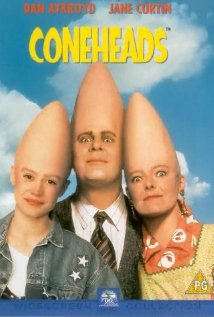
Coneheads: written by Tom Davis, Dan Aykroyd, Bonnie Turner, and Terry Turner; directed by Steve Barron; starring Dan Aykroyd (Beldar Conehead), Jane Curtin (Prymatt Conehead), Phil Hartman (Marlax), David Spade (Eli Turnbull), Michael McKean (Gorman Seedling), Michelle Burke (Connie Conehead), and Chris Farley (Ronnie) (1993): I really like Coneheads. Many do not. But I think it's one of the five best movies based on characters who first appeared on Saturday Night Live. The script and performances are funny, the cameos are almost ridiculously abundant, and even the product placements (there are a lot of them) are weirdly funny at times. I mean, I'm not sure anyone would go to Subway based on the way its sandwiches are eaten here. Even the science-fiction elements are intermittently more well-thought-out than those one would find in a dramatic science-fiction film. the film even uses David Spade perfectly. Recommended.
Lincoln: written by Tony Kushner, based partially on Team of Rivals by Doris Kearns Goodwin; directed by Steven Spielberg; starring Daniel Day Lewis (Abraham Lincoln), Sally Field (Mary Todd Lincoln), David Straitharn (William Seward), Joseph Gordon-Levitt (Robert Lincoln), James Spader (W.N. Bilbo), Tommy Lee Jones (Thaddeus Stevens) and Hal Holbrook (Preston Blair) (2012): Spielberg and Kushner put together a movie that would have made Stanley Kramer (Judgement at Nuremberg, Inherit the Wind) proud, as it engages history in a most Kramerian way: it deploys an all-star cast playing real, or at least based-on-real, people; and the movie positively bristles with lengthy, literate speeches in the service of explaining historical events, political gamesmanship, and ideological viewpoints.
Lincoln focuses on a couple of months towards the end of the American Civil War, as Lincoln jockeys to get the anti-slavery 13th Amendment passed by Congress before the war ends, and brings dozens of pro-slavery Southern congressmen back into the U.S. government. To do so requires pretty much every political trick available to Lincoln, most notably the appointment of out-going Democratic congressmen to governmental patronage jobs in exchange for their 'Yes' votes. With the November elections over, but the new congressmen not slated to take over their seats until March, much of Lincoln's strategy relies on these lame-duck political opponents.
Lincoln also knows that the war is all but over: the industrial North has begun to overwhelm the South. And a diplomatic party of Rebel politicians is on its way to negotiate a peace settlement. And so the need for speed and expediency increases, as does the need for political shenanigans in the service of a greater good.
Lincoln does a fine job of laying out the various factions in this fight. The radical abolitionists of the North want more than just the 13th Amendment, and they want it now. But trying for more will almost undoubted cause the anti-slavery movement to lose everything. And so Lincoln has to create a temporary voting coalition from disparate parts.
I think this is a very good movie about the pragmatic idealism of Lincoln and, by extension, other great politicians. Daniel Day-Lewis disappears into the role, his Lincoln a somewhat high-voiced man who slouches a lot because he's taller than everyone around him. The other actors, especially Tommy Lee Jones as a radical abolitionist whose influence is needed and Sally Field as the distressed and vitriolic Mary Todd Lincoln, deliver fine performances.
Spielberg keeps his showiness to a minimum in service to the story: the chief stylistic device here is the abundance of low-lighting scenes that show just how physically dark the mid-19th century was after the sun went down. Metaphorically speaking, the characters are all submerged not only in the fog of war, but in the crepuscular world of political manuevering, a world where the sun never rises or sets completely.
One of the interesting things that comes out, in terms of parallels to today's politics, is that small land-owning farmers were often against slavery because the slave plantations were the original Factory Farms. Their cheap labour allowed them to steamroll small farmers. It's funny how circumstances change and remain the same in certain areas. Well, not funny 'Ha ha.' Recommended.


