The King's Speech (2010): written by David Seidler; directed by Tom Hooper; starring Colin Firth (King George VI), Helena Bonham Carter (Queen Elizabeth), Derek Jacobi (Archbishop Lang), Geoffrey Rush (Lionel Logue), Michael Gambon (King George V), and Guy Pearce (King Edward VIII): Colin Firth certainly is good in his Oscar-winning Best Actor performance as King George VI, afflicted with a stammer and stuck with a whole lot of public speaking gigs once he assumes the British throne after his brother's abdication.
The whole thing is about as rock-solid a BBC sort-of production as one could want -- indeed, it really plays like a Very Special Episode of Masterpiece Theatre. Geoffrey Rush is fine as the eccentric speech therapist who helps Bertie overcome his speaking problems and Guy Pearce is subtly wormy as Edward VIII.
One can understand the Best Actor Oscar. Oscars for Best Director, Best Original Screenplay, and Best Picture testify more to how much Hollywood loves a certain type of Presitgious British Cinema (and movies about real people who have to overcome physical and/or mental problems) than to the movie's quality. Recommended.
The Theory of Everything: adapted by Anthony McCarten from the non-fiction memoir by Jane Hawking; directed by James Marsh; starring Eddie Redmayne (Stephen Hawking), Felicity Jones (Jane Hawking), Maxine Peake (Elaine Mason), and Charlie Cox (Jonathan Hellyer Jones) (2014): Eddie Redmayne's Oscar-winning performance as ALS-afflicted physicist Stephen Hawking really is remarkable, on par with Daniel Day-Lewis's break-out Oscar-winning portrayal of Christy Brown in 1989's My Left Foot.
Unlike Day-Lewis, Redmayne portrays a man who gradually becomes immobilized by his disease. Like Day-Lewis, Redmayne avoids going for mawkish sympathy from the viewer. Felicity Jones is excellent as Hawking's first wife -- as Jane Hawking, Jones may actually be on-screen more than Redmayne. She makes Jane brave and sympathetic, more sympathetic than Stephen by the end (the movie is based on one of her memoirs, after all).
The movie's relatively faithful to reality, with the requisite condensing and conflating of events. The direction is competent, workman-like. When it strives for the cosmological sublime, it looks like a Discovery Channel show on space-time that's been stripped of Morgan Freeman's narration. Brief explanations of Hawking's importance to physics occur throughout, accurate though truncated.
Hawking's atheism (counterpointed throughout with Jane's devout Roman Catholicism) isn't addressed honestly, though, or accurately in relation to his best-selling A Brief History of Time. The movie makes that non-fiction work in which Hawking posits a model of the universe that he explicitly states leaves God nothing to do as a love letter about faith to his wife, by omitting the whole 'nothing to do' thing from discussion and instead focusing on Hawking's metaphoric bit about "reading the mind of God" as if it were literal.
Titles to keep the viewer aware of when things happen would have been nice, especially as the make-up people seem to have forgotten to age Felicity Jones over the 30 year span of the film's events. And the first half of the movie, which deals with the first two years or so of Hawking's ALS and marriage, is far stronger dramatically than the increasingly montage-like later scenes, as we rush through three decades like a careening space probe being sucked into a black hole. Recommended.
Lincoln: written by Tony Kushner, based partially on Team of Rivals by Doris Kearns Goodwin; directed by Steven Spielberg; starring Daniel Day Lewis (Abraham Lincoln), Sally Field (Mary Todd Lincoln), David Straitharn (William Seward), Joseph Gordon-Levitt (Robert Lincoln), James Spader (W.N. Bilbo), Tommy Lee Jones (Thaddeus Stevens) and Hal Holbrook (Preston Blair) (2012): Spielberg and Kushner put together a movie that would have made Stanley Kramer (Judgement at Nuremberg, Inherit the Wind) proud, as it engages history in a most Kramerian way: it deploys an all-star cast playing real, or at least based-on-real, people; and the movie positively bristles with lengthy, literate speeches in the service of explaining historical events, political gamesmanship, and ideological viewpoints.
Lincoln focuses on a couple of months towards the end of the American Civil War, as Lincoln jockeys to get the anti-slavery 13th Amendment passed by Congress before the war ends, and brings dozens of pro-slavery Southern congressmen back into the U.S. government. To do so requires pretty much every political trick available to Lincoln, most notably the appointment of out-going Democratic congressmen to governmental patronage jobs in exchange for their 'Yes' votes. With the November elections over, but the new congressmen not slated to take over their seats until March, much of Lincoln's strategy relies on these lame-duck political opponents.
Lincoln also knows that the war is all but over: the industrial North has begun to overwhelm the South. And a diplomatic party of Rebel politicians is on its way to negotiate a peace settlement. And so the need for speed and expediency increases, as does the need for political shenanigans in the service of a greater good.
Lincoln does a fine job of laying out the various factions in this fight. The radical abolitionists of the North want more than just the 13th Amendment, and they want it now. But trying for more will almost undoubted cause the anti-slavery movement to lose everything. And so Lincoln has to create a temporary voting coalition from disparate parts.
I think this is a very good movie about the pragmatic idealism of Lincoln and, by extension, other great politicians. Daniel Day-Lewis disappears into the role, his Lincoln a somewhat high-voiced man who slouches a lot because he's taller than everyone around him. The other actors, especially Tommy Lee Jones as a radical abolitionist whose influence is needed and Sally Field as the distressed and vitriolic Mary Todd Lincoln, deliver fine performances.
Spielberg keeps his showiness to a minimum in service to the story: the chief stylistic device here is the abundance of low-lighting scenes that show just how physically dark the mid-19th century was after the sun went down. Metaphorically speaking, the characters are all submerged not only in the fog of war, but in the crepuscular world of political manuevering, a world where the sun never rises or sets completely.
One of the interesting things that comes out, in terms of parallels to today's politics, is that small land-owning farmers were often against slavery because the slave plantations were the original Factory Farms. Their cheap labour allowed them to steamroll small farmers. It's funny how circumstances change and remain the same in certain areas. Well, not funny 'Ha ha.' Recommended.
The Goodbye Girl: written by Neil Simon; directed by Herbert Ross; starring Richard Dreyfuss (Elliot Garfield), Marsha Mason (Paula McFadden) and Quinn Cummings (Lucy McFadden) (1977): Richard Dreyfuss won the Best Actor Oscar for 1977 for this film, becoming the youngest Best Oscar winner until Adrien Brody more than 20 years later. It's a manic performance in a solid romantic comedy, with the usual mix of rapid-fire patter and sentimentality that distinguishes most Neil Simon material, especially from his heyday of the 1960's and 1970's.
A series of mishaps puts single mother Marsha Mason, daughter Quinn Cummings, and Dreyfuss in the same apartment in New York for four months while she searches for a job and he prepares to play Richard III in an off-Broadway production of Shakespeare's play. Various meet-cute things happen. Mason's character tries to come to grips with her tendency to be attracted to men who always leave her; Dreyfus's character tries to come to grips with the horrible botch that this version of Richard III is turning out to be.
The film holds up for the most part, though much of the comedy of this version of Richard III hasn't aged all that well, given that much of it is based on the director's misguided efforts to make Richard III gay. And by gay, we mean stereotyped-gay. And it's a bit hard to navigate exactly where the comedy is supposed to be situated in those scenes dealing with this interpretation: with the ineptitude of the director or with the simple idea that Richard is being played as a stereotypical gay man? Is gayness in and of itself supposed to be the punchline here?
Mason's ten-year-old daughter is played as one of those wise-beyond-her-years children who luckily gets some good lines and isn't overwhelmingly annoying or surpassingly omniscient. Dreyfuss's character is an interesting assortment of twitches and bluster. I can't imagine him winning a Best Actor Oscar for this role now because, of course, the character is neither a historical figure nor someone suffering from a mental or physical illness. Have the Oscars gotten worse since 1977? Recommended.
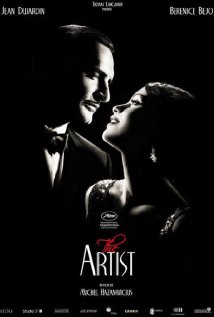
The Artist: written and directed by Michel Hazanavicius: starring Jean Dujardin (George Valentin), Berenice Bejo (Peppy Miller), John Goodman (Al Zimmer), and James Cromwell (Clifton) (2011): Hollywood tends to like its metanarratives peppy and upbeat when it's going to reward them with Oscars, and on the surface last year's Best Picture winner is just that. There's an underlying thread of despair, though, reminiscent of the sort of thing one sometimes found in Charlie Chaplin movies. Thankfully, the abyss is kept at bay with slapstick, dancing, and some awfully good scenes involving a dog.
This mostly silent movie (there's a score and sound effects and voices at key moments), shot in colour but presented entirely in period-appropriate black and white (and in a period-appropriate 1:1.33 aspect ratio) is a delight about the last days of silent motion pictures and the first few years of sound in Hollywood. Box-office king George Valentin, loosely based on Douglas Fairbanks, Jr., finds himself a relic of the past. The ingenue he discovered, Peppy White, finds herself becoming a big star.
The plot bears some similarity to the oft-filmed chestnut A Star is Born. Shot and staged like a late-silent-era movie, we get a certain amount of approriate mugging, a heroic dog with several killer scenes (one in which he fetches a police officer is a lovely bit of business worthy of a Chaplin or a Keaton), and a host of actors who look pretty much absolutely right for the time period and the way films looked back then. The French stars look great, while the Hollywood supporting actors -- most notably John Goodman and James Cromwell -- have the sort of faces that work perfectly in this milieu.
While there are also parallels between the plot of The Artist and Singing in the Rain, the number of allusions and references is broader than that. One will see shades of some of F.W. Murnau's films, Sunset Boulevard, Citizen Kane, City Lights, a musical quote from Vertigo, and a number of Guy Maddin films that play in the same sandbox. But you don't need a background in film to enjoy these references and salutes: The Artist is a delight on its own, and a delight from beginning to end. Highly recommended.