La La Land (2016): written and directed by Damien Chazelle; music, songs and lyrics by Justin Hurwitz, Benj Pasek, and Justin Paul; starring Ryan Gosling (Sebastian) and Emma Stone (Mia): A 2016 Oscar winner for Best Director and Best Actress, though memorably not Best Picture (oh, look it up). La La Land is a fairly frothy musical salute to Hollywood and, um, jazz clubs, two things not generally associated with each other. And following your dreams!
La La Land is at its best when it stays light -- a third-act move into melodrama doesn't entirely work, in part because that also means an end to songs and dancing for the space of about 20 minutes. Ryan Gosling and Emma Stone are good in their roles as star-crossed lovers of the jazz-loving and film-acting variety, respectively.
Stone's pre-movie work-outs to prepare for all the dancing did leave her face looking dismayingly gaunt when photographed from certain angles and in certain lighting. Gosling continues with the cool, generally laid-back persona that suggests he's watched a lot of early Jeff Bridges movies, to positive effect. The direction and choreography both work nicely for the most part, and some of the songs are quite catchy. Recommended.
Star Trek: Into Darkness: written by Roberto Orci, Alex Kurtzman, and Damon Lindelof; based on characters created by Gene Roddenberry, Carey Wilber, Gene L. Coon, Harve Bennett, Jack B. Sowards, Samuel A. Peeples, Nicholas Meyer, and Ramon Sanchez; directed by J.J. Abrams; starring Chris Pine (Captain Kirk), Zachary Quinto (Mr. Spock), Zoe Saldana (Uhura), Karl Urban (McCoy), Simon Pegg (Scotty), John Cho (Sulu), Anton Yelchin (Chekov), Bruce Greenwood (Pike), Peter Weller (Admiral Marcus), Alice Eve (Carol Marcus) and Benedict Cumberbatch (John Harrison) (2013): The second Trek film from J.J. Abrams and company plays better on second viewing, I think. It's still too action-packed for its own good, and it needed to create new scenes rather than re-mixing old ones, but its heart seems to be in the right place. Though the redesigned Klingons really seem to be heavily into piercings. Recommended.
Cloverfield: written by Drew Goddard; directed by Matt Reeves; starring Lizzy Caplan (Marlena Diamond), Jessica Lucas (Lily Ford), T.J. Miller (Hud), Michael Stahl-David (Rob Hawkins), Mike Vogel (Jason Hawkins) and Odette Annable (Beth) (2008): I'm not entirely certain why I enjoy this movie so much. I think I just like seeing annoying yuppies pursued through Manhattan by a 500 foot-long gecko.
I do think viewers who thought the annoying nature of the protagonists was accidental miss the point of the whole film: these are some of the annoying, self-absorbed New Yorkers whose actions would contribute to the financial meltdown several months after Cloverfield was released. Hell, the movie's prescient! The handheld camerawork throughout makes this the only giant monster movie I can think of which is overwhelmingly claustrophobic rather than spacious and sublime, especially in a great scene in which giant shrimp-spiders pursue the protagonists down a dark subway tunnel. Recommended.
Argo: adapted by Chris Terrio from work by Tony Mendez and Joshuah Bearman; directed by Ben Affleck; starring Ben Affleck (Tony Mendez), Bryan Cranston (Jack O'Donnell), Alan Arkin (Lester Siegel), John Goodman (John Chambers), and Victor Garber (Ken Taylor) (2012): In 1979, the Canadian embassy in Iran secretly sheltered six American diplomats who'd escaped the hostage-taking of the rest of the American embassy staff by Iranian militants. It was a wild true story, told in Best-Picture-Oscar winner Argo as a thriller in which Americans are actually almost completely behind the escape of those escapees from Iran.
OK, historical inaccuracies and omissions make Argo only slightly more fact-based than your average Aliens Invented Thanksgiving documentary on The History Channel. And I think backing off a bit on some of the thrillery additions and alterations to the real story might have made this feel a bit less contrived and Hollywoodesque.
Absolutely none of the tense moments of the last 40 minutes of the film, as CIA agent Affleck rushes to get the six American diplomats hidden at Canadian ambassador Ken Taylor's residence onto a plane and out of Iran before their cover is blown, really happened. By the time Iranians race to catch an ascending plane with their cars and jeeps, the artificiality of the whole exercise seems to mirror the bizarre artificiality of the central premise of the escape plan: that the six diplomats pretend to be part of a film crew scouting Iran for locations for a science-fiction film named Argo.
Well, so it goes. Canada at least comes across better than New Zealand and Great Britain. Argo claims they refused to help the escaped embassy staff when in reality Canada, Great Britain, and New Zealand all took part in the dangerous months-long ordeal -- to the extent that in real life, New Zealand diplomats, and not Ben Affleck, drove the escapees to the airport during the events that conclude the film. And Jimmy Carter didn't have to authorize the purchase of airplane tickets in the nick of time, as the movie shows -- Canadian ambassador Ken Taylor's wife had already bought those tickets. Oh, well. I was entertained! Recommended.
Mrs. Miniver: based on the book by Jan Struther; written by Arthur Wimperis, George Froeschel, James Hilton, Claudine West, Paul Osborn, and R.C. Sheriff; directed by William Wyler; starring Greer Garson (Mrs. Miniver), Walter Pidgeon (Clem Miniver), Teresa Wright (Carol Beldon), Richard Ney (Vin Miniver), Henry Travers (Mr. Ballard) and Dame May Whitty (Lady Beldon) (1942): Multiple Oscar winner is almost a perfect example of Classic Hollywood Drama. Greer Garson became a big star thanks to her portrayal of middle-class British housewife Mrs. Miniver in a small town just outside of London during the first two years of World War Two for Great Britain. The movie itself was also a huge box-office hit and a rallying point for America as it entered World War Two.
This is Hollywood England, so we never find out why Miniver's husband, played by Canadian Walter Pidgeon, doesn't sound English, or how their son developed an almost parodic upper-class-twit accent, given that they're middle-class and neither of them sound remotely like him. American Teresa Wright also doesn't sound particularly English. Things never really change in Hollywood.
But anyway, much rallying of spirits occurs as Mrs. Miniver and the town endure war, Nazi bombing, fugitive Nazi airmen, Dunkirk (Mr. Miniver owns a boat and so is drafted into helping out with the evacuation), personal tragedy, a dogfight that seems to take place about three feet above the English countryside, and the annual Canterbury flower show.
That last is a major plot point, by the way. President Roosevelt loved the movie for its propaganda value as America itself finally entered the war. The final singing of "Onward, Christian Soldiers" may strike one as mildly disturbing -- the Nazis loved putting crosses on their military hardware, after all. Recommended.
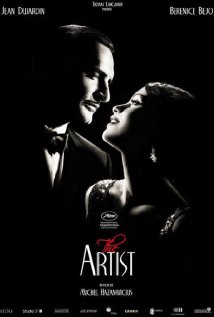
The Artist: written and directed by Michel Hazanavicius: starring Jean Dujardin (George Valentin), Berenice Bejo (Peppy Miller), John Goodman (Al Zimmer), and James Cromwell (Clifton) (2011): Hollywood tends to like its metanarratives peppy and upbeat when it's going to reward them with Oscars, and on the surface last year's Best Picture winner is just that. There's an underlying thread of despair, though, reminiscent of the sort of thing one sometimes found in Charlie Chaplin movies. Thankfully, the abyss is kept at bay with slapstick, dancing, and some awfully good scenes involving a dog.
This mostly silent movie (there's a score and sound effects and voices at key moments), shot in colour but presented entirely in period-appropriate black and white (and in a period-appropriate 1:1.33 aspect ratio) is a delight about the last days of silent motion pictures and the first few years of sound in Hollywood. Box-office king George Valentin, loosely based on Douglas Fairbanks, Jr., finds himself a relic of the past. The ingenue he discovered, Peppy White, finds herself becoming a big star.
The plot bears some similarity to the oft-filmed chestnut A Star is Born. Shot and staged like a late-silent-era movie, we get a certain amount of approriate mugging, a heroic dog with several killer scenes (one in which he fetches a police officer is a lovely bit of business worthy of a Chaplin or a Keaton), and a host of actors who look pretty much absolutely right for the time period and the way films looked back then. The French stars look great, while the Hollywood supporting actors -- most notably John Goodman and James Cromwell -- have the sort of faces that work perfectly in this milieu.
While there are also parallels between the plot of The Artist and Singing in the Rain, the number of allusions and references is broader than that. One will see shades of some of F.W. Murnau's films, Sunset Boulevard, Citizen Kane, City Lights, a musical quote from Vertigo, and a number of Guy Maddin films that play in the same sandbox. But you don't need a background in film to enjoy these references and salutes: The Artist is a delight on its own, and a delight from beginning to end. Highly recommended.