My Little Chickadee: written by W.C. Fields and Mae West; directed by Edward F. Cline; starring W.C. Fields (Cuthbert J. Twillie), Mae West (Flower Belle Lee), Margaret Hamilton (Mrs. Gideon) and Donald Meek (Amos Budge) (1940): Two of the biggest movie-comedy stars of the 1930's team up for 1940, while hating each other in real life all the while. Both Mae West and W.C. Fields were in the home stretch of movie stardom when they did My Little Chickadee -- West would live for another 40 years but without being a box-office star, while Fields would be dead by 1946.
Their comedy personas are fascinating, though overwhelmed somewhat by time and distance and changing taste. West really isn't all that funny, a problem caused in part by the escalation in movie censorship at the time. It's hard for a comedienne whose comedy is based on double-entendres if the censorship people won't allow them. Fields is a lot funnier. It helps that he does some physical comedy. That stuff never gets old. He falls into a bathtub. He mistakenly romances a goat. Hoo ha!
The two stars wrote their own lines; West also wrote the rest of the movie. Fields was a drunken boor during filming; West was a professional. You can still see the appeal of the then-47-year-old West in her scenes. The movie's certainly an interesting historical artifact, and it does point the way back in time to better individual projects for the two stars. Lightly recommended.
Gravity: written by Alfonso and Jonas Cuaron and George Clooney; directed by Alfonso Cuaron; starring Sandra Bullock (Ryan Stone), George Clooney (Matt Kowalski) and Ed Harris (Mission Control) (2013): The plot and characterization of Gravity creak and groan as if the movie had been penned in the early days of silent movies. The technology needed to make the film amazes, and the film's set-pieces and terse pacing won it a number of Oscars, including Best Director.
I like George Clooney and Sandra Bullock. I'm guessing that much of the movie-viewing public does as well: it's their film. There are almost no other characters. When their space-shuttle mission goes awry, survival in space becomes the movie's point. But because we live in the era of Hollywood Screenwriting 101 and the endless need to supply the viewer with "motivation," Bullock must also be supplied with motivation.
Yes, motivation for surviving in space. Motivation for NOT DYING. Writing in the movies hasn't gotten worse over the years, but it has gotten worse in the blockbusters and big-budget extravaganzas. Sandra Bullock can't just be a professional with a survival instinct. She has to have a sad past. She has to be emotionally crippled until someone gives her a lecture because even imminent death isn't enough to shake her out of her self-pity. Women! Am I right, Hollywood guys?
So some stuff happens in space and Bullock and Clooney have to deal with it. The effects are pretty nice, though occasionally ridiculous to anyone with a modicum of knowledge of physics and orbital mechanics. Stars impossibly twinkle in space. People suddenly become religious. There are pep talks and floating things and microgravity explosions. The title never really makes sense. The actual direction is as old as D.W. Griffith figuring these things out in 1915, and the old tricks still work, especially with CGI and 3-D and astonishingly complicated technical systems. So it goes. Recommended.
Showing posts with label best director. Show all posts
Wednesday, July 23, 2014
Tuesday, January 29, 2013
Groove is in the Heart
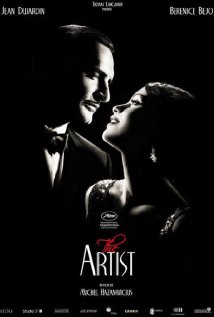
The Artist: written and directed by Michel Hazanavicius: starring Jean Dujardin (George Valentin), Berenice Bejo (Peppy Miller), John Goodman (Al Zimmer), and James Cromwell (Clifton) (2011): Hollywood tends to like its metanarratives peppy and upbeat when it's going to reward them with Oscars, and on the surface last year's Best Picture winner is just that. There's an underlying thread of despair, though, reminiscent of the sort of thing one sometimes found in Charlie Chaplin movies. Thankfully, the abyss is kept at bay with slapstick, dancing, and some awfully good scenes involving a dog.
This mostly silent movie (there's a score and sound effects and voices at key moments), shot in colour but presented entirely in period-appropriate black and white (and in a period-appropriate 1:1.33 aspect ratio) is a delight about the last days of silent motion pictures and the first few years of sound in Hollywood. Box-office king George Valentin, loosely based on Douglas Fairbanks, Jr., finds himself a relic of the past. The ingenue he discovered, Peppy White, finds herself becoming a big star.
The plot bears some similarity to the oft-filmed chestnut A Star is Born. Shot and staged like a late-silent-era movie, we get a certain amount of approriate mugging, a heroic dog with several killer scenes (one in which he fetches a police officer is a lovely bit of business worthy of a Chaplin or a Keaton), and a host of actors who look pretty much absolutely right for the time period and the way films looked back then. The French stars look great, while the Hollywood supporting actors -- most notably John Goodman and James Cromwell -- have the sort of faces that work perfectly in this milieu.
While there are also parallels between the plot of The Artist and Singing in the Rain, the number of allusions and references is broader than that. One will see shades of some of F.W. Murnau's films, Sunset Boulevard, Citizen Kane, City Lights, a musical quote from Vertigo, and a number of Guy Maddin films that play in the same sandbox. But you don't need a background in film to enjoy these references and salutes: The Artist is a delight on its own, and a delight from beginning to end. Highly recommended.
This mostly silent movie (there's a score and sound effects and voices at key moments), shot in colour but presented entirely in period-appropriate black and white (and in a period-appropriate 1:1.33 aspect ratio) is a delight about the last days of silent motion pictures and the first few years of sound in Hollywood. Box-office king George Valentin, loosely based on Douglas Fairbanks, Jr., finds himself a relic of the past. The ingenue he discovered, Peppy White, finds herself becoming a big star.
The plot bears some similarity to the oft-filmed chestnut A Star is Born. Shot and staged like a late-silent-era movie, we get a certain amount of approriate mugging, a heroic dog with several killer scenes (one in which he fetches a police officer is a lovely bit of business worthy of a Chaplin or a Keaton), and a host of actors who look pretty much absolutely right for the time period and the way films looked back then. The French stars look great, while the Hollywood supporting actors -- most notably John Goodman and James Cromwell -- have the sort of faces that work perfectly in this milieu.
While there are also parallels between the plot of The Artist and Singing in the Rain, the number of allusions and references is broader than that. One will see shades of some of F.W. Murnau's films, Sunset Boulevard, Citizen Kane, City Lights, a musical quote from Vertigo, and a number of Guy Maddin films that play in the same sandbox. But you don't need a background in film to enjoy these references and salutes: The Artist is a delight on its own, and a delight from beginning to end. Highly recommended.
Subscribe to:
Posts (Atom)