Star Trek: Into Darkness: written by Roberto Orci, Alex Kurtzman, and Damon Lindelof; based on characters created by Gene Roddenberry, Carey Wilber, Gene L. Coon, Harve Bennett, Jack B. Sowards, Samuel A. Peeples, Nicholas Meyer, and Ramon Sanchez; directed by J.J. Abrams; starring Chris Pine (Captain Kirk), Zachary Quinto (Mr. Spock), Zoe Saldana (Uhura), Karl Urban (McCoy), Simon Pegg (Scotty), John Cho (Sulu), Anton Yelchin (Chekov), Bruce Greenwood (Pike), Peter Weller (Admiral Marcus), Alice Eve (Carol Marcus) and Benedict Cumberbatch (John Harrison) (2013): The second Trek film from J.J. Abrams and company plays better on second viewing, I think. It's still too action-packed for its own good, and it needed to create new scenes rather than re-mixing old ones, but its heart seems to be in the right place. Though the redesigned Klingons really seem to be heavily into piercings. Recommended.
Cloverfield: written by Drew Goddard; directed by Matt Reeves; starring Lizzy Caplan (Marlena Diamond), Jessica Lucas (Lily Ford), T.J. Miller (Hud), Michael Stahl-David (Rob Hawkins), Mike Vogel (Jason Hawkins) and Odette Annable (Beth) (2008): I'm not entirely certain why I enjoy this movie so much. I think I just like seeing annoying yuppies pursued through Manhattan by a 500 foot-long gecko.
I do think viewers who thought the annoying nature of the protagonists was accidental miss the point of the whole film: these are some of the annoying, self-absorbed New Yorkers whose actions would contribute to the financial meltdown several months after Cloverfield was released. Hell, the movie's prescient! The handheld camerawork throughout makes this the only giant monster movie I can think of which is overwhelmingly claustrophobic rather than spacious and sublime, especially in a great scene in which giant shrimp-spiders pursue the protagonists down a dark subway tunnel. Recommended.
Argo: adapted by Chris Terrio from work by Tony Mendez and Joshuah Bearman; directed by Ben Affleck; starring Ben Affleck (Tony Mendez), Bryan Cranston (Jack O'Donnell), Alan Arkin (Lester Siegel), John Goodman (John Chambers), and Victor Garber (Ken Taylor) (2012): In 1979, the Canadian embassy in Iran secretly sheltered six American diplomats who'd escaped the hostage-taking of the rest of the American embassy staff by Iranian militants. It was a wild true story, told in Best-Picture-Oscar winner Argo as a thriller in which Americans are actually almost completely behind the escape of those escapees from Iran.
OK, historical inaccuracies and omissions make Argo only slightly more fact-based than your average Aliens Invented Thanksgiving documentary on The History Channel. And I think backing off a bit on some of the thrillery additions and alterations to the real story might have made this feel a bit less contrived and Hollywoodesque.
Absolutely none of the tense moments of the last 40 minutes of the film, as CIA agent Affleck rushes to get the six American diplomats hidden at Canadian ambassador Ken Taylor's residence onto a plane and out of Iran before their cover is blown, really happened. By the time Iranians race to catch an ascending plane with their cars and jeeps, the artificiality of the whole exercise seems to mirror the bizarre artificiality of the central premise of the escape plan: that the six diplomats pretend to be part of a film crew scouting Iran for locations for a science-fiction film named Argo.
Well, so it goes. Canada at least comes across better than New Zealand and Great Britain. Argo claims they refused to help the escaped embassy staff when in reality Canada, Great Britain, and New Zealand all took part in the dangerous months-long ordeal -- to the extent that in real life, New Zealand diplomats, and not Ben Affleck, drove the escapees to the airport during the events that conclude the film. And Jimmy Carter didn't have to authorize the purchase of airplane tickets in the nick of time, as the movie shows -- Canadian ambassador Ken Taylor's wife had already bought those tickets. Oh, well. I was entertained! Recommended.
Ten Tales Calculated to Give you Shudders (1972): edited by Ross Olney containing the following stories: Sweets to the Sweet (1947) by Robert Bloch; The Waxwork (1931) by A. M. Burrage; Used Car (1932) by H. Russell Wakefield; The Inexperienced Ghost (1896) by H. G. Wells; The Whistling Room (1910) by William Hope Hodgson; The Last Drive (1933) by Carl Jacobi; The Monkey's Paw (1902) by W. W. Jacobs; Second Night Out (1933) by Frank Belknap Long; The Hills Beyond Furcy (1966) by Robert G. Anderson; and Floral Tribute (1949) by Robert Bloch.
This little reprint anthology was a staple of my childhood, and probably the childhood of a lot of other Americans and Canadians, given that it was a Whitman book for older kids, or 'Young Adults' as the publishing industry now names them.
And it's a very good ten-story assortment, though the inclusion of two Robert Bloch stories, the second one a bit of Bradburyian supernatural nostalgia that won't make anyone shudder, seems odd. Maybe Olney and Bloch were buddies. Other than that oddity, the selection can stand beside that of pretty much any decades-spanning anthology I can think of. It's certainly still relevant today. I wonder if Wakefield's story is the first haunted used-car story? Recommended.
Scars and Other Distinguishing Marks (1987) by Richard Christian Matheson containing the following stories: Third Wind; The Good Always Comes Back; Sentences; Unknown Drives; Timed Exposure; Obsolete; Red; Beholder; Dead End; Commuters; Graduation; Conversation Piece; Echoes; Incorporation; Hell; Break-Up; Mr. Right; Cancelled; Mugger; The Dark Ones; Holiday; Vampire; Intruder; Dust; Goosebumps; Mobius; Where There's a Will; and Magic Saturday.
Horror and fantasy great Richard Matheson's son Richard Christian Matheson is no slouch either, having carved out a prominent career for himself in television, movies, and short stories by the time he was 30.
Scars and Other Distinguishing Marks is the younger Matheson's first collection of short stories (and one teleplay for Amazing Stories). As he pretty much specialized in very short stories, there's quite a range of stories included here, with supernatural horror, realistic horror, science fiction, and gentle whimsy all showing up. And one disturbing narrative that doubles as a poem ("Vampire").
The impact of such short stories requires a certain type of writer: terse and concise in his style, imaginative and unusual in the subjects he deals with and the POV he uses to view those subjects. Matheson is astonishingly good at these things at a very young age, an engaging mutation from the schools of O. Henry and Dennis Etchison (who provides one of the two glowing-with-praise forewords, the other coming from a similarly enthusiastic Stephen King). Recommended.
Whispers VI: edited by Stuart David Schiff (1987) containing the following stories:
The Bones Wizard by Alan Ryan: Supernatural musical shenanigans. Extremely subtle to the point of attenuation, with little actual horror.
Leaks by Steve Rasnic Tem: Quintessential Tem: mysterious, disturbing, rooted in the real.
Everything to Live For by Charles L. Grant: Almost a Philip K. Dick science-fiction horror story both in execution and in its treatment of its themes.
Bogy by Al Sarrantonio: Poetic, Bradburyesque piece with the sort of nasty ending that Bradbury specialized in back in the 1940's.
The Fool by David Drake: Lengthy novella echoes the regional dialects and themes of Drake's friend, horror legend Manly Wade Wellman, but with its own peculiar spin on magic and justice. Really a good, convincingly regional piece, and quite different from much of Drake's other output.
Repossession by David Campton: Enjoyable ghost story with a couple of interesting concepts. Would probably work better if it developed the narrator more.
The Years the Music Died by F. Paul Wilson: Bleakly humourous conspiracy tale about Rock-and-Roll.
The Woman in Black by Dennis Etchison: Typically elusive Etchison tale of mysterious horrors in the suburbs turns into an almost surreal freak-out at the end. This is not an ending you will see coming. Disturbing.
My Name Is Dolly by William F. Nolan: Concise, ably narrated in the first-person by a child, straddles psychological and supernatural horror.
Toad, Singular by Juleen Brantingham: Well-written but intensely unpleasant story in what I generally find to be an unrewarding sub-sub-genre of horror: the tale of a sympathetic nebbish who's been brutalized by the normal world...and now gets further brutalized by the supernatural! It all feels awfully sadistic.
Sleeping Booty by Richard Wilson: Droll short-short: black comedy, not horror.
Privacy Rights by J. N. Williamson: Really disturbing bit involving rape and abortion. Verges on the exploitative, and the madness of the main character doesn't seem fully earned by the story.
One for the Horrors by David J. Schow: Great, nostalgic piece about old movies and lonely people. Not horror.
The Black Clay Boy by Lucius Shepard: Super-duper creepy tale of sex, death, magic, and what I'd describe as Hagar Shipley goes to Hell.
Where Did She Wander? by Manly Wade Wellman: The last John the Balladeer story by the then-recently-deceased Wellman. Lovely and somewhat mournful.
In all: highly recommended.
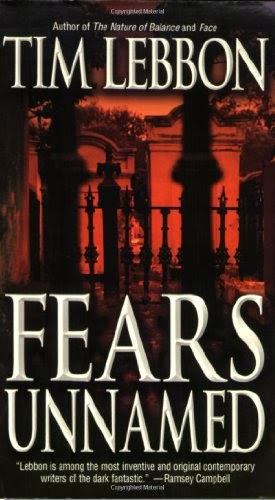
Fears Unnamed by Tim Lebbon (2004) containing the following stories:
Remnants: A really lovely combination of eerie, cosmic, Time-Abyss adventures in a mysterious lost city and psychological realism, as the problems and disappointments of two life-long friends -- one an adventurer and archaeologist, the other a sedentary writer depressingly disappointed by the choices he's made -- are examined and evaluated during a descent into the unknown.
White: An apocalyptic story of the 'Ten Little Indians' variety. Several acquaintances become snowbound in Northern England while the world rapidly plunges into chaos and mysterious destruction, and the snow keeps coming. And weird, weird, half-glimpsed creatures prowl the snow. Or are the gruesome murders being committed actually the work of someone inside the house?
Naming of Parts: Lebbon takes what initially seems to be a zombie plague observed by a 12-year-old boy and turns it into an apocalypse in which everything -- humanity, one's family, all of nature -- seems to be afflicted by entropy and rapid, irreversible decay. The ending in this one is a bit of a dud, as the story seems to demand some sort of closure that is instead given up to mysterious ambiguity. Nonetheless, very good and very sad.
The Unfortunate: Occasionally almost surreal weird-out about the sole survivor of a plane crash, and the supernatural forces behind his survival. The weirdness of the supernatural universe could use more development -- to the extent that this novella would probably make a wonderful novel -- though the bleakness of the material is never less than daunting. All four of these novellas evade and confound catharsis in a manner peculiar to the best horror fiction: there is no satisfying purgation here, only greater mysteries and sublime abjection.
In all: highly recommended.
Sky Captain and the World of Tomorrow: written and directed by Kerry Conran; starring Gwyneth Paltrow (Polly Perkins), Jude Law (Sky Captain), Giovanni Ribisi (Dex), Michael Gambon (Paley), Bai Ling (Assassin), Omid Djalili (Kaji), Angelina Jolie (Franky), and the digital ghost of Laurence Olivier (Dr. Totenkopf) (2004): Sky Captain and the World of Tomorrow creates a coherent world based on the comics and movie serials and science-fiction covers and cartoons of the 1930's, along with the New York World's Fair of 1939, itself dubbed The World of Tomorrow. It's gradually becoming a cult favourite, possibly because it uses CGI and digital compositing and virtual sets in the service of something retro and weird and wholly authentic in its own way.
Unfortunately, Paramount's decision to dump it in September 2004 with a baffling marketing campaign pretty much sealed its box-office doom. This is really too bad because writer-director Kerry Conran is much better at creating a digital movie-world than most famous directors have proven to be. The whole thing makes Georges Lucas' Star Wars prequel trilogy look visually dim-witted by comparison.
There's real character and charm in the designs, and in the performances by Gwyneth Paltrow as crusading reporter Polly Perkins and Jude Law as private air-hero Sky Captain, with a nice, relatively straightforward supporting performance from Giovanni Ribisi as gadgeteer Dex.
Along the way, the film drops into a number of locales that allude to forebears such as the 1930's film version of Lost Horizon, any number of Lost Worlds and Skull Islands, the Krell world-machine from Forbidden Planet, Thunderbirds, and brief visual homages to the 1930's King Kong and to the original Godzilla. All in all, it's swell. Highly recommended.
Mama: written by Andy Muschietti, Barbara Muschietti, and Neil Cross; directed by Andy Muschietti; starring Jessica Chastain (Annabel), Nikolaj Coster-Waldau (Lucas/Jeffrey), Megan Charpentier (Victoria), Isabelle Nelisse (Lily), Daniel Kash (Dr. Dreyfuss) and Javier Botet (Mama) (2013): Produced by Guillermo del Toro, Mama has some of his tropes scattered throughout, most notably the linkage of insects with the supernatural. It's not the most brilliant of horror movies, as at least two characters do really stupid horror-movie cliche things, and a sub-plot turns out to exist because it makes the main plot run more smoothly towards the end.
On the other hand, the movie looks great. The set design is impressively functional insofar as it's atmospheric while also serving the plot and not being ridiculous. Jessica Chastain is never less than fully invested in her lead character, almost unrecognizable in a black short-cut wig and raccoon eye make-up. Nikolaj Coster-Waldau (Jamie Lannister in Game of Thrones) has an oddly thankless dual part as twin brothers, both of whom disappear for the middle of the picture so thoroughly that one wonders if he was called away to do reshoots on that HBO series. And the two little girls do about as good a job of playing semi-feral girls abandoned in the woods for five years as one could ask.
The movie really succeeds or fails, though, on how one feels about the eponymous monster. Or ghost. Or ghost-monster. There are a couple of really nice aspects to the visualization of Mama: her hair perpetually seems to float as if she's underwater (and metaphorically speaking, she is). And she occasionally comes at people while almost completely submerged in the floor, with only her ghostly hair marking her approach like some ghastly shark's fin. There's more imaginative CGI in her creation than in all of Peter Jackson's last three films put together.
And there are also several imaginatively shot dream/memory sequences from Mama's standpoint that are seriously disturbing. It would be lovely if as much care had been taken with the story as is taken with the visuals, but at least the movie is neither found-footage nor 'based on a true story.' Recommended.
Lincoln: written by Tony Kushner, based partially on Team of Rivals by Doris Kearns Goodwin; directed by Steven Spielberg; starring Daniel Day Lewis (Abraham Lincoln), Sally Field (Mary Todd Lincoln), David Straitharn (William Seward), Joseph Gordon-Levitt (Robert Lincoln), James Spader (W.N. Bilbo), Tommy Lee Jones (Thaddeus Stevens) and Hal Holbrook (Preston Blair) (2012): Spielberg and Kushner put together a movie that would have made Stanley Kramer (Judgement at Nuremberg, Inherit the Wind) proud, as it engages history in a most Kramerian way: it deploys an all-star cast playing real, or at least based-on-real, people; and the movie positively bristles with lengthy, literate speeches in the service of explaining historical events, political gamesmanship, and ideological viewpoints.
Lincoln focuses on a couple of months towards the end of the American Civil War, as Lincoln jockeys to get the anti-slavery 13th Amendment passed by Congress before the war ends, and brings dozens of pro-slavery Southern congressmen back into the U.S. government. To do so requires pretty much every political trick available to Lincoln, most notably the appointment of out-going Democratic congressmen to governmental patronage jobs in exchange for their 'Yes' votes. With the November elections over, but the new congressmen not slated to take over their seats until March, much of Lincoln's strategy relies on these lame-duck political opponents.
Lincoln also knows that the war is all but over: the industrial North has begun to overwhelm the South. And a diplomatic party of Rebel politicians is on its way to negotiate a peace settlement. And so the need for speed and expediency increases, as does the need for political shenanigans in the service of a greater good.
Lincoln does a fine job of laying out the various factions in this fight. The radical abolitionists of the North want more than just the 13th Amendment, and they want it now. But trying for more will almost undoubted cause the anti-slavery movement to lose everything. And so Lincoln has to create a temporary voting coalition from disparate parts.
I think this is a very good movie about the pragmatic idealism of Lincoln and, by extension, other great politicians. Daniel Day-Lewis disappears into the role, his Lincoln a somewhat high-voiced man who slouches a lot because he's taller than everyone around him. The other actors, especially Tommy Lee Jones as a radical abolitionist whose influence is needed and Sally Field as the distressed and vitriolic Mary Todd Lincoln, deliver fine performances.
Spielberg keeps his showiness to a minimum in service to the story: the chief stylistic device here is the abundance of low-lighting scenes that show just how physically dark the mid-19th century was after the sun went down. Metaphorically speaking, the characters are all submerged not only in the fog of war, but in the crepuscular world of political manuevering, a world where the sun never rises or sets completely.
One of the interesting things that comes out, in terms of parallels to today's politics, is that small land-owning farmers were often against slavery because the slave plantations were the original Factory Farms. Their cheap labour allowed them to steamroll small farmers. It's funny how circumstances change and remain the same in certain areas. Well, not funny 'Ha ha.' Recommended.