The Thief of Broken Toys (2011) by Tim Lebbon: This lovely, lonely, haunting short novel is a thing of disturbing beauty from Tim Lebbon. There's a Ray Bradbury quality to some of the story elements (especially that eponymous being). But it's the leaner Bradbury of the 1940's, the one capable of horror.
The loss of a son to an undiagnosed genetic disorder has left the novel's protagonist, the boy's father, in an emotional purgatory as The Thief of Broken Toys begins. His wife struggles to move on -- in part by having left him. He stays at home, for the most part, where he's been for the most part of a year. And then, on one of his nightly walks on the English sea coast, he encounters the eponymous being -- an old man who offers him the ability to heal. Beware strangers bearing supernatural gifts, no matter how seemingly benign!
I don't know that all of the elements work. The occasionally intruding narration speaks to larger things outside the events of the novel, but it never entirely convinced me, or at least convinced me that it was necessary to the tragedy and horror of the story itself. Nonetheless, this is stellar work from Lebbon.
Technically this is 'quiet horror,' but it's horror nonetheless. And the final catastrophe horrifies without any blood being spilled or tentacled monster making an appearance. Actually, a tentacled monster would probably have been comforting. Highly recommended.
 The Keep (1981) by F. Paul Wilson: F. Paul Wilson's first 'big' novel is also his best. A dreadful movie adaptation in the mid-1980's, directed by Michael Mann, got pretty much everything wrong about Wilson's original. The Keep is a clever synthesis of vampire novel, cosmic horror, and high fantasy, though that last bit doesn't become evident until the last 50 pages or so. Its best horror moments come in its first half, while the full nature of the adversary remains hidden from reader and characters alike.
The Keep would soon be folded into Wilson's 'Adversary Cycle,' a six-novel arc that is itself part of a much larger body of work dubbed 'The Secret History of the World' that includes Wilson's multi-volume Repairman Jack series. My version of The Keep ends without any sort of cliffhanger or 'stinger' ending, but this may not be true of later editions of the novel. Wilson rewrote a number of novels to eradicate inconsistencies within both the Cycle and the Secret History.
The genius of The Keep lies in its use of the Nazis as foils to the greater evil growing inside the Keep. It's 1941. Much of the action occurs in an isolated part of Romania where German infantry have been entrusted with taking control of that mysterious Keep. The name itself is a misnomer -- there was never a castle surrounding the structure, and the name was simply attached as a matter of convenience. Why are there unusually designed crosses embedded in the walls of the Keep? Why does anyone who tries to sleep there awake from nightmares of confinement? Who's been paying to maintain the Keep with a long line of well-recompensed villagers from an adjacent village for the last 500 years? And why has the German Army Captain in charge of the Keep telegrammed High Command to ask for help because "something is killing my men"?
Well, there's the novel. Wilson's strongest character work involves the fraught relationship between the German Army Captain and the SS Major sent to deal with the problem. The Captain hates the Nazis, but he's also a loyal soldier. The SS Major is a coward and a sadist who dreams of the money to be made once he takes control of Nazi preparations in Ploesti for the coming Romanian Holocaust. As problems at the Keep continue despite the SS presence, they agree to summon a Romanian-Jewish scholar who's the world's only known authority on the Keep. As the scholar has been crippled by a wasting disease, along with him comes his bright, unmarried daughter.
Props where props are due: that daughter makes for an interesting and unusual character in a horror novel written by a young man in the late 1970's and early 1980's. She becomes the focus of the third-person narrative, and Wilson makes her a compelling figure who wants a life of intellectual achievement in a world where both her gender and her ethnicity stand against any such achievement. While this character is put in jeopardy on numerous occasions, Wilson never makes her a stereotypical female victim. By the climax of the novel, she's one of the two most important characters in terms of opposing the ancient, dark force inside the Keep.
As noted, the strongest moments of horror come in the first half, as a mysterious, unseen force stalks the Keep. But the revelation of the horror doesn't immediately deflate the narrative of its mystery: the creature explains what it is, but there are odd gaps and curiosities in its story. And the discovery of a cache of Lovecraftian banned texts points the way towards an explanation that has nothing to do with vampires or werewolves or ghosts. And they are literally Lovecraftian texts, the Necronomicon and a number of other fictional 'banned' books mentioned by H.P. Lovecraft and his fellow Cthulhuists over the years in a nod by Wilson to his American horror forerunners.
Once the novel passes that midway point, elements of a more conventional thriller begin to blend with elements of both dark and high fantasy. There are even riffs on the sort of material made popular by The Lord of the Rings and Robert E. Howard's Conan series. But Wilson also keeps things rooted in the historical setting of 1941 Eastern Europe, with the seemingly unstoppable Nazis about to embark on their betrayal of the Soviet Union. It's a relatively long novel, but it's briskly told in Wilson's competent, unflashy prose. To nod to an old chestnut, if you read one novel by F. Paul Wilson, it should be this one. Highly recommended.

The Black Country (2013) by Alex Grecian: Enjoyable mystery set in England's coal country in 1890. The characters are engaging, though the central mystery will be familiar to anyone who has read The Suspicions of Mr. Whicher: A Shocking Murder and the Undoing of a Great Victorian Detective (2008) by Kate Summerscale. Grecian adds a second mystery to the mix, albeit one linked to the first. Apparently not finding the generally well-portrayed oddities of the coal-mining town and its superstitions to be diverting enough, he also throws in several sections set at the horrifying Andersonville POW camp run with murderous efficiency by the Confederacy in one of those historical foreshadowings of the Holocaust.
Just to lighten things up, Grecian adds a lot of low-level comedy to the relationship of the two Scotland Yard detectives sent to the coal town. He even throws in a lovable, mentally handicapped giant. And a scar-faced mystery man. And an abandoned baby magpie which first one detective and then the giant try to nurse back to health. And village superstitions attached to a mythical monster called Rawhead and Bloody Bones. And a mysterious disease sweeping the village. And a cinematic climax, first above and then below the ground in the village as it is wracked by subsidence caused by over-mining.
We even get a final few lines that will remind the reader of either the forced comedy that seemed to end every 1960's and 1970's American TV drama no matter how dire the preceding events -- or the parodic endings of every episode of Police Squad (a.k.a. the TV show that the Naked Gun movie series continued). It's a diverting novel, though the setting seems under-served by the novel's pedestrian yet over-stuffed ambitions. Lightly recommended.

The Ghost Map: The Story of London's Most Terrifying Epidemic – and How it Changed Science, Cities and the Modern World (2006) by Steven Berlin Johnson: Enthralling, sweeping examination of England's last major cholera outbreak in London's Broad Street neighbourhood near Soho in 1854, and how two men ensured that England would never suffer from a cholera outbreak again. Medical Doctor John Snow and Anglican curate Henry Whitehead, both of whom lived near the outbreak, would form a somewhat unlikely Dynamic Duo whose detective work and scientific acumen would convince the medical and civil authorities of London that cholera was a disease spread by contaminated water and not, as then-standard wisdom had it, by 'miasmic' gases.
Much of the book is marvelous and humane, explaining the rise of cholera to being one of the world's great killers over the course of the last 200 years. Along the way, The Ghost Map also delves into the development of epidemiology, safe sewer and water-supply systems, and the toxic Social Darwinism that helped blind Victorian England to the true cause of cholera in its cities. The book also offers a tour through London's underground economy of night-soil men and cat-meat men and coster-mongers and 'pure' collectors (pure was a euphemism for dog shit), and their roles in keeping the 'above-ground' world running.
You'll also visit the horrifying cess-pits and cesspools and streets of 1854 London. You'll discover why alcohol, tea, and coffee were all integral to the urbanization of the world. But mostly you'll deal with these two heroes of science and rationality, Snow and Whitehead, as they individually and then dually seek an answer to the Broad Street Outbreak. Only in the last 20 pages or so does Johnson waver, as he suddenly takes the book so wide as to attempt to convince the reader that the world will be a better, more environmentally friendly place when everyone lives in cities (not suburbs -- cities proper). It feels like the beginning of a different book, one whose enthusiasm for urban living and disdain for rural living comes gushing straight out of its author and onto the page. All it really lacks is the line, "Since the beginning of time, man has longed to evacuate the countryside!".
But other than the writer's book-derailing, evangelical rant about the Great Goodness of Cities, The Ghost Map is terrific, informative, sad, and hopeful. Lift your glass of clean drinking water to Snow and Whitehead, who defeated an invisible enemy 30 years before humanity could reliably find cholera under a microscope. Highly recommended.
 The Nature of Balance by Tim Lebbon (2000): An early novel from the prolific Tim Lebbon pits a small group of people against nature gone mad. Or at least intensely angry at human beings.
There are elements of Arthur Machen's work throughout the novel, as one reviewer points out in a blurb on the back cover. Of course, Lebbon has a character talk about an Arthur Machen story early in the text, so there's a signpost here, brightly illuminated. It's Machen's "The Terror," in which animals launch an attack on humanity, that's referenced in the novel.
However, there are other Machanesque touches as well that recall other works, especially a discussion of what true natural evil would look like ("The White People") and Machen's ideas of reality being perhaps too horrible to contemplate without some mediation ("The White People" and "The Great God Pan," among others).
Lebbon doesn't attempt to write like Machen. The Nature of Balance is more like SplatterMachen, with all the explicit blood and guts and gore and sexual ramifications shown where they were only (strongly) implied in Machen's early 20th-century work. It works because of Lebbon's strong hand at characterization more than anything else.
The litany of horrors can get a bit repetitive after awhile (never have so many things smelled so "rich" and "meaty" -- the line between gross-out and dog-food commercial can be a thin one). But Lebbon also exhibits a great deal of creativity in depicting Nature gone mad at warp-speed. There's actually something Miltonic in some of the descriptions of what is, I suppose, a post-post-lapsarian landscape, a world in which once again everything has changed, changed utterly. But there's also hope, and hopeful characters amidst the rubble and the crawling tentacles of malevolent trees. Recommended.
The Superman Chronicles Volume 10, containing Superman stories from Action Comics 53-55, Superman 18-19, and World's Finest 7 (published 1942/collection 2012): written by Jerry Siegel; illustrated by John Sikela, Leo Nowak, Jack Burnley, George Roussos, and Ed Dobrotka.
Minor, unpowered villains that include The Snake, The Night-Owl, and Captain Ironfist appear in this chronological collection of Superman stories, all of them originally published in 1942. You can tell America has entered WWII from the covers alone, which feature Superman vs. the Axis powers in various locales (though none of the stories deal with the war directly).
Lex Luthor makes another of his early appearances in "The Heat Horror," this time threatening humanity from his new headquarters inside an artificial asteroid. Jerry Siegel loved his science fiction. There are a few more mundane tales involving mining and racketeers. The three oddities of the volume are also the stand-outs.
In "The Case of the Funny Paper Crimes," Superman battles gigantic comic-strip characters who've come to life and started committing crimes. All the characters and strips we see in the course of the story are riffs on popular comic strips of the time that include Prince Valiant and Dick Tracy. It's one of the most fun and metafictional of all early Superman stories.
But we're not done with metafiction and the super-roman a clef just yet! In "A Goof Named Tiny Rufe," Superman deals with a very, very thinly disguised parody/homage of popular comic strip Li'l Abner and its creator Al Capp. And there are (unnamed) cameos in this story from various Superman editors and writers. Superman writer/creator Jerry Siegel is certainly having fun, as are his artists on this one, doing awfully good approximations of the style and characters of Li'l Abner.
But wait! There's more metafiction! In "Superman, Matinee Idol!," Clark Kent and Lois Lane visit a movie theatre that's showing a Superman cartoon. Indeed, it's a sequel to the first Fleischer Studios Superman cartoon, "Superman vs. The Mechanical Monsters." The story of this fictional cartoon occupies the bulk of the story. Interpolated throughout are scenes in which Clark prevents Lois from learning his secrets (including his secret identity) from the cartoon itself. This story is all play and all meta, a jolly and fairly sophisticated piece of fantasy writing.
These three fantastical, metafictional Superman stories make me wonder if Jerry Siegel had been reading Captain Marvel comics, which were generally more fantastical than the adventures of Superman, and by 1942 almost as popular if not moreso for a brief time.
In any case, they're a delight. Siegel's artists do fine work, especially John Sikela, who approximates both Joe Shuster's style and Al Capp's style in the course of a volume. And I haven't even mentioned one of the greatest scenes in Superman history. See, The Night-Owl has a trained owl with claws dipped in deadly poison. He sends it after Lois Lane. But Superman arrives just in the nick of time... and punches the owl so hard it explodes in a flurry of feathers and claws. That is awesome. Highly recommended.
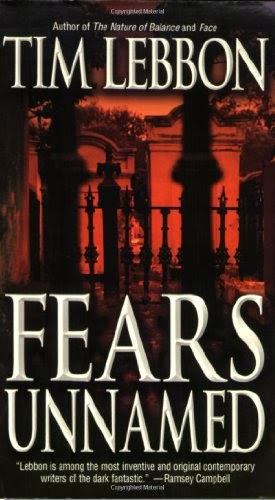
Fears Unnamed by Tim Lebbon (2004) containing the following stories:
Remnants: A really lovely combination of eerie, cosmic, Time-Abyss adventures in a mysterious lost city and psychological realism, as the problems and disappointments of two life-long friends -- one an adventurer and archaeologist, the other a sedentary writer depressingly disappointed by the choices he's made -- are examined and evaluated during a descent into the unknown.
White: An apocalyptic story of the 'Ten Little Indians' variety. Several acquaintances become snowbound in Northern England while the world rapidly plunges into chaos and mysterious destruction, and the snow keeps coming. And weird, weird, half-glimpsed creatures prowl the snow. Or are the gruesome murders being committed actually the work of someone inside the house?
Naming of Parts: Lebbon takes what initially seems to be a zombie plague observed by a 12-year-old boy and turns it into an apocalypse in which everything -- humanity, one's family, all of nature -- seems to be afflicted by entropy and rapid, irreversible decay. The ending in this one is a bit of a dud, as the story seems to demand some sort of closure that is instead given up to mysterious ambiguity. Nonetheless, very good and very sad.
The Unfortunate: Occasionally almost surreal weird-out about the sole survivor of a plane crash, and the supernatural forces behind his survival. The weirdness of the supernatural universe could use more development -- to the extent that this novella would probably make a wonderful novel -- though the bleakness of the material is never less than daunting. All four of these novellas evade and confound catharsis in a manner peculiar to the best horror fiction: there is no satisfying purgation here, only greater mysteries and sublime abjection.
In all: highly recommended.

 The Keep (1981) by F. Paul Wilson: F. Paul Wilson's first 'big' novel is also his best. A dreadful movie adaptation in the mid-1980's, directed by Michael Mann, got pretty much everything wrong about Wilson's original. The Keep is a clever synthesis of vampire novel, cosmic horror, and high fantasy, though that last bit doesn't become evident until the last 50 pages or so. Its best horror moments come in its first half, while the full nature of the adversary remains hidden from reader and characters alike.