Thursday, January 31, 2013

Cthulhu's Self-Help Guidelines

Told by the Dead by Ramsey Campbell, containing the following stories: "Return Journey" (2000) "Twice by Fire" (1998) "Agatha's Ghost" (1999) "Little Ones" (1999) "The Last Hand" (1975) "Facing It" (1995) "Never to be Heard" (1998) "The Previous Tenant" (1975) "Becoming Visible" (1999) "No End of Fun" (2002) "After the Queen" (1977) "Tatters" (2001) "Accident Zone" (1995) "The Entertainment" (1999) "Dead Letters" (1978) "All for Sale" (2001) "No Strings" (2000) "The Worst Fog of the Year" (1990) "The Retrospective" (2002) "Slow" (1985) "Worse than Bones" (2001) "No Story In It" (2000) and "The Word" (1997) (2003):

 
I think this may be Campbell's best first-time-reprinted collection in his now-50-years-and-counting career. It's a bit of a retrospective, as the stories were written between 1968 and 2001 but weren't collected in any of his other collections. There's a story in here called "The Retrospective." Oh ho!
 

Campbell's writerly voice (as Poppy Z. Brite notes in her generous introduction) has remained strangely constant even as his prose has richened and deepened -- a 1968 Campbell story is recognizably by him, the early emulation of H.P. Lovecraft's prose style already pretty much gone by the time Campbell was in his mid-20's.

 
The world seems distorted by the narrative voice -- but often in Campbell, distortion is objective and not subjective within the story. Terrible things are breaking through into one's perceptions. It's a career-spanning signature that renders the Lovecraftian idea of reality being attacked in descriptive rather than expositional terms.

 
Thankfully, Campbell has a sense of humour as well (and indeed wrote pretty much the only funny serial killer novel I can think of, The Count of Eleven, in which humour and sadness feed off each other in illuminating ways). "The Word" is probably the funniest story here, but it also follows the first-person descent of its unlikeable narrator into madness. Or perhaps not.

 
All within a story involving science-fiction conventions, self-help gurus, and New-Age 'wisdom.' Somehow it all ends up being one of the scarier investigations of the long-lived sub-genre of The Forbidden Book that I can think of. I mean, what if the Necronomicon came disguised as The Celestine Prophecy? What if the Necronomicon always comes disguised as The Celestine Prophecy (or The Shack, or The Secret, or...)...?

 
Other standouts here include "The Retrospective", in which going home turns out to be a bad idea; "The Entertainment", in which figures a senior citizens' home with peculiar ideas about nightly entertainment for its residents; and "Never to be Heard", in which choral music plays a singular part. Places that turn out to be places one shouldn't have gone include trains, highways, schools, carnivals, old movie houses, and, of course, one's boring job. Highly recommended.

Tuesday, January 29, 2013

Groove is in the Heart

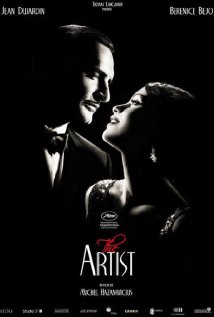
The Artist: written and directed by Michel Hazanavicius: starring Jean Dujardin (George Valentin), Berenice Bejo (Peppy Miller), John Goodman (Al Zimmer), and James Cromwell (Clifton) (2011): Hollywood tends to like its metanarratives peppy and upbeat when it's going to reward them with Oscars, and on the surface last year's Best Picture winner is just that. There's an underlying thread of despair, though, reminiscent of the sort of thing one sometimes found in Charlie Chaplin movies. Thankfully, the abyss is kept at bay with slapstick, dancing, and some awfully good scenes involving a dog.

This mostly silent movie (there's a score and sound effects and voices at key moments), shot in colour but presented entirely in period-appropriate black and white (and in a period-appropriate 1:1.33 aspect ratio) is a delight about the last days of silent motion pictures and the first few years of sound in Hollywood. Box-office king George Valentin, loosely based on Douglas Fairbanks, Jr., finds himself a relic of the past. The ingenue he discovered, Peppy White, finds herself becoming a big star.

The plot bears some similarity to the oft-filmed chestnut A Star is Born. Shot and staged like a late-silent-era movie, we get a certain amount of approriate mugging, a heroic dog with several killer scenes (one in which he fetches a police officer is a lovely bit of business worthy of a Chaplin or a Keaton), and a host of actors who look pretty much absolutely right for the time period and the way films looked back then. The French stars look great, while the Hollywood supporting actors -- most notably John Goodman and James Cromwell -- have the sort of faces that work perfectly in this milieu.

While there are also parallels between the plot of The Artist and Singing in the Rain, the number of allusions and references is broader than that. One will see shades of some of F.W. Murnau's films, Sunset Boulevard, Citizen Kane, City Lights, a musical quote from Vertigo, and a number of Guy Maddin films that play in the same sandbox. But you don't need a background in film to enjoy these references and salutes: The Artist is a delight on its own, and a delight from beginning to end. Highly recommended.

Monday, January 28, 2013

The Real Monster Homes of Maine

Hell House by Richard Matheson (1970): Matheson's great ghost story pays homage to Shirley Jackson's earlier, great haunted-house novel, The Haunting of Hill House, in many of its attributes. As in Jackson's novel, Hell House gives us a quartet of psychic investigators led by an academic and weighed down by personal issues who've been brought together to stay in an extremely haunted house for several days.

Matheson's novel focuses on the always fuzzy world of "psychic research" far more than Jackson's did. The psychosexual issues are much more overt. And unlike Hill House, where the haunting seemed to be a matter of a Bad Place rather than individual Bad Ghosts, Hell House appears to be the domain of the ghost of Emeric Belasco. Matheson loosely bases Belasco on Aleister Crowley, black magician and self-proclaimed "wickedest man in the world." Belaso is much wickeder: his remote Maine mansion was the site of mass murder, suicide, and worse. But when the authorities finally broke into the mansion in the 1920's, Belasco was nowhere to be found among the dead.

Hell House is set in 1970. Two previous attempts to probe the mysteries of Hell House, the last in 1940, ended in the deaths or institutionalization of all those involved but one. And that one, a then-16-year-old boy judged to be one of the greatest psychics ever, is along for this expedition. Why? Because a dying millionaire is paying him and the others $100,000 each to try to figure out from the evidence of Hell House whether the human soul survives death.

As with his great, rational vampire novel I am Legend, Matheson herein sails the edge between the supernatural and the scientific. The physics professor who leads the expedition believes that ghosts are a product of human minds interacting with a charged psychic environment left behind by traumatic events in a specific location. There is no life after death except as an amorphous energy field subject to the fears and hopes of the living. The academic's wife isn't so sure. And the two psychics know that there's something more than that going on. But what?

Matheson doesn't write 'long.' Hell House is fairly brief and to-the-point, and its structure is as much mystery novel as horror novel. But the horrors are quite potent, and the characters sympathetically drawn even as they wrestle with their fears and their failings. Highly recommended.

Sunday, January 27, 2013

Small-town Bringdown

'Salem's Lot: adapted by Peter Filardi from the novel by Stephen King; directed by Mikael Salomon; starring Rob Lowe (Ben Mears), Andre Braugher (Matt Burke), Donald Sutherland (Straker), Samantha Mathis (Susan Norton), Robert Mammone (Dr. James Cody), Dan Byrd (Mark Petrie), James Cromwell (Father Callahan) and Rutger Hauer (Barlow) (2004): Very enjoyable, mildly unfaithful TNT miniseries adaptation of King's vampire novel could use another 80 minutes (which would have made it a 6-hour rather than a 4-hour miniseries). Most of that extra time could have been beneficially front-loaded: as is, we've really only scratched the surface with the main characters before we're headlong into the vampire narrative.

The most obvious change is that the story is now set in 2004 rather than 1975. There are the usual, necessary character conflations when dealing with a long novel (one sub-plot involving marital infidelity has been folded into the story of Dr. James Cody) and several pretty effective shifts made so as to show the viewer certain bad behaviours rather than explain different, more complicated behaviours, as the novel can do and a movie generally can't without a lengthy bit of spoken-word exposition. The small town of Salem's Lot comes across as more blatantly sinful than in the book, but that's partially because of the narrative compression. In any case, the evil from without still manifests itself at least partially as a mirror image of the evil within.

Rob Lowe does nice, nuanced work as protagonist Ben Mears -- watch this and an episode of Parks and Recreation to realize what a sharp actor he's become, handicapped though he is by being prettier than most of his female leads. Andre Braugher -- as Van Helsingesque English Teacher Matt Burke -- is solid and dependable in a somewhat underwritten role, while Samantha Mathis, Dan Byrd and Robert Mammone also do solid work as the unlikely, reluctant, disbelieving vampire fighters. Donald Sutherland plays the vampire's human henchman as a somewhat antic lunatic, more Renfield than the novel's version. Rutger Hauer wisely underplays Barlow the vampire, and the miniseries doesn't force him to deliver some of the novel's Dracula-esque Barlow lines, easily the weakest part of King's novel.

The filmmakers drop King's homage to Tolkien -- in the novel, crosses and holy water glow "with an elvish light" when a vampire is near. I think that's unfortunate, as one scene that uses that glow in the novel seems perfectly suited to filming (Father Callahan's confrontation with Barlow at the Petrie household). Creatures crawling across ceilings also don't have the same zing as they once did. There is something cool about the movie's depiction of vampire death, though, drawing as the visual effect does on a deflating balloon sputtering around.

Overall, there are a lot of good scares here and, because of changes made from the novel, a certain number of surprises awaiting King readers as well. Maybe the smartest decision made was to incorporate stretches of the novel's third-person narration as the first-person narration of Ben Mears. It's very effective, especially during the movie's opening and closing scenes. Recommended.

Saturday, January 26, 2013

Rise of the Super-Communist

Superman: Red Son: written by Mark Millar; illustrated by Dave Johnson, Kilian Plunkett, Andrew Robinson and Walden Wong (2003): What if Superman's rocket landed in Stalin's USSR in the 1930's? That's the initial changed premise in this Elseworlds 'What if?' story of a Communist Superman and his crusade to keep everyone on the planet safe, all the time, whether they want him to or not.

It's a much-praised story that riffs an awful lot on a classic Silver-Age Superman 'Imaginary Story' in which Superman, concerned by his failures, exposes himself to a barrage of various types of Kryptonite radiation and ends up splitting into two mono-coloured versions of himself, Superman-Red and Superman-Blue. They're both about 100 times smarter than the original, and thus proceed to eliminate all crime, disease, poverty, and want from Earth in about a week. That was presented as a utopia. What's presented here is also a utopia unless one wants a certain level of freedom.

Superman's powers here are actually greater than pretty much any other version of the character in comic books: he actually can protect everyone on the planet from even relatively small-scale dangers such as car accidents. This causes people to start driving recklessly in great numbers (!!!). Once the Soviet Man of Steel takes over from Stalin, the countries of the world join the Communist Bloc with the exception of the United States. Lex Luthor helps keep the U.S. free while trying to figure out how to stop Superman. Some heroes join Superman (Wonder Woman being the prime example) while others are deployed against him (Green Lantern and Batman).

It's all fairly enjoyable, though I'm not entirely sure why this is praised as much as it is: besides Superman-Red/Superman-Blue, there's a Marvel graphic novel from the 1980's, Emperor Doom, which covers pretty much the same territory in about 1/3 the space, while Alan Moore's Marvelman (aka Miracleman) epic also ends in similar territory, only with much better writing.

Time constraints also forced an art change with the last third of the collected book (the third issue of the three issue miniseries in its original printing). Dave Johnson's work is cleaner and more suited to the narrative, making the change a bit jarring when the art switches to Kilian Plunkett. The twist ending is nice, if a bit gimmicky and telegraphed a bit too much in the closing pages. Lightly recommended.

Wednesday, January 23, 2013

Into the Woods

The Ritual by Adam Nevill (2011): Four British friends (Luke, Dom, Phil, and Hutch) who first met in university 15 years earlier decide to go camping in Sweden for their 15th anniversary reunion. Tensions start to run a bit high, as Luke begins to chafe at what he feels is the derogatory attitude of two of the others to his low-income, high-freedom lifestyle. But when the group finds an animal so mutilated as to be unrecognizable hanging fifteen feet up in a tree, social frictions gradually start to seem less important. Something is out there, and they are lost because the most competent of them decided to try a short-cut. Oops.

In the small but sturdy sub-genre of 'camping trips gone wrong', The Ritual is a humdinger. Nevill has a sure hand with characterization, giving all the characters reasons for their behaviour, and eliciting sympathy in the face of whatever it is that's out there just beyond the firelight.

One of the things that elevates The Ritual above the run-of-the-mill is Nevill's careful attention to describing the problems of navigating a forest that hasn't been navigated by people for hundreds of years, if ever. His characters are pursued through a forest that has reduced their speed to a near-crawl. Whatever it is that pursues them is never seen clearly. And the forest seems only to want them to go on one specific path -- to a moldering house, an ancient graveyard complete with an ancient dolmen and a passage graveyard, and beyond.

There are glimpses of something in the trees improbably big, and sounds of trees crashing down in the distance. Food and water run scarce. Two of the four are injured and unable to make good time. Night keeps arrving too soon.

Nevill acknowledges the influences of both fiction and non-fiction work -- this may be one of the first novels to owe a debt to both Into the Wild and Arthur Machen's "The White People." But this is a striking work on its own, perhaps in need of a bit of trimming in its second half, but overall a riveting horror novel. Highly recommended.

Don't Let Them In

'Salem's Lot by Stephen King (1975): Stephen King's second published novel did at least two new things I can think of: it collided the vampire novel with a sweeping character study of an entire town (as many have noted, it's Dracula meets Peyton Place); and it codified the role of the Familiar in a vampire's life in a way that many subsequent novelists treat as if it were derived from vampire mythology. King extrapolates the role of Straker in this novel from Renfield in Dracula and Renfield/Harker's altered role in the Bela Lugosi Dracula.

Later works such as Fright Night (1985) and Justin Cronin's The Passage and The Twelve would run with the idea of a non-vampiric helper paving the way for the vampire. That Straker also has to perform certain rituals to let the vampire Barlow into the town of (Jeru)'salem's Lot also seems new to me.

The novel still purrs along like a dream. Some elements (the rapid development of love between protagonist Ben Mears and townie Susan Norton) come a bit too fast, even in a lengthy novel such as this. But both major characters (struggling novelist Mears, who's returned to the town at pretty much the worst time ever; Father Callahan) and minor (the sheriff, especially) are fleshed out with great sympathy and precision, or at least empathy.

King wisely keeps the vampire Barlow off-stage for much of the novel -- the few times when Barlow talks (or writes) are also a bit weak, as King has borrowed pretty much all of Barlow's attributes from the Dracula 101 class of king-vampire characterization. Straker, the Familiar, is much more interesting. Highly recommended.