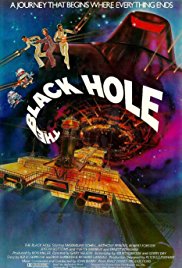
The Black Hole (1979): written by Jeb Rosebrook, Bob Barbash, Richard H. Landau, and Gerry Day; directed by Gary Nelson; starring Maximilian Schell (Dr. Reinhart), Anthony Perkins (Dr. Durant), Robert Forster (Captain Holland), Joseph Bottoms (Lt. Pizer), Yvette Mimieux (Dr. McCrae), Ernest Borgnine (Harry Booth), Roddy McDowall (Voice of V.I.N.C.E.N.T.), and Slim Pickens (Voice of B.O.B.):
The Black Hole (1979) was Disney's $20 million reply to Star Wars. In the 22nd century, the Earth exploration ship stumbles across the giant Cygnus, an Earth vessel missing and presumed destroyed for 20 years. The Cygnus orbits the massive black hole that gives the movie its title.
Not as bad as I remember. You can tell how out of touch 1979 Disney was, though, by the fact that the movie mostly emulates two 1950's sci-fi epics, their own 20,000 Leagues under the Sea and Forbidden Planet, rather than, you know, Star Wars. Except for the cute robots voiced by Roddy McDowell and Slim Pickens. Their big eyes and squat shape makes them look like South Park's Eric Cartman. How's that for a distraction?
Well, and the final 10 minutes turn into a weird Christian allegory version of the trippy visuals sequence at the end of 2001. So to emulate the success of Star Wars, the people at Disney cobbled together a movie from two 1950's sci-fi epics and a Stanley Kubrick movie. This helps to explain why people in the film industry thought Disney had become increasingly out-of-touch with its audience since Walt died in the mid-1960's.
Nonetheless, the visual effects are very good. And the score by John Barry is so good that I realized I'd been humming portions of it for 39 years without remembering the source.
But the best thing is that Ernest Borgnine plays a shifty reporter. Why an expedition of four people and an annoying robot also needs Ernest Borgnine along... your guess is as good as mine.
Maximilian Schell chews the scenery as Professor Morbius... um, Captain Nemo... um, Dr. Reinhart! Anthony Perkins is suitably squirmy as an easily dazzled scientist. Robert Forster as the Captain of the Palamino and Yvette Mimieux and Joseph Bottoms as the other crew members... well, they showed up and they got paid. There's not a lot for them to do. Lightly recommended.
The Big Red One (1980): written and directed by Samuel Fuller; starring Lee Marvin (The Sergeant), Mark Hamill (Griff), Robert Carradine (Zab), Bobby Di Cicco (Vinci), and Kelly Ward (Johnson): Startling good and refreshingly plotless movie about World War Two and 'the Big Red One' -- the USA First Infantry. The movie basically follows the rubric of Sgt. Rock comic books by having its focal characters -- four callow G.I.'s and career sergeant Lee Marvin -- fight in every major European battle from 1943 Vichy-held North Africa (OK, not technically Europe) to the liberation of a death camp in Czechoslovakia in May 1945.
The movie succeeds to a great extent because of Marvin's world-weary, sardonic, pragmatic, sorrowful sergeant, whom we open with in a B&W sequence at the conclusion of WWI. Mark Hamill gets second billing because of his Star Wars fame and is fine (and very young), but the main GI is narrator Robert Carradine, an aspiring pulp novelist. The youth and inexperience of the younger actors works in the movie's favour.
Long-time director Samuel G. Fuller made a movie that remains a favourite of later directors that include Quentin Tarantino. The difference here is that violence is almost never shown -- its aftermath is, sometimes, and sometimes it's only implied. Nonetheless, there's a startling brutality to some sequences that gets the horrors of war across better than flying giblets, especially Fuller's depiction of the effects of explosions on people (hint: people don't fly through the air and then get up; mostly, they just scream and die). In all, I think this a great movie, war or otherwise, and should have secured Lee Marvin some sort of major acting prize. He's terrific, turning in a career-best performance. Highly recommended.
Per IMDB, "In 2004, film critic Richard Schickel restored this film to a new director's cut length of approximately 160 minutes. Using Samuel Fuller's production notes and the full-length, unexpurgated script, Schickel restored the footage that was forced to be cut by the studio upon its original 1980 release (which runs 116 minutes). The restored version's DVD release date is 3 May 2005. This longer, epic-length version is closer to Fuller's original vision for the film."
Jane Fonda in Five Acts (2018): directed by Susan Lacy: Fascinating HBO documentary about the life and times of Jane Fonda, clearly made with her full cooperation. It's not hagiographic, and Fonda is often the one to take the stuffing out of herself. Her troubled childhood, complete with a mentally ill, suicidal mother and the distant, philandering Henry Fonda as father, is perhaps the most closely observed part of the documentary.
And I didn't know that all proceeds from the Jane Fonda Workout franchise went to charity -- that, indeed, the series was created for just that purpose. And the floating striptease in Barbarella was shot with Fonda lying on a glass floor. And here I thought she was on wires all these years. Recommended.
All Of Me (1984): adapted by Henry Olek and Phil Alden Robinson from the Ed Davis novel; directed by Carl Reiner; starring Steve Martin (Cobb), Lily Tomlin (Edwina Cutwater), Victoria Tennat (Terry), Richard Libertini (Prahka Lasa), Jason Bernard (Tyrone), and Dana Elcar (Schuyler):
Brilliant, one-of-a-kind acting performance by Steve Martin with able support from Lily Tomlin. Martin plays a frustrated, unfulfilled lawyer who ends up with Tomlin's soul trapped in his body after a botched attempt at soul transference. Things progress from there, especially as Tomlin and Martin each controls one side of his body.
This makes for inspired slapstick as they attempt to navigate walking, driving, using a urinal, and a variety of other tasks. A mostly sweet-natured movie, competently directed by veteran Carl Reiner with no visual flair whatsoever -- indeed, the opening titles make All of Me look like a TV movie. Not that there's anything wrong with that. Martin should at least have been nominated for a Best Acting Oscar for this one, but as we all know, the Academy hates comedy. Highly recommended.
Game Night (2018): written by Mark Perez; directed by John Francis Daley and Jonathan Goldstein; starring Jason Bateman (Max), Rachel McAdams (Annie), Kyle Chandler (Brooks), and Jesse Plemons (Gary): Adequate time-filler takes forever to set up its premise. Jason Bateman and Rachel McAdams make an appealing couple, though the 10-year age gap makes it difficult to believe they met in college. Maybe Bateman was going back to school after 10 years in the work force. Oh, Hollywood!
Kyle Chandler is weirdly miscast as Bateman's swashbuckling, risk-taking older brother. Cameos from Danny Huston, Jeffrey Wright, and Michael C. Hall are so perfunctory that they seem more like accidental walk-throughs. Sort of genial, anyway, and Jesse Plemons exudes comic menace as a sad, creepy cop neighbour. Lightly recommended.
Super 8 (2011): written and directed by J.J. Abrams; starring Jeff Courtney (Joe Lamb), Ryan Lee (Cary), Zach Mills (Preston), Riley Griffiths (Charlie), Kyle Chandler (Deputy Lamb), Ron Eldard (Louis Dainard), and Elle Fanning (Alice Dainard): Lightweight Spielberg homage from J.J. Abrams comes with the approval and cooperation of Spielberg himself. It's a lot like ET gene-spliced with Close Encounters of the Third Kind, The Goonies, and the South Park 'dream' episode in which the kids are trapped on a bus by a monster. Elle Fanning is distractingly wan and emaciated throughout. The kids are underwritten and overdetermined and not all that appealing. Not a terrible film, but so much of a pastiche it hardly seems to exist. Lightly recommended.

Three Billboards outside Ebbing, Missouri (2017): written and directed by Martin McDonagh; starring Frances McDormand (Mildred), Sam Rockwell (Dixon), and Woody Harrelson (Willoughby): Frances McDormand and Sam Rockwell get lots of pithy dialogue and violent moments to earn their Best Acting Oscars (Lead Female and Supporting Actor, respectively) in this pungent NuTarantino offering from writer-director Martin McDonagh (In Bruges, 7 Psychopaths). It's not as good as you might expect from the awards, but it's certainly an actor's showcase of a certain sort. Recommended.

The Secret Life of Walter Mitty (1947): adapted by Philip Rapp, Everett Freeman, and Ken Englund from the story by James Thurber; directed by Norman Z. McLeod; starring Danny Kaye (Walter Mitty), Virginia Mayo (Osalind van Hoorn), Boris Karloff (Dr. Hugo Hollingshead), Fay Bainter (Walter's Mother), Ann Rutherford (Walter's Fiancee), and Thurston Hall (Bruce Pierce): A special edition that removes Danny Kaye's bafflingly popular patter songs from this movie would be super. James Thurber's short-short story gets pulled and twisted like taffy to accommodate a romantic plot involving Danny Kaye and Virginia Mayo. The movie's a lot of fun except for those patter songs. Boris Karloff is a delight as a menacing 'doctor.' Recommended.

Living in Oblivion (1995): written and directed by Tom DiCillo; starring Steve Buscemi (Nick Reve), Catherine Keener (Nicole Springer), Dermot Mulroney (Wolf), Danielle von Zerneck (Wanda), James Le Gros (Chad Palomino), Rica Martens (Cora), Peter Dinklage (Tito), and Kevin Corrigan (Assistant Camera): Witty look at Indy film-making remains fresh and exciting more than 20 years after its release. Everyone is good. The character of 'Chad Palamino' is not based on Brad Pitt, apparently, despite decades of rumors, but another young actor of 1995 whom writer-director Tom DiCillo refuses to name. Johnny Depp, maybe? A young Peter Dinklage has a show-stopper of a rant about the preponderance of dwarves in movie dream sequences. Highly recommended.

Emma (1996): adapted from the Jane Austen novel and directed by Douglas McGrath; starring Gwyneth Paltrow (Emma), Greta Scacchi (Mrs. Weston), Alan Cumming (Mr. Elton), Sophie Thompson (Miss Bates), Phyllida Law (Mrs. Bates), Jeremy Northam (Mr. Knightley), Toni Collette (Harriet Smith), and Ewan McGregor (Frank Churchill): In and around the fictional English village of Highbury and the surrounding estates, romance is blooming in the second decade of the 19th century. Or at least it's brewing inside 21-year-old busybody matchmaker Emma's head. Gwyneth Paltrow is very sparkly and glowy as Emma, while the supporting cast is solid and witty throughout. Well, maybe except for Ewan McGregor, hot off Trainspotting. McGregor admitted later that the part was outside his range and not helped by a terrible wig. Oh, well. Recommended.
Gun Machine (2013) by Warren Ellis: Warren Ellis, a long-time comic-book writer (Transmetropolitan, The Authority, and Planetary, among many others) and acerbic futurist, creates one hell of a smart Pop detective thriller here.
Lonely, burned-out, never-was NYPD detective John Tallow starts Gun Machine with a bad day that quickly gets worse. The violent events of the first few pages open a door into a secret Manhattan world of murder and weird maps. And guns. Lots of guns. Hundreds of guns from flintlocks to modern, near-metal-less handguns. An otherwise empty apartment filled with guns arranged into a mysterious, incomplete pattern. And every gun attached to either an unsolved murder or a murder now known to be incorrectly solved.
Tallow's detective instincts get jump-started by this room of mystery, especially after the case is dumped on him because the NYPD not-so-secretly wants Tallow to fail and the cases to vanish as quickly as possible. A bad detective gets born again, though that rebirth may be short-lived. Conspiracies of power don't want the secret of the guns solved.
Ellis' prose is as pungent and cynical as ever, densely packed with information. The plot rockets along. Tallow and the other characters are sharply drawn. Sharply drawn, too, is our attention to the secret maps of Manhattan which Tallow discovers. A financial map based on the time it takes for financial offices to communicate with Wall Street. A map of gun crimes in Manhattan and the other boroughs. And the map the killer carries in his head, of Manhattan before Europeans came, a map that still surfaces in surprising places in the postmodern landscape.
It's a dark romp that engages with social and technological questions as it zips along, dialogue crackling and sparking, the narrative casting a cold eye on the modes of NYPD evidence collection, the surveillance state, the technical specifications of guns used in famous murders, the difficulty of parking in New York, the meaning of Occupy Wall Street, the malign rise of private policing, the dangers of too much exercise, an assortment of Native American tribes and rituals, and the politics of the police bureaucracy.
Gun Machine is too densely packed to make a great movie, but it would make one hell of an HBO miniseries. Highly recommended.
The Trip to Italy (2014): written by Steve Coogan, Rob Brydon, and Michael Winterbottom; directed by Michael Winterbottom; starring Steve Coogan (Steve Coogan), Rob Brydon (Rob Brydon), Rosie Fellner (Lucy), Claire Keelan (Emma), and Timothy Leach (Joe Coogan) (2014): Sequel to 2011's The Trip sends British comedians Steve Coogan and Rob Brydon, playing 'themselves,' on another restaurant-visiting road trip, this time in Italy.
Highlights include more dueling Michael Caine impersonations, a hilarious take on the vocal problems of Tom Hardy and Christian Bale in The Dark Knight Rises, and some ventriloquism in Pompeii. All that and a colourful travelogue of food, scenery, Alanis Morrisette, and middle-age angst. Highly recommended.
Marshall (2017): written by Michael Koskoff and Jacob Koskoff; directed by Reginald Hudlin; starring Chadwick Boseman (Thurgood Marshall), Josh Gad (Sam Friedman), Kate Hudson (Eleanor Strubing), and Sterling K. Brown (Joseph Spell): Marshall plays a bit fast and loose with history in its tale of then-NAACP lawyer and future Supreme Court Justice Thurgood Marshall's participation in a rape trial in Connecticut in 1940. The major alteration come with re-imagining veteran Civil Rights lawyer Sam Friedman as a young, inexperienced Josh Gad.
Of course, this is a bit of a 'sauce for the goose' situation. The movie diminishes the contributions and experience of a white character (albeit Jewish and thus also familiar with bigotry) so as to foreground the competence and accomplishments of an African-American character. The movie does hew fairly closely to the facts of the case, so kudos for that.
Chadwick Boseman is riveting as Thurgood Marshall. The NAACP would send Marshall to consult on cases involving Civil Rights matters across America. How this hasn't been the basis for a TV show, I have no idea. Boseman has now played real-life characters Ernie Davis, James Brown, Thurgood Marshall, and Jackie Robinson. And he's the Black Panther!
Josh Gad is fine in a somewhat simplistic sidekick role. Equalizing the power relationship between Friedman and Marshall might have made for a quieter, better movie. But it's amazing that this film got made at all. And seemingly with the help of a lot of Chinese investors. What is up with that? Reginald Hudlin, whom I still associate with House Party, navigates a period-specific drama with grace and aplomb.
The movie navigates the very, very hazardous territory of a false rape accusation with care and finesse. The reason for such a rarity of a false accusation are made perfectly clear, and the film foregrounds the sympathetic reasons that Kate Hudson's lonely socialite would have done such a thing. Sterling K. Brown is solid as the accused, a chauffeur with a checkered past (but not a rapey past). In all, recommended.