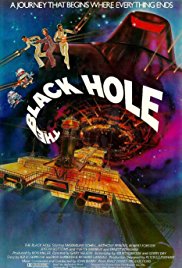
The Black Hole (1979): written by Jeb Rosebrook, Bob Barbash, Richard H. Landau, and Gerry Day; directed by Gary Nelson; starring Maximilian Schell (Dr. Reinhart), Anthony Perkins (Dr. Durant), Robert Forster (Captain Holland), Joseph Bottoms (Lt. Pizer), Yvette Mimieux (Dr. McCrae), Ernest Borgnine (Harry Booth), Roddy McDowall (Voice of V.I.N.C.E.N.T.), and Slim Pickens (Voice of B.O.B.):
The Black Hole (1979) was Disney's $20 million reply to Star Wars. In the 22nd century, the Earth exploration ship stumbles across the giant Cygnus, an Earth vessel missing and presumed destroyed for 20 years. The Cygnus orbits the massive black hole that gives the movie its title.
Not as bad as I remember. You can tell how out of touch 1979 Disney was, though, by the fact that the movie mostly emulates two 1950's sci-fi epics, their own 20,000 Leagues under the Sea and Forbidden Planet, rather than, you know, Star Wars. Except for the cute robots voiced by Roddy McDowell and Slim Pickens. Their big eyes and squat shape makes them look like South Park's Eric Cartman. How's that for a distraction?
Well, and the final 10 minutes turn into a weird Christian allegory version of the trippy visuals sequence at the end of 2001. So to emulate the success of Star Wars, the people at Disney cobbled together a movie from two 1950's sci-fi epics and a Stanley Kubrick movie. This helps to explain why people in the film industry thought Disney had become increasingly out-of-touch with its audience since Walt died in the mid-1960's.
Nonetheless, the visual effects are very good. And the score by John Barry is so good that I realized I'd been humming portions of it for 39 years without remembering the source.
But the best thing is that Ernest Borgnine plays a shifty reporter. Why an expedition of four people and an annoying robot also needs Ernest Borgnine along... your guess is as good as mine.
Maximilian Schell chews the scenery as Professor Morbius... um, Captain Nemo... um, Dr. Reinhart! Anthony Perkins is suitably squirmy as an easily dazzled scientist. Robert Forster as the Captain of the Palamino and Yvette Mimieux and Joseph Bottoms as the other crew members... well, they showed up and they got paid. There's not a lot for them to do. Lightly recommended.
Real Life (1979): written by Albert Brooks, Monica McGowan Johnson, and Harry Shearer; directed by Albert Brooks; starring Albert Brooks (Albert Brooks), J.A. Preston (Dr. Cleary), Charles Grodin (Warren Yeager), and Frances Lee McCain (Jeanette Yeager): Albert Brooks' first stint as writer-director-star of a movie riffs on the seminal 1972 PBS documentary series An American Family and in the process moves presciently into the world of reality shows that stage and distort reality while pretending to document it dispassionately. Welcome to a movie that could be called, in all its hilarity and loopiness, The Coming of the Observer Effect. Highly recommended.
Forever Evil: written by Geoff Johns; illustrated by David Finch and Richard Friend (2013-2014; collected 2015): I guess if you ever wanted to see Bizarro-Superman kill Otis from Superman: The Movie, then this is the Event Series for you. The Crime Syndicate of an Earth parallel to that of the Justice League figures out how to take the Justice League off the board without actually fighting them. And then they invade and conquer the Earth. But they hadn't reckoned on Lex Luthor putting together a team of super-criminals to... save the world? Yep.
David Finch's artwork is suitably gloomy for this crossover event. Writer Geoff Johns does love the ultraviolence from time to time. Moreover, the seven issues collected here seem awfully padded in the middle, a classic case of gear-grinding so as to get the maximum number of crossovers from the entire DC line (there were about 200 Forever Evil issues of other comic books in addition to the core miniseries). Competent series but not all that much fun; the Crime Syndicate was a lot more interesting when introduced in the wacky Silver Age or re-introduced by Grant Morrison and Frank Quitely in a late 1990's Justice League graphic novel. Lightly recommended.

In Search of Galactus: written by Marv Wolfman; illustrated by Keith Pollard, John Byrne, Sal Buscema, Joe Sinnott, and others (1979-1980/collected 2010): From the sometimes fun, occasionally broody, and always wordy Marvel of the late 1970's (very late, given that we move into 1980 in the course of this collection) comes this collection of nearly a year's worth of Fantastic Four comics penned by Marv Wolfman.
Wolfman decided to wrap up the major plot-lines of his just-cancelled Nova series in the Fantastic Four comic, thus pairing the team with Nova and craptastic D-List superhero group New Champions for part of this adventure. The main adversary is the Sphinx, a super-powerful, immortal human with a yen to blow up the Earth. Outgunned, Reed Richards decides to find Galactus and get him to beat up the Sphinx. Why would Galactus do this? Because Reed will then waive the promise he received from Galactus to not eat the Earth. OK! This is a cunning plan.
There are also Skrulls, an aging virus that's going to kill all the members of the Fantastic Four not named the Human Torch in about three days, and a brief solo foray for the Human Torch with his buddy Spider-man at an evil college run by a forgotten FF villain from the later issues of the Stan Lee/Jack Kirby Fantastic Four. It's all enjoyably wordy, has some nice artwork -- especially from the John Byrne/Joe Sinnott team, who do a mean Galactus -- and goes down smoothly.
Though why Galactus wants yet another Herald, given the 100% failure rate of the first three (beginning with the Silver Surfer, natch), is a great question. As we learn in this series that Galactus has a zoo on board his spaceship, perhaps his recurring need for a Herald is just an expression of his deep-seated but unacknowledged need for... a friend. Recommended.
Being There: adapted by Jerzy Kosinski and Robert C. Jones from the 1971 novel by Kosinski; directed by Hal Ashby; starring Peter Sellers (Chance), Shirley MacLaine (Eve Rand), Melvyn Douglas (Ben Rand), Jack Warden (President 'Bobby'), Richard Dysart (Dr. Robert Allenby), and Ruth Attaway (Louise) (1979):
The last great performance of the inestimably great Peter Sellers should have nabbed him a Best Actor Oscar. But the Academy hates comedy. Hal Ashby's film, adapted from Jerzy Kosinski's partially plagiarized 1971 novel, was a pet project of Sellers for years. Only the success of the later Pink Panther films secured him the clout to get it made. And boy, is it dandy.
Sellers plays Chance, the live-in gardener for a Washington recluse known only as the Old Man. Chance is... well, simple. Very simple. Amiable and harmless and simple. And boy, does he love TV! And having apparently never left the Old Man's house, no record of Chance's existence seems to exist. When the Old Man dies, no provisions for Chance exist in the will. So he's cast out to walk the streets of Washington, DC.
Almost everything Chance knows about the world comes from the mediated world of television: he wants to watch TV all the time, if possible. And as he watches, he'll sometimes imitate what he sees. He imitates the gestures of people around him. He parrots back what people say to him (along with the occasional 'I understand,' which for Chance really means 'I don't know what you're talking about, I'm just being polite'). And when pressed, he'll talk about gardening. There's almost no there there. So of course some people view him as wise and insightful.
Sellers modeled some of his performance on the screen persona of Stan Laurel. It's absolutely winning in any event, ranging from subtle bits that modulate Chance's affably blank stare depending on the situation to moments of absurd slapstick. Chance reflects back to people what they want to see in him. None of his utterances are cryptic or wise, but people -- and especially the rich people he falls in with -- take his comments on proper gardening as wise thoughts on the U.S. economy.
Being There is a surprisingly bleak satire of American politics, sweetened by Chance's utter simplicity and sweetness. He's a holy fool who has fallen in with the Illuminati. And the Illuminati just aren't all that bright. Indeed, the rulers of the world pretty much all seem to be idiots made idiotic by their own narcissistic self-involvement. Chance's former housekeeper knows what he really is; as she observes when she sees him on a talk show, just being white in America can get a person almost anything.
Being There is in many ways the mirror-image of another great satire of the 1970's, Network. But here, the sinister Cabal that really runs things is made up of people who've willed themselves into perfect blindness. What the last scene of the movie, made up on the set by director Ashby and Sellers, means to the overall movie is something for the individual viewer to decide. Me, I'm still not sure. Highly recommended.
Best in Show: written by Christopher Guest and Eugene Levy; directed by Christopher Guest; starring Parker Posey (Meg Swan), Michael Hitchcock (Hamilton Swan), Catherine O'Hara (Cookie Fleck), Eugene Levy (Gerry Fleck), Bob Balaban (Dr. Theodore W. Millbank, III), Christopher Guest (Harlan Pepper), Michael McKean (Stefan Vanderhoof), John Michael Higgins (Scott Donlan), Jennifer Coolidge (Sherri Ann Cabot), Jane Lynch (Christy Cummings), and Ed Begley Jr. (Hotel Manager) (2000):
Maybe the high point of movies made by Christopher Guest and his merry band of co-writers and performers, though some prefer Waiting for Guffman. I don't include This is Spinal Tap because it has Rob Reiner directing. This one, focused on several people whose dogs are competing in a dog show based on the Westminster Kennel Club Dog Show, is a comic gem.
While the characters all verge on being comic grotesques, they're invested with enough warmth and sympathy to make Best in Show a rarity -- a gentle satire. The performances are superb, the direction smoothly negotiates the faux-documentary approach, and the writing absolutely sparkles with wit and goofiness. Best in Show is an all-timer. Highly recommended.
Lair by James Herbert (1979): Late, prolific English horror novelist James Herbert really had a gift for blending left-leaning social commentary into his blood-spattered works. Lair, the second novel in his Rats trilogy, isn't quite as agit-proppy as The Rats or Domain. Nonetheless, it takes a lot of shots at upper-class twits, self-serving politicians, and money-grubbing corporate types.
The two co-dependent sub-species of giant rats that brought London to its knees in The Rats seem to have been vanquished when this novel opens. Four years have passed. But in the idyllic private forest of Epping Wood, a protected green space just a few miles from the centre of London, England, something is stirring. The two-foot-long black rats and their two-headed, nearly immobile overlords have adapted to life in the forest. And boy, are they hungry!
This time around, a plucky male biologist who works for the world's biggest rat-catching corporation (the Rat Invasion of London created some great business opportunities) and a plucky female forest guide are our main protagonists. This is an early James Herbert novel, so be assured that they will engage in a graphic five-page-long sex scene before the story's over.
The super-rats soon create lots of mayhem and a lot of headless bodies stripped of all flesh. As a second book in a trilogy, Lair is a bit more restrained than the first and third novels. The action stays confined to the forest. Really, it's a pastoral from Hell.
The gruesome scenes are very gruesome and quite inventive. The bureaucrats and politicians are dangerous idiots. The adaptation of the super-rats seems logical and well-thought-out, as do the social frictions between the two sub-species of super-rats. There's trouble in Rat Paradise! But they're still super-hungry! And, in what I think is a first for Herbert, the supporting pervert character doesn't die. Or does he? In any case, Herbert really didn't like Phys. Ed. teachers. Recommended.
Shadows 2: edited by Charles L. Grant (1979; this edition 1984) containing the following stories:
Saturday's Shadow by William F. Nolan
Night Visions by Jack Dann
The Spring by Manly Wade Wellman
Valentine by Janet Fox
Mackintosh Willy by Ramsey Campbell
Dragon Sunday by Ruth Berman
The White King's Dream by Elizabeth A. Lynn
The Chair by Alan Dean Foster and Jane Cozart
Clocks by Barry N. Malzberg and Bill Pronzini
Holly, Don't Tell by Juleen Brantingham
The Old Man's Will by Lee Wells
The Closing Off of Old Doors by Peter D. Pautz
Dead End by Richard Christian Matheson
Seasons of Belief by Michael Bishop
Petey by T. E. D. Klein
The late Charles L. Grant was both a talented writer and one of the four or five finest anthologists the horror genre has had. His original anthology series -- Shadows -- was a high point for horror short fiction in the late 1970's and early 1980's, sometimes reading more like a 'Best of' than anything else. Most stories in Shadows are contemporary in setting, as the mandate seemed to focus thereon, but beyond that, anything seemed to go.
There isn't a clunker in the bunch in Shadows 2. Moreover, there are at least two all-timers that appeared here for the first time: Ramsey Campbell's unnerving tale of childhood horror, "Mackintosh Willy", and T.E.D. Klein's "Petey," a novella about a house-warming party that plays enjoyably as both social satire and a Lovecraft-infused horror of suggestion and accumulation of detail. Entries by Michael Bishop and William F. Nolan are also excellent, and the whole anthology is well worth the read. Highly recommended.
The Amityville Horror, written by Scott Kosar, based on the screenplay by Sandor Stern, based on the book by Jay Anson, based on material by George and Kathleen Lutz, directed by Andrew Douglas, starring Ryan Reynolds, Melissa George, Chloe Grace Moretz, Jesse James and Philip Baker Hall (2005): The original Amityville Horror (1979) was a financially successful, dramatically awful horror movie whose only greatness may lie in the Eddie Murphy comedy bit it spawned ("GET OUT!" "Too bad I gotta go!").
The "true story" it's based on has since turned out to be a hoax perpetrated by the Lutz family, though the original murders were tragically real. Subsequent residents of the house in question, in Suffolk County, New York, have reported nothing unusual about the house other than the hordes of tourists that stop by to look at it. Hoo ha!
This movie looks a lot better than the original, not much of a feat considering how crappily 70's the cinematography was in that original shitfuck. It's shorter, which pretty much eliminates any building of suspense. And it cuts the one scene I (and Stephen King in Danse Macabre) would cite as the first film's one moment of fully realized suburban terror, an incident in which the House appears to steal much needed money from George Lutz, cash needed to pay for a wedding. That was a good scene. So they don't even try to duplicate it.
So far as I can tell, the screenwriter realized how bad the original material was pretty early on and so decided to remake The Shining instead. I shit you not. So this is basically The Shining as written and directed by moronic hacks and produced by Michael Bay (seriously on that last one). Ryan Reynolds and Melissa George are spectacularly miscast as a young couple in the 1970's -- Reynolds's hairless hard-body alone pretty much erases all suspension of disbelief.
Philip Baker Hall struggles manfully with the underwritten priest part which caused Rod Steiger to devour the scenery in the original, and we don't even get the spectacularly bizarre bit involving Kathy Lutz's nun sister. Or the bit where the demon, its red eyes clearly light bulbs, perches at the window to glare at the Lutzes. Or the crazy part about the doorway to Hell in the basement.
Come to think of it, at least that godawful 1970's movie was sorta fun; this one is just sorta boring. The remake does have a terrific bit of fucked up continuity, though. At the end, Kathy Lutz spends all day at the Amityville library researching the house. When she returns home that night, George has turned into Mr. Cuckoobanana. What seems to be a real-time ten minutes of shenanigans ensues which ends with the family taking off in their motorboat...at which point the sun comes up. Because in Amityville, the nights are about 20 minutes long. Really not recommended.