Showing posts with label albert brooks. Show all posts
Monday, January 15, 2018
Real Life (1979):
Real Life (1979): written by Albert Brooks, Monica McGowan Johnson, and Harry Shearer; directed by Albert Brooks; starring Albert Brooks (Albert Brooks), J.A. Preston (Dr. Cleary), Charles Grodin (Warren Yeager), and Frances Lee McCain (Jeanette Yeager): Albert Brooks' first stint as writer-director-star of a movie riffs on the seminal 1972 PBS documentary series An American Family and in the process moves presciently into the world of reality shows that stage and distort reality while pretending to document it dispassionately. Welcome to a movie that could be called, in all its hilarity and loopiness, The Coming of the Observer Effect. Highly recommended.
Saturday, June 27, 2015
Strange Heroes
Spy: written and directed by Paul Feig; starring Melissa McCarthy (Susan Cooper), Jessica Chaffin (Sharon), Jude Law (Bradley Fine), Miranda Hart (Nancy), Jason Statham (Rick Ford), Bobby Cannavale (Sergio De Luca), Rose Byrne (Rayna Boyanov), Alison Janney (Elaine Crocker), and 50 Cent (Himself) (2015): Hilarious spy spoof takes full advantage of Melissa McCarthy's out-sized comic talents by making her hyper-competent, if occasionally a bit over-matched. The supporting cast is pretty much uniformly well-served as well, whether it's Jason Statham spoofing Jason Statham or 50 Cent supplying a winning cameo. Paul Feig, who did similar writing/directing duties on previous McCarthy movies The Heat and Bridesmaids, has become a gifted comic voice with a particularly appealing manner with women. Highly recommended.
Defending Your Life: written and directed by Albert Brooks; starring Albert Brooks (Daniel Miller), Rip Torn (Bob Diamond), Meryl Streep (Julia), and Lee Grant (Lena Foster) (1991): Albert Brooks writes, headlines, and directs this delightful bit of afterlife satire. I think it's one of the great all-time satiric-romantic film fantasies. The efficient, vaguely sinister bureaucracy of the Afterlife is really a star itself. Brooks is great riffing on that neurotic Albert Brooks archetype. Meryl Streep is unprecedentedly funny and charming. Rip Torn and Lee Grant supply sharp supporting work as dueling attorneys at Brooks' post-death 'trial' that decides whether or not he moves on or gets sent back to be reincarnated again. Highly recommended.
Big Hero 6: adapted by Jordan Roberts, Robert L. Baird, David Gerson, Joseph Mateo, and Paul Briggs from the comic book written by Steven T. Seagle and illustrated by Duncan Rouleau; directed by Don Hall and Chris Williams; starring the voices of Scott Adsit (Baymax), Ryan Potter (Hiro), T.J. Miller (Fred), James Cromwell (Callaghan), and Maya Rudolph (Cass) (2014): Charming Disney adaptation of a little-known comic book is better (and more moral) than most of Disney-Marvel's live-action superhero movies. The writing is sharp enough for adults but soft on hands for children. 'Personal health-care' robot Baymax, voiced by 30 Rock's Scott Adsit, steals every scene. Wait until the end of the credits. This is a Marvel movie, after all, even though it pretends otherwise... except in that post-credits scene. Recommended.
The Boxtrolls: adapted by Irena Brignull, Adam Pava, Anthony Stacchi, Phil Dale, and Vera Brosgol from the novel Here Be Monsters! by Alan Snow; directed by Graham Annable and Anthony Stacchi; starring the voices of Ben Kingsley (Archibald Snatcher), Jared Harris (Lord Portley-Rind), Nick Frost (Mr. Trout), Richard Ayoade (Mr. Pickles), Isaac Hampstead Wright (Eggs), Simon Pegg (Herbert Trubshaw), Dee Bradley Baker (Fish/ Wheels / Bucket), and Elle Fanning (Winnie Portley-Rind) (2014): Very, very English stop-motion animation film from the studio that brought you the weird and excellent Corpse Bride and Coraline. The first 20 minutes are a bit off-putting, but give the film a chance and the design, writing, and voice work ultimately make it well worth watching. A post-modern bit in the end credits is just icing on the cake. Or wheel of cheese. Indeed, The Boxtrolls is almost as obsessed with cheese as Wallace and Gromit. Recommended.
Defending Your Life: written and directed by Albert Brooks; starring Albert Brooks (Daniel Miller), Rip Torn (Bob Diamond), Meryl Streep (Julia), and Lee Grant (Lena Foster) (1991): Albert Brooks writes, headlines, and directs this delightful bit of afterlife satire. I think it's one of the great all-time satiric-romantic film fantasies. The efficient, vaguely sinister bureaucracy of the Afterlife is really a star itself. Brooks is great riffing on that neurotic Albert Brooks archetype. Meryl Streep is unprecedentedly funny and charming. Rip Torn and Lee Grant supply sharp supporting work as dueling attorneys at Brooks' post-death 'trial' that decides whether or not he moves on or gets sent back to be reincarnated again. Highly recommended.
Big Hero 6: adapted by Jordan Roberts, Robert L. Baird, David Gerson, Joseph Mateo, and Paul Briggs from the comic book written by Steven T. Seagle and illustrated by Duncan Rouleau; directed by Don Hall and Chris Williams; starring the voices of Scott Adsit (Baymax), Ryan Potter (Hiro), T.J. Miller (Fred), James Cromwell (Callaghan), and Maya Rudolph (Cass) (2014): Charming Disney adaptation of a little-known comic book is better (and more moral) than most of Disney-Marvel's live-action superhero movies. The writing is sharp enough for adults but soft on hands for children. 'Personal health-care' robot Baymax, voiced by 30 Rock's Scott Adsit, steals every scene. Wait until the end of the credits. This is a Marvel movie, after all, even though it pretends otherwise... except in that post-credits scene. Recommended.
The Boxtrolls: adapted by Irena Brignull, Adam Pava, Anthony Stacchi, Phil Dale, and Vera Brosgol from the novel Here Be Monsters! by Alan Snow; directed by Graham Annable and Anthony Stacchi; starring the voices of Ben Kingsley (Archibald Snatcher), Jared Harris (Lord Portley-Rind), Nick Frost (Mr. Trout), Richard Ayoade (Mr. Pickles), Isaac Hampstead Wright (Eggs), Simon Pegg (Herbert Trubshaw), Dee Bradley Baker (Fish/ Wheels / Bucket), and Elle Fanning (Winnie Portley-Rind) (2014): Very, very English stop-motion animation film from the studio that brought you the weird and excellent Corpse Bride and Coraline. The first 20 minutes are a bit off-putting, but give the film a chance and the design, writing, and voice work ultimately make it well worth watching. A post-modern bit in the end credits is just icing on the cake. Or wheel of cheese. Indeed, The Boxtrolls is almost as obsessed with cheese as Wallace and Gromit. Recommended.
Sunday, April 12, 2015
There's a Warning Sign on the Road Ahead
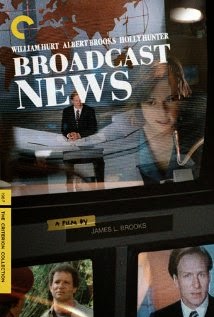
Broadcast News: written and directed by James L. Brooks; starring William Hurt (Tom Grunick), Albert Brooks (Aaron Altman), Holly Hunter (Jane Craig), Robert Prosky (Ernie Merriman), Lois Chiles (Jennifer Mack), Joan Cusack (Blair Litton), and Jack Nicholson (Bill Rorish) (1987): Broadcast News predicts the future better than most science-fiction films, as it shows American broadcast journalism on a collision course with infotainment. Thankfully, the movie is also funny and suitably dramatic, with James L. Brooks making even the intellectual vacuum that is William Hurt's up-and-coming anchorman a sympathetic character.
The major players -- Hurt, Holly Hunter as a Washington TV bureau's assistant producer, and Albert Brooks as a reporter -- are terrific. There is a sort of love triangle going on throughout the movie, but it never completely goes where one expects it to. The triangle is also in service to the movie's concern with the dumbing-down of American news coverage. For Hunter's character, To fall in love with William Hurt is to abandon her most cherished beliefs about what the news can be (as Brooks' character keeps telling her).
In our era of Fox News and 24-hour-Justin-Bieber coverage, Hurt's crowning journalistic sin now seems like very small potatoes. But it isn't. It was, however, a sign of where things were going, and how much further the news had to fall. Highly recommended.
When You Are Engulfed In Flames: Essays by David Sedaris (Collected 2008): Comic essayist and occasional short-story writer David Sedaris seems to have known from the beginning of his late-blooming career that if one wants to mock a wide assortment of people, things, customs, behaviors, and events around one, one must also mock one's self. Otherwise, you're just a judgmental dick. The trials, tribulations, and tics of David Sedaris the character make his judgments of all those things outside himself funnier and, in some cases, at least a little more poignant.
The novella-length essay that finishes this volume, "The Smoking Section," is a marvelous piece about Sedaris' love affair with cigarettes and the reasons for his decision to quit smoking. It's also an often hilarious indictment of a society gone absolutely bonkers on the topic of smoking. Like Orwell, Sedaris doesn't have much time for the "smelly little orthodoxies" of the smug and self-righteous, even when the smug and self-righteous occasionally turns out to be him. Highly recommended.
The major players -- Hurt, Holly Hunter as a Washington TV bureau's assistant producer, and Albert Brooks as a reporter -- are terrific. There is a sort of love triangle going on throughout the movie, but it never completely goes where one expects it to. The triangle is also in service to the movie's concern with the dumbing-down of American news coverage. For Hunter's character, To fall in love with William Hurt is to abandon her most cherished beliefs about what the news can be (as Brooks' character keeps telling her).
In our era of Fox News and 24-hour-Justin-Bieber coverage, Hurt's crowning journalistic sin now seems like very small potatoes. But it isn't. It was, however, a sign of where things were going, and how much further the news had to fall. Highly recommended.
When You Are Engulfed In Flames: Essays by David Sedaris (Collected 2008): Comic essayist and occasional short-story writer David Sedaris seems to have known from the beginning of his late-blooming career that if one wants to mock a wide assortment of people, things, customs, behaviors, and events around one, one must also mock one's self. Otherwise, you're just a judgmental dick. The trials, tribulations, and tics of David Sedaris the character make his judgments of all those things outside himself funnier and, in some cases, at least a little more poignant.
The novella-length essay that finishes this volume, "The Smoking Section," is a marvelous piece about Sedaris' love affair with cigarettes and the reasons for his decision to quit smoking. It's also an often hilarious indictment of a society gone absolutely bonkers on the topic of smoking. Like Orwell, Sedaris doesn't have much time for the "smelly little orthodoxies" of the smug and self-righteous, even when the smug and self-righteous occasionally turns out to be him. Highly recommended.
Thursday, July 17, 2014
1985
Lost in America: written by Albert Brooks and Monica McGowan Johnson; directed by Albert Brooks; starring Albert Brooks (David Howard) and Julia Hagerty (Linda Howard) (1985): Brooks takes his often hilariously neurotic persona on the road as David Howard, who transmutes a massive disappointment at work into an attempt to replicate Easy Rider, but in a Winnebago and without the whole death problem at the end.As ad executive Howard, Brooks is his usual self-doubting, blabbermouth self, while Julie Hagerty -- best known for the Airplane movies -- is charming and off-beat as his wife. The movie dissects the ideological fallacies of a certain type of modern personality whose fantasies are dangerous because they're so ill-thought-out and not because they're daring.
Terrific set-pieces abound in Las Vegas, Los Angeles, and on the road. Brooks keeps things moving throughout. There's really no fat on this movie, which clocks in at a satisfying 90 minutes or so. Highly recommended.
Fletch: adapted from the Gregory McDonald novel by Andrew Bergman; directed by Michael Ritchie; starring Chevy Chase (Fletch), Joe Don Baker (Chief Karlin), Dana Wheeler-Nicholson (Gail Stanwyk), Tim Matheson (Alan Stanwyk), George Wendt (Fat Sam), Geena Davis (Larry) and Richard Libertini (Frank) (1985): This enjoyable, occasionally and weirdly aimless mystery-comedy sends investigative reporter Chevy Chase off on the trail of drug-dealers, corrupt police, and a mysterious businessman.
You know it's the mid-1980's because Harold Faltermeyer supplies the music, just as he did on megahit Beverly Hills Cop the year before. Indeed, Faltermeyer replaced the original composer for this movie after the posters had been printed, suggesting that he was parachuted in because studio executives thought he was the reason Beverly Hills Cop grossed a gajillion dollars.
Chase and a very strong cast are very funny throughout, though the fact that Fletch keeps disguising himself for his investigations seems a bit odd given that Chase wasn't one of Saturday Night Live's gifted mimics. It's always nice to see Joe Don Baker, here playing a sinister police chief, with George Wendt, Geena Davis, Richard Libertini, and M. Emmet Walsh also doing solid work in supporting roles.
A relatively complicated plot sputters at times, and Chase really doesn't evoke sympathy when the movie turns to the character's pain over his ex-wife's infidelity. He's just not that type of comic actor. Recommended.
Labels:
albert brooks,
chevy chase,
fletch,
julie hagerty,
lost in america
Saturday, September 14, 2013
Apatow Descending
This is 40: written and directed by Judd Apatow; starring Paul Rudd (Pete), Leslie Mann (Debbie), Maude Apatow (Sadie), Iris Apatow (Charlotte), Jason Segel (Jason), Megan Fox (Desi), Graham Parker (Himself), Chris O'Dowd (Ronnie), Albert Brooks (Larry) and John Lithgow (Oliver) (2012): This movie feels like it's 40 hours long. And not a good 40 hours.
Writer-director Judd Apatow's greatest weakness (other than the colour yellow) has been his inability to trim even his best movies, leaving the viewer with comedies that seem to always clock in with about 20 minutes too much footage. Here, that inability to edit really infects the entire film. This entire movie could be deleted from the space-time continuum without any harm being done.
My two favourite review titles for this movie are 'First-World Problems' and 'Here's a Bunch of Things That I've Been Thinking About, In No Particular Order.' We follow a week in the life of some supporting characters from Knocked Up, primarily married couple Pete (Paul Rudd) and Debbie (Leslie Mann). Pete runs his own failing record label. Debbie runs her own clothing boutique. They have a giant house in Los Angeles. They are having marital problems. I don't care.
I suppose part of the problem is that Paul Rudd really needs to either get back into television or start playing supporting roles again. He's an amiable actor with a gift for improv, but he can't carry a movie.
And Leslie Mann, who in the real world is Mrs. Judd Apatow, is fine as a supporting actress but also becomes quite irksome quite quickly as a lead actress. I think part of it is that she has a character actor's face, which is to say she has a distinct and permanent look to her face, in her case that look being 'comically aggrieved'. And it just doesn't work when she's expected to emote in ways that aren't supposed to embody comic aggrievedness. She just looks constipated.
Much of the writing here is lazy, whether it was actually improvised (as happens a lot on Apatow films) or written down beforehand. The characters are flat, their problems weirdly attenuated, possibly because they're too upper-middle-class to be sympathetic without the movie working a lot harder to give them character traits other than 'whiteness' and 'permanently aggrieved.' Pete and Debbie are written as increasingly tiresome whiners, but almost always in a comic mode. The moments in which we're supposed to feel genuine sympathy -- or in which the film expects us to engage with what's happening as if it were a well-written drama -- fail utterly.
And then there are Judd Apatow's daughters. Because his daughters played the daughters of Pete and Debbie in Knocked Up, Apatow has them reprise their roles here. But Knocked Up didn't have the two on-screen in every other scene. The actual child (Iris) is passable in the way child actors can be, though her line readings in certain scenes are stilted.
Poor Maude, playing 13-year-old Sadie, is terrible. Sofia Coppola in The Godfather III terrible. The writing presents Sadie as an angry, screaming young teen. Indeed she is. So she's very yelly and jumpy, in the manner of young actors in middle-school theatrical productions everywhere. Shrill. Even more yelly. Why do this to your daughter? She can't act!
So anyway, this is a crappy movie. There are funny lines and situations scattered throughout, and a number of funny performances break through the crap, the always charming Chris O'Dowd and the always entertaining Albert Brooks chief among them.
There's also a shamefully, embarrassingly tone-deaf sequence in which Pete mocks the accent of an East Indian doctor. And there's a dreadful waste of Melissa McCarthy's talents, not because she isn't funny, but because the movie uses her size and brashness as objects of ridicule, and then has her character comment upon this ridicule as if to defuse the problematic construction of fatness and brashness as being funny when set against the much better looking and more socially acceptable Pete and Debbie.
But all McCarthy's meta-commentary does is make it clear that Apatow is well aware of what he's doing -- and apparently thinks the situation is funny anyway. See, she's fat and obnoxious! And she wrongly accuses Pete of touching her breast! Ha ha, what fun! What a moment of familial triumph when Pete and Debbie make her look stupid!
Oh, and Megan Fox plays one of Leslie Mann's clerks at her boutique. And of course Fox's character also moonlights as a hooker. Sorry, escort. And the other clerk turns out to be addicted to Oxy. And in Judd Apatow's world, Oxy makes you speak like the possessed Linda Blair in The Exorcist and makes you an object of simple ridicule as well. What larks, Pip, what larks! So, a terrible movie, and an intermittently odious one. Not, not, not recommended.
Writer-director Judd Apatow's greatest weakness (other than the colour yellow) has been his inability to trim even his best movies, leaving the viewer with comedies that seem to always clock in with about 20 minutes too much footage. Here, that inability to edit really infects the entire film. This entire movie could be deleted from the space-time continuum without any harm being done.
My two favourite review titles for this movie are 'First-World Problems' and 'Here's a Bunch of Things That I've Been Thinking About, In No Particular Order.' We follow a week in the life of some supporting characters from Knocked Up, primarily married couple Pete (Paul Rudd) and Debbie (Leslie Mann). Pete runs his own failing record label. Debbie runs her own clothing boutique. They have a giant house in Los Angeles. They are having marital problems. I don't care.
I suppose part of the problem is that Paul Rudd really needs to either get back into television or start playing supporting roles again. He's an amiable actor with a gift for improv, but he can't carry a movie.
And Leslie Mann, who in the real world is Mrs. Judd Apatow, is fine as a supporting actress but also becomes quite irksome quite quickly as a lead actress. I think part of it is that she has a character actor's face, which is to say she has a distinct and permanent look to her face, in her case that look being 'comically aggrieved'. And it just doesn't work when she's expected to emote in ways that aren't supposed to embody comic aggrievedness. She just looks constipated.
Much of the writing here is lazy, whether it was actually improvised (as happens a lot on Apatow films) or written down beforehand. The characters are flat, their problems weirdly attenuated, possibly because they're too upper-middle-class to be sympathetic without the movie working a lot harder to give them character traits other than 'whiteness' and 'permanently aggrieved.' Pete and Debbie are written as increasingly tiresome whiners, but almost always in a comic mode. The moments in which we're supposed to feel genuine sympathy -- or in which the film expects us to engage with what's happening as if it were a well-written drama -- fail utterly.
And then there are Judd Apatow's daughters. Because his daughters played the daughters of Pete and Debbie in Knocked Up, Apatow has them reprise their roles here. But Knocked Up didn't have the two on-screen in every other scene. The actual child (Iris) is passable in the way child actors can be, though her line readings in certain scenes are stilted.
Poor Maude, playing 13-year-old Sadie, is terrible. Sofia Coppola in The Godfather III terrible. The writing presents Sadie as an angry, screaming young teen. Indeed she is. So she's very yelly and jumpy, in the manner of young actors in middle-school theatrical productions everywhere. Shrill. Even more yelly. Why do this to your daughter? She can't act!
So anyway, this is a crappy movie. There are funny lines and situations scattered throughout, and a number of funny performances break through the crap, the always charming Chris O'Dowd and the always entertaining Albert Brooks chief among them.
There's also a shamefully, embarrassingly tone-deaf sequence in which Pete mocks the accent of an East Indian doctor. And there's a dreadful waste of Melissa McCarthy's talents, not because she isn't funny, but because the movie uses her size and brashness as objects of ridicule, and then has her character comment upon this ridicule as if to defuse the problematic construction of fatness and brashness as being funny when set against the much better looking and more socially acceptable Pete and Debbie.
But all McCarthy's meta-commentary does is make it clear that Apatow is well aware of what he's doing -- and apparently thinks the situation is funny anyway. See, she's fat and obnoxious! And she wrongly accuses Pete of touching her breast! Ha ha, what fun! What a moment of familial triumph when Pete and Debbie make her look stupid!
Oh, and Megan Fox plays one of Leslie Mann's clerks at her boutique. And of course Fox's character also moonlights as a hooker. Sorry, escort. And the other clerk turns out to be addicted to Oxy. And in Judd Apatow's world, Oxy makes you speak like the possessed Linda Blair in The Exorcist and makes you an object of simple ridicule as well. What larks, Pip, what larks! So, a terrible movie, and an intermittently odious one. Not, not, not recommended.
Subscribe to:
Posts (Atom)