Wreck-it Ralph: written by Rich Moore, Phil Johnston, Jim Reardon, Jennifer Lee, Sam Levine, Jared Stern, and John C. Reilly; directed by Rich Moore; starring the voices of John C. Reilly (Ralph), Sarah Silverman (Vanellope), Jack McBrayer (Felix), Jane Lynch (Calhoun), and Alan Tudyk (King Candy) (2012): Jolly video-game-based fable about a hero who Learns Better. Ralph is the Donkey-Kong-like villain of a still-popular 1980's arcade game called Fix-it Felix. In the world of the movie, the characters in video games have regular lives when the games are over and the arcade is silent. They can even leave their games to visit one another in a central city that appears to exist in the electrical cables of the arcade.
Ralph is bored of being the villain for the last 30 years. Moreover, he's tired of being ostracized by his fellow characters. He may be a bad guy while someone is playing the game, but otherwise he's just a regular fella, the lonely Marty of the eight-bit world. So he decides to try to get a hero's medal. And things start to go awry.
Sharply written and closely observed when it comes to video games, Wreck-it Ralph is a really enjoyable piece of entertainment. The animators made their characters at least vaguely resemble their voice actors in many cases. Ralph, a hang-dog John C. Reilly, is perfectly acted and animated. Vanellope, voiced by Sarah Silverman, is equally enjoyable. Alan Tudyk does his best Ed Wynn as King Candy, and Jane Lynch and Jack MacBrayer do solid back-up work as a hard-case space marine and Fix-it Felix, respectively. My attention didn't flag. Recommended.

A Muppet Christmas Carol: adapted by Jerry Juhl from the novella by Charles Dickens; directed by Brian Henson; starring Michael Caine as Scrooge and the voices of Dave Goetz, Steve Whitmire, Jerry Nelson, and Frank Oz (1992): The first Muppet movie after the death of Jim Henson, with Steve Whitmire taking over the role of Kermit and other characters Henson voiced. And it's really a nice piece of work, with a remarkably sophisticated frame story in which Gonzo plays Charles Dickens as a narrator taking us through the events of Ebenezer Scrooge's fateful night. Michael Caine is solid as Scrooge, though the rest of the human supporting cast is a bit bland. The Muppets are in fine form, though. Recommended.

How to Lose Friends & Alienate People: adapted from the book by Toby Young by Peter Straughan; directed by Robert B. Weide; starring Simon Pegg (Sidney Young), Megan Fox (Sophie Maes), Gillian Anderson (Eleanor Johnson), Jeff Bridges (Clayton Harding), Kirsten Dunst (Alison Olsen), and Danny Huston (Lawrence Maddox) (2008): A fictionalization of Toby Young's memoir of working at Vanity Fair, How to Lose Friends & Alienate People wastes a metric shite-tonne of good actors with a bland, cliche-ridden script. It's not a terrible movie. It's just a boring one, with not one scene that rings with anything resembling verisimilitude.
Apparently, Toby Young was banned from the set because he kept making suggestions. Given what a bollocks the writer and director made of this production, my sympathies are with Toby Young. A book that criticizes selling out, sells out to a bland Hollywood ideal. Megan Fox, as a scheming, ditzy starlet, steals the movie. Pegg looks lost as a Romantic Lead with no good lines. Jeff Bridges just seems miscast as a fictionalized version of Graydon Carter. Not recommended.
Bad Boys II: written by George Gallo, Marianne Wibberley, Cormac Wibberley, Ron Shelton, and Jerry Stahl; directed by Michael Bay; starring Martin Lawrence (Marcus), Will Smith (Mike), Jordi Molla (Johnny Tapia), Gabrielle Union (Syd), and Peter Stormare (Alexei) (2003): Ron Shelton, the fine director and screenwriter behind such films as The Best of Times, Bull Durham, and Cobb clearly needed some money when he wrote this film. Indeed, he claimed afterwards that he didn't watch all of the first Bad Boys before working on this movie and that he's never seen Bad Boys II in its entirety. Lucky him!
There's one absolutely terrific car chase in Bad Boys II, about 40 minutes into the movie. Kudos to Michael Bay for that ten-minute sequence. The rest of the action is fairly rote stuff, big-budget blood-baths, occasionally slowed down to a CGI-era Peckinpah crawl. The dialogue is mostly terrible, though there's some unintentional hilarity buried throughout. Martin Lawrence and Will Smith really deserve better -- their charisma carries what little human interest the movie has.
As to other problems, a couple. How can the movie waste Peter Stormare as an ineffectual supporting villain? And what in the name of Holy Hell are we supposed to make of a sequence involving a dead, naked, big-breasted woman in a morgue who becomes the centrepiece of all the shots and the dialogue for about five minutes? And the actress who plays the corpse appears as 'Female Corpse' in the end credits. It's like a doctoral thesis in the male gaze. Not recommended.
Muppets Most Wanted: based on characters created by Jim Henson; written by James Bobin and Nicholas Stoller; directed by James Bobin; starring Ricky Gervais (Dominic Badguy), Ty Burrell (Jean Pierre Napoleon), Tina Fey (Nadya), and the voices of Steve Whitmire, Eric Jacobson, Dave Goelz, Bill Barretta, David Rudman, and Matt Vogel (2014):
The fundamental problem with a Muppet movie is that the Muppets were best on their 1970's and early 1980's TV variety show (well, or on Farscape, but that's a different story).
That said, this is an enjoyable sequel with a lot of winning moments and funny songs. Its box office suggests that the Muppets aren't a draw for children, but I think that's mainly the problem of there not being a Muppet TV show. Or podcast. Or whatever. The actors, human and puppet, all seem to be having a marvelous time. Cameos abound, as the movie takes its cues from the first Muppet movie (that being The Muppet Movie) when it comes to cameos.
Muppets Most Wanted is all a bit music-heavy, and the plot creaks in its machinery. Ricky Gervais makes a fine villain who could use more lines. And boy, Tina Fey has lost weight since 30 Rock! Recommended.
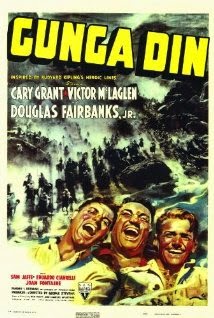
Gunga Din: based on the poem by Rudyard Kipling; written by Joel Sayre, Fred Guiol, Ben Hecht, Charles MacArthur, William Faulkner, Lester Cohen, John Colton, Vincent Lawrence, Dudley Nichols, and Anthony Veiller; starring Cary Grant (Cutter), Victor McLagen (MacChesney), Douglas Fairbanks Jr. (Ballantine), Sam Jaffe (Gunga Din), and Eduardo Ciannelli (Guru) (1939): Tremendously dated in its presentation of racial, cultural. and colonial values, Gunga Din nevertheless still has its moments of comedy, action, and drama. It's also one gigantic crib-note for Indiana Jones and the Temple of Doom.
Set in colonial India in the 1890's, Gunga Din is somewhat improbably based on a poem by Rudyard Kipling (who shows up as a character towards the end, along with a partial reading of the poem). Cary Grant, Victor McLagen, and Douglas Fairbanks Jr. play three sergeants tasked with investigating an uprising by the Thugee cult of murderous Kali worshipers.
Grant wisely took the best role in the film, that of the treasure-obsessed Cutter who's nonetheless the soldier who most treats water-carrier Gunga Din like a man and not an object. And Sam Jaffe manages to invest Din, who's about one step away from Stepin Fetchit, with a certain amount of dignity and heroism.
As the villainous cult leader with the oddly generic name of Guru, Eduardo Cianelli steals every scene he's in. At this point in history, his opposition to British colonialism seems perfectly legitimate. Maybe if he'd just have his followers stop strangling everybody! But he's the most articulate character in the movie, he has a self-sacrificing end that parallels that of Gunga Din, and he has one terrific speech about why he fights for Indian self-rule. He's like Gandhi, only with a lot more strangling and killing! Also, there's a lovable elephant, and enough historical inaccuracies in the types of weapons used by the British to keep any gun enthusiast up all night. Recommended.
King Rat by China Mieville (1998): The prolific and gifted China Mieville's first novel is an urban fantasy that's about as subterranean and cloachal as they come. It's also a clever, subversive riff on that overused fantasy and science-fiction trope of The Chosen One and his Journey to Adventure.
Saul Garamond, a somewhat aimless 30-something living in London with his left-wing, widower father, wakes up to discover that his father has been murdered and that he's the prime suspect. The police lock him up. And then Something rescues him from lock-up and reveals his True Nature to him.
He's a rat.
In the universe of King Rat, the various animal species all have their avatars, avatars that can appear to be human but are ultimately (supernatural) animals. But Saul is a hybrid of rat and human, his lost mother a member of the Rat's ruling family. He's Prince Rat.
And so off Saul and King Rat go, with King Rat showing Saul a rat's eye view of London and Saul beginning to learn the powers and abilities he has as Prince Rat. Saul sometimes sees these abilities as super-powers, but they're not the sort of powers with which King Arthur or Luke Skywalker or Neo are blessed. Saul flourishes and gains strength by eating rotten food. He moves through the sewers and cracks of the city with ease. And being covered in muck and filth doesn't bother him -- indeed, he enjoys it.
King Rat has partial allies among the other animal kingdoms, though we meet only the bird and spider kings here. And all three have an Ancient Enemy who's come to London, and against whom they must unite or die. Saul is needed for the war, for reasons that are revealed about halfway through the text.
As a left-wing subversion of traditionally right-wing or conservative fantasy tropes, King Rat is a delight. It's a satisfying read with surprising shifts and turns, and an unusual protagonist in Saul Garamond. The Ancient Enemy's plan for world domination is off-beat but, given the Enemy's real identity, perfectly logical.
There are some problems -- Mieville's postmodern aversion to closure ends up looking a lot like a plan for a sequel, or at least a young writer's aversion to killing his darlings even when they need to be killed. But it's a grand, effluvium-covered adventure in any case. Recommended.
The Witches by Roald Dahl (1983): Roald Dahl's zippy, scary, funny, Whitbread-Award-winning children's novel about the efforts of a plucky boy and his grandmother to thwart the Witches of England in their quest to turn all children into mice is a humdinger. It's also got some disturbing psychological elements that the excellent 1990 Nicholas Roeg film version eliminated, understandably so. The changes prompted Dahl to publicly trash the movie, but it's a darned good movie and you should see it anyway.
The novel is also darned good. Dahl, a great writer of both horrifying short stories and weird children's novels, had a great imagination. And he didn't patronize his intended readers with fake scares. The witches in his story are terrible beings, which doesn't stop them from breaking out into song from time to time. And for whatever reason, childhood gluttony is once again a target of Dahl's writerly wrath.
There are also a number of nicely gross scenes calculated to make children giggle in between the scenes of fantasy and horror. For example, to witches, a human child smells like dog poo. Hee hee hee. The protagonists are a brave pair, and Dahl's witches are a fascinating bunch with some fascinating peculiarities (why don't they have toes?). Recommended.
Back Issues: The Hustler Magazine Story: written by Flynn Hundhausen and Michael Lee Nirenberg; directed by Michael Lee Nirenberg (2014): Fascinating documentary about the history of Hustler magazine from its creation in the early 1970's to today. I'd never really considered the fact that Hustler founder Larry Flynt "won" the American pornography wars. Hustler is still a vital, successful online porn presence. The other three major American porn magazines -- Playboy, Penthouse, and Screw -- have all either dwindled, been sold off, or completely disappeared.
With the McKinnon-Dworkin Anti-Porn Goofiness behind us, one can see how important porn was to free speech in the United States. Both Al Goldstein's Screw and Larry Flynt's Hustler fought multiple battles against censorship and obscenity laws. That isn't to say Flynt was a saint -- the film does a nice job of laying out all his weird moments, with Flynt himself commenting on his own weirdness with the benefit of hindsight. His completely bananas, muck-raking Presidential campaign in 1984 is probably Flynt's crowning moment as a social commentator.
As the song goes, it's hard to kick against the pricks. Was Hustler important? Yes. How? Well, it de-mechanized the female body in American pornography, following Screw's lead in eschewing airbrushing and other photo touch-ups. It actually ran real investigative journalism. And Flynt was almost fearless. You may not always get the free-speech advocates you want, but sometimes you get the one you need.
Made by the son of one of Hustler's early art directors, Back Issues does fall down in two places. The timeline sometimes isn't clear. And the movie takes vast jumps in time to get to its 90-minute length. But a fascinating documentary nonetheless. Highly recommended.
No Clue: written by Brent Butt; directed by Carl Bessai; starring Brent Butt (Leo), Amy Smart (Kyra), David Koechner (Ernie), Kirsten Prout (Reese), David Cubitt (Horn) and Garwin Sanford (Nelson) (2013): Pleasant spoof of film noir and hardboiled detective movies, starring and written by Corner Gas's Brent Butt. It looks and feels like a nice time-waster of a TV movie, very much in the pleasant, mildly observant comedy tradition of Corner Gas. And it admits that it's set in Canada (Vancouver, to be exact). Boy, though, did the director fall in love with his overhead helicopter shots of the city. Recommended.
Lair by James Herbert (1979): Late, prolific English horror novelist James Herbert really had a gift for blending left-leaning social commentary into his blood-spattered works. Lair, the second novel in his Rats trilogy, isn't quite as agit-proppy as The Rats or Domain. Nonetheless, it takes a lot of shots at upper-class twits, self-serving politicians, and money-grubbing corporate types.
The two co-dependent sub-species of giant rats that brought London to its knees in The Rats seem to have been vanquished when this novel opens. Four years have passed. But in the idyllic private forest of Epping Wood, a protected green space just a few miles from the centre of London, England, something is stirring. The two-foot-long black rats and their two-headed, nearly immobile overlords have adapted to life in the forest. And boy, are they hungry!
This time around, a plucky male biologist who works for the world's biggest rat-catching corporation (the Rat Invasion of London created some great business opportunities) and a plucky female forest guide are our main protagonists. This is an early James Herbert novel, so be assured that they will engage in a graphic five-page-long sex scene before the story's over.
The super-rats soon create lots of mayhem and a lot of headless bodies stripped of all flesh. As a second book in a trilogy, Lair is a bit more restrained than the first and third novels. The action stays confined to the forest. Really, it's a pastoral from Hell.
The gruesome scenes are very gruesome and quite inventive. The bureaucrats and politicians are dangerous idiots. The adaptation of the super-rats seems logical and well-thought-out, as do the social frictions between the two sub-species of super-rats. There's trouble in Rat Paradise! But they're still super-hungry! And, in what I think is a first for Herbert, the supporting pervert character doesn't die. Or does he? In any case, Herbert really didn't like Phys. Ed. teachers. Recommended.