Showing posts with label jeff bridges. Show all posts

Saturday, March 19, 2016

Spies and Aliens and Witches, Oh My...

Starman (1984): written by Bruce Evans and Raynold Gideon; directed by John Carpenter; starring Jeff Bridges (Starman/Scott Hayden), Karen Allen (Jenny Hayden), and Charles Martin Smith (Mark Shermin): Not normally known as a director of warm dramedies, John Carpenter took on Starman to ensure he could keep getting funding for the horror movies and thrillers (and one never-made supernatural Western, Diablo) he preferred. The result was Starman, a science-fiction movie that nabbed a rare major Oscar nomination for an sf film -- a Best Actor nom for Jeff Bridges.

And Bridges is great as an alien being pretending to be human so he can make his way to a rendezvous in Arizona with his mother-ship. He takes on the appearance (and, thanks to a lock of hair, the DNA) of the dead husband of Karen Allen. Having watched the alien's rapid growth in her living-room, Allen knows he is an alien. Their relationship drives the rest of the film, as they drive to Arizona. Basically, it's ET meets Planes, Trains, and Automobiles.

As noted, Bridges does fine work as the alien, managing comedy and pathos when required and doing an awfully good job of suggesting a creature learning to use a body (and language) on the fly. Allen is also solid, as usual -- as in Raiders of the Lost Ark, she makes for a non-cookie-cutter leading woman. The government forces are, as always, bad. However, the lead scientist played by Charles Martin Smith is sympathetic. It's politicians and the military and not the forces of science who are the bad guys. In all, this is very good movie that's aged surprisingly well. Highly recommended.


The Blair Witch Project: written and directed by Daniel Myrick and Eduardo Sanchez; starring Heather Donahue (Heather), Joshua Leonard (Josh), and Michael C. Williams (Mike) (1999): Maryland: home of the Terrapins, the Ravens, The Wire, that weird state flag, and a homicidal witch. The Blair Witch Project is the most influential horror movie of the last 40 years, as it made the found-footage film the go-to vehicle for filmed horror pretty much up to the present day. It also suggested that less was more both in terms of putting graphic images on the screen and in terms of budget.

And despite a couple of verisimilitude-harming flubs (yes, it's those guys fishing in two inches of water again near the beginning), it's a fine piece of work. Of course, it's hard to separate the film from the hype surrounding it in 1999. But watching it for the first time in at least 15 years, I'm struck by what a fine piece of mounting suspense it represents.

The three actors we spend most of our time with, those three film-makers lost in the demon-haunted woods of Maryland back in 1994, are utterly credible. They're not all that good at camping or hiking. Their growing panic seems genuine -- The Blair Witch Project is a really fine study of how group harmony can disintegrate disastrously under pressure. There's even a tie-in to the 2016 presidential campaign, as the growing resentment directed towards director/group leader Heather by her male partners-in-film-making seems at least partially a result of sexism towards female leaders. And there's that witch, of course, that deadly metaphor for hidden female power revealed and aimed at the patriarchy.

There are problems, but forgivable ones, especially in a movie that cost about $10 to make. I'd have liked more scenes shot in thicker portions of the woods during the day-time to add some atmosphere and menace to those day-time hiking excursions. That they're traipsing through some very thin growth isn't a plot problem -- it's not like witchcraft is contingent on Old-Growth forests. But there is a dearth of mood in some of those day-time scenes. 

The night-time scenes are well-imagined, though. I especially like how the sounds that terrify the campers on the first three nights all seem to involve massive, unseen beings crashing through unseen trees. It gives an almost Lovecraftian feel to those moments, an idea of something much larger and much worse than a witch walking somewhere behind the trees.

And so we leave our campers, forever stranded in woods they can't seem to walk out of, no matter how long and how straight a bee-line they make in any one direction. Oh, sure, it's hard to believe that someone doesn't put down a camera (or pick up a weapon) as things get closer and closer to that much-discussed ending. So it goes. And those little hand-prints on the walls, when they come, are as awful as anything gory one could depict. Highly recommended.


Spy: written and directed by Paul Feig; starring Melissa McCarthy (Susan Cooper), Jessica Chaffin (Sharon), Jude Law (Bradley Fine), Miranda Hart (Nancy), Jason Statham (Rick Ford), Bobby Cannavale (Sergio De Luca), Rose Byrne (Rayna Boyanov), Alison Janney (Elaine Crocker), and 50 Cent (Himself) (2015): Hilarious spy spoof takes full advantage of Melissa McCarthy's outsized comic talents by making her hyper-competent, if occasionally a bit over-matched. 

The supporting cast is pretty much uniformly well-served as well, whether it's Jason Statham spoofing Jason Statham or 50 Cent supplying a winning cameo. Paul Feig, who did similar writing/directing duties on previous McCarthy movies The Heat and Bridesmaids, has become a gifted comic voice with a particularly appealing manner with women. If the new Ghostbusters is this good, people will be happy. Highly recommended.

Thursday, June 18, 2015

American Lives

The Great Gatsby: adapted by Francis Ford Coppola from the novel by F. Scott Fitzgerald; directed by Jack Clayton; starring Robert Redford (Jay Gatsby), Sam Waterston (Nick Carraway), Mia Farrow (Daisy Buchanan), Bruce Dern (Tom Buchanan), Lois Chiles (Jordan Baker), Scott Wilson (George Wilson), Karen Black (Myrtle Wilson), and Roberts Blossom (Mr. Gatz) (1974): Faithful, somewhat plodding adaptation of F. Scott Fitzgerald's Jazz Age masterpiece. Mia Farrow makes for a somewhat weak Daisy, but Redford as Gatsby and especially Sam Waterston as Nick Carraway are pretty much pitch perfect, as is Bruce Dern as the almost Mr. Hydesque brute from old money, Tom Buchanan. Coppola parachuted in to save a hated, unfinished Truman Capote adaptation in about three weeks. It's too bad they couldn't have had him direct the film as well -- I'd imagine it would have had a lot more bounce and zest than what it got from the workmanlike Jack Clayton. Recommended.


The Last Picture Show: adapted by Peter Bogdanovich and Larry McMurtry from the novel by Larry McMurtry; directed by Peter Bogdanovich; starring Timothy Bottoms (Sonny Crawford), Jeff Bridges (Duane Jackson), Cybill Shepherd (Jacy Farrow), Ben Johnson (Sam the Lion), Cloris Leachman (Ruth Popper), Ellen Burstyn (Lois Farrow), Eileen Brennan (Genevieve), Sam Bottoms (Billy), and Randy Quaid (Lester Marlow) (1971): Often found on 100 Best Movie Lists either All-Time or All-American, The Last Picture Show is a gritty, minutely observed look at life in a small Texas town in the early 1950's.

Naturalistic and episodic though carefully structured, starkly black-and-white, beautifully acted by newcomers like Cybill Shepherd and old-timers like Ben Johnson, who would win a posthumous Best Supporting Oscar for his role as Sam the Lion. Cloris Leachman would also win an Oscar, for Best Supporting Actress for her performance as the haunted, lonely wife of the town's high school's coach and phys. ed. teacher. A young Timothy Bottoms is the protagonist, while a young Jeff Bridges plays his best friend, Duane. Well deserves its place in the upper reaches of the pantheon of American movies. Highly recommended.


Malcolm X: adapted by Spike Lee and Arnold Perl from the book by Malcolm X and Alex Haley; directed by Spike Lee; starring Denzel Washington (Malcolm Little/X), Angela Bassett (Betty Shabazz), Albert Hall (Baines), Al Freeman Jr. (Elijah Muhammad), Delroy Lindo (West Indian Archie), Spike Lee (Shorty), Lonette McKee (Louise Little), Tommy Hollis (Earl Little), James McDaniel (Brother Earl), Kate Vernon (Sophia), and Theresa Randle (Laura) (1992): Spike Lee's epic biopic towers over most movies of the 1990's, and should at the very least have earned Best Picture and Best Actor (for Denzel Washington as Malcolm X) Oscars. But Hollywood really loved Al Pacino chewing the scenery in Scent of a Woman that year. So it goes.

The movie takes surprisingly few liberties with the facts of the story, primarily in creating compound characters to streamline the narrative. As Malcolm X (nee Malcolm Little), Denzel Washington gets to travel from hustler and hood to questing intellect over the 3+ hours of the movie, and all of it convincing. The rest of the cast is superb, with stand-outs including Angela Bassett as Malcolm's wife, Betty Shabazz, and Al Freeman Jr. as the manipulative, charismatic Elijah Muhammad, head of the Nation of Islam.

Lee's direction conveys gravitas, lightness of tone, and impending disaster with equal surety. One can see the energetic, bombastic director of previous films that include Do the Right Thing, but that director can now give the viewer a moving, often very formal biopic in which the didactic moments are dramatically satisfying. Lee also plays with film stock and other factors to simulate period-specific 'real' footage from the time in as deft a manner as anything Oliver Stone had managed in JFK the previous year (and Malcolm X actually uses footage from JFK for the Kennedy assassination in this film, as Stone was one of many who helped Lee get the long-delayed Malcolm X made).

Washington, Lee, and the screenwriters credited and uncredited make Malcolm X into a sympathetic figure on an almost unbelievably rich and complex journey of spiritual growth. One misses him when he's gone from the film, while the film brilliantly shifts from its depiction of events to actual footage of the real Malcolm. The two-part conclusion to the film, with Ossie Davis's 1965 funeral oration followed by contemporary footage shot for the film, is a stunner. So too the movie. Highly recommended.

Friday, April 10, 2015

Catching Up

Lemons Never Lie by Richard Stark (pen-name of Donald E. Westlake) (1971): Alan Grofield, occasional co-thief with Westlake/Stark's anti-hero Parker, gets one of his own adventures here, an often grim series of events clumsily but murderously orchestrated by a sociopathic heist planner with no idea how to successfully set up a big heist. Grofield, who needs money for his summer theatre company (!), turns down the seemingly incompetent Myers' offer to join his gang for a brewery heist, thus setting off a country-hopping series of criminal events. Details of the planning and execution of a competent heist not involving Myers are especially fascinating. Recommended.


Neighbors: written by Andrew J. Cohen and Brendan O'Brien; directed by Nicholas Stoller; starring Seth Rogen (Mac Radner), Rose Byrne (Kelly Radner), Zac Efron (Teddy Sanders) and Dave Franco (Pete) (2014): Amusing, raunchy tale of a battle between a fraternity run by Zac Efron and young couple Rose Byrne and Seth Rogen, who've just had a baby and now face the horrors of having a frat move in next to them. Could be sharper, but it passes the time. Lightly recommended.


The Giver: adapted from the novel by Lois Lowry by Michael Mitnick and Robert B. Weide; directed by Philip Noyce; starring Brenton Thwaites (Jonas), Odeya Rush (Fiona), Cameron Monaghan (Asher), Jeff Bridges (The Giver), Meryl Streep (Chief Elder), Katie Holmes (Mother), and Alexander Skarsgard (Father) (2014): Film adaptation plays fairly freely with Lowry's award-winning novel, but nonetheless remains a fairly enjoyable tale of a future dystopia. Jeff Bridges is solid as usual as the literal keeper of memories for a post-apocalyptic society which carefully regulates emotions and emotional attachments. Recommended.


The Superman Chronicles Volume 8: written by Jerry Siegel; illustrated by Joe Shuster, Fred Ray, Leo Nowak, Jack Sikela, Ed Dobrotka, Paul Cassidy, and others (1941-42; this collection 2010): Superman battles an unfrozen caveman and an electrically super-charged Lex Luthor in this volume of his early adventures. Jerry Siegel's interest in science-fiction tropes also manifests in a battle between the Man of Steel and an army of evil mermen, a ray that can age or de-age people, and the electricity-wielding threat of the Lightning Master. Stories written just before the United States entered World War Two feature the Man of Tomorrow battling saboteurs from Napkan (a thinly veiled Japan) and defeating the forces of aggressive European country Oxnalia (an even more thinly veiled Nazi Germany, complete with an Adolf Hitler lookalike as leader). Recommended.

Sunday, January 18, 2015

Bury the Lead

Last Vegas: written by Dan Fogelman; directed by Jon Turteltaub; starring Michael Douglas (Billy), Robert De Niro (Paddy), Morgan Freeman (Archie), Kevin Kline (Sam), and Mary Steenburgen (Diana) (2013): Relatively enjoyable, fairly tame senior-citizens' version of The Hangover gets aided by its top-notch cast. A number of scenes play like ads for Las Vegas, LMFAO, and Red Bull (to name three of the most blatant). Coming off cancer surgery, Michael Douglas looks haggard and about a decade older than everyone else in the cast. Lightly recommended.


Stardust: adapted by Matthew Vaughn and Jane Goldman from the novel by Neil Gaiman and Charles Vess; directed by Matthew Vaughn; starring Charlie Cox (Tristan), Claire Danes (Yvaine), Mark Strong (Septimus), Michelle Pfeiffer (Lamia), Robert De Niro (Captain Shakespeare), and Kate Magowan (Una) (2007): Somewhat loose adaptation of the Neil Gaiman novel originally and heavily illustrated by the great Charles Vess is a real charmer for those people looking for something to watch after watching The Princess Bride for the fiftieth time.

The cast is strong, and given enough decent lines and character bits to keep everything percolating in what may be a slightly too-long film. Michelle Pfeiffer is terrific as the arch-witch Lamia. Several transition scenes involving walking and riding are photographed pretty much exactly as these things are done in Peter Jackson's Tolkien movies, possibly in the hopes of tricking some people into thinking they're at a Lord of the Rings movie. The score also comes pretty close to Horner's LOTR score at points. I do wonder whether these things were done at studio insistence -- certainly the majority of the movie is lighter and cleverer than Jackson's Middle Earth. Recommended.


The Fisher King: written by Richard LaGravenese; directed by Terry Gilliam; starring Jeff Bridges (Jack), Mercedes Ruehl (Anne), Robin Williams (Parry), Amanda Plummer (Lydia), Michael Jeter (Unnamed), Tom Waits (Uncredited) (1991): Gilliam and LaGravenese's urban fantasy offers a sometimes sarcastic love letter to New York. Bridges, Ruehl, Williams, and Plummer all do terrific work, though only Ruehl (deservedly) won an Oscar.

Seen now, The Fisher King is a document of a much dirtier New York, one that hadn't yet had Times Square turned into a food court at Disneyland. Williams manages to modulate manic and melancholy as he did in few other movies, and Bridges is his usual Jeff Bridges self, making the acting appear too effortless and invisible for him to be recognized for how good it always is. He's probably the perfect fit for the role of a vain, self-centred, but potentially decent talk-radio shock-jock: he may be handsome, but he's not afraid to look awful in a variety of ways.

This is probably Gilliam's biggest commercial success (along with 12 Monkeys). He tones down his weirdness without ever losing it -- his vision of New York suggests the medieval at the right points, and not the shiny medieval, but the crap-covered ground-level world we laughed at in Monty Python and the Holy Grail. It isn't Gilliam's best film, but it's certainly his sunniest. Highly recommended.

Sunday, December 28, 2014

Wrecking and Wrecking and Wrecked

Wreck-it Ralph: written by Rich Moore, Phil Johnston, Jim Reardon, Jennifer Lee, Sam Levine, Jared Stern, and John C. Reilly; directed by Rich Moore; starring the voices of John C. Reilly (Ralph), Sarah Silverman (Vanellope), Jack McBrayer (Felix), Jane Lynch (Calhoun), and Alan Tudyk (King Candy) (2012): Jolly video-game-based fable about a hero who Learns Better. Ralph is the Donkey-Kong-like villain of a still-popular 1980's arcade game called Fix-it Felix. In the world of the movie, the characters in video games have regular lives when the games are over and the arcade is silent. They can even leave their games to visit one another in a central city that appears to exist in the electrical cables of the arcade.

Ralph is bored of being the villain for the last 30 years. Moreover, he's tired of being ostracized by his fellow characters. He may be a bad guy while someone is playing the game, but otherwise he's just a regular fella, the lonely Marty of the eight-bit world. So he decides to try to get a hero's medal. And things start to go awry.

Sharply written and closely observed when it comes to video games, Wreck-it Ralph is a really enjoyable piece of entertainment. The animators made their characters at least vaguely resemble their voice actors in many cases. Ralph, a hang-dog John C. Reilly, is perfectly acted and animated. Vanellope, voiced by Sarah Silverman, is equally enjoyable. Alan Tudyk does his best Ed Wynn as King Candy, and Jane Lynch and Jack MacBrayer do solid back-up work as a hard-case space marine and Fix-it Felix, respectively. My attention didn't flag. Recommended.


A Muppet Christmas Carol: adapted by Jerry Juhl from the novella by Charles Dickens; directed by Brian Henson; starring Michael Caine as Scrooge and the voices of Dave Goetz, Steve Whitmire, Jerry Nelson, and Frank Oz (1992): The first Muppet movie after the death of Jim Henson, with Steve Whitmire taking over the role of Kermit and other characters Henson voiced. And it's really a nice piece of work, with a remarkably sophisticated frame story in which Gonzo plays Charles Dickens as a narrator taking us through the events of Ebenezer Scrooge's fateful night. Michael Caine is solid as Scrooge, though the rest of the human supporting cast is a bit bland. The Muppets are in fine form, though. Recommended.


How to Lose Friends & Alienate People: adapted from the book by Toby Young by Peter Straughan; directed by Robert B. Weide; starring Simon Pegg (Sidney Young), Megan Fox (Sophie Maes), Gillian Anderson (Eleanor Johnson), Jeff Bridges (Clayton Harding), Kirsten Dunst (Alison Olsen), and Danny Huston (Lawrence Maddox) (2008): A fictionalization of Toby Young's memoir of working at Vanity Fair, How to Lose Friends & Alienate People wastes a metric shite-tonne of good actors with a bland, cliche-ridden script. It's not a terrible movie. It's just a boring one, with not one scene that rings with anything resembling verisimilitude. 

Apparently, Toby Young was banned from the set because he kept making suggestions. Given what a bollocks the writer and director made of this production, my sympathies are with Toby Young. A book that criticizes selling out, sells out to a bland Hollywood ideal. Megan Fox, as a scheming, ditzy starlet, steals the movie. Pegg looks lost as a Romantic Lead with no good lines. Jeff Bridges just seems miscast as a fictionalized version of Graydon Carter. Not recommended.

Sunday, June 8, 2014

Cities in Fright

R.I.P.D.: adapted from the Peter M. Lenkov comic book by Phil Hay, Matt Manfredi, and David Dobkin; directed by Robert Schwentke; starring Jeff Bridges (Roy), Ryan Reynolds (Nick), Kevin Bacon (Hayes), Mary Louise Parker (Proctor), and Stephanie Szostak (Julia) (2013): One of 2013's biggest box-office busts, R.I.P.D. isn't awful -- indeed, I've seen a lot of hits that were worst. That doesn't mean it's good, however.

The Rest in Peace Department (R.I.P.D., get it? ha ha!) enlists dead police officers to apprehend escaped dead criminals, or 'Deados' as they're colloquially known. Newly dead Ryan Reynolds partners with 19th-century Western lawman Jeff Bridges to protect the streets of Boston. Nefarious doings are afoot, related to Reynolds' death during a drug bust.

The movie's premise echoes previous entries in the dead-cop subgenre that include the TV shows Reaper, Brimstone, and G. Vs. E. (all of which are a lot better than this movie, by the way). But it's most closely modelled on Men in Black, with a third act right out of Ghostbusters.

There are some clever flourishes throughout -- weird little bits and strange production design. Jeff Bridges is the most interesting thing in the movie, as he so often is. The peculiar speech pattern of his lawman seems so specific and odd that it seems like a private joke. I have the feeling he had to keep himself interested amidst all the green-screen work and rote police shenanigans. Lightly recommended.


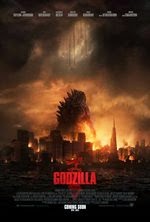
Godzilla: written by Max Borenstein and Dave Callaham, based on the Toho Studios character; directed by Gareth Edwards; starring Aaron Taylor-Johnson (Ford Brody), Ken Watanabe (Dr. Serizawa), Bryan Cranston (Joe Brody) and Elizabeth Olsen (Elle Brody) (2014): The newest version of Godzilla begins in murky menace and ends in metropolitan mayhem. I enjoyed it a lot, despite the Spielbergian family stuff that every blockbuster now seems required to carry around. Does every hero have a family he wants to get home to? Must he? Must she? Must they?

The first 40 minutes play like a horror movie. Indeed, they play a lot like director Gareth Edwards' only previous directorial effort, Monsters, which was that rarest of rare birds, an Indy giant-monster movie, and a pretty good one. Edwards did all the visual effects for that one at home on his computer over the course of a couple of years. Here, he's got a much bigger budget to work with, and much bigger commercial expectations to satisfy. Hence the Hollywood 101 family quest.

The acting is mostly fine, with nice turns from Kickass Aaron Taylor-Johnson as the narrative focalizer (ha ha!) and Ken Watanabe as a New-Agey Japanese scientist who apparently has a Ph.D. in Monster Studies. The monster work gives us the currently de rigeur gray behemoth look. I prefer my Godzilla bright-green, thank you.

But anyway, much monster mayhem ensues. The movie balances scenes of civic destruction with a few set-pieces filled with dread and the Sublime. The best of these set-pieces, a high-altitude paratrooper drop into the middle of a monster-devastated San Francisco, manages a feeling of cyclopean, Lovecraftian Sublime horror that one sees very rarely in movies of any era. It's a show-stopper. Recommended.