Muppets Most Wanted: based on characters created by Jim Henson; written by James Bobin and Nicholas Stoller; directed by James Bobin; starring Ricky Gervais (Dominic Badguy), Ty Burrell (Jean Pierre Napoleon), Tina Fey (Nadya), and the voices of Steve Whitmire, Eric Jacobson, Dave Goelz, Bill Barretta, David Rudman, and Matt Vogel (2014):
The fundamental problem with a Muppet movie is that the Muppets were best on their 1970's and early 1980's TV variety show (well, or on Farscape, but that's a different story).
That said, this is an enjoyable sequel with a lot of winning moments and funny songs. Its box office suggests that the Muppets aren't a draw for children, but I think that's mainly the problem of there not being a Muppet TV show. Or podcast. Or whatever. The actors, human and puppet, all seem to be having a marvelous time. Cameos abound, as the movie takes its cues from the first Muppet movie (that being The Muppet Movie) when it comes to cameos.
Muppets Most Wanted is all a bit music-heavy, and the plot creaks in its machinery. Ricky Gervais makes a fine villain who could use more lines. And boy, Tina Fey has lost weight since 30 Rock! Recommended.
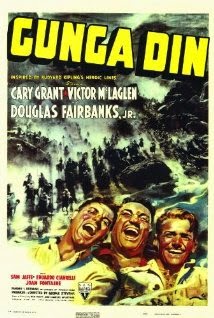
Gunga Din: based on the poem by Rudyard Kipling; written by Joel Sayre, Fred Guiol, Ben Hecht, Charles MacArthur, William Faulkner, Lester Cohen, John Colton, Vincent Lawrence, Dudley Nichols, and Anthony Veiller; starring Cary Grant (Cutter), Victor McLagen (MacChesney), Douglas Fairbanks Jr. (Ballantine), Sam Jaffe (Gunga Din), and Eduardo Ciannelli (Guru) (1939): Tremendously dated in its presentation of racial, cultural. and colonial values, Gunga Din nevertheless still has its moments of comedy, action, and drama. It's also one gigantic crib-note for Indiana Jones and the Temple of Doom.
Set in colonial India in the 1890's, Gunga Din is somewhat improbably based on a poem by Rudyard Kipling (who shows up as a character towards the end, along with a partial reading of the poem). Cary Grant, Victor McLagen, and Douglas Fairbanks Jr. play three sergeants tasked with investigating an uprising by the Thugee cult of murderous Kali worshipers.
Grant wisely took the best role in the film, that of the treasure-obsessed Cutter who's nonetheless the soldier who most treats water-carrier Gunga Din like a man and not an object. And Sam Jaffe manages to invest Din, who's about one step away from Stepin Fetchit, with a certain amount of dignity and heroism.
As the villainous cult leader with the oddly generic name of Guru, Eduardo Cianelli steals every scene he's in. At this point in history, his opposition to British colonialism seems perfectly legitimate. Maybe if he'd just have his followers stop strangling everybody! But he's the most articulate character in the movie, he has a self-sacrificing end that parallels that of Gunga Din, and he has one terrific speech about why he fights for Indian self-rule. He's like Gandhi, only with a lot more strangling and killing! Also, there's a lovable elephant, and enough historical inaccuracies in the types of weapons used by the British to keep any gun enthusiast up all night. Recommended.
The Unwritten: Tommy Taylor and the Bogus Identity: written by Mike Carey; illustrated by Peter Gross, Yukio Shimizu, and others (2009-2010); The Unwritten: Inside Man: written by Mike Carey; illustrated by Peter Gross, Yukio Shimizu, and others (2010):; The Unwritten: Dead Man's Knock: written by Mike Carey; illustrated by Peter Gross, Yukio Shimizu, and others (2010); The Unwritten: Leviathan: written by Mike Carey; illustrated by Peter Gross, Yukio Shimizu, and others (2010-2011); The Unwritten: On to Genesis: written by Mike Carey; illustrated by Peter Gross, Yukio Shimizu, and others (2011); The Unwritten: Tommy Taylor and the War of Words: written by Mike Carey; illustrated by Peter Gross, Yukio Shimizu, and others (2011-2012):
Carey and Gross's epic metafantasy pulls out a lead character modelled upon Christopher Milne and Harry Potter and throws the whole of fiction, poetry, myth, legend, and religion at him. Tom Taylor starts the narrative as the bored, drifting son of mysteriously vanished children's literary titan Wilson Taylor. Wilson seemingly modelled the hero of his incredibly popular series of children's books upon his own son, much as A.A. Milne did with Christopher Robin in Winnie the Pooh.
Well, at least his own son's name and general appearance. And then Wilson vanished, leaving Tom Taylor to make his own way in the world by attending various literary and fantasy conventions as the "real" Tommy Taylor. He signs memorabilia. Sometimes he gets lucky. Mostly he's bored.
But why did Wilson make Tommy memorize an encyclopedic array of knowledge related to "literary geography" -- both the places where works were written and the places where works took place? When Tommy gets kidnapped by an obsessed fan who seems to be an actual vampire modelled upon the literary Tommy Taylor's vampiric nemesis Count Ambrosio, things start to get weird. Especially when he's saved by a young woman named Lizzie Hexam, who knows more about the real Tom Taylor than he does, though less about herself than she's aware of. And all this is just in the first issue of the ongoing series.
The Unwritten is a lot of fun as a narrative, as a metanarrative, and as a fictional meditation on the nature and meaning not just of stories, but of Story itself. And as conspiracies are revealed, the nature of Story assumes geopolitical significance: control a society's narratives about itself and one controls the society.
A complex, funny, and scary piece of work, with lovely art on the stories themselves by Peter Gross and the occasional helper, and by Yuko Shimizu on the gorgeous covers. Highly recommended -- I'd guess there are maybe 20 issues to go before the whole thing wraps up.