'V' for Vendetta: written by Alan Moore, illustrated by David Lloyd (1981-89; collected 1990): Now that V's Guy Fawkes mask has been appropriated by both the Occupy movement and Anonymous, it's getting hard to remember what a violent, anarchic fellow Alan Moore and David Lloyd's original character was. The dystopia of the graphic novel is about ten times worse than that seen in the movie adaptation, and V himself (herself? itself?) ten times more violent and ten times more problematically justified in that violence.
The story started life in the pages of England's Warrior comic magazine in the early 1980's, alongside Moore's other early opus Marvelman (aka Miracleman). If Miracleman was Moore's push-the-limits take on Superman, then V was his Batman: a Batman fighting a dystopic future Britain that strongly resembled the world of George Orwell's 1984. A Batman whose true face and true identity remain forever hidden from the characters in the story and from readers as well. When you put on a mask, you become a symbol.
Moore was initially reacting to the heightening nuclear tensions of the early Reagan/Thatcher era, and to the ruthless economic and social policies of those two genial abominations. The dystopia of the graphic novel is a Great Britain that avoided direct nuclear conflict thanks to its Labour Government severing all nuclear ties with the United States in the 1980's.
The U.S.A. and U.S.S.R. are presumably smoking, irradiated ruins. Great Britain fell into chaos and was soon under the control of a far-right party which now rules with an iron fist and a hatred of civil liberties and anyone different. There are no non-white ethnic groups left in this Great Britain; gays and lesbians have also been exterminated or forced underground.
And so rises V, a mysterious, anarchic freedom fighter who possesses the improbable fighting and planning skills of Batman and the homicidal justice-seeking of the Shadow. Also, he loves Motown music and Thomas Pynchon. He's Anarchy personified, set against Fascism. And he knows he's a monster, which makes him oddly sympathetic, and the ending quite moving. Moore has given him some of the qualities of Mary Shelley's hyper-educated Creature in Frankenstein.
The reactions to the book have been quite telling over the years -- this is, ultimately, a book with a terrorist as its protagonist. But he's a terrorist fighting a terrorist government, a monster set against monsters. And Moore is fairly clear throughout that V's violence isn't to be romanticized, and that there must a price, a price V knows. Having lost his essential humanity at some point, V fights now to allow people the Free Will to choose their own humanity. But Moses cannot enter the Promised Land.
In any case, this book remains thrilling and bracing today, and perhaps even more relevant in a world of perpetual war with shadowy terrorist groups. David Lloyd's moody art hits the right notes, though the book would be better if the entire thing was done in the Black and White of its early Warrior episodes: colour really does nothing to improve Lloyd's art, and indeed somewhat mutes it at points. Highly recommended.
My Week with Marilyn: adapted by Adrian Hodges from writings by Colin Clark; directed by Simon Curtis; starring Michelle Williams (Marilyn Monroe), Eddie Redmayne (Colin Clark), Kenneth Branagh (Laurence Olivier), Judi Dench (Sybil Thorndyke) and Julia Ormond (Vivien Leigh) (2011): The major attraction of this enjoyable little film is the portrayal of Marilyn Monroe by Michelle Williams. Williams doesn't really look like Monroe, even made up to do so, but she absolutely nails the film's portrait of the troubled actress, helping to make her a fascinating character first and an actual real person being portrayed on film second.
The rest of the film -- ostensibly based on the experiences of 23-year-old 3rd-assistant-director Colin Clark while making The Prince and the Showgirl at Pinewood Studios in 1956 -- is a bit of a self-congratulatory piffle, especially in the second half. Colin Clark turns out to be the only person in the world who understands Marilyn, and they have a week-long platonic romance during the shooting of the film (directed by and starring Laurence Olivier). Did they really? Well, all the people who could have confirmed Clark's version of things were dead by the time he published his first account of these events, so make of that what you will.
Technically, this is a mainstream version of science-fiction fandom's Mary Sue plot device, in which a character based on the writer saves everybody in a piece of fan fiction set (originally) in the Star Trek universe. Oh, go look it up.
But regardless of how 'true' the movie is, the only real problems with this particular Mary Sue plot lie in the opacity and superior smugness of Colin Clark. As he's in every scene, Clark's nobly disingenuous upper-class savoir-faire gets a bit wearing after awhile, especially when the movie switches from the light comedy of its first half to an exploration of Marilyn's problems with her handlers, publicity, acting, Olivier, Arthur Miller, drugs, alcohol, family history, and assorted other things in the second half.
Everyone in the world except Colin Clark is against her! Imagine that, in a movie based on autobiographical material by Colin Clark...except that Clark's real-life observations about Monroe were much less flattering, though much of the film's story still comes from the book versions of Clark's diaries. Two books, in fact. Because Marilyn Monroe can make people money.
Among the other players, Kenneth Branagh is delightful as Laurence Olivier (whom he resembles not in the slightest), as are Julia Ormond as Olivier's then-wife Vivien Leigh and Judi Dench as British acting legend Sybil Thorndike (Dench, who first met the late Thorndike in 1958, observed that My Week with Marilyn gets Thorndike's kindness to younger actors pretty much spot on). In the small sub-genre of Movies Like This, My Week with Marilyn is inferior to My Favourite Year and Me and Orson Welles, but still enjoyable. Recommended.
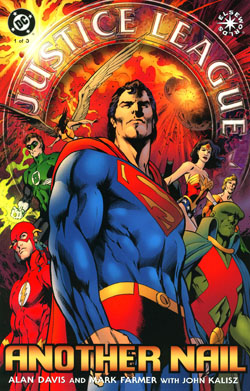
JLA: Another Nail: written and pencilled by Alan Davis, inked by Mark Farmer (2004): Alan Davis's alternate-world Justice League storyline continues here a year after the events of The Nail. Superman is gradually becoming accustomed to life in the outside world, a horribly wounded Green Arrow continues to rail against superheroes in the media, and Something Bad appears to be invading the universe.
Davis' art is great, very much in the tradition of Neal Adams, but with a distinctiveness all his own. And the story is epic without losing sight of small character moments -- it would be the perfect superhero comic book from 1985. Indeed, the basis for the continuity of the book is the 1980's pre-Crisis DC Universe with a few added flourishes.
Davis also comes up with an explanation for the existence of the ridiculously powerful JLA foe Amazo that's so perfect, it should be canonical. DC really needs to package this up with The Nail in a Deluxe edition. It looks terrific, it reads beautifully, and Davis' JLA is a lot more charming and interesting than what we get from the normal title these days. Recommended.
Blue World: written by Robert R. McCammon: containing "Yellowjacket Summer", "Makeup", "Doom City", "Nightcrawlers", "Yellachile's Cage", "I Scream Man!", "He'll Come Knocking at Your Door", "Chico", "Night Calls the Green Falcon", "Pin", "The Red House", "Something Passed by" and "Blue World" (1981-89; collected 1989): Superior collection of Robert McCammon's 1980's non-novel-length work (though the title story is nearly the length of a short novel). The collection encompasses psychological, science-fictional, and supernatural horror, along with two works of suspense ("Blue World" and "Night Calls the Green Falcon").
One of the standouts is "Nightcrawlers," filmed for an episode of the 1980's Twilight Zone revival. A Viet Nam veteran walks into a highway diner, and bad things happen. It's an excellent bit of science-fictional horror, and also seems to be the precursor to a novel that never materialized.
Many of the other stories are set in McCammon's home-state of Alabama, generally in small towns you really don't want to visit ("Yellowjacket Summer," "He'll Come Knocking at Your Door," and "Something Passed By."). The latter is an extremely effective bit of Cthulhuesque cosmic horror that dwells on the effects of a dimensional incursion without worrying about the how, why, or who.
"Night Calls the Green Falcon" is another stand-out that would make a terrific movie. An aging, forgotten, and psychologically damaged former star of a children's superhero serial about crimefighter the Green Falcon finds himself dropped into a real-life mystery that he initially has no real desire to tackle.
But tackle it he does, sometimes literally, dressed in the faded remnants of his movie costume. The story strikes a nice balance between the childish idealism of the superhero and the realities of the real world that's much more heart-breaking (and ultimately heart-warming) than the vast majority of adult superhero comics of the last thirty years.
Finally, there's the title novella, a plunge into a hard-boiled world of porn, sex, and serial killers with a Roman Catholic priest and a strangely innocent female porn star as its two protagonists. It verges on hard-core at points, but it's ultimately a story about conventional and unconventional morality set in San Francisco's famous Tenderloin district. McCammon's deft third-person narration is really on display here as the narrative moves seamlessly from the thoughts and actions of one character to another and another and then back again. Recommended.
Wanderlust: written by David Wain and Ken Marino; directed by David Wain; starring Paul Rudd (George Gergenblatt), Jennifer Aniston (Linda Gergenblatt), Justin Theroux (Seth), and Alan Alda (Carvin) (2012): Some day, years from now, someone will write a computer program that will remove Jennifer Aniston from all movies not entitled Horrible Bosses or The Good Girl and replace her with someone funnier. Anyone funnier.
Actually, funnier isn't even necessary: we just need someone who isn't a black hole that devours all laughs when the camera is on her. Her film career is only rivalled by Ed Helms' last two seasons on The Office, in which he's become The Man Where Laughs Go To Die. It's as if the two of them somehow generate a malign radiation known as Unlaughter.
Wanderlust comes from many of the same writers and directors and actors who gave us the brilliant Wet Hot American Summer, a fine parody of pretty much every teen movie cliche. Here, they're a little hamstrung by the dictates of a conventional narrative, though there are still some satisfyingly bizarre moments. Also, you know, Aniston.
Paul Rudd and Aniston play a down-on-their-luck New York couple who, through various misadventures, end up staying the night at Elysium, a hippie commune turned bed-and-breakfast near Atlanta. Things seem much more appealing there than back in the real world, so they end up joining the commune. And things get wacky. Well, they already are wacky -- David Wain and Ken Marino love the wacky. Wackier. Things get wackier.
There are a few dead moments not caused by Jennifer Aniston, along with a final plot twist that requires one character to suddenly become a hypocritical jerk without any development of said jerkiness. The cast is a lot of fun, the movie's nice and short, and there's a weirdly compelling sub-plot involving a nudist who's written a political thriller. If only Jennifer Aniston were not the female lead! Lightly recommended.
The Night Boat by Robert R. McCammon (1980): This enjoyable, overstuffed, pulpy as all get-out early novel from McCammon gives us a World War Two U-Boat filled with undead Nazis terrifying a Caribbean Island in the late 1970's after the explosion of an old depth charge releases the U-Boat from its burial beneath tons of sand on the ocean floor.
One of McCammon's strengths throughout his career has been the density of his inventiveness in his novels -- stuff just keeps on happening even when it doesn't necessarily build from anything or to anything. Here, that density gives us three Ahabs in search of their great black-hulled Nazi whale, one of them suddenly appearing with about 60 pages to go. It also gives us a former Nazi Ishmael who shows up and then has almost nothing to do. Was this novel edited down from a much longer manuscript? I wonder.
Anyway, an expariate American scuba diver with a tragic past which will, of course, become a vital part of the story's machinery is compelled to unearth the submarine that's lain on the sea floor since 1942. It's the same sub that shelled the small Caribbean island of Coquina during World War Two before being sent to its apparent death by several sub-chasers and a lot of depth charges. But rise it does, to the astonishment of all, whereupon it drifts into the harbour and gets stuck on a reef. So the good people of Coquina elect to tow it into an abandoned military dock despite the fact that the sub managed to kill one fisherman during its trek into the harbour.
And from within the decades-sealed submarine...is that the sound of someone pounding with a hammer? Well, let's open it up and find out!
Did I mention that Voodoo plays a role as well? Of course it does. And undead zombie Nazis with an unquenchable thirst for blood and the ability to use tools. They can smash you with a hammer or fix a submarine. These are not your garden-variety stupid zombies. They have an ethos, and it's called National Socialism!
All in all, The Night Boat is a wild romp that pays off on enough plot threads to be pretty thoroughly enjoyable. McCammon would write much better novels, but no more enjoyable ones on the basic level of pulp melodrama. Recommended.
Burn, Witch, Burn (aka Night of the Eagle): adapted by Charles Beaumont and Richard Matheson from the novel Conjure Wife by Fritz Leiber; directed by Sidney Hayers; starring Peter Wyngarde (Norman Taylor), Janet Blair (Tansy Taylor), and Maragret Johnson (Flora Carr) (1962): It's an all-star writing team-up as genre greats Richard Matheson (Duel, Hell House, a lot of Twilight Zone episodes) and Charles Beaumont (a lot of Twilight Zone episodes) adapt Science-fiction-and-fantasy Grandmaster Fritz Leiber's terrific 1940's fantasy novel Conjure Wife for the big screen.
The action is moved to England and compressed in time, doing some violence to the original, but the result is still an enjoyable, fast-paced bit of modern horror-fantasy set in the cut-throat world of academia. Yes, academia. Professor Norman Taylor seems to have led a charmed life both personally and professionally. And he has. But he's about to find out the cost. And witchcraft is involved. And possibly Sexual-Harassment Panda.
Two bits of goofiness mar the very beginning and the very end, seemingly added by a nervous studio. But they're minor. This story of modern witchcraft has some real thrills and horrors awaiting, along with one pissed-off eagle-shaped gargoyle. The film-makers do a nice job of suggesting as much as possible, a necessity given the budget and visual effects limitations of the time. The most chilling scene relies on no visual effects whatsoever -- just Tarot cards, a match, and an increasingly panicked Norman Taylor.
My main beef with the movie would be that the scariest line of the novel -- and the events that flow forwards from it -- have been replaced here by a more conventional ending in which our protagonists are quite a bit less intelligent than they are in the book. Oh, well. Still a superior tale of magic and its discontents. Recommended.