Showing posts with label justice league of america. Show all posts

Wednesday, September 12, 2018

Wonder Woman and the Justice League of America

Wonder Woman and the Justice League America Volume 1 (1993-94/ Collected 2017): written by Dan Vado, Chuck Dixon, and Bill Loebs; illustrated by Kevin West, Mike Collins, Chris Hunter, Greg LaRocque, Rick Burchett, Ken Branch, and others:  

DC repackaged these early 1990's Justice League America issues to put Wonder Woman's name above the title. Which is fine. It's an undercollected era of DC's super-group, so whatever helps it sell!

Wonder Woman takes over as leader a few months after the Death of Superman event removed the Man of Steel from the group. The surviving members, most of whom took a beating at the hands of Superman-killer Doomsday, are still pretty traumatized. Booster Gold needs new armor, his 25th-century duds having been shredded by Doomsday. Blue Beetle is still recovering from his own physical and emotional trauma. Fire still hasn't regained her fire powers. Former Green Lantern Guy Gardner, now wielding Sinestro's yellow power ring, is unusually pissy even for him.

The group gets asked by the United Nations to intervene in an African military coup. There may be no super-villains involved in the coup, but that rapidly changes. The Extremists show up. Or maybe The New Extremists. A sort-of generic group of super-villains, they're working for a sinister mastermind who won't be revealed until the next collected volume.

The JLA makes its way through several problems, from alien fugitives to problems in member Ice's frozen Northern kingdom. The Extremists and the political problems in Ice's homeland are both part of a larger strategy from a mystery figure. Guy Gardner's ultra-belligerence is not -- it's something from his own book crossing over into JLA. We also get a chapter from perhaps DC's least-loved title-wide crossover of the 1980's and 1990's, Bloodlines.

New writer Dan Vado keeps things chugging along with what is really a Marvel-level of angst and superheroic sorrow. New regular artist Kevin West is certainly a competent penciler, though he's outshined in a one-off appearance by Mike Collins. The JLA was never really an 'Art book' -- it's hard enough to keep all the costumes straight, I think! Overall, it's a solid slice of 1990's superheroics, complete with some truly hair-raising costumes and hair-styles. Recommended.


Wonder Woman and the Justice League America Volume 2 (1994/ Collected 2017): written by Dan Vado, Gerard Jones, and Mark Waid; illustrated by Marc Campos, Chuck Wojtkiewicz, Sal Velluto, Ken Branch, and others: 

Wonder Woman leads the Justice League America against the somewhat wiggy Cult of the Machine. But that's just the warm-up for the six-part crossover with Justice League Europe and Justice League Task Force as the three Leagues must join forces in the Day of Judgment story-line to save the Earth from the Overmaster and his Cadre.

Primary JLA penciler Marc Campos does a decent job throughout, though he's occasionally overwhelmed by a desire to do unusual page lay-outs that compromise the reader's ability to understand what the Hell is going on. But he does seem very energetic and enthusiastic. Because the book crosses over with two other titles, the artists change between Day of Judgment chapters, which can be a bit discombobulating.

Wonder Woman does her best as team leader. There's a sly visual nod to Watchmen at one point which I like a lot. Booster Gold screws up. Blue Beetle gets off the mat. Vandal Savage gets to be non-threatening for once. Co-writer on Day of Judgment Mark Waid seems to do a practice run for the Quintumvirate of Kingdom Come with a trio of immortals here debating what to do about Earth's potentially dire fate. 

Overmaster never comes into complete focus as a villain. He's like Galactus if Galactus were into eugenics rather than planet-eating. Superman and Batman are completely absent from the shenanigans because of events over in their own books. They should probably have appeared for at least a cameo, given the stakes, but editors can be really, really fussy about appearances of their characters in the books of other editors. This is how one sometimes ends up with a Justice League or an Avengers that would have problems defeating the Mormon Tabernacle Choir. Oh, well.

One of the period-specific curiosities here (well, other than a book called Justice League Task Force, a name it shared with a video game of the time) are repeated references to Wonder Woman's loss of the ability to fly. Clearly this happened in her own book. We're told again and again that she can no longer fly, but never is it explained further. Get this woman an Invisible Jet stat! Recommended.

Saturday, November 18, 2017

Justice League (2017)

Justice League (2017): written by Joss Whedon, Chris Terrio, and Zack Snyder; directed by Zack Snyder and Joss Whedon; based story-wise on works by James Robinson, Gardner Fox, Nicola Scott, Mike Sekowsky, Geoff Johns, and Jim Lee; starring Ben Affleck (Batman), Gal Gadot (Wonder Woman), Amy Adams (Lois Lane), Ezra Miller (The Flash), Jason Momoa (Aquaman), Ray Fisher (Cyborg), Jeremy Irons (Alfred), Ciaran Hinds (Voice of Steppenwolf), Amber Heard (Mera), Diane Lane (Martha Kent), and Henry Cavill (Superman):

Saw Justice League at the 12:45 p.m. show in Galleria on opening day. The 'print' arrived late so they hadn't done a sound-check before showing it. Oops! 

The first ten minutes played without any noticeable treble in the mix (seriously!), which made for an interesting audio experience. I wondered if Christopher Nolan had done the sound mix until they stopped the movie, fixed the sound, and started again from the beginning.

Then for another ten minutes or so, the theatre made almost inaudible announcements that it was seeking out the source of the fire alarm (which we couldn't hear) and not to panic. Friday was a PA Day for kids. Damn kids going to a superhero movie in the afternoon and pulling fire alarms! Rascals!

Also they never quite got the movie framed properly. But then we all got free passes at the end of the show, so really, who's complaining? Though it did all make me wonder if Disney is paying people to sabotage the film.

As to the film -- well, the stitches between the fairly light-hearted, earnest or snarky Whedon scenes and the glum, occasionally straining-to-be-funny Snyder scenes are pretty obvious. Whedon also turned up the Brightness, which means Superman is actually dressed in bright blue and red for the first time in the DCEU movies, so that's good. 

Whedon clearly also had the job of hacking and slashing the movie down to two hours, and having it be basically 'stand-alone' rather than Part One. So Darkseid gets only one mention, though it's clear that the big bad works for him (the villain is Steppenwolf, who is a Kirby New Gods character whom writer James Robinson promoted to Darkseid's world-conquering general in the Earth-2 comic series from 2012). 

The hacking and slashing results in some pretty funny 'infodumps' which end up feeling like homages to the crazily fast-paced, Gardner-Fox-scripted Silver Age Justice League comics from the 1960's. The explanation of what a Mother Box is is especially... compact... as is an exchange between Aquaman and Atlantean Mera (Amber Heard) which condenses Aquaman's back story into about 45 seconds of dialogue.

The acting is pretty solid. The Flash is genuinely funny and charming. Jason Momoa's Aquaman seems to have been written as a surly underwater hillbilly Wolderine by Snyder and as a jolly underwater stand-up comedian by Snyder. Cyborg is, well, a cipher.

Also, somebody (probably Snyder) basically restages the opening battle against Sauron from Fellowship of the Ring as part of the backstory of Steppenwolf's previous invasion of Earth, and even frames it in terms of it being the last time the various races of Earth (Atlanteans, Amazons and Greek Gods, and what seems to be King Arthur and his knights) united against a common foe. I kid you not. Wonder Woman narrates, per Galadriel in LOTR: TFOTR...

Bonus points for including parademons and getting a mention of Kirby's New Gods into the dialogue. Fun fact: the movie's 'Unity' seems to pretty clearly Jack Kirby's Anti-Life Equation restated euphemistically.

Though the only two rational explanations for Superman's unintentionally funny, late-movie line to Bruce Wayne ("How did you get the farm back from the bank ?!?!?") are that Superman doesn't understand how money works or that Lex Luthor owned the bank that foreclosed on the Kent farm.

Also, maybe it's swim-suit season on Themyscira, Snyder-haters! Did you ever think of that?

There are two end credits sequences, one early and one right at the end. Plan accordingly.

Hey, the movie is only 2 hours and one minute long. Kudos! My butt thanks you!

Far better than a lot of superhero movies, a list that includes Whedon's studio-garbled Avengers: Age of Ultron, The Dark Knight Rises, Superman III, Superman IV: The Quest for Peace, Spider-man 3, Amazing Spider-mans 1 and 2, X-Men: The Last Stand, Guardians of the Galaxy 2, the first two Thor movies, Dr. Strange, the two Hulk movies, Wolverine: Origins and The Wolverine, Batman Forever, Batman and Robin, X-Men: Apocalypse, Ant-man, Superman Returns, Man of Steel, Batman v. Superman, Suicide Squad, and many others. Recommended.

Wednesday, May 24, 2017

Continuity

DC Comics Classics Library: Justice League of America by George Perez Volume 1 (1980-84/ Collected 2009): written by Gerry Conway; penciled by George Perez; inked by Frank McLaughlin and John Beatty: The big flaw with DC's quickly cancelled DC Comics Classics Library was their ridiculously high price for what was often less than 200 pages of reprints. This volume is a pretty good case in point. 

George Perez drew fewer than 12 issues of the Justice League of America back in the early 1980's. That should be one reprint volume. Nope. The DC Comics Classics Library broke that up into two volumes, padding this first one with Perez JLA postcards from the mid-1980's. The quality of the reprints is fine, though. And I bought this one for about 70%-off Canadian. So I can't complain about my deal. 

Gerry Conway's scripts are cosmic and very much Marvelesque in the amount of bickering among JLA members. Perez's artwork is already detailed as Hell and extremely strong in the characterization and action departments. He also assays a very nice two-page spread of Metron of the New Gods and some other nice visuals in locations that include the planet Apokolips, the JLA satellite, and Siberia. 

Perez's introduction notes that he didn't think either of the inkers assigned to him were a good fit. He's right, though neither John Beatty nor Frank McLaughlin is terribly misapplied. At least DC didn't assign Vince Colletta to ink him. It's an enjoyable, too-short voyage into superhero adventure. We even get a continuity-heavy explanation of super-android Red Tornado's secret origin. Bonus. Recommended.


Adventures of Superman: Jose Luis Garcia- Lopez (1975-1981/ Collected 2013): written by Martin Pasko, Gerry Conway, Elliot S. Maggin, David Michelinie, Len Wein, and Denny O'Neil; illustrated by : Jose Luis Garcia- Lopez with inking on some stories by Vince Colletta, Bob Oksner, Frank Springer, Dan Adkins, Steve Mitchell, Joe Giella, and Dick Giordano: 

Jose Luis Garcia- Lopez became the marketing face of Superman for a long time beginning in the early 1980's -- if it's a paper plate or place mat or bag of French fries with Superman artwork on it released between about 1980 and 1995, the artwork is probably by Jose Luis Garcia- Lopez. He also did a nice job on the early 1980's Batman/Hulk team-up.

Jose Luis Garcia- Lopez is also one of a handful of the finest Superman artists of the 1970's and 1980's. There's a fluidity, grace, and lightness to his superhero work that's a rare treat. He didn't always get the best inkers (he was really best inked by himself), but his work still comes through. Collecting stories from his early days as a recurring Superman artist, this volume also collects the enjoyable, rare Superman vs. Wonder Woman tabloid-sized comic from the late 1970's. 

There are a lot of other stand-outs here, including a three-parter in which writer Gerry Conway really tried to Marvelize Superman (for awhile, the Man of Steel even believes he's really a mutant) and a nifty two-part team-up with the Flash. Through it all, Jose Luis Garcia- Lopez draws everything with grace and precision and a balletic approach to action. Highly recommended.


Batman, Inc. Volume 1: Demon Star (2012-2013/ Collected 2013): written by Grant Morrison and Chris Burnham; illustrated by Chris Burnham and Frazer Irving: Confusingly, this is really the second volume of Grant Morrison's Batman, Inc., but the first after the Flashpoint line-wide reboot of DC Comics back in 2011-2012. As the whole magilla is one storyline, this is not a beginning but rather a middle. And Batman, Inc. actually involved an overarching story that went all the way back to Morrison talking over the writing reins on Batman in 2006. This lovely fellow explains the seven years of the Bat here . In short, Batman, Inc. is really the end of a seven-year Batman story. Hoo ha!

If you're going to read the whole Morrison Batman run, then you're going to have to read this volume. By this time, the zany pomo Scotsman seemed to be running out of serious steam: this whole volume feels like about two issues stretched out to interminable length. It's still enjoyable enough, I guess, and Chris Burnham's art is mostly swell in its occasionally odd melding of Frank Quitely and Geof Darrow. 

That the overall arc straddles Flashpoint requires one not to dwell on the absurd continuity ramifications of this: Flashpoint said that what appeared to be about 15 years of the Batman when the previous continuity ended was now five years. But Morrison kept everything -- every previous Robin, every Batman imitator in a foreign country -- for that new five years. So don't think about it. It's too absurdly crowded to imagine. And DC's new, ultra-successful Rebirth reboot scrambles all that up anyway. Lightly recommended, but don't read it until you've read the previous volumes of Morrison's Batman.

Wednesday, January 11, 2017

Mullet Time

Superman Vs. Aliens (1996): written and pencilled by Dan Jurgens; inked by Kevin Nowlan: 20 years ago, DC and Dark Horse put out this fairly nifty battle between Superman (still in his mullet phase) and the Alien film franchise. It was a time when the Kryptonian Supergirl was still gone from DC continuity. That fact explains much of the storyline, in which Superman responds to a distress signal from a domed city in space that appears to have once been part of Krypton. It comes complete with a spunky blonde girl named Kara who's pretty much the image, in appearance and name, of the pre-1987 Supergirl.

The story is a bit heavy on the then-continuity of the Superman comics, from the mullet to the absence of Lex Luthor from the storyline. Superman can't travel unaided through space for long at this point in his career, necessitating some technology help from LexCorp. Or LuthorCorp. Whatever. 

It's solid, unspectacular, and relatively unbloody fun. There's a bit too much harping on Superman's decision not to kill anything, including hordes of acid-blooded aliens. Is this a workable moral stance for the Man of Steel under the circumstances? Well, yes, but as written it relies an awful lot on other people killing aliens, which makes the moral stance seem awfully dubious, if not completely daft. A sin of omission rather than commission is still a sin.

Inker Kevin Nowlan makes the normally straightforward pencils of writer-penciller Dan Jurgens broody, moody, and intermittently menacing. It's a great job of inking in terms of establishing a tone a penciller isn't known for -- Nowlan did something similar with his inks on the sunny Jose Luis Garcia Lopez's Dr. Strangefate during the Marvel/DC crossover around the same time. Lightly recommended.


JLA: Justice League of America: Power and Glory (2015-2016): written by Bryan Hitch with Tony Bedard; illustrated by Bryan Hitch with Tom Derenick, Scott Hanna, Daniel Henriques, Wade von Grawbadger, Alex Sinclair, and others: Maybe getting the perennially late Bryan Hitch to both write and draw a new Justice League comic book way back in 2015 wasn't such a great idea because, well, perennially late. 

It took so long for the nine issues of his initial story arc to appear that DC had already rebooted Hitch's Justice League title (now known as Justice League and not JLA: Justice League of America) when the last issue of this title came out. And by rebooted, I mean, there were as many issues of the subsequent title on the stands as there were of this title when that last issue appeared. Whew!

Hitch writes the reboot, but the art has been left to others. That's too bad because of Hitch's strengths as an artist, strengths that outweigh his strengths as a relatively new writer. Hitch's art, a career-long riff on Neal Adams and Alan Davis, made him a superstar nearly 20 years ago in the pages of ultra-violent superhero book The Authority. And he does good work here -- 'widescreen,' as they say, cosmic though sometimes crowded.

His writing seems a bit padded at times. Nine issues seems like about two issues too much here, with about 40 pages too many of running back and forth without resolving anything plot-wise. Hitch's new Justice League has shorter story arcs so far, suggesting that something may have been learned.

Power and Glory pits Superman, Wonder Woman, Batman, and the usual gang of super-powered idiots against the Kryptonian Sun-god Rao, who arrives in near-Earth space with a whole lot of super-powered followers and an offer to bring peace, health, and long life to all the citizens of Earth -- and indeed, someday, everyone in the universe. He's initially greeted as a saviour. And of course there's a catch.

Hitch throws a lot of super-science and bombastic, epic battles around the nine issues. And time travel, strange visitors with hidden agendas, and weird standing stones waiting to fulfill some plot point or another. It's good, overlong fun. One caveat: in order to finally put a capper on this story (and this JLA title), DC elected to have other people write and draw the final issue, with only the plot by Hitch. Given how long readers had waited by this time, a few more months could probably have been survived if the end result was an all-Hitch writing-and-drawing issue. Oh, well. Recommended.

Tuesday, May 5, 2015

Crisis Times Two!

Crisis on Multiple Earths Volume 6: written by Gerry Conway and Roy Thomas; illustrated by George Perez, Don Heck, Adrian Gonzales, Jerry Ordway, Romeo Tanghal, and others (1981-82; collected 2013): When DC had multiple Earths the first time around, an annual team-up between the Justice League of Earth-1 and the Justice Society of Earth-2 started in the early 1960's. Earth-1 was home to the heroes regularly published by DC; Earth-2 was home to their counterparts who first appeared in the late 1930's and 1940's, along with a few 'legacy' heroes like Power Girl (Earth-2's Supergirl) and the Huntress (daughter of the Earth-2 Batman and Catwoman).

This volume reprints two of the longest team-ups -- eight issues in all between the two. The second team-up also brings in the All-Star Squadron, writer Roy Thomas's ret-conned Justice Society of World War Two, when the Society was disbanded in favour of a larger assemblage of Axis-fighting superheroes.

In all, this is a lot of time and space-bending fun from the late Bronze Age at DC, which ended in 1985 with the Crisis on Infinite Earths. 'Crisis' is the keyword here, used in the titles of the very first JLA/JSA team-up and then forever after in the titles of subsequent team-ups. When someone says 'Crisis!' in the DC Universe, something big and bad is going down.

The great George Perez pencils the first story arc, one which pits the League and the Society against the Secret Society of Super-villains and the Crime Syndicate of Earth-3. Much punching and inter-dimensional travel ensues. Perez demonstrates his almost uncanny ability to make super-heroes seem distinct and different and razor-sharp in their delineation. Conway's script is full of cosmic absurdity and 'cosmic balance,' as the scripts of these team-ups should be.

The second story arc crosses over between Justice League of America and All-Star Squadron. The long-penciling Don Heck does yeoman's duty on the JLA sections, especially when he inks his own pencils in the last JLA issue. Over on All-Star Squadron, a young Jerry Ordway inks Adrian Gonzales in crisp, pleasing fashion. This arc jumps between worlds and times as Golden-Age Justice Society villain Per Degaton (love that name!) enlists the help of a variety of super-villains so as to rule Earth-2. Thomas and Conway's time-travel plot is a twisty one, and at one point takes us to Earth-Prime -- which is to say, to 'our' Earth, where superheroes appear only in comic books, TV, movies, and on Underoos.

In all, this is a fine collection of melodramatic, high-stakes superhero action. One of the funnier bits involves the heroes being shocked at the idea of a world without superheroes. A running bit in which the JLA's nuclear superhero, Firestorm, keeps trying to hit on Power Girl is a bit lame, though. Stop macking on Superman's cousin! Recommended.

Monday, March 30, 2015

Starro Night

JLA Deluxe Edition Volume 3: written by Grant Morrison; illustrated by Howard Porter, John Dell, and others (1998-99; collected 2010): Grant Morrison and Howard Porter's epic 1990's relaunch of the Justice League of America comic book gets the over-sized reprint treatment here, to good effect. Porter was very much in the tradition of slightly offbeat artists who made the JLA their own (Mike Sekowsky and Dick Dillin are two other good examples), aided by Morrison's cosmically bizarre scripts.

This is the thinnest of the four Deluxe Morrison volumes, as we check in with the DC One Million event and the ensuing Ultramarines stand-off; watch the team battle another, more sinister variation on their first foe, Starro the Conqueror; and team up with the Justice Society of America to battle threats from the past and the 5th dimension.

The Starro story-line is one of the high points of the Morrison/Porter run. Starro, that giant, hyper-intelligent, telepathic starfish from beyond the stars, now invades Earth through its dreams, necessitating a guest appearance by the (then) new Lord of Dreams, Daniel. The new Starro's sudden physical appearance in Hudson's Bay (which is to say, occupying ALL of Hudson's Bay) is a great moment as well, along with Orion's incredibly stupid attack on Starro, the growing role of fallen angel Zauriel as a productive member of the team, and the subtle meta-ness of the entire enterprise. Once upon a time, the JLA used quicklime to defeat Starro. That won't work this time.

The Justice League also has to deal with a rogue U.S. general who deploys the U.S. military's super-group against the JLA. Yes, it's General Eiling, who fares much better here than he did in his last appearance on The Flash TV show. To finish things up, we get what was once an annual occurrence -- a team-up between the Justice League and the Justice Society -- which this time around pulls the original Shazamy Captain Marvel and a forgotten hero of the early 1990's into the adventure.

It's all what was then being called 'wide-screen' comic-book action. There's nothing here as convoluted and nutty as the Rock of Ages story-line from the earlier volumes, though there are nods forward to the World War Three story-line coming in Deluxe Volume 4. Highly recommended.

Monday, February 10, 2014

Justice League of Amnesia

Justice League of America: The Greatest Stories Ever Told: written by Gardner Fox, Denny O'Neil, Martin Pasko, Gerry Conway, J.M. DeMatteis, Keith Giffen, Grant Morrison, Mark Millar, and Joe Casey; illustrated by Mike Sekowsky, Dick Dillin, Kevin Maguire, Doug Mahnke, Howard Porter, Terry Austin, and others (1962-2005; collected 2006): Brad Meltzer and Rags Morales' popular and controversial Justice League miniseries Identity Crisis had just come out when this volume was assembled. The selection criteria for this 'Best-of' collection thus became slanted to earlier Justice League stories that led somehow into Identity Crisis. It would have been a much better idea to create some sort of Justice League: Prelude to Identity Crisis volume, but no one ever accused DC of being sensible.

This assortment of Justice League stories is enjoyable, but very, very, very heavy on the Identity Swap trope that Identity Crisis would explore. And the first story seems to have been included because it introduces the handy element Amnesium to the Justice League (the memory-erasing substance had previously appeared several times in Superboy and Superman comics). Good old Amnesium. Lightly recommended.


Superboy: The Greatest Team-up Stories Ever Told: written by Leo Dorfman, Frank Robbins, Cary Bates, and others; illustrated by Kurt Schaffenberger, Dave Hunt, Bob Brown, Murphy Anderson, and others (1951-1981; collected 2011): Herein lies the template for Smallville and Arrow: early stories of a hero's career in which he meets pretty much everyone we thought he met much later. Aquaboy! Green Arrow, Green Lantern, and Batman before they were Green Arrow, Green Lantern, and Batman! Young Lex Luthor! Young Jor-El! Young Lori Lemaris! Time-travelling Jimmy Olsen!

The 1950's and 1960's material is especially breezy and occasionally very, very odd as it attempts to have its earlier meet-up cake and eat it too, or whatever. So teen-aged Jor-El gets his memory erased by Amnesium so that he doesn't remember meeting his own son on Earth. Superboy gets his memory erased so that he doesn't remember Supergirl's visit, a story which seems to also have a disquieting level of protosexual longing by Superboy for (first) cousin Supergirl. Lori Lemaris, Lana Lang, and Superboy all get their memories erased by Atlantean super-hypnosis so that none of them remember their earlier meeting. DC really should do a volume of the greatest memory-erasure stories ever told! Recommended.

Saturday, August 3, 2013

Multiple Earths


Showcase Presents Justice League of America Volume 6: written by Len Wein, Martin Pasko, Elliot S! Maggin, Cary Bates, Denny O'Neil, and Gerry Conway; illustrated by Dick Dillin, Frank McLaughlin, Dick Giordano, Nick Cardy, and Ernie Chan (1973-1976; collected 2013): Fun collection of 1970's Justice League stories that synchronizes with my own first JLA comic books.

While editor Julius Schwartz used a lot of different writers at this point on the title, penciller Dick Dillin was a constant throughout. Indeed, JLA only had two different pencillers for the first 17 years or so of its existence, Mike Sekowsky and then Dillin. Dillin was solid, straightforward, and dependable -- so far as I know, he never missed a deadline, and he only left the book because he died (!).

He's "the" JLA artist for people of a certain age, an emblem of professionalism who knew how to tell a story, and could occasionally startle with some effects (here, he does some really interesting and memorable things with a wisp of smoke that gradually resolves itself into The Spectre over the course of an issue, as well as a fascinating couple of pages in which supervillain Libra expands while also losing all materiality). Also, Dillin's clean pencilling really looks good in the black-and-white Showcase format.

The stories are a lot of fun as well, with the post-Marvel psychology boom resulting in a certain amount of hand-wringing and soul-searching on the part of the Super Friends. Three unusual inter-universal crossovers appear, including a trip to Earth-X, where the Nazis won World War Two, and to Earth-2, the home of the Golden Age Justice Society which comes under attack by...a super-powered DC Comics writer named Cary Bates, previously of "our" Earth, Earth-Prime. Oh, Meta! All this, and Black Canary knits Red Tornado a new costume to replace the purple-and-red horror he'd been stuck with since his first appearance! Recommended.

Tuesday, December 25, 2012

Nails

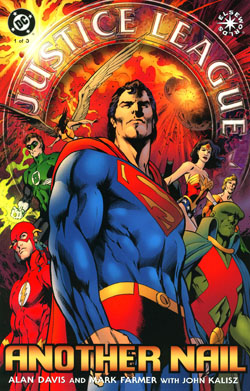
JLA: Another Nail: written and pencilled by Alan Davis, inked by Mark Farmer (2004): Alan Davis's alternate-world Justice League storyline continues here a year after the events of The Nail. Superman is gradually becoming accustomed to life in the outside world, a horribly wounded Green Arrow continues to rail against superheroes in the media, and Something Bad appears to be invading the universe.

Davis' art is great, very much in the tradition of Neal Adams, but with a distinctiveness all his own. And the story is epic without losing sight of small character moments -- it would be the perfect superhero comic book from 1985. Indeed, the basis for the continuity of the book is the 1980's pre-Crisis DC Universe with a few added flourishes.

Davis also comes up with an explanation for the existence of the ridiculously powerful JLA foe Amazo that's so perfect, it should be canonical. DC really needs to package this up with The Nail in a Deluxe edition. It looks terrific, it reads beautifully, and Davis' JLA is a lot more charming and interesting than what we get from the normal title these days. Recommended.

Tuesday, October 30, 2012

Closing Time

Hitman Volume 7: Closing Time: written by Garth Ennis; illustrated by John McCrea, Garry Leach, Doug Mahnke, and others (2000-2001, 2007; collected 2012): 11 years after the series ended, DC finally gets around to finishing its collections of Garth Ennis and John McCrea's Hitman. And it's a wild ride to the end, complete with side-journeys to the hilarious Hitman/Lobo one-shot and the melancholy 'coda' to the series, JLA/Hitman, published in 2007 but taking place before the end of the regular series.

Tommy Monaghan's life as a super-powered hitman-for-hire who only kills bad people moves inexorably towards what seems like an inevitable climax. Along the way, the body count will be just south of ludicrous. Had the series not concluded with issue 60, I'm not sure how it really could have continued -- by that last issue, we're down to about three surviving regular characters.

Before the 8-issue closing arc, we get the Doug Mahnke-illustrated Lobo 'team-up', in which the inexplicably popular alien bounty hunter gets literally and figuratively de-pantsed when he bugs Tommy and the boys at their favourite bar. It's taking the piss out of a popular character in pretty typical Ennis fashion, reminiscent of his takedown of Wolverine and Spider-man during his later run on Punisher.

Ennis, of course, really hates superheroes. Except for Superman. And what he really seems to hate are grim, gritty, 'realistic' superheroes. The short arc involving Six-Pack and Section 8, the bizarre quasi-superheroes who frequent Gotham City's more rundown areas, ends with a tribute to the idea of a superhero that also informs Ennis's take on Superman both earlier in the series and in the Hitman/JLA epilogue. Someone should hire Ennis to actually write Superman. It would be a hell of a ride.

In any case, the seven volumes of Hitman mark a fascinating bit of ultraviolent comic-book story-telling that runs the gamut from slapstick to tragedy to odd, quiet moments of uplift. John McCrea's art is gritty and violent and cartoony when it needs to be, with the inks of Garry Leach adding a real gloss to the later issues. Highly recommended in its entirety.

Sunday, September 2, 2012

Nail Fail

JLA: The Nail: written and pencilled by Alan Davis; inked by Mark Farmer (1998; collected 1999): In this Elseworlds miniseries (or 'What If?' were it from Marvel), the DC Universe suffers from the apparent non-existence of Superman because of a nail in Ma and Pa Kent's truck tire on the day of baby Kal-El's arrival from Krypton.

Alan Davis has always been a very clean, exciting superhero artist, firmly in the tradition of Neal Adams and John Byrne in the world of the hyper-real. He's also turned out to be a solid writer. The Nail feels like a throwback to the early 1980's or even earlier. It may be aimed at some sort of adult, but it nonetheless zips along in a breezy and entertaining fashion, without too much psychobabble despite some of the heavy-duty shenanigans that go on.

Without Superman, the present-day Justice League of America finds itself in a world where many normal citizens hate and fear super-heroes. Without Superman, DC-Earth has become Marvel-Earth. Or maybe just a foreshadowing of the New 52. In any case, someone or something is causing super-heroes and super-villains alike to vanish while simultaneously fanning the flames of xenophobia. This looks like a job for...oh, right.

A new edition collecting both The Nail and its excellent sequel, Another Nail, would be nice -- they really form one narrative. The biggest laugh here comes from the identity of the supervillain behind the woes of the JLA. It's at once weirdly funny and, given the thematic relevance of the whole 'Nail' concept -- of greater and greater consequences resulting from one small changed moment -- completely apt. Recommended.

Sunday, April 1, 2012

Complicated without Complexity

Darkseid, fussy.
Justice League: Origin: written by Geoff Johns; illustrated by Jim Lee and Scott Williams and others (2011-2012): Fan favourites Johns and Lee seem to have turned the rebooted Justice League into DC's most popular monthly title, one that is still outselling every other title, DC or other, seven months after its launch.

The League has seemed to move through a set cycle, reboot or not, since the late 1970's: a line-up fronted by one or more of the 'Big Three' (Superman, Wonder Woman, and Batman) makes the book popular; some or all of them leave; the book becomes less popular as lesser-known heroes take over; the book gets cancelled and then relaunched with one or more of the Big Three; and so on, and so forth.

Johns and Lee certainly make this an event book again, as the League forms for the first time to combat a massive alien invasion. Along with the usual suspects (Superman, Batman, Wonder Woman, Aquaman, Flash, and Green Lantern) and without original founding member Martian Manhunter, the league's seventh founding member turns out to be Cyborg in this iteration.

Historically, Cyborg did appear on the 1980's version of Super Friends, and he is a founding member of the League on Smallville. And he's African-American, which make the League look a little less white.

A lot of things blow up. Much Marvel-style bickering and posturing occurs among the superheroes before they figure out how to work together. Humanity, afraid of these relatively new super-heroes, comes to embrace them after they see them battling aliens in defence of humanity.

Lee's often hilariously fussy costume redesigns are distracting and often far goofier than previous iterations. His Darkseid is especially ugly, fussy, and over-complicated. Not much of interest happens here, but it happens loudly and repeatedly for emphasis. Lightly recommended.

Wednesday, August 3, 2011

Rock of Ages


JLA Deluxe Edition Volume 2, written by Grant Morrison, illustrated by Howard Porter, Val Semeiks, John Dell and others (1997-98; collected 2010): DC's repackaging of previously reprinted works can sometimes seem almost comic (the repackaging of Alan Moore material is a whole side industry).

Here, though, it makes sense. Grant Morrison's late-1990's run on DC flagship super-group title JLA (for Justice League of America) was first reprinted in arc-specific books, leading to trade paperbacks which were in some cases barely 100 pages long. The deluxe editions pop the page count close to 300 pages, present the stories in a slightly oversized format, and include material that hadn't been reprinted before (in this volume, a JLA/WildCATS crossover). So it's a good deal.

Morrison's JLA first took the Justice League back to its early 1960's roots by reuniting as close an approximation of the original seven members as could be reunited in the mid-1990's when the original Green Lantern and Flash were dead, their legacies carried on by another Flash and another GL. And Morrison ramped up the cosmic, time-bending action with world-wide and even galaxy-wide threats. Penciller Howard Porter, who could be weak with the wrong scripter, delivered the best art of his career. The result was a JLA that sold well and got critical raves.

In this second collected volume, the JLA finds itself in the twisty labyrinth of the "Rock of Ages" storyline, which begins with a new Legion of Doom before veering off into a future dystopia in which evil has conquered almost everything. The JLA has to save the universe. Or maybe destroy it.

The second arc features new villain Prometheus, who's planned for years how to kill the entire Justice League and invades their lunar Watchtower to fulfill the plan. New members begin to fill out the roster, most notably Plastic Man (whom Morrison makes an incredibly useful addition), Steel and Zauriel, the last an actual angel of the Hawk Host of Heaven.

The collection ends with the aforementioned JLA/WildCATS crossover between DC's and Wildstorm's super-groups as they face upgraded Silver Age JLA villain the Lord of Time. Morrison's love of twisty plots and comic-book minutiae isn't for everyone -- a lot of readers will probably need to Google J'emm, Son of Saturn prior to giving themselves a refresher course on what the Philosopher's Stone actually is in the "Rock of Ages" arc and where this particular version comes from (Jack Kirby's New Gods comics of the 1970's, btw). But I love it. Highly recommended.

Saturday, June 4, 2011

Gas Crisis on Earth-One


Showcase Presents Justice League of America Volume 5, written by Mike Friedrich, Len Wein, Robert Kanigher, Denny O'Neil and Gardner F. Fox, illustrated by Dick Dillin, Mike Sekowsky, Neal Adams, Nick Cardy, Joe Giella and Dick Giordano (1971-73; collected 2011): The so-called Bronze Age adventures of DC's premier superteam continue here, as DC attempts to 'Marvelize' their big characters that include Superman, Batman, Green Lantern and the Flash by giving them personal lives, self doubt, and the occasional acid flashback. OK, I made that last one up.

Friedrich, a very young gun at this point, sometimes goes off the rails into total loopiness, most notably in a story starring "jaded TV writer Harlequin Ellis," a thinly veiled homage to writer Harlan Ellison that includes Friedrich addressing the reader at the end. The cosmic adventures go down pretty smoothly, with the JLA facing big guns like Starbreaker the Cosmic Vampire and The Nebular Man and the somewhat overpowered Shaggy Man and Solomon Grundy. Solid pro Len Wein takes over the writing chores with issue 100, and things get a lot more cohesive and less loopy.

Of note here are new members Phantom Stranger, Elongated Man and Red Tornado, along with Friedrich's answer to a Marvel Avengers story by Roy Thomas that pitted the Marvel heroes against thinly veiled versions of DC's JLA. For all the occasional craziness, this is still enjoyable superhero storytelling in which plotting had precedence over decompressed longeurs and fanboy sexuality. Of interest is the fact that this covers the period in which DC had decreased the superpowers of Wonder Woman, Superman and Green Lantern in their own books. The move didn't increase sales, and so these three would soon be back to their previous overwhelming mightiness.

Another nod to Marvel seems to be the revamped Red Tornado -- like Marvel's The Vision, he's a superpowered, red-faced android looking for friendship and love and, for some reason probably born of nostalgia, my favourite B-list DC hero. He can generate massive tornadoes! How awesome is that! Recommended.