Saturday, April 30, 2011
Horror '75
DAW Year's Best Horror Stories Series IV (1975), edited by Gerald W. Page (1976):
Contents
Introduction by Gerald W. Page
Forever Stand the Stones by Joseph F. Pumilia
And Don't Forget the One Red Rose by Avram Davidson
Christmas Present by Ramsey Campbell
A Question of Guilt by Hal Clement
The House on Stillcroft Street by Joseph Payne Brennan
The Recrudescence of Geoffrey Marvell by G. N. Gabbard
Something Had to Be Done by David Drake
Cottage Tenant by Frank Belknap Long
The Man with the Aura by R. A. Lafferty
White Wolf Calling by Charles L. Grant
Lifeguard by Arthur Byron Cover
The Black Captain by H. Warner Munn
The Glove by Fritz Leiber
No Way Home by Brian Lumley
The Lovecraft Controversy- Why? by E. Hoffmann Price
Page's first outing as editor of the DAW series is a solid one, bringing us (then) new stories from some very old horror masters (Price, Munn and Long all hail from the earliest days of the American horror pulps, and all had connections to H.P. Lovecraft; Price contributes an essay on a controversial L. Sprague de Camp biography of HPL; Munn's short, brutal story is a real dandy).
One sees some of those who'd come to writing maturity in the 1970's represented here, most notably a bit of a trifle from Ramsey Campbell; one of my ten favourite vampire stories ever by David Drake (vampires and Viet Nam -- yes!); a melancholy chiller from the late, great Charles L. Grant; and Brian Lumley's uncharacteristically (for the time) non-HPL derived tale of bad times on the English roadways. Old masters Leiber, Lafferty and Davidson also contribute interesting entries, while hard-science-fiction master Hal Clement manages an increasingly chilling non-supernatural (and non-cryptozoological) story about the origin of all vampires. Highly recommended.
Labels:
horror,
supernatural fiction,
year's best horror
Bossypants by Tina Fey
Bossypants by Tina Fey (2011): Funny, breezy autobiography with very little dirt and a surprising amount of practical advice on comedy (the two-page section on 'How to Successfully Improv' is gold, Jerry, pure gold!). Some of the stuff on Fey's Sarah Palin is pretty interesting as well, combining the personal (Palin offered to have Bristol baby-sit Fey's duaghter during their co-appearance on Saturday Night Live) and the political (a few weeks later, Palin complained publically about all those mean impressions of her).
You'll find out that a certain number of 30 Rock bits are based on reality (including the propensity of some male writers at SNL to urinate into containers in their offices because they were too lazy to go to the bathroom), though you'll get very little on the day-to-day workings of the show or wacky stories about wacky goings-on -- probably because 30 Rock is still airing, making it a bit of a necessity to avoid the chance of ruffling any feathers.
Like Steve Carrell on The Office, Fey is a happily married parent who plays a gormless singleton. I'm not sure what that means in the Big Picture, but there it is. Fey also briefly explains where the scar on her face came from, a scar I wasn't actually aware she had until I read this autobiography. The Photoshopped cover riffs on Fey's experiences being on the covers of magazines, by the way. Recommended.
Labels:
30 rock,
bossypants,
sarah palin,
saturday night live,
snl,
tina fey
Tuesday, April 26, 2011
DAW The Year's Best Horror Series XI (1982), edited by Karl Edward Wagner
DAW The Year's Best Horror Series XI (1982), edited by Karl Edward Wagner (1983):
Contents:
Introduction: One from the Vault by Karl Edward Wagner
The Grab by Richard Laymon
The Show Goes On by Ramsey Campbell
The House at Evening by Frances Garfield
I Hae Dream'd a Dreary Dream by John Alfred Taylor
Deathtracks by Dennis Etchison
Come, Follow! by Sheila Hodgson
The Smell of Cherries by Jeffrey Goddin
A Posthumous Bequest by David Campton
Slippage by Michael P. Kube-McDowell
The Executor by David G. Rowlands
Mrs. Halfbooger's Basement by Lawrence C. Connolly
Rouse Him Not by Manly Wade Wellman
Spare the Child by Thomas F. Monteleone
The New Rays by M. John Harrison
Cruising by Donald Tyson
The Depths by Ramsey Campbell
Pumpkin Head by Al Sarrantonio
1982 gives us a nice selection of horror stories ranging from M.R. James homages ("The Executor" and "Come, Follow!", the latter based on James's brief notes for stories he never got around to writing) to creepy contemporary horror ("Spare the Child", which makes overseas-foster-children sponsoring almost as scary as gormless middle-class Americans). Ramsey Campbell shows up twice, in both cases at least a bit meta for stories of a haunted cinema and a really haunted horror writer, respectively.
We also get short and punchy stories from Manly Wade Wellman and Mrs. Manly Wade Wellman (Frances Garfield), another mindfuck from M. John Harrison about, um, a bizarre new cancer treatment? Sarrantonio's "Pumpkin Head" is a Bradburyesque Hallowe'en story unconnected to the Lance Henriksen movie of the same name; Michael Kube-McDowell's "Slippage" manages to suggest classic Twilight Zone in its story of a man gradually being erased from history; and John Alfred Taylor gives us my nomination as the scariest supernatural hiking story ever written. Yes, it's a small sub-genre, but this one is a dandy. All in all, highly recommended.
Friday, April 22, 2011
30 Past
The Year's Best Horror Series X (1981), edited by Karl Edward Wagner (1982):
Contents:
Introduction: A Decade of Fear by Karl Edward Wagner
Through the Walls by Ramsey Campbell
Touring by Michael Swanwick and Gardner Dozois and Jack Dann
Every Time You Say I Love You by Charles L. Grant
Wyntours by David G. Rowlands
The Dark Country by Dennis Etchison
Homecoming by Howard Goldsmith
Old Hobby Horse by A. F. Kidd
Firstborn by David Campton
Luna by G. W. Perriwils
Mind by Les Freeman
Competition by David Clayton Carrad
Egnaro by M. John Harrison
On 202 by Jeff Hecht
The Trick by Ramsey Campbell
Broken Glass by Harlan Ellison
Another year, another beautifully selected 'Year's Best' anthology edited by Karl Edward Wagner. Standouts among the standouts include "Through the Walls", Ramsey Campbell's tale of a nightmarish drug trip; "On 202", Jeff Hecht's story of a homecoming plagued by bad weather and worse memories; "Egnaro", another M. John Harrison story that reads like Borges as rewritten by Kafka and Robert Aickman; "The Dark Country", a rueful traveller's tale by the estimable, non pareil Dennis Etchison; and "Touring", in which a mysterious concert promoter stages a fairly unlikely triple bill of performers in a seemingly deserted Minnesota town. Other stories run the gamut from M.R. James homages to science fictional terror, and we get at least one humourous horror story, "Firstborn", that actually does manage to be both funny and horrifying. Highly recommended.
Swamping
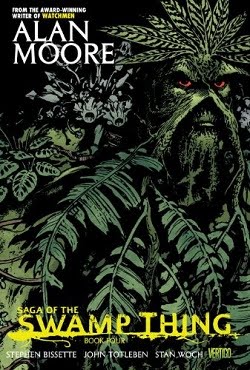
Saga of the Swamp Thing Volume 4, written by Alan Moore, illustrated by Steve Bissette, John Totleben, Rick Veitch, Stan Woch, Ron Randall, Alfredo Alcala and Tom Mandrake (1985-86; collected 2011): Blessedly, DC continues to go with non-glossy-coated paper and relatively muted colours for the re-collected Swamp Thing series. I still have nightmares about the candy-coloured original collected paperback of Alan Moore's run, from the late 1980's.
Herein we get the second half of Alan Moore's longest arc on the series, the "American Gothic" storyline. As Swamp Thing visits more American supernatural hotspots, John Constantine gathers his occult forces as part of his plan to stop the Patagonian sorcerers' circle The Brujeria from unleashing the original, pre-Creation Darkness on the universe in an effort to destroy Heaven itself. In between battling serial killers and haunted houses, Swamp Thing learns more about the history of plant elementals on Earth, and why they are created periodically through the years.
Occult investigator John Constantine is already his old snarky self, though less of a magician than he'd later be in his own book. Moore's tour of DC's lesser-known occult characters is a lot of revisionist fun, as is the showdown between an allied army of demons, angels and mystical superheroes and the forces of the Original Darkness (or 'O.D.' as I like to call it!). Moore seems to delight in taking the piss out of some of DC's more pompous supernatural heroes (Dr. Fate and the Spectre take quite an uncharacteristic pounding) so that our favourite plant elemental can finally save the day.
While a lot of different artists worked on these issues, a fair level of artistic continuity is maintained; the real stand-out, though, is long-time Swamp Thing inker John Totleben's full-art duties on what was issue 48. It's an astonishingly high-level debut, presaging his horrifying, beautiful work on his later collaboration with Moore, Miracleman. Highly recommended.
Labels:
alan moore,
john totleben,
steve bissette,
swamp thing
Tuesday, April 19, 2011
Wretched Hexcess
Jonah Hex, written by William Farmer, Mark Neveldine and Brian Taylor, based on the DC Comics character created by John Albano and Tony DeZuniga, directed by Jimmy Hayward, starring Josh Brolin, John Malcovich, Megan Fox and Will Arnett (2010): This movie is staggeringly bad in an almost giddy way. Good actors, a number of whom I didn't know were in the movie until I saw the closing credits (I'm looking at you, Michaels Fassbender and Shannon!), really have nothing to work with but dreadful dialogue and inept staging.
This may be the longest 81-minute movie in history. It bears almost no resemblance to its excellent comic-book source, which was really, when it started in the 1970's, an attempt to translate a spaghetti Western into a mainstream comic book. That effort succeeded, and a pretty good Hex book is on the comic stands even now. But this thing...Holy Fuck! Pardon my French!
But it is fascinating. For one thing, I really came to believe by the end of the movie that we were looking at several different screenplays from which scenes had been pulled at random, filmed, and then assembled hastily. One movie seems to have been based on the Wild Wild West TV show and much-later Will Smith movie, giving us a steampunky Old West in which villainous Confederate General Malcovich plans to destroy Washington, DC on the night of America's centennial with a doomsday machine Super Cannon created for the U.S. government by Eli Whitney, who also created the Cotton Gin; Jonah Hex has his own anomalous high-tech guy make crazy-ass, future-looking weapons for him like a 19th-century Batman.
In another, scarred bounty hunter Hex (Brolin) tracks down killers in the Wild West in the 1870's. In another, Hex has magical powers that allow him to bring the dead back to life so he can get information from them (Pushing Daisies, anyone?). And in yet another movie, Hex has a loveable dog sidekick who vanishes and reappears depending on which script the film-makers are using at that point. Megan Fox's colossal fall from Fanboy starlet to has-been continues apace here -- she neither looks nor sounds like a prostitute from 1876, and her role is kept pretty minimal to hide her ineptitude.
What else? Flashbacks and confusing dream sequences, sometimes cut right into action sequences for added confusion; recurring flashbacks of the same scene; a badly animated opening sequence that condenses Hex's history so that we can get the stuff actually derived from comic books out of the way; Will Arnett as a weinery Union lieutenant; a ridiculously miscast Aidan Quinn as President Ulysses S. Grant; a climactic sequence that occurs entirely at night because the movie doesn't have the budget for a CGI climax one can fully see; a totally out-of-left-field use of Native Americans; almost no attention to Hex's actual backstory from the comic books. Choppy, confusing editing. But it's short! Really not recommended.
Monday, April 18, 2011
Dr. Thirteen
The Year's Best Horror XIII (1984), edited by Karl Edward Wagner (1985):
Contents:
Introduction: 13 Is A Lucky Number - Karl E. Wagner
Stephen King - Mrs. Todd's Shortcut
Charles L. Grant - Are You Afraid Of The Dark?
John Gordon - Catch Your Death
Gardner Dozois - Dinner Party
Daniel Wynn Barber - Tiger In The Snow
Ramsey Campbell - Watch The Birdie
David J. Schow - Coming Soon To A Theatre Near You
Leslie Halliwell - Hands With Long Fingers
Fred Chappell - Weird Tales
Jovan Panich - The Wardrobe
Vincent McHardy - Angst For The Memories
David Langford - The Thing In The Bedroom
John Brizzolara - Borderland
Roger Johnson - The Scarecrow
James B. Hemesath - The End Of The World
John Gordon - Never Grow Up
Charles Wagner - Deadlights
Dennis Etchison - Talking In The Dark
One of the strongest entries from Wagner's 15+ year run on DAW's Year's Best Horror series, with a gratifyingly broad and deep range of stories. Splatterpunk was still in its formative stages in 1984, so the violence levels in these stories generally never go above a Yellow Alert level. Comic horror (David Langford's "The Thing In The Bedroom"), science-fiction-horror (Gardner Dozois's "Dinner Party"), children's horror (the two entries from John Gordon) and even a prose adaptation of what was originally a story from a comic book (Charles Wagner's "Deadlights") represent some of the more off-beat offerings.
The King story isn't horror per se, though it is a charming piece that straddles the line between light and dark fantasy. Fred Chappell's story, from a literary journal, takes us through a nightmarish historical voyage that includes the weird-but-true meetings of Hart Crane and H.P. Lovecraft; Dennis Etchison heads into Misery territory, albeit with a decided twist; David Schow pits a Viet Nam vet against the bizarre proprietors of a repertory cinema in rundown L.A.; Roger Johnson presents an able M.R. James homage; Ramsey Campbell is at his drollest in a "true story" which I'm guessing (or hoping) isn't. Karl Edward Wagner was a world wonder; highly recommended.
Subscribe to:
Posts (Atom)