Showing posts with label superheroes. Show all posts

Sunday, March 17, 2019

Glass (2019)

Glass (2019): written and directed by M. Night Shyamalan; starring James McAvoy (Kevin Wendell Crumb), Bruce Willis (David Dunn), Samuel L. Jackson (Elijah Price), Anya Taylor-Joy (Casey Cooke), Sarah Paulson (Dr. Staple), Spencer Treat Clark (Joseph Dunn), and Charlayne Woodard (Mrs. Price):

In this sequel to 2000's Unbreakable, M. Night Shyamalan returns to his own private world of super-heroes, super-villains, and the ordinary people all around them. A very subdued Bruce Willis reprises his Unbreakable role as reluctant superhero David Dunn, 19 years older and now getting an assist from his now-adult son playing Oracle on the earpiece.

Samuel L. Jackson's Elijah Price -- aka Mr. Glass -- has been doped up in a psychiatric wing for the last two decades or so after Dunn handed him over to the police for his role in the deaths of hundreds. A third super-powered piece has been added, however -- James McAvoy's super-powered multiple personality/Alter The Beast from Split (2016). Dunn is on his trail for the kidnapping and murder of a couple of groups of teen-aged girls, racing the clock before The Beast kills his next kidnap victims, a group of cheerleaders.

M. Night Shyamalan manages some pretty interesting twists here, though many found them obnoxious or off-putting. His take on super-heroes seems to me to be a complaint against the homogenized corporate movie-super-heroes who took over the box office since the release of Unbreakable. Indeed, the first 'contemporary' superhero universe movie came out the same year -- Bryan Singer's X-Men (2000). 

M. Night Shyamalan's heroes and villains mostly have to obey the laws of physics, More importantly, he posits them -- especially his superheroes -- as Folk Figures about whom the classic superhero comic books were myths and legends once-removed. Does this mean that there's a sinister global conglomerate that seeks to control those with superpowers as if they were just some sort of product?

Well, we'll see. Glass may have a controversial ending, and M. Night Shyamalan as always does some things that seem, well, a little goofy. Nonetheless, this is a fine film both featuring and about superheroes, supervillains, and the idea that in a world of crushing media conformity, magic may still exist -- real magic, dangerous magic, and maybe the real hero of a piece doesn't become apparent until the very end. Highly recommended.

Saturday, December 9, 2017

The League Of Regrettable Heroes (2015) by Jon Morris

The League Of Regrettable Superheroes (2015) by Jon Morris: Jon Morris of the Gone&Forgotten blog does a terrific balancing act here, mocking and celebrating in equal measure some of the goofiest super-heroes in the history of American comic books. 

While the Golden Age (1938-1954) supplies such non-luminaries as the Red Bee, The Black Dwarf, and Doctor Hormone, the book also presents some of the most ridiculous heroes from other eras. 

AKA X-Poochie
The mullet-ridden, EXTREME 1990's provides such unfortunate decisions as Marvel's Adam X-the-Extreme (probably not coming to a Marvel movie any time soon, though there's always Agents of S.H.I.E.L.D.!) and Ravage 2099 (don't ask). 

Earlier decades gave us Marvel truck-driving hero U.S. 1 and DC's dadaistically ridiculous 'New Look' Blackhawks and the Metamorpho-wannabe Ultra the Multi-Alien.

CTE forced an early retirement
Those were the days.

Most of these heroes had fairly short runs, demonstrating that the marketplace sometimes knows what it's doing. Some are absurdly offensive (Mr. Muscles conquers polio by working out a lot). Some are awesome and recognized as such (Joe Simon's Prez got a terrific return appearance in Neil Gaiman's Sandman in the early 1990's). 

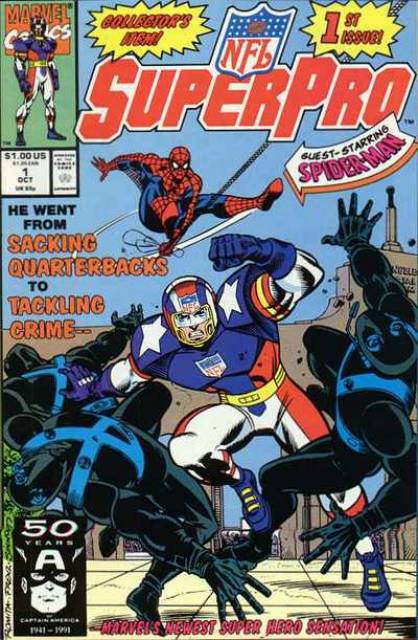
Some have even moved into the mainstream (Steve Ditko's hilarious Squirrel Girl). Some are truly screwed-up product advertisements (Marvel's NFL Superpro, who really deserved a crossover with Marvel's Kickers, Inc., a team of crime-fighting professional football players). 

There's now a second volume of this focusing on goofy super-villains. I'll have to pick that up. In any case, hours of fun and education make this Highly Recommended.

Tuesday, November 21, 2017

Shut Up, Crime!

Super (2010): written and directed by James Gunn; starring Rainn Wilson (Frank Darbo), Ellen Page (Libby), Liv Tyler (Sarah), and Kevin Bacon (Jacques): Super pretty much asks and answers the question, 'What if Travis Bickle had wanted to be a superhero?' 

The answer is a bleak, bloody satire that does everything well except stick the landing. Frustrated, mentally ill fry cook Rainn Wilson loses his recovering addict wife (Liv Tyler, way too good-looking for the movie, especially when she's supposed to be in the throes of drug use) to drug kingpin Kevin Bacon. Inspired by a Christian TV show superhero (Nathan Fillion under a hilarious Jesus wig), Wilson sets out to fight crime as the pipe-wrench wielding Crimson Bolt!

Let me tell you, writer-director James Gunn (in his pre-Guardians of the Galaxy days) is on to something here -- a massive pipe-wrench really is a good weapon!

Gunn maintains a certain tone for much of the movie -- violent, satiric, but weirdly weightless -- that only collapses in the coda. One could interpret that coda as yet another delusion by Wilson's character, though there aren't really any cues that is meant to be a delusion and not a curiously sentimental summation. 

A similar problem occurred with the unearned (and anomalous) treacle at the end of Guardians of the Galaxy 2, meaning that I'd say that the very similar Defendor is a better version of almost the same movie, by a smidgen, because its ending supports more ambiguous interpretations as to the worth (or lack thereof) of superheroes. Actually, Hobo With a Shotgun might be the best version of this story in recent years.


Ant-Man (2015): based on the character created by Stan Lee, Larry Lieber, and Jack Kirby; written by Edgar Wright, Joe Cornish, Adam McKay, and Paul Rudd; directed by Peyton Reed; starring Paul Rudd (Scott Lang), Michael Douglas (Hank Pym), Evangeline Lilly (Hope van Dyne), Corey Stoll (Darren Cross), Bobby Cannavale (Paxton), Anthony Mackie (The Falcon), and Michael Pena (Luis) (2015): Still the greatest pilot ever for a superhero TV show that was never intended to be made and never will be made. If only Edgar Wright had been allowed to stay onboard as writer and director, this might have been an all-time great superhero movie. As is, still refreshingly zippy and fun, with a cast up to the hijinks. Recommended.

Thursday, January 14, 2016

Born Kree

Marvel Boy: written by Grant Morrison; illustrated by J.G. Jones (2000-2001; collected 2012): One of superhero-comics super-writer Grant Morrison's projects from his relatively brief stint at Marvel Comics in the early oughts, Marvel Boy seems like a perfect example of how Morrison was always more suited to DC Comics and to his own creations than he was to Marvel. 

Marvel Boy is a lot of fun. But it's fun in the post-modern, DC-Silver-Age manner that Morrison made his own, with breathless plotting, weird events, alternate universes, and an anti-Establishment vibe. There's none of the angsty characterization that made Marvel Marvel. There's barely any characterization at all. And in the beginning of the NuMarvel era of 'decompressed storytelling,' Marvel Boy is instead as dense as neutronium.

'Marvel Boy' was the name of a Marvel Comics hero in the 1950's -- a time when Marvel wasn't even called Marvel yet. He's never called that in this miniseries. He's the last survivor of a super-powered Kree diplomatic team. But they're not the alien Kree who've been around since the 1960's in the Marvel universe. They're from an alternate universe where the Kree seem to be a lot more helpful to other alien races. 

His crew killed, his ship crippled -- all by a new trillionaire super-villain who seems to be wearing a really old set of Iron Man armor. Weird new things continue to happen. SHIELD disastrously deploys genetically engineered superheroes created specifically for the United Nations. An escapee from the Kree ship's prison threatens all life on Earth, forcing 'Marvel Boy' to save the planet: but the escapee is an intelligent idea, a living corporation. How do you punch that? And so on, and so forth.  It feels like a great DC Comics miniseries in which the postmodern and the gonzo, hyper-caffeinated Silver Age collide as they so often do in Morrison's 'mainstream' superhero work. 

The art by a relatively young J.G. Jones is very good (he and Morrison would later and very successfully collaborate on DC's Final Crisis). Jones may occasionally have the over-rendering tendencies of modern superhero artists, but he's also got a real sense of page design and an old-school, Neal Adams/ John Buscema hyper-realism to his pencils. He's one of a handful of contemporary superhero artists who can handle the bombast and the epic ridiculousness of a superhero epic such as Marvel Boy. Only 'Marvel Boy' himself remains somewhat inert, a character always in motion without there being much interesting about his character other than his stubborn refusal to give up, give in, or drop dead. Recommended.

Sunday, April 5, 2015

Young Superman Chronicles

The Superman Chronicles Volume 3: written by Jerry Siegel; illustrated by Joe Shuster, Wayne Boring, Jack Burnley, and others (1939-1940; this collection 2007): The third chronological volume of Superman's adventures sees the art chores shifting away from co-creator Joe Shuster, whose eyesight was already failing, and onto the artists of the Shuster studio. It's a mostly clean transition. Though Shuster's successors would often be far better artists than him, none would bring the sketchy, restless energy to the adventures of Superman that Shuster did.

Co-creator Jerry Siegel writes all the stories included here. They're a pretty good representation of Siegel's interests in politics and pulp science fiction. Superman stops a war in Europe between two fictional countries and cleans up the crooked slot machine racket in Metropolis. Don't gamble, kids!

But he also battles early mad-scientist-nemesis the Ultra-Humanite, once a bald man but now with his brain transplanted into that of a Hollywood starlet. Seriously. Lex Luthor also begins his run here, not yet bald but instead red-headed. Nonetheless, he's a malevolent foe who unleashes super-science on The Man of Steel, including a heavily armed Undersea City. The Ultra-Humanite brings the atomic disintegrator. Sometimes you're fighting the gambling schemes of mobsters, sometimes you're punching out sharks and robots. 

Even early in his career, the Man of Steel led a rich, full life.  But he's less powerful than later iterations, less concerned with preserving the lives of his enemies if they themselves are murderers, and a whole lot punchier. It's a characterization of Superman that would probably be a lot more popular now than all the other iterations people have been trying in comics and on the big and small screens for decades. Why someone doesn't go back to the beginning is beyond me. He wisecracks like Spider-man and has only slightly more regard for the lives of his enemies than Wolverine. And he's left-wing. What's not to love? Recommended.

Wednesday, April 30, 2014

Captain Canuck!

Captain Canuck: The Complete Edition: written by Richard Comely and George Freeman; illustrated by George Freeman, Richard Comely, and J.C. St-Aubin; Captain Canuck created by Ron Leishman and Richard Comely (1975-1981; collected 2011): Canadian superhero Captain Canuck originally appeared in 1975. He would ultimately star in about 15 issues of his own comic book before finally vanishing in the early 1980's; later, there would be revivals, but this volume collects that first run.

Richard Comely would write and draw the first published adventures of Canuck. In those issues we met a hero who'd gained super-strength from an encounter with mysterious aliens. As he was a Mountie at the time, he would end up becoming a sort of super-Mountie for the growing world power that was Canada in the far-flung future of...the mid-1990's!

OK, so the book got technological and social changes really, really, really wrong. So it goes.

Comely was (and still is, I believe) a One-World Conspiracy adherent, and some of that creeps into the pages of Canuck (though not nearly as much as it did into another Comely project from the same time, Star Rider and the Peace Machine). For the most part, though, the book sticks to superheroics, often in vaguely James-Bond-like situations in the first few issues.

Where Captain Canuck really takes off is with the addition of writer/artist/colourist George Freeman and artist/colourist J.C. St-Aubin to the creative team. The colouring on Captain Canuck was markedly better than the mainstream offerings of DC and Marvel right from the start; Freeman and St-Aubin would make the book look remarkably good from a production standpoint. Freeman was also a much better, cleaner cartoonist than Comely.

By issue 9 or so, Captain Canuck looked great, and the stories had begun to flow more smoothly -- and to 'pop' as well with odd situations and characters. Not many comic books in any time period would have had the desire and the skilful creators to pull off an homage to (Canadian) Hal Foster's Prince Valiant; Captain Canuck does.

All things end, of course, and given the difficulty in securing adequate distribution, Captain Canuck was probably always doomed -- especially in a world in which comic shops were just starting to become the primary means of comic-book distribution. The book ends on a cliffhanger. So it goes. Recommended.

Thursday, January 10, 2013

Cry for Love

The Boys Volume 7: The Innocents: written by Garth Ennis; illustrated by Darick Robertson, Russ Braun, and John McCrea (2010): Revelations follow revelations, as Bill Butcher comes to believe Hughie is secretly working for the evil Vought-American corporation because his girlfriend turns out to be a member of premiere superhero group The Seven.

Hughie being Hughie, this is all a coincidence aggravated by Hughie's blithe ignorance of current events and, for that matter, who exactly it is that he and the rest of The Boys are fighting. Hughie's also going to finally find out a different terrible truth about his girlfriend, but only after spending time keeping tabs on Superduper, the only superhero group composed of neither bastards nor poseurs.

That's because, no joke, they're all suffering from major mental health issues which render them benign, loveable, and pretty much harmless. Hughie's relationship with the members of Superduper (a parody of DC's teen supergroup of the 31st century, the Legion of Superheroes) will pay dividends much later in the series. Recommended.


The Boys Volume 10: Butcher, Baker, Candlestickmaker: written by Garth Ennis; illustrated by Darick Robertson (2011): Collection of the six-issue miniseries that finally laid out Boys leader Bill Butcher's tortured personal history. The violence is often overwhelming, as is the tragedy: Butcher is cut from the same mould as Ennis's Saint of Killers in the earlier Preacher series, a violent hardcase redeemed by love and then further damned with the loss of that love. Recommended.


The Boys Volume 11: Over the Hill with the Swords of a Thousand Men: written by Garth Ennis; illustrated by Russ Braun, John McCrea, Keith Burns, and Darick Robertson (2011-2012): The corporate controlled superheroes have decided to take over the world. Well, 65% of them, anyway, while the other 35% lay low and wait to see who wins.

Have Bill Butcher's plans prepared the world to successfully stand against several thousand nigh-invulnerable wankers, or will the vile and vainglorious Homelander soon rule over everything? And which side will corporation Vought-American, which didn't authorize a hostile takeover of the United States by the superheroes it created, come down on as all Hell breaks loose? And will Bill Butcher finally get vengeance upon the Homelander for the rape and subsequent death in (super-powered) childbirth of his wife? And if everything ends here, why is there one more volume to go? Highly recommended.


The Boys Volume 12: The Bloody Doors Off: written by Garth Ennis; illustrated by Garth Ennis, Russ Braun, and Darick Robertson (2012): The six-year, 90-issue, 2000-page odyssey of The Boys ends here, a few months after the blood-soaked superheroic attempt to overthrow the U.S. government. Loveable Scottish Boys member Hughie is still having relationship problems with former superheroine Starlight, more normally referred to as Annie. Vought-American is still up to lots of things, most of them profitable and dreadful. But with armageddon averted, Boys leader Bill Butcher suggests that the Boys take a vacation.

But when a Russian superhero ally of the Boys shows up dead along with a black marketeer, the vacation is cut short. And then the deaths of both supporting and main characters start to mount. Who is tidying up? Was the superhero coup the real threat? Is Hughie capable, mentally and physically, of engaging this newly revealed conspiracy and saving millions or perhaps even billions of lives? Is this Garth Ennis' last superhero comic book? All will be revealed. Highly recommended.

Monday, December 10, 2012

Corporations are people, my friends!


The Boys Volume 4: We Gotta Go Now: written by Garth Ennis; illustrated by Darick Robertson (2008-2009; collected 2009): Black Ops group The Boys delve into the secret history of the G-Men, superhero-corporation Vought American's (very) thinly veiled version of the X-Men and all their X-books, X-teams, and X-merchandising. As superhero groups in the world of The Boys go, the G-Men may be the most awful of all when their secret origins are revealed. But how will The Boys fight several hundred angry, crazy superheroes with a bewilderingly wide array of superpowers? Excellent question. Recommended.


The Boys Volume 5: Herogasm: written by Garth Ennis; illustrated by Darick Robertson and John McCrea (2009; collected 2009): Corporate-owned superheroes. Just like the comic books themselves! CIA-affiliated Black Ops group The Boys continue their investigation of superhero corporation Vought American and the legion of super-heroes created, controlled, and owned by them as the heroes of the world have their annual team-up against a force too powerful for them to combat singly or in small groups. It's a crisis and a not-so-secret war!

Well, no. In reality, the heroes and some villains annually go to a tropical island where they debauch themselves for a week on the company dime: the company-wide team-up is all about sex and drugs, not saving the world. The greatest threat to the world is the superheroes themselves and the corporation that controls them. The Boys do learn a lot more about both the secret history of recent events and what the World's Greatest Hero, the Homelander, is really up to. None of it is pretty. Recommended.


The Boys Volume 8: Highland Laddie: written by Garth Ennis; illustrated by Darick Robertson and John McCrea (2010-2011; collected 2011): Depressed by recent personal events and by his work with The Boys, Scottish team-member Hughie (he whom artist Darick Robertson originally drew to look pretty much exactly like Simon Pegg) returns home to the north of Scotland for some soul-searching. Almost certainly the most Scottish superhero miniseries ever written. Recommended.


The Boys Volume 9: The Big Ride: written by Garth Ennis; illustrated by Darick Robertson and Russ Braun (2011; collected 2011): As things gradually move towards a series-ending climax (still three volumes to go, though), we learn terrible secrets about the first go-round for The Boys in their battle against Vought American and its corporate superheroes. We also learn about the first appearance of said superheroes during World War Two and the subsequent history of both the superheroes and the CIA's attempts to find out what Vought American is up to. We also learn even more about the insane sex lives of superheroes. And one of The Boys will not make it out of this volume alive! Recommended.


Justice League Volume 2: The Villain's Journey: written by Geoff Johns; illustrated by Jim Lee, Gene Ha, Gary Frank, and Ivan Reis (2012): The new Justice League battles a couple of new menaces, refuses Green Arrow's request to join the team, and ponders its role in today's fast-paced, modern society. The new Shazam's interminably long origin story also begins. People yell at Batman. And Superman and Wonder Woman kiss.

Jim Lee's new costume designs for DC's major heroes really are fussy and distracting. Superman needs his red shorts back. And everyone needs to stop wearing armor like the Avengers all did in that terrible 1990's Avengers cartoon that didn't feature any of the major Avengers (Iron Man, Captain America, and Thor). Most of the heroes here are pissy almost all the time, which in today's superhero comics is what substitutes for camaraderie and characterization. Lightly recommended.
 

Sunday, October 14, 2012

Those Who Battle Monsters

The Boys Volume 2: Get Some: written by Garth Ennis; illustrated by Darick Robertson and Peter Snejberg (2007): The Wrath of Ennis turns to teen sidekicks, millionaire playboys who are really dark-night avengers, and the former Soviet Union in the second collection of The Boys.

Here, the covert group seeking to stop superheroic abuses of power sets its targets on the Tek-Knight and his former partner Swingwing during an investigation into the mysterious death of a gay teen. Celebrity culture takes its punches here, as does the often hypocritical world of celebrity charity endorsements. Well, that and dressing up in a high-tech costume to fight crime. And asteroids with vaginas.

After that, the Boys truck off to Russia to find out what a mysterious corporation, a Russian crimelord, a hyper-patriotic Russian politician, and a drug that creates unstable superheroes have in common. And by unstable, I mean physically unstable: these heroes have heads with a tendency to explode.

Loveable former Soviet hero Love Sausage helps the Boys uncover a conspiracy between capitalism and Russian patriotism, one that could plunge the entire planet into World War Three. All that and Little Hughie discovers the joys of alcohol made from Soviet-era brake fluid. MMM!!! Recommended, not for the squeamish or easily offended.

Violent Cases

The Boys Volume 1: The Name of the Game: written by Garth Ennis; illustrated by Darick Robertson (2006-2007): Even though Irish comic-book writer Garth Ennis has done a lot of work for Marvel and DC over the last 20 years, he hates superheroes. Boy, does he hate superheroes. Well, except for Superman.

The Boys is Ennis's superhero hate made manifest, a scabrous series about superpowered beings and the people who hate them and the people who want to be them and the people who try to control them. The Boys bears a thematic resemblance to the great Marshal Law series by Pat Mills and Kevin O'Neill, another world of superheroes gone terribly wrong. Ennis's superheroes may sometimes superficially appear to be like the beloved characters of pop culture (indeed, they often do in both costume and name, anyway). But for the most part, his superheroes are corrupted by fame and power, nearly as bad as the supervillains they have violent, super-destructive public battles with. Sometimes worse.

And so a mysterious former CIA operative puts together a team to monitor superheroes and, when necessary, destroy either their public image or, if possible, their existence. Collectively, these are the Boys (though one is a woman). They have super-powers because that's pretty much necessary to survive conflicts with super-powered beings. And their leader, Butcher, really hates superpowers. And he's got an agenda of his own.

This first volume introduces the Boys and sets them on their first case, an investigation of a teen superhero group (think Teen Titans or Young Justice). The horrible world just beneath the surface of jaunty, colourful superheroing fairly firmly puts one on the side of the Boys, even if they're no angels. Darick Robertson's clean, straightforward art lays everything out in almost clinical detail -- he's about as normative as a modern-day (mostly) superhero artist can be. That the most sympathetic member of the Boys, Little Hughie, has been drawn to look almost exactly like Simon Pegg adds a whole other layer of sympathy. Well, as does the origin of Little Hughie's antipathy towards superheroes, an event that brings him to the attention of Butcher.

Terrible things happen. So do funny things. Sometimes they're the same thing. Ennis's satiric vision is as sharp as ever, the character names often sadly appropriate (in this world, the Superman stand-in is named The Homelander. And boy, is he a prick). Early throwaways seem to promise later development (the existence of fundamentalist Christian superhero groups seems somehow logical and creepy, though no creepier than the 'Extreme' super-teens the Boys try to take down).

The deforming capability of power (and the will-to-power) seems to be Ennis's main target here, as torture and sexual cruelty come esaily to most super-beings. And they're never punished for their cruelties and murders because, hey, they're part of the Establishment. People like them. They're cool. They've got power. Well, here comes the Butcher. Recommended, but not for the squeamish.

Sunday, April 8, 2012

Nihilists, Dude!

Talk to the hand!
The Infinity Gauntlet: written by Jim Starlin; illustrated by George Perez, Ron Lim, and Josef Rubenstein (1991; collected 2000): The good thing about this epic Marvel miniseries from the early 1990's is George Perez's art on the first 3 1/2 issues, especially those sections depicting Marvel's Sorcerer Supreme, Dr. Strange. What those pages suggest is that, with the right writer, a Perez-illustrated Dr. Strange series would have been fantastic -- the mystical nature of the few Strange-centric pages herein really seem to free Perez to do things with layout that he doesn't generally do.

Otherwise, though, this almost reads like a parody of a massive superhero crossover event. The Infinity Gauntlet is basically half roll call, half fight scene. And as the fight scenes mostly involve hopeless battle against an omnipotent being, they quickly become distractingly depressing.

The death count is high, meaning that a reset button looms at the end of things, an end that takes forever to get to. But those heroes will suffer and be humiliated and get killed in the meantime. Boy, will they suffer and be humiliated and get killed. Among the sadists of the superhero-writing world of the 1980's and 1990's, only Chris Claremont seemed to revel more than Starlin at doing terrible and grotesque things to Marvel's heroes.

Jim Starlin, the destitute man's Jack Kirby, has been death-obsessed as a writer since his beginnings in the early 1970's. Herein, he has his death-obsessed super-god Thanos ("He's a nihilist!" one character breathlessly informs us) kill off half the non-vegetable, non-bacterial living beings in the universe in the opening pages as a love offering to Death. Literally. In Starlin's version of the Marvel universe, Death is a silent woman in a purple, hooded robe. And Thanos loves her. But she doesn't love Thanos. And he never learns. And she never says anything.

But with the Infinity Gauntlet -- essentially a remote control for the universe -- Thanos can now cause havoc for everybody. Leading the forces of good is dour cosmic crusader Adam Warlock, Starlin's go-to character for cosmic angst along with Marvel's original Captain Marvel. Much fighting and yelling and sophomoric philosophical musing ensues, and once Perez leaves and is replaced by the capable but somewhat bland Ron Lim as penciller, the series thuds and stumbles to its conclusion. Not recommended.

Monday, January 23, 2012

When Men Were Superheroes and Women Were Secretaries

All-Star Comics Archives Volume 2; written by Gardner F. Fox and Sheldon Mayer; illustrated by Jack Burnley, Bernard Baily, Sheldon Moldoff and others (1941-42; collected 1992): In the 1940's, the Justice Society of America was what would later be DC Comics's first group of superheroes, created in part to boost interest in the lesser-known characters of the infant DC superhero community (Superman and Batman were honourary members who didn't really participate in the adventures, while other characters that included the Flash and Green Lantern would also become honourary members once they became popular enough, though both those heroes would eventually return to active status as the superhero boom of the early 1940's started to bust at the end of World War Two).

The first few appearances of the JSA involved members meeting to tell stories about recent cases. Quickly, though, All-Star Comics would showcase the evolution of the superhero group, with members first doing solo duty in individual stories oriented around a common quest and then members actually fighting together against a common foe.

The main JSA members at work here include Johnny Thunder, Dr. Mid-nite, Hawkman, Dr. Fate, the Atom, the Flash, the Spectre, and Green Lantern. We also get the first 'bonus' insert story in superhero history, as Wonder Woman gets introduced in a solo story in one issue. Eventually, the JSA would deign to make her their recording secretary, a skill I'm pretty sure life as an Amazon didn't prepare her for.

In this second archive edition, the stories are firmly in the second mode, with the heroes teaming up at the end for the sake of closure. Gardner Fox and editor Shelly Mayer were inventing a sub-generic form on the fly, with no real antecedents unless you want to get goofy and claim Jason and the Argonauts as the first superhero group. Wartime concerns form the motivation for the cases in this book, as the heroes seek to raise money for European war orphans, bust saboteur rings, and secure America from aerial attack with a super-secret 'bomb shield.'

This last quest -- and the last story in the book -- sees Fox finally start to write stories with a certain amount of fanciful 'oomph' to them. The JSA gets dispatched singly through a time-portal in order to retrieve plans for the bomb shield from several hundred years in the future. This allows Fox to finally play with exotic locales (cities in the sky and beneath the sea) and a certain amount of humble-pie for the JSA members, who discover that the average man of the future can mop up the floor with all but the most powerful of them.

Comic-book art in the 1940's could often be pretty awful (the page rates of the time didn't exactly make for a rewarding work situation), though the craftsmanship of the artists would increase as the months flew by. Jack Burnley, a longtime 'ghost' on the Superman comics, draws the Starman episodes here with skill and a certain degree of professional slickness, while Bernard Baily on the Spectre remains one of the more idiosyncratic artists of the early Golden Age. Recommended for superhero fans.

Thursday, September 8, 2011

Magnetic Fields Forever


The One, written and illustrated by Rick Veitch (1985-86; this edition 2003): Veitch's satiric look at superheroes in a quasi-realistic (though blackly comic) setting predated such better-known, similar offerings like Watchmen and The Dark Knight Returns by several months in the mid-1980's. It's an unjustly neglected entry in this sub-sub-genre of comic books, alternately funny and heart-felt.

"Itchy" Itch, a leprous parody of Richie Rich all grown up, starts World War Three as a means to make a lot of money and hopefully seize control of pretty much all the world's financial markets. But things aft gang agley. He doesn't expect a nuclear exchange between the USSR and USA, and he really doesn't expect nuclear explosions to be neutralized -- and perhaps transformed -- by...something.

Traumatized by their inability to properly wage war, the USSR and the USA unleash their super-secret superheroes on the world. But why did a portion of the world's population fall asleep at the moment the bombs were supposed to go off? Who is the mysterious figure known as The One? And who or what is The Other?

The One fires away at such targets as mutually assured destruction and realpolitik, American consumerism and Soviet hypocrisy, greed and the will to power. It does so with a fair amount of humour, not all of it black, and an ending that manages to combine catastrophe and eucatastrophe into a pleasing, thought-provoking mix. Like the battles in Alan Moore's Miracleman/Marvelman, the conflict between the American and Soviet superbeings causes mass death and destruction: when gods cry 'War', humans suffer.

But humanity's hope lies in its own superiority to these clashing behemoths, its own ability to change or die.

Exhilarating and off-beat, The One suffers only from typos and annoying substitutions for swear words that remain from when it was originally published by Epic Comics, an adult division of Marvel that nonetheless discouraged strong language (but not violence or nudity -- What the H?). If I never read another character saying 'Mothershuking!', it will be too soon. Nonetheless, that's a quibble. Highly recommended.