Weird Legacies (1977) edited by Mike Ashley, containing the following stories: "Skulls in the Stars" (1929) by Robert E. Howard; "The Three Marked Pennies" (1934) by Mary Elizabeth Counselman; "He That Hath Wings" (1938) by Edmond Hamilton; "The Distortion Out Of Space" (1934) by Francis Flagg; "The Utmost Abomination (1973) by Lin Carter and Clark Ashton Smith; "Eternal Rediffusion" (1973) by Eric Frank Russell and Leslie J. Johnson; "The Ducker"(1943) by Ray Bradbury; "The Black Kiss" (1937) by Henry Kuttner and Robert Bloch; and "The Survivor" (1954) by H.P. Lovecraft and August Derleth.
Enjoyable, brief anthology of stories previously published in the venerable Weird Tales (originally 1923-1954, with several brief revivals since then). Robert Bloch supplies a nice little introduction while anthologist Mike Ashley gives the reader lengthy, informative notes before and sometimes after the nine stories. The two 1973 anomalies in the story appearance dates come from Lin Carter finishing a much older Clark Ashton Smith fragment for the brief 1970's revival of Weird Tales and a rejected 1940's Eric Frank Russell/Leslie Johnson story that also appeared in the 1970's revival.
For such a short anthology, Weird Legacies possesses impressive range. All of the original Weird Tales writers who got high marks in the readers' polls in the magazine appear here with the exception of Seabury Quinn, whom Ashley promises will appear in a later (non-existent, so far as I can tell) anthology.
Kuttner and Bloch's "The Black Kiss" is a revelation, an excellent, unsettling bit of aquatic horror with certain similarities to H.P. Lovecraft's "The Shadow Over Innsmouth" from two correspondents with H.P.L.. August Derleth's literal-minded expansion of a Lovecraft fragment, "The Survivor," is perhaps too similar, and inferior, to the Bloch/Kuttner piece to profitably appear here. Lin Carter's Smith expansion offers an interesting pastiche of Smith's ornate, baroque writing style, but it too offers too much of the same thing as it concludes.
The other stories are more in line with the excellence of "The Black Kiss," with a solid Solomon Kane story from Robert E. Howard and Edmond Hamilton's elegiac tale of a winged mutant leading the way. "The Three Marked Pennies", one of the most popular Weird Tales stories ever, seems like a Twilight Zone bit super-collided with a conte cruel. It is indeed memorable. The Francis Flagg piece is interesting as a Lovecraftian riff with an ending more suited to the Horta episode of Star Trek. A somewhat atypical Ray Bradbury story set on the battlefields of WWII and the truly odd, metaphysical "Eternal Rediffusion" round out the selection. Recommended.
The Hobbit: The Battle of the Five Armies: adapted from J.R.R. Tolkien's novel The Hobbit by Fran Walsh, Philippa Boyens, Peter Jackson, and Guillermo del Toro; directed by Peter Jackson; starring Martin Freeman (Bilbo Baggins), Ian McKellen (Gandalf), Richard Armitage (Thorin), Orlando Bloom (Legolas), Evangeline Lilly (Tauriel), Lee Pace (Thranduil), Cate Blanchett (Galadriel), Hugo Weaving (Elrond), Christopher Lee (Saruman), Ian Holm (Old Bilbo), and Benedict Cumberbatch (Voices of Smaug and The Necromancer) (2014):
The Hobbit: The Battle of the Five Armies is not terrible. It has its moments. Turning one chapter of The Hobbit into a two-hour battle sequence is pretty strange, and none of the wholesale changes made by Peter Jackson to the original story seem to be worth the effort. For example, there's a 'comic' bit with the cowardly second-in-command of Lake Town that eats up minutes to no discernible purpose other than a terrible pun at the conclusion of this 'comic' relief. For this we lost the thematic and metaphorical significance of Beorn's role in the novel? Beorn's role in in the battle has been whittled down to a cameo, though it's a cameo that suspends the laws of physics, so, you know, Anti-gravity Bear.
Changes abound. The added characters of Legolas and Tauriel get most of Beorn's major actions. Thranduil rides around on an elk, and that pretty much just looks stupid throughout. There's some Kung Fu sword-fighting between the trio of Saruman, Galadriel, and Elrond, and the nine Ring-wraiths that once again features Peter Jackson's reluctance to have wizards do any of that wizardy stuff they do in the books. Instead, they fight by jumping around like Kung Fu Panda, swinging that wizard's staff that Jackson has clearly mistaken for a bo. It's as if out of all the things in the universe of The Lord of the Rings, the thing that Jackson and his co-writers found most unbelievable was magic itself.
Well, and elves who laugh and sing. Jackson's elves are pretty much Vulcans by this point, and not early Vulcans, but the pissy jerks of the first three seasons of Star Trek: Enterprise. At least the invented elf-maiden Tauriel is nice, and Legolas sort of learns better. As Jackson's dwarves are pretty much Klingons, one wonders why he hasn't volunteered to direct a Star Trek movie already.
We also get the potentially exciting effort of Bard the Bowman to stop Smaug the Dragon as imagined by someone with a sudden loss of attention to drama. Does Bard shoot Smaug out of the air through that tiny chink in Smaug's armor-like skin? Well, no. Smaug lands about three feet away from Bard and jabbers away like the most talky of all talky villains, all the while keeping that hole in his outer skin exposed until Bard manages to McGyver together a bow from stuff lying around (including his son -- look, see it for yourself, I'm not kidding) and shoot Smaug dead. What larks, Peter Jackson, what larks!
As in the previous two Hobbit extravaganzas, Martin Freeman supplies all the wit and occasional gravitas as Bilbo Baggins. Ian McKellan is fine again as Gandalf. There's a Scottish dwarf played by Billy Connolly. There are endless widescreen shots of battlefields and ranks of warriors that don't seem to have been finished properly in the CGI department -- never has a Peter Jackson Tolkien movie looked more like a video game. The laws of physics come and go, subject to whether or not a character's going to die from a fall or just be slightly inconvenienced. And in an unexpected mash-up with Frank Herbert's Dune, there are sandworms.
One of the long-standing discussions about The Hobbit's relation to The Lord of the Rings lies in the earlier novel's status as a work meant for children, implicitly taking the exaggerated and often comic tone of Bilbo's reminiscences long after the events of the novel. It's how things like the mountain giants are explained away, as no such things exist in the larger world of The Lord of the Rings and the other works about Middle-Earth. If we view the much different exaggerations and alterations of the three films adapted from The Hobbit in the same light, we're left with a Bilbo Baggins who must be addicted to video games and high-caffeine Mountain Dew. And poop jokes. And physics-free cartoons. Maybe his retelling of the events of The Hobbit occurs entirely in 140-character tweets. Lightly recommended.
The Exorcism of Emily Rose: written by Paul Harris Boardman and Scott Derrickson; directed by Scott Derrickson; starring Laura Linney (Erin Bruner), Tom Wilkinson (Father Moore), Cambell Scott (Ethan Thomas), Jennifer Carpenter (Emily Rose), Colm Feore (Karl Gunderson), and Henry Czerny (Dr. Briggs) (2005): Handsomely mounted and morally bankrupt piece of irresponsible garbage. And I wouldn't call it irresponsible if it didn't trumpet its based-on-a-true-story merits right through to the 'Where are they now?' end titles. But the facts of the case have been changed so much that the end titles are as much fiction as the narrative that precedes them.
The movie was filmed in British Columbia, Canada and takes place in America in what looks to be the early oughts. The real story took place in Germany in the 1970's. About the only thing that stays the same is that the young woman being exorcised ended up dead. Her real name wasn't Emily Rose. The priest conducting the exorcism was tried for negligent homicide, so that's sort of right. Why not go with a complete fiction? Because 'Based on a true story' is part of the selling point for a movie like this.
So a devout young woman from a rural area goes to a big city college and gets possessed by a Devil. Or maybe The Devil. No, maybe it's six devils piled into her like she's a clown car. And they're all really important devils, name-checking their importance. Or maybe they're lying. Mean old medical science decides Emily Rose is epileptic, prescribes drugs.
Oh ho, we're told by an anthropologist called in for the homicide trial, those epilepsy drugs made Emily Rose MORE SUSCEPTIBLE to demonic possession! Because God didn't account for the invention of pharmaceuticals or something. Also, the expert witness anthropologist quotes Carlos Castenada on the stand. I kid you not. She also appears to be Hindu. Theologically speaking, I have no idea what that means.
Laura Linney plays the agnostic defence attorney who learns to believe in something after being stalked by a demonic presence throughout the trial because Dark Forces want a certain trial outcome! The demons like to wake people up at 3 a.m., I'd assume because they're doing a riff on The Amityville Horror. The devil, or a devil, occasionally shows up as a silhouette of what appears to be Emperor Palpatine.
One thing that gets me with works like this is that they make no sense from the standpoint of the very religion they purport to champion. Father Moore (a beleaguered Tom Wilkinson, earning that paycheck) theorizes that God wants him to stand trial so that people will hear Emily Rose's story and thus find proof of God. But proof negates faith. If God had ever wanted proof to be a component of Christianity, then He's been going about it the wrong way for more than 2000 years. This is an advertisement for Roman Catholicism from people who don't seem to have the faintest idea what Roman Catholicism stands for.
Anyway, the movie makes it clear that there's a possession going on, and that Emily Rose died not as a result of the exorcism but as a result of the demons getting stuck inside her because of her anti-epileptic medication. And it's all true, even though it isn't. How many people die in exorcisms every year? What a self-righteous, morally reprehensible turd of a movie. Everyone involved should be ashamed. Not recommended.
Lobster Johnson 2: The Burning Hand: characters created and designed by Mike Mignola; written by John Arcudi; illustrated by Tonci Zonjic and Dave Stewart (2011-2012; collected 2013): Introduced years ago in Mike Mignola's Hellboy, Depression-era pulp hero Lobster Johnson gets his second miniseries adventure here. Illustrator Tonci Zonjic's style fits the material as his art works in the clean-lined, retro tradition of period-appropriate cartoonists that include Roy Crane, Noel Sickles, and Milton Caniff. John Arcudi's script presents New York-based Lobster Johnson, still a crime-fighter on a learning curve, with both a challenge from the Mob and a challenge from beyond.
As this is the universe of Hellboy and the BPRD, supernatural menaces abound. And while fighting a gangster, Johnson and his associates find themselves fighting a seemingly unkillable supernatural being with the ability to destroy people and things with an unquenchable black flame. It's pulpy fun in the tradition of the Shadow and Doc Savage, with a little H.P. Lovecraft thrown into the mix. Recommended.
The Boxer: written by Jim Sheridan and Terry George; directed by Jim Sheridan; starring Daniel Day-Lewis (Danny Flynn), Emily Watson (Maggie), Brian Cox (Joe Hamill), Ciaran Fitzgerald (Liam), Ken Stott (Ike Weir), and Gerald McSorley (Harry) (1997): Daniel Day-Lewis and writer-director Jim Sheridan team up for the third time (previous collaborations were Best Actor Oscar-winning My Left Foot and docudrama In the Name of the Father).
Set in a Northern Ireland on the cusp of a peace agreement between Great Britain and the IRA/Sinn Fein, The Boxer follows Day-Lewis' Danny Flynn, a once-promising young boxer who's been released from prison after 14 years. His prison sentence came in part for covering for IRA accomplices, but the IRA has no time for him -- disgusted with his own complicity, he refused to socialize with them while in jail. He's back now, trying to avoid sectarian politics while he re-opens the boxing gym he himself trained at. Of course, things are going to go awry. As he's still in love with the daughter of the local IRA chief, she herself married to a jailed IRA man, his personal life may go a bit wonky.
The acting is strong throughout. Day-Lewis seems pitch perfect as always, making Flynn a man who's learned to control his anger without ever eradicating it. Emily Watson is almost literally luminous as his now-married former lover. We get just enough background on the politics to see the problems with both sides, and the frustration of those who would like to have no part of either. Belfast plays Belfast in the second-unit photography, while Dublin stands in for parts of Belfast when the actors are in the frame. The whole presents a city run down and defaced in a way that almost makes it look like Day-Lewis and Watson are appearing in another adaptation of 1984. Recommended.
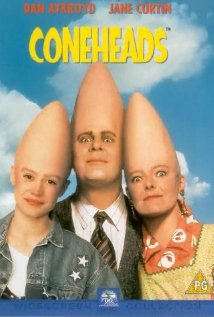
Coneheads: written by Tom Davis, Dan Aykroyd, Bonnie Turner, and Terry Turner; directed by Steve Barron; starring Dan Aykroyd (Beldar Conehead), Jane Curtin (Prymatt Conehead), Phil Hartman (Marlax), David Spade (Eli Turnbull), Michael McKean (Gorman Seedling), Michelle Burke (Connie Conehead), and Chris Farley (Ronnie) (1993): I really like Coneheads. Many do not. But I think it's one of the five best movies based on characters who first appeared on Saturday Night Live. The script and performances are funny, the cameos are almost ridiculously abundant, and even the product placements (there are a lot of them) are weirdly funny at times. I mean, I'm not sure anyone would go to Subway based on the way its sandwiches are eaten here. Even the science-fiction elements are intermittently more well-thought-out than those one would find in a dramatic science-fiction film. the film even uses David Spade perfectly. Recommended.
Stormwatch: Lightning Strikes: written by Warren Ellis; illustrated by Tom Raney, Randy Elliott, Jim Lee, Scott Williams, and Richard Bennett (1996-97; collected 2000): From 1996 to 2000, Warren Ellis was pretty much the State-of-the-Art in sophisticated superhero story-telling. And he did all his best work at Wildstorm, an Image imprint that would be sold to DC pretty much at the end of the bulk of Ellis' work at Wildstorm. Once Ellis had his feet under him on his first major work for Wildstorm, the pre-existing Stormwatch, he combined Alan Moore's mordant wit and Grant Morrison's Silver Agey hyper-science-fictionalism (!) with his own pragmatically optimistic take on the superhero: maybe they could be just good enough and idealistic enough to save us from ourselves.
Lightning Strikes continues Ellis' introduction of his own characters into Stormwatch, Jim Lee's United Nations-sponsored superhero response team. Stormwatch came complete to Ellis with Justice League-like orbital headquarters and SHIELD-like armies of agents and piles of heavy, science-fictional weaponry.
It also came with a Nick-Fury-like Director dubbed 'The Weatherman.' This was Henry Bendix, and in this second collected volume of Ellis' Stormwatch, the team is just beginning to realize that Henry Bendix is a homicidal megalomaniac who intends to save the world by taking total control of it.
But this is just becoming apparent: for now, Stormwatch continues in its missions to save the world from Extinction-level threats. Stories focus on Ellis-creation Jack Hawksmoor, defender of cities, and holdover Battalion, for whom Ellis has plans that will move him away from being team trainer.
Team co-creator and Wildstorm publisher Jim Lee supplies art for another standalone that pits Stormwatch against some particularly awful results of alien genetic experimentation on humans. Lee's art is perfectly suited to the material, while regular artist Tom Raney keeps things humming along in his installments. Raney's main job was to cleanly depict Ellis' occasionally violently harrowing action sequences while also working with Ellis' words to make the once-cardboard characters of pre-Ellis Stormwatch into appealing individuals. Raney succeeds. There's no epic here yet, but it's coming. Recommended.
Stormwatch: Change or Die: written by Warren Ellis; illustrated by Tom Raney, Randy Elliott, Oscar Jiminez, and Richard Bennett (1997; collected 2000): Warren Ellis's run on Wildstorm's Stormwatch builds to one major event here that will ultimately set the stage for Ellis and Bryan Hitch's 'widescreen' superhero team The Authority in a couple of years.
We learn more about the enigmatic Jenny Sparks, nearly a century old and not looking a day over 20. She controls electricity. She also claims to be The Spirit of the 20th Century. And as crazy-ass Stormwatch director Henry Bendix's plans for world domination get flushed into the open by the return of an idealistic, Superman-like hero called The High, Stormwatch finally faces the rot within itself.
Tom Raney and Oscar Jiminez do nice and sometimes startlingly gruesome work on the visuals, as Stormwatch battles an enemy it should be allies with and ostensive allies who are really enemies. It's a little like a John Le Carre novel, only with more punching and exploding. Highly recommended.
Stormwatch: A Finer World: written by Warren Ellis; illustrated by Bryan Hitch, Paul Neary, Michael Ryan, and Luke Rizzo (1997-98; collected 2000): Warren Ellis' version of Stormwatch begins its transition to being The Authority as we meet two soon-to-be members of that follow-up team, Apollo and the Midnighter. They're riffs on Superman and Batman, respectively. They're also lovers.
And they're on the run from Stormwatch, which they believe still to be run by nutty leader, the Weatherman Henry Bendix. He had them created as part of a secret team and then abandoned them when that team's first mission turned catastrophically wrong, leaving the two as the only survivors. They've been fighting evil in the shadows ever since. But new Weatherman Battalion wants to bring them into the light, preferably as allies.
Artist Bryan Hitch, he of the 'widescreen' action sequences and art that reminds one of comic-book great Neal Adams as funneled through later artist Alan Davis (Excalibur, The Nail), handles the penciling on the Apollo and the Midnighter issues. He'd return to those characters in the first 12 issues of the subsequent The Authority, to widespread fan-love. It's bombastic, finely rendered art, offering a nice counterpoint to writer Warren Ellis' shadowy conspiracies and a nice amplification of Ellis' large-scale action sequences.
The volume concludes with an alternate world take on Stormwatch, accidentally brought to 'our' Stormwatch's attention by a tunnel in The Bleed, the weird stuff between universes. It's a bit of an oddity -- enjoyable, but overly reliant on the mythology of shared universe book WildC.A.T.S. for its eucatastrophic finale. Michael Ryan's pencils are perfectly solid superhero stuff, though they lack the zing of Hitch or long-time Stormwatch artist Tom Raney.
This version of Stormwatch had only a couple of issues left in its existence, though somewhat confusingly that, too, would be tied intimately into WildC.A.T.S. (geez, I hate typing that). Two issues of Stormwatch and an extra-length WildC.A.T.S. Vs. Aliens (yes, the Xenomorphs from the Alien franchise) would end this team's existence. While Stormwatch was always a United Nations-sponsored superteam, The Authority that would follow, with mostly new members, would seek to save the world without government support, and sometimes despite it. Recommended.
The Deep by Nick Cutter [Craig Davidson] (2015): Nick Cutter, the horror-writing pseudonym of mainstream Canadian writer Craig Davidson, became a James-Herbert-Award-winning nom-de-plume with the horror novel The Troop (2013). The Deep is the follow-up, with a jacket design that mimics that of The Troop despite their lack of similarities. Well, they're both mainly set on, under, or near water. So there you go.
A new disease nicknamed "The 'Gets'" (from "Forget") is ravaging humanity. Victims go from being forgetful to forgetting how to breathe in a matter of months. But through a series of events I'm not going to summarize, scientists discover that the cure for The Gets may exist at the deepest part of the ocean floor, in the Marianas Trench. So about a gazillion dollars goes into building an underwater science lab and an above-water support base. Three scientists go down. Things get weird. Communications fail. Underwater disturbances make it impossible to get back down to the station to investigate. One scientist comes up, dead and horribly mutilated.
So the authorities, at the request of a cryptic radio message from one of the two surviving scientists, round up his estranged brother, a divorced veterinarian whose only son disappeared without a trace a few years earlier. The vet doesn't know why his brother would have summoned him -- they haven't spoken in eight years and were never close to begin with. The brother down below is a super-genius (and a bit of a sociopath). Has their relationship changed? Are all great scientists in horror novels sociopaths?
Only one way to find out -- so down we go, eight miles down, to the Trieste underwater laboratory and the mysteries within and without.
As in The Troop, The Deep's strengths lie in fast-twitch plotting and an exuberantly hyper-caffeinated approach to the synthesis of its horror influences. Cutter doesn't invent new horrors, but he does throw so many old ones at the reader in sometimes strikingly odd combinations that the effect is often one of horror born of a startling novelty of contrast.
To cite one example, The Deep presents scenes of horrified claustrophobia that riff on antecedents such as John Carpenter's version of The Thing, Alien, and a host of other works that present isolated people under siege by Terrible Things. But in the midst of this, scenes reminiscent of Stephen King's "The Boogeyman" suddenly break out. And then we're plunged into a backstory of the abused childhoods of the vet and his brother. And then back to a new supernatural or science-fictional horror. And for the bulk of the novel, this sort of on-going juxtaposition of science-fictional, supernatural, and psychological horror actually works.
Unfortunately, the engine blows up with about 100 pages to go. The novel seems to lose sight of its above-water McGuffin, The Gets, which have never been fully developed as a threat to humanity. Indeed, the novel could have functioned quite well without The Gets, given how under-developed and under-shown this plague is. Cutter's synthetic horror cavalcade begins to replicate the content of his influences too closely, with a scene lifted almost verbatim from Carpenter's The Thing being just one example. There's also a lengthy bit involving mutated honeybees that's a weak riff on George R.R. Martin's "Sandkings." And a riff on a bit from Stephen King's "The Raft" that gets used once too often. A lovable dog also wears out its welcome.
These failures might have been survivable had the last fifty pages not degenerated into Basil Exposition's Nude House of Wacky Body Horror. We finally learn the secrets of what has really been going on. Well, sort of. But we learn these things from anthropomorphized antagonists who cackle and snark like the bitchiest of Joss Whedon's bitchy Big Bads. We get a very, very old science-fictional and horror trope as an explanation for the horror's existence in the Marianas Trench. We get about 40 pages of Cutter doing a bad imitation of Laird Barron, one with neither menace nor wit but only a gushy, goopy tide of bodily atrocities. We get a damp squib of an ending. We get characters behaving as stupidly and helplessly as characters can act. The end.
Oh, for a couple of flame-throwers or a convenient nuclear bomb. They too would be borrowings, but they'd be welcome borrowings. Nuke the sight from orbit. Absolutely goddamned right.
Oh, well. The Deep really is a page-turner for 80% of its not-inconsiderable length. However, if you're one of those people who get annoyed by tiny, short little chapters in the manner of The Da Vinci Code or a novel meant for fourth-graders, steer clear. These are some of the shortest chapters you're ever going to encounter in a novel aimed at adults. Lightly recommended.
The Blair Witch Project Dossier by D.A. Stern and others (1999): As with the In Search of... style 'documentary' that promoted The Blair Witch Project on the SciFi and Space Channels when the movie came out in 1999, this book is better than the movie it promotes. The Blair Witch Project Dossier comprises fake newspaper articles, interview transcripts, historical records, photos, period illustrations, and hand-written letters and journals. It's old-school documentary horror of which Poe or Lovecraft might have approved.
There's real wit here, whether in a name-check of one of Lovecraft's creepy backwoods characters or in subtle and fascinating implications dotted throughout the historical portions of the text. These things suggest a horror much larger and older than that which we see in the movie. They also offer a context for the scenes in the house that makes the events of the movie seem even worse. However, no explanation is offered for why those two bozos are fishing in two inches of water. Recommended.
 The Savage Sword of Conan the Barbarian Archives Volume 1: written by Roy Thomas, Lin Carter, and Robert E. Howard; illustrated by Barry Windsor-Smith, John Buscema, Tony DeZuniga, Pablo Marcos, Tim Conrad, Jim Starlin, and others (1971, 1973-75; collected 2007): This first reprint volume of Marvel's black-and-white Conan comics magazines that started in the 1970's peaks right at the beginning, with quintessential Conan comic-book artist Barry Windsor-Smith illustrating several tales. He's terrific on what's almost a vignette about a teen-aged Conan, "The Frost Giant's Daughter." And he hits an all-time high with an adaptation of the Conan novella "Red Nails." There's a reprint volume devoted entirely to Windsor-Smith's colour and black-and-white Conan work for Marvel, if you're so inclined.
The rest of the volume, almost entirely written by long-time Conan scribe/adapter Roy Thomas, is mostly high quality as well. Thomas' Conan was always more stereotypically heroic than Robert E. Howard's original, but he can still be a bit of a jerk at times. Highlights include the oft-imitated crucifixion of Conan from an adaptation of Howard's "A Witch Shall Be Born" and an original team-up with Howard's female barbarian Red Sonya. John Buscema, who penciled more Conan stories at Marvel than anyone else, gives us his older-looking Conan throughout, with Tony DeZuniga and others ably inking Buscema or drawing him themselves. It's too bad these volumes weren't reprinted at their original magazine-page size, though -- the art and lettering can get a bit cramped at points in the comic-book-page dimensions of the collection. Recommended.

Dr. Spektor Volume 1: written by Mark Waid; illustrated by Neal Edwards and Christian Ward (2014): Enjoyable reboot of a Silver Age Gold Key hero about whom I know absolutely nothing. Veteran scribe Mark Waid gives us a master of the mystic arts who's also a TV personality and a bit of a knob. The art is competent, though never particularly mystical or surreal. It's a book about a magician that could use an injection of the surreal and the non-representational on the artistic side. Lightly recommended.

Superman: Camelot Falls Vol. 1 and 2: written by Kurt Busiek; illustrated by Carlos Pacheco and Jesus Merino (2006-2007; collected 2009): Lengthy Superman story that appeared intermittently in about a year-and-a-half's worth of Superman comics gets collected here, with art primarily by Carlos Pacheco and story by Kurt Busiek. It's among the finest Superman stories of the last 25 years in both art and story. Pacheco is a clean, dynamic penciler with just the right hint of whimsy in his art. Busiek's Superman is forthright and stalwart though occasionally plagued by doubt.
Busiek riffs on a Superman story from the early 1970's, "Must There Be A Superman?", as Superman discovers that the presence of he and his fellow heroes will ultimately lead to the destruction of all human life on Earth. Or will it?
Busiek brings back Atlantean super-magician Arion to present a superhero-tinged version of Vico's cyclical view of history. There will always be a Rise, there will always be a Fall, there will always be another Rise, and so on, but the prevention of that Fall by Superman and friends will cause the Fall to build in power until when it comes, there will be no subsequent Rise again. Humanity will perish in the turbo-charged wave of darkness. Arion wants Superman to retire intentionally so this future won't come to pass. But if Superman won't retire, Arion will retire him forcibly and then start the next wave of darkness himself before it builds any further. To Arion, the ends justify the means, no matter how many billions must die to ensure humanity's survival.
It may sound grim, but Busiek keeps things hopeful throughout: Arion may be wrong. And Superman remains heroic and dedicated to preserving life, as he should. Busiek introduces a new villain for Superman, Khyber, who grows on one over the course of the story. He is in many ways an attempt to give Superman his own Ra's Al Ghul, an immortal enemy with designs on global domination and a patience born of immortality. Only the name, which seems to be an attempt to meld the historic and ongoing importance of the Khyber Pass with the sounds-similar 'Cyber,' is a bit vexing. Well, unless Busiek is playing with the Cockney rhyming slang construction of "Khyber Pass" as a stand-in for "Ass" (or "Arse"), which would be hilarious. In all, recommended.


