The Savage Sword of Conan the Barbarian Archives Volume 1: written by Roy Thomas, Lin Carter, and Robert E. Howard; illustrated by Barry Windsor-Smith, John Buscema, Tony DeZuniga, Pablo Marcos, Tim Conrad, Jim Starlin, and others (1971, 1973-75; collected 2007): This first reprint volume of Marvel's black-and-white Conan comics magazines that started in the 1970's peaks right at the beginning, with quintessential Conan comic-book artist Barry Windsor-Smith illustrating several tales. He's terrific on what's almost a vignette about a teen-aged Conan, "The Frost Giant's Daughter." And he hits an all-time high with an adaptation of the Conan novella "Red Nails." There's a reprint volume devoted entirely to Windsor-Smith's colour and black-and-white Conan work for Marvel, if you're so inclined.
The rest of the volume, almost entirely written by long-time Conan scribe/adapter Roy Thomas, is mostly high quality as well. Thomas' Conan was always more stereotypically heroic than Robert E. Howard's original, but he can still be a bit of a jerk at times. Highlights include the oft-imitated crucifixion of Conan from an adaptation of Howard's "A Witch Shall Be Born" and an original team-up with Howard's female barbarian Red Sonya. John Buscema, who penciled more Conan stories at Marvel than anyone else, gives us his older-looking Conan throughout, with Tony DeZuniga and others ably inking Buscema or drawing him themselves. It's too bad these volumes weren't reprinted at their original magazine-page size, though -- the art and lettering can get a bit cramped at points in the comic-book-page dimensions of the collection. Recommended.

Dr. Spektor Volume 1: written by Mark Waid; illustrated by Neal Edwards and Christian Ward (2014): Enjoyable reboot of a Silver Age Gold Key hero about whom I know absolutely nothing. Veteran scribe Mark Waid gives us a master of the mystic arts who's also a TV personality and a bit of a knob. The art is competent, though never particularly mystical or surreal. It's a book about a magician that could use an injection of the surreal and the non-representational on the artistic side. Lightly recommended.

Superman: Camelot Falls Vol. 1 and 2: written by Kurt Busiek; illustrated by Carlos Pacheco and Jesus Merino (2006-2007; collected 2009): Lengthy Superman story that appeared intermittently in about a year-and-a-half's worth of Superman comics gets collected here, with art primarily by Carlos Pacheco and story by Kurt Busiek. It's among the finest Superman stories of the last 25 years in both art and story. Pacheco is a clean, dynamic penciler with just the right hint of whimsy in his art. Busiek's Superman is forthright and stalwart though occasionally plagued by doubt.
Busiek riffs on a Superman story from the early 1970's, "Must There Be A Superman?", as Superman discovers that the presence of he and his fellow heroes will ultimately lead to the destruction of all human life on Earth. Or will it?
Busiek brings back Atlantean super-magician Arion to present a superhero-tinged version of Vico's cyclical view of history. There will always be a Rise, there will always be a Fall, there will always be another Rise, and so on, but the prevention of that Fall by Superman and friends will cause the Fall to build in power until when it comes, there will be no subsequent Rise again. Humanity will perish in the turbo-charged wave of darkness. Arion wants Superman to retire intentionally so this future won't come to pass. But if Superman won't retire, Arion will retire him forcibly and then start the next wave of darkness himself before it builds any further. To Arion, the ends justify the means, no matter how many billions must die to ensure humanity's survival.
It may sound grim, but Busiek keeps things hopeful throughout: Arion may be wrong. And Superman remains heroic and dedicated to preserving life, as he should. Busiek introduces a new villain for Superman, Khyber, who grows on one over the course of the story. He is in many ways an attempt to give Superman his own Ra's Al Ghul, an immortal enemy with designs on global domination and a patience born of immortality. Only the name, which seems to be an attempt to meld the historic and ongoing importance of the Khyber Pass with the sounds-similar 'Cyber,' is a bit vexing. Well, unless Busiek is playing with the Cockney rhyming slang construction of "Khyber Pass" as a stand-in for "Ass" (or "Arse"), which would be hilarious. In all, recommended.
The Chronicles of Conan Volume 1: The Tower of the Elephant and Other Stories: written by Roy Thomas, based on stories and fragments by Robert E. Howard and L. Sprague de Camp; illustrated by Barry Windsor-Smith and others (1970-1971; collected 2003): Marvel's long-running affair with Robert E. Howard's mighty barbarian begins here, with the first few early-1970's issues of the Conan colour comic book (a B&W magazine, The Savage Sword of Conan, would soon follow).
Roy Thomas was always a bit of a wet blanket as an adapter of Howard's stories. He buffed away all the sharp edges of Conan for the Comics Code Authority while indulging in that peculiar sin of 1970's comic books, the endless description of things one can already see in the comics panel.
Nonetheless, the strength of Howard's original stories still shines through, especially in the title adaptation of what I'd say is Howard's finest Conan short story. "The Tower of the Elephant" offers us a thieving young Conan, a seemingly impregnable fortress, a wicked sorcerer, a giant spider, and a surprisingly sympathetic character who allows Conan to showcase his rough-hewn Cimmerian honour. Other stories introduce such Conan staples as giant snakes, wicked Set-worshipping wizard Thoth-Amon, and an endless string of slave girls, prostitutes, and thieves.
Main artist Barry Windsor-Smith, a Kirby knock-off artist before his stint on Conan, grows with astonishing swiftness from issue to issue. He maintains the dynamism he learned from Kirby while coming quickly into an early version of his fluid, evocative style. He's the only comic-book artist I can think of whose two main artistic influences are Jack Kirby and the Pre-Raphaelites. It's neato. Recommended.
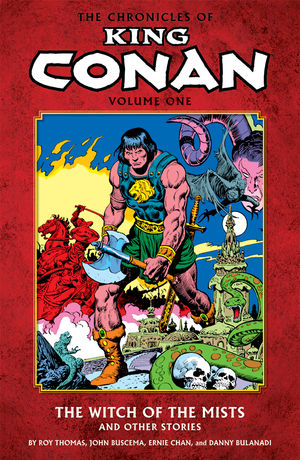
The Chronicles of King Conan Volume 1: The Witch of the Mists and Other Stories: written by Roy Thomas, based on characters created by Robert E. Howard and stories by L. Sprague de Camp, Bjorn Nyberg, and Lin Carter; illustrated by John Buscema, Ernie Chan, and Danny Bulanadi (1980-81; collected 2010): Writer Roy Thomas's decade-long affiliation with Conan at Marvel Comics would end fairly early into this early 1980's spin-off series, which gives us a 50-something Conan ruling the Hyborean Age's greatest kingdom, Aquilonia.
The five double-length adventures reprinted here present King Conan's final, multi-issue battle with the wizard Thoth-Amon, owner of the most unwieldy hat in Marvel history. Conan's son Conn is a chip off the old block, already a decent fighter at the age of 13. Penciller John Buscema's Conan is stolid and solid and grim. Buscema is strong on humans and, as always, somewhat uninspired when depicting the fantastic -- unlike seminal Marvel Conan artist Barry Windsor-Smith, Buscema is too representative in his art to convincingly depict magic and monsters. It all makes for a good time-waster, but not much else. Lightly recommended.
The Chronicles of Conan Volume 2: Rogues in the House and Other Stories, written by Roy Thomas, illustrated by Barry Windsor-Smith, Sal Buscema and Others (1970-71; collected 2003): This second volume of Thomas and Windsor-Smith's pivotal Conan Marvel comic-book work of the early 1970's offers one fairly faithful adaptation of a Robert E. Howard Conan novelette (the eponymous "Rogues"), a lovingly rendered adaptation of short story "The Frost-Giant's Daughter", and several other stories of young Conan as he wanders around thieving, getting arrested, escaping arrest, and fighting wizards, gods and monsters.
Windsor-Smith's art grows more splendid and idiosyncratic throughout this volume as he changes from Kirbyesque super-hero artist to lush, pre-Raphaelite-influenced illustrator at a fairly astonishing rate of progression. He wouldn't stay on Conan much beyond this point, but he'd remain the acknowledged, definitive comic-book Conan artist ever afterwards, though John Buscema would soon surpass him in page count if not in overall effect.
Writer Roy Thomas thuds along as if he were paid by the word (which he wasn't). He'd work on Conan's comic-book adventures at Marvel for a decade and become the "definitive" Conan comic-book writer through sheer weight of output. Occasionally, the artwork creaks and shudders under the weight of all that obscuring prose. Uk wuk. Recommended.
The Chronicles of Conan Volume 3: The Monster of the Monoliths and Other Stories, written by Roy Thomas, Michael Moorcock and James Cawthorn, illustrated by Barry Windsor-Smith, Gil Kane and others (1971-72; collected 2006): It took awhile for Marvel's comic-book Conan the Barbarian to gain sales traction, but once it did it ran for about 30 years in both colour and black-and-white magazines. For fans, the high point of the series came early, when long-time writer Roy Thomas was teamed with up-and-coming artist Barry Windsor-Smith for the first twenty issues or so of the colour comic.
Windsor-Smith's art became increasingly refined, complex and painterly as the series went on, evidenced in part here by the decision to try printing one issue directly from his pencils (it doesn't work that well here reproduced and remastered in a high-quality format, so I shudder to think what it looked like on pulp newsprint).
Thomas was (and is) an almost self-parodically verbose writer, and it becomes quite trying here after awhile, though this was admittedly also Marvel's house writing style at the time. Which is to say, every damn panel has to have dialogue or captions in it. When your book is about a taciturn barbarian, this seems especially annoying.
Included here is the two-part cross-universal team-up between Conan and Michael Moorcock's anti-Conan sword-and-sorcery character, Elric of Melnibone. The Windsor-Smith art achieves some startling effects in this story, especially in a battle between two god-like beings, though it suffers somewhat from Windsor-Smith's misunderstanding of what Elric's headgear was supposed to look like. As is, Elric ends up wearing a hat that seems to have been borrowed from a garden gnome. How does Conan keep from laughing?
Other artistic high points occur throughout this reprint collection, including a two-parter illustrated by Gil Kane. The writing can be a really heavy, purple slog at points, but the art makes this worth picking up. Recommended.